
It is 9:37 p.m. You just finished reviewing the score breakdown from your latest MCAT full‑length.
Your overall score? Below your target. Again.
Worse, you have no idea why you keep underperforming. You have dozens of hours of content review behind you, Anki decks, videos, question banks… and yet your full‑length scores look stuck.
Here is the uncomfortable truth: most students “review” full‑lengths by casually scrolling through the answer explanations and calling it a day. That is not review. That is entertainment.
What you need is a post‑exam autopsy. A structured, repeatable system that tells you:
- Why you missed what you missed
- Which mistakes are patterns, not flukes
- What to change before the next test—down to the level of daily habits
That is what we will build here.
Step 1: Hard Stop – Lock In the Raw Data First
You wake up the day after the exam and your first impulse is to re-take questions or check Reddit to see if “that one insane question” tricked everyone.
Skip the drama. Start with data.
1.1. Capture your baseline numbers
Open your score report and write these down in a dedicated “FL Autopsy” document or notebook:
- Test date and which exam (e.g., AAMC FL 2, NS FL 5)
- Total score and each section score
- Percent correct by section (if available)
- Timing data for each section: finished early, on time, or guessed through last X questions
Do this before reading any explanations so you do not contaminate your memory of what really happened.
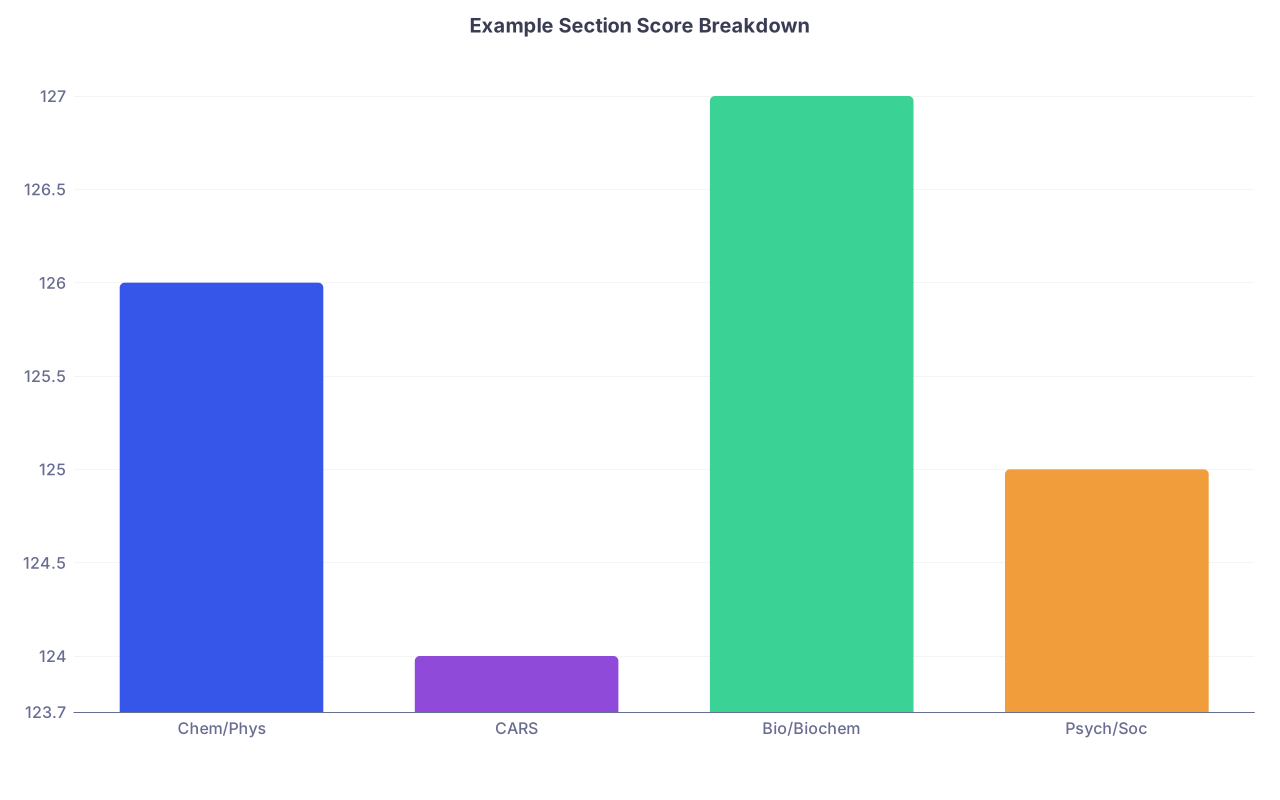
| Category | Value |
|---|---|
| Chem/Phys | 126 |
| CARS | 124 |
| Bio/Biochem | 127 |
| Psych/Soc | 125 |
1.2. Quick emotional debrief (yes, this matters)
You do not get to pretend you are a robot. Your test performance is tied to how you felt.
Write 3–5 bullet points per section answering:
- How did I feel starting this section? (calm, anxious, rushed, sleepy)
- Where did my focus dip? (early, mid‑section, last 15 questions)
- Any obvious mental errors I remember? (changed right answers, misread units, etc.)
Keep it blunt, not dramatic.
Example:
- “Started CARS already annoyed from CP”
- “Panicked when I saw a dense experimental passage in CP; lost 5+ minutes”
- “Eyes burning by B/B; caffeine crash”
You are building a pattern database. Not a diary.
Step 2: Build a Post-Exam Autopsy Spreadsheet
If you are not systematically tracking why you miss questions, you are basically hoping repetition magically fixes things. It will not.
You need a simple, brutal spreadsheet.
2.1. The columns you actually need
Make a sheet with these columns (or adapt what you already use):
| Column | Purpose |
|---|---|
| Test # / Name | Track across exams |
| Section | CP, CARS, BB, PS |
| Question # | For quick reference |
| Topic | e.g., Acid/base, Circulatory, Memory |
| Subtype | Conceptual, Calculation, Data/Graph, CARS |
| Passage/Discrete | P or D |
| Miss Reason (Primary) | Root cause (see list below) |
| Miss Reason (Secondary) | Optional nuance |
| Difficulty (1–3) | Your perceived difficulty |
| Time Issue? (Y/N) | Mark if rushed or ran out of time |
| Fix / Action Item | What you will do differently or learn |
You can keep it simple at first: Test, Section, Q#, Topic, Miss Reason, Fix.
2.2. The “Miss Reason” categories (no more vague “careless errors”)
Here is a set of categories that actually help you change behavior:
- Content gap – did not know or misremembered the fact/concept
- Shallow understanding – knew the term but could not apply it in context
- Misread question stem – missed key word, unit, or direction
- Passage misinterpretation – misread figure, table, or logic of the passage
- Math/estimation error – arithmetic, exponent, or rough estimate failure
- Overthinking / second‑guessing – changed correct answer to wrong one
- Timing/rushing – guessed due to time or rushed logic
- Strategy error – wrong approach (e.g., reading answers before stem, not using POE)
- Attention/focus lapse – mental fatigue, zoned out, mind wandering
Pick one primary reason per question. If you want, add a secondary.
Do this categorization for every wrong question and every lucky guess where you were not confident. Guesses that were right still reveal weaknesses.
Step 3: Section-by-Section Autopsy Protocol
Now we dig into each section. Not just “Why is my CARS bad?” but “Why does CARS question type X destroy me every single time?”
3.1. CARS Autopsy
Most students “review” CARS by reading the explanation and mumbling, “Ah, that makes sense.” Then they repeat the same mistakes on the next exam.
Do this instead:
3.1.1. Rebuild your thought process
For each wrong or low‑confidence CARS question:
- Cover the answer choices.
- Re‑read the question stem only.
- Summarize, in one sentence, what the question actually asks (main idea, tone, detail, inference, etc.).
- Now look at the passage. Mark the sentence(s) that justify the correct answer.
- Only then, uncover the answer choices and pick again.
Ask yourself:
- Did I misidentify what the question wanted?
- Did I answer based on my opinion instead of the passage?
- Did I pick an extreme answer when the passage was neutral or nuanced?
- Did I fall for a trap answer that reuses passage words but changes the meaning?
Tag the main reason in your spreadsheet.
3.1.2. Classify by question type
You will likely find that you are not “bad at CARS.” You are bad at a few particular types of questions.
Rough categories:
- Main idea / primary purpose
- Author attitude / tone
- Inference
- Function of a paragraph / sentence
- Detail / according to the passage
- Application / analogy
Track which category you miss most. Then build a focused drill set (3–5 passages) from UWorld/Jack Westin/etc. only on that weakness.
3.2. Chem/Phys and Bio/Biochem Autopsy
Students love to blame content here. Often the real issues are:
- Cannot translate verbal description into equations
- Panics when seeing a graph
- Does not approximate, tries to calculate every digit
Here is how to break it down.
3.2.1. For each missed CP/BB question, do this mini‑review
Identify whether it was primarily:
- Content gap
- Application issue
- Math issue
- Passage/data interpretation issue
If content gap:
- Write the correct principle in one sentence in your notebook (e.g., “At constant temperature, increasing volume decreases pressure (Boyle’s law).”)
- Add 1–3 ultra‑targeted Anki cards. Not a paragraph. Just the missing link.
If application issue:
- Ask: “What piece of information from the passage should have triggered the right formula / principle?”
- Write a mini cue: “When you see X in a passage, immediately think of Y concept/formula.”
If math issue:
- Re‑work the problem while forcing yourself to approximate.
- Ask, “How could I have solved this in <30 seconds without exact calculation?”
If passage/figure issue:
- Redraw the graph/table by hand.
- Label axes, trend, and key comparisons.
- Write one sentence: “This figure shows that as X increases, Y does ___.”
You are training pattern recognition, not punishing yourself.
3.3. Psych/Soc Autopsy
PS is where overconfident students hemorrhage points.
The traps:
- Confusing buzzwords (e.g., “confirmation bias” vs “self‑fulfilling prophecy”)
- Half‑remembering definitions
- Not reading the specific behavior/experiment described
Autopsy approach:
- For every missed PS question, write:
- The correct definition of the key term involved
- Why the wrong answer you chose is actually wrong in this context
- One concrete real‑life example of the correct concept
Then create a “Confusing Pairs” list:
- Sensory adaptation vs habituation
- Stereotype vs prejudice vs discrimination
- Role conflict vs role strain
- Internal vs external validity
Anytime you miss a distinction like this, it goes on that list, with two columns: “Looks like” and “Actually is.”
Step 4: Pattern Extraction – Turn Data into Diagnosis
After 1–2 full‑lengths using this autopsy process, you will have enough data to see trends. That is where the real value sits.
4.1. Look for high-frequency miss reasons
Filter your spreadsheet by Miss Reason. Count how many times each appears.
You might find:
- “Content gap” – 12 questions
- “Misread question stem” – 9 questions
- “Timing/rushing” – 8 questions
- “Math error” – 5 questions
That tells you what your next two weeks should focus on. Not “everything.”
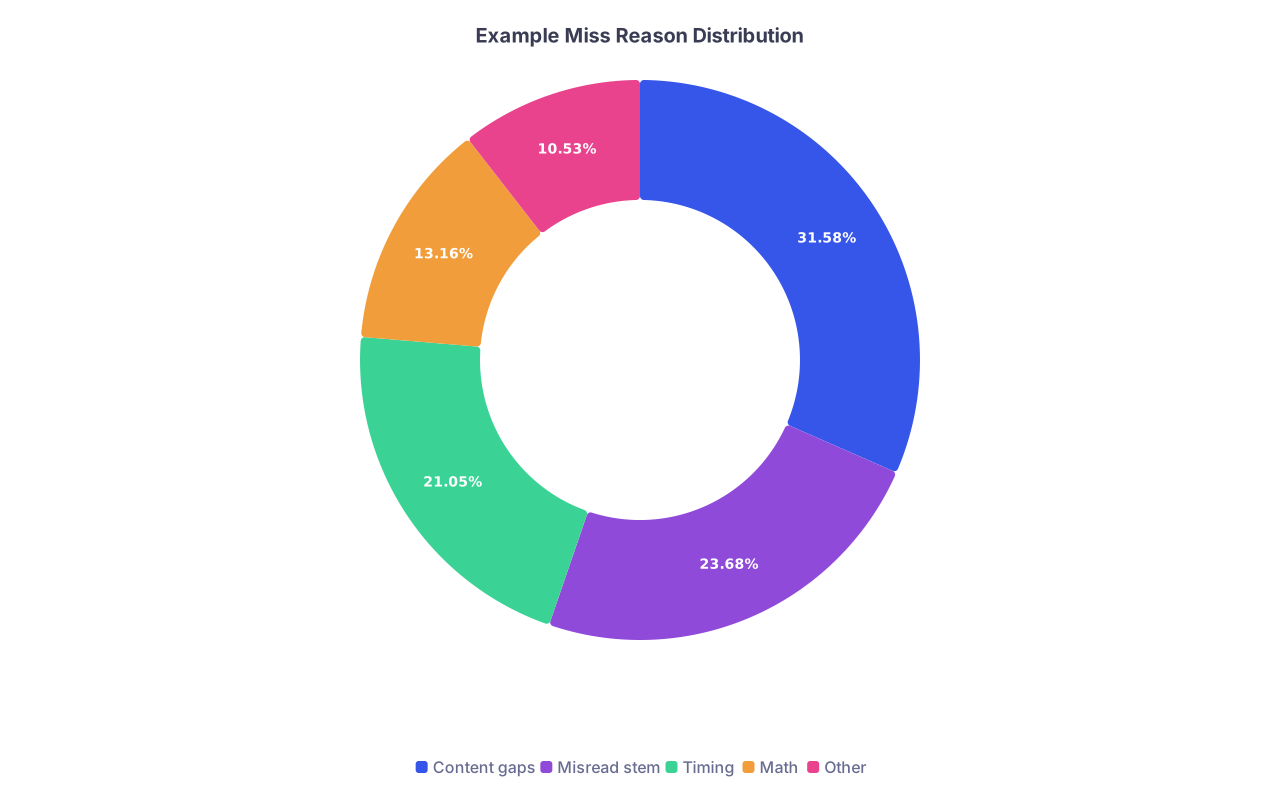
| Category | Value |
|---|---|
| Content gaps | 12 |
| Misread stem | 9 |
| Timing | 8 |
| Math | 5 |
| Other | 4 |
4.2. Look for section‑level trends
Do the same by section:
- Are your timing issues concentrated in CP and CARS?
- Are content gaps mostly BB and PS?
- Are your “passage misinterpretation” errors mostly CP graphs and BB experimental designs?
Your study plan should mirror your error profile. Period.
Step 5: Convert Findings into a Concrete Fix Plan
This is where most people fail. They do a nice review, feel productive, and then do… nothing different.
You will build a Post‑Autopsy Action Plan every time you finish a full‑length.
5.1. Create a one-page “Autopsy Summary” per exam
For each FL, summarize on a single page:
Score snapshot
- FL name, date, total score, each section score
Top 3 error patterns with counts
- e.g., “Misread question stem – 9 questions,” “Inference CARS questions – 7 questions,” “Math/estimation errors – 5 questions”
3–5 specific behavior changes you will implement before the next FL
- Concrete, observable, not vague wishes
Example behavior changes:
- “For every physics question, I will write units clearly and check they match before choosing an answer.”
- “In CARS, I will force myself to answer from the passage first, then look at choices.”
- “I will annotate each CP figure with a quick ‘as X increases, Y does ___’ note.”
Stick this one‑pager somewhere you see it before every practice exam.
5.2. Map patterns to training drills
Now translate patterns into daily work. For example:
Pattern: CARS inference questions are killing you
- Fix plan: 3 passages/day only inference‑heavy questions + post‑passage reflection on why each correct answer is supported by text
Pattern: CP math errors
- Fix plan: 20–30 minutes/day of MCAT‑style mental math / estimation drills, plus re‑doing missed math questions with strict 30–45 second limits
Pattern: BB experimental passages confuse you
- Fix plan: 1–2 experimental passages/day with focus on:
- Identifying independent/dependent variables
- Recognizing control groups
- Interpreting figures
- Fix plan: 1–2 experimental passages/day with focus on:
You are not “just doing questions.” You are doing targeted rehab.
Step 6: Timing and Endurance – The Hidden Score Killers
Plenty of students “know the content” but crash because they treat timing like an afterthought. That is a mistake.
6.1. Build a timing checkpoint system
Before your next full‑length, decide your checkpoints:
CP, BB, PS (59 questions / 95 minutes):
- After ~30 minutes: should be around question 20
- After ~60 minutes: around question 35–40
- After ~80 minutes: around question 50
CARS (53 questions / 90 minutes):
- Roughly 10 minutes per passage, so check after every 2 passages
During your next exam, jot tiny time notes in your scratch area (e.g., “CP Q30 at 31:00”). Then during autopsy, compare where you were:
- Behind and started rushing?
- Ahead but still missing late questions due to fatigue?
If you are consistently behind at the same point (e.g., CP passages 3–4), that is where you focus speed training.
6.2. Endurance fixes for later sections
If your later sections tank:
- Track sleep, caffeine, and nutrition on FL days. You are not above biology.
- Simulate test conditions: same start time, minimal phone use, same breaks.
- Add 1–2 “combo practice blocks” into your week:
- Example: 59 CP Qs + 30‑minute break + 53 CARS Qs, back‑to‑back
You are training your nervous system, not just your memory.
Step 7: The 48-Hour Review Protocol After Every Full-Length
You should not be reviewing a full‑length for 10 minutes a day for a week. That is too slow and too diluted. Treat it like an operation.
Here is a tight review protocol that takes 1–2 days and actually changes things.

| Step | Description |
|---|---|
| Step 1 | Finish Full-Length |
| Step 2 | Sleep / Take Rest of Day Off |
| Step 3 | Next Day: Score + Global Review |
| Step 4 | Section-by-Section Autopsy |
| Step 5 | Enter Errors into Spreadsheet |
| Step 6 | Extract Patterns + Write Autopsy Summary |
| Step 7 | Build 1-2 Week Targeted Drill Plan |
Day 0 (Exam Day)
- Finish exam
- Briefly glance at score if you must, but do not deep dive
- Light walk, non‑academic activity. You will not “fix” anything tonight.
Day 1
Morning: Global review (1–2 hours)
- Check overall scores and section scores
- Do your emotional debrief bullets
- Note any catastrophic timing or focus issues
Afternoon/Evening: Detailed question review (2–4 hours)
- Work through each section: wrongs and unsure guesses
- For each, do:
- Re‑answer without seeing explanation
- Identify miss reason
- Log into spreadsheet
- Capture key content / concept fix in notes or Anki
Day 2
- Finish any remaining questions
- Extract patterns from spreadsheet
- Write 1‑page Autopsy Summary
- Build concrete drill plan for the next 7–14 days
Do not take another full‑length until you have implemented at least several days of those fixes.
Step 8: How Often to Autopsy and Adjust
If you are early in prep (2+ months out):
- 1 full‑length every 1–2 weeks is plenty
- Use the time between to crush the specific issues that showed up
If you are later (4–5 weeks out):
- 1 full‑length per week is reasonable for most
- Still do full autopsies, but you can be more surgical:
- Focus on high‑yield misses, not every single question
If you are in the last 2 weeks:
- You should not be discovering brand‑new massive weaknesses
- Your autopsies should be confirming that previous fixes are holding:
- Timing stable
- Fewer repeated error types
- More confidence in previously weak areas
Step 9: A Realistic Example – From Vague Frustration to Clear Fixes
Let us walk through a simplified example.
You take AAMC FL 2 and score a 505:
- CP 125, CARS 124, BB 127, PS 129
You feel like: “I just suck at CARS and physics.”
You run the autopsy and your spreadsheet shows:
CP:
- 6 content gaps (electrostatics, circuits, fluids)
- 4 math/estimation errors
- 3 passage/graph interpretation errors
CARS:
- 5 inference questions wrong
- 4 tone/attitude questions wrong
- 3 main idea questions wrong
BB:
- Mostly fine; 3 misses due to unfamiliar experimental setups
PS:
- 2 concept confusion pairs (stereotype vs prejudice, internal vs external validity), 1 misread stem
Your Autopsy Summary might say:
Top issues:
- Weak physics content in electrostatics, circuits, fluids
- CARS inference and tone questions
- Overly precise math – slow and error‑prone
Behavior changes:
- Practice writing “approximate setup only” equations before choosing answers in CP.
- For CARS, I will paraphrase the question in my own words before looking at answer choices, especially for inference/tone.
- Build 60‑minute focused review on electrostatics, circuits, fluids with 20–30 practice questions.
Drill plan (10 days):
- Daily: 3 CARS passages focusing on inference/tone (Jack Westin or similar).
- Alternate days: 15–20 CP questions on physics topics + timed mental math drills.
- 3–4 BB experimental passages per week for practice with figures and setups.
Now you have a roadmap. Not a vague feeling.
Step 10: What To Do Today
You have two options right now:
- Keep taking full‑lengths and hoping the scores “magically” rise.
- Treat each exam like a patient and do a proper autopsy.
You know which one works.
Here is your next concrete step:
Open the score report from your most recent full‑length. Create a simple spreadsheet or notebook page with the columns listed above, and fully autopsy just one section (e.g., Chem/Phys) today.
Do not worry about building the perfect system. Start with one section, one exam, and one honest look at why you are missing what you are missing.
Then replicate that process. That is how scores climb.