
MCAT CARS inference questions are not “mysterious reading between the lines.” They are engineered traps with predictable construction rules.
Once you see those rules, your accuracy stops being luck and starts being reproducible.
Let me break this down specifically.
1. What “Inference” Really Means On CARS (Not What You Think)
Most students use “inference” to mean “I kind of feel like the author might also believe…”
That is how you miss questions.
On CARS, an inference question almost always satisfies three conditions:
The correct answer is:
- Not stated in a single sentence
- But is the only answer that integrates multiple pieces of text logically
- And never contradicts anything in the passage
The wrong answers usually:
- Sound more “interesting” or “insightful”
- Add new content, explanations, or causes that the passage never commits to
- Or overextend something that is mentioned once
The stem language is deliberately vague:
- “It can be inferred that the author would most likely agree with…”
- “The passage suggests that…”
- “The author’s attitude toward X is most consistent with which of the following?”
The MCAT writers are not asking: what could possibly be true in the real world given this passage?
They are asking: what must be true or is best supported given only what we told you?
If you keep real-world plausibility in your head, you are playing the wrong game. CARS inference lives entirely inside the four walls of that passage.
2. The 5 Core Inference Question Types The AAMC Reuses
Most people talk about “inference” as one vague category. That is sloppy. The AAMC leans on a handful of repeatable templates.
Once you recognize the template, you know what to look for and, more importantly, what to ignore.
| Type | What It Really Tests |
|---|---|
| Implied Belief/Claim | Author’s hidden but necessary stance |
| Latent Relationship | Connections between ideas, groups, or events |
| Consequence/Prediction | What follows if author is correct |
| Strength/Qualification | How strong or limited a claim is |
| Comparative/Counterfactual | How author would react in a new but related scenario |
Let’s go through these like a tutor who has watched hundreds of people miss them for the same stupid reasons.
2.1 Implied Belief / Claim Inference
Typical stems:
- “The author would most likely agree that…”
- “The passage suggests that the author believes…”
- “Which of the following is an assumption underlying the author’s argument?”
Pattern:
The correct answer restates a belief that:
- Is not quoted directly
- But is required to make the author’s line of reasoning make sense
- Is usually supported in multiple paragraphs, not a single sentence
How they write the wrong choices:
- One answer will be too strong (“always,” “never,” “all,” “none”) relative to the passage tone
- One will be tangentially related but only mentioned once in a background sentence
- One will be opposite to the author’s stance but phrased attractively
What you should do:
- First, define in your own words: “If I had to summarize the author’s bias or project, what is it?”
- Then scan: which answer sounds like that same agenda, but compressed into one sentence, without exaggeration?
If the author spends 3 paragraphs attacking standardized tests as “blunt instruments” and “socially biased,” the answer “Standardized tests should be abolished immediately in all contexts” is too far. The safer inference: “Standardized tests provide a limited and potentially unfair measure of human ability.”
Stronger but not insane. That is the sweet spot.
2.2 Latent Relationship Inference
Typical stems:
- “The relationship between X and Y is best characterized as…”
- “What can be inferred about the interaction between Group A and Group B?”
- “The author’s discussion of X implies which of the following about its relation to Y?”
Pattern:
They want you to notice how two things are linked indirectly:
- One section describes X in detail.
- Another section later mentions Y.
- The passage hints that Y is a reaction to or consequence of X, but never says it cleanly.
Wrong answers usually:
- Flip the direction (say Y causes X when the text supports X → Y)
- Turn correlation into equivalence (“are essentially the same as” when the text only parallels them)
- Introduce a new relational label (cause, dependence, identity) that the passage never earns
Your move:
Track tone and function of each element. Does the author:
- Present X as the traditional view and Y as critique?
- Present X as a theory and Y as an example?
- Present X and Y as imperfect but related analogies?
Then pick the answer whose relationship label matches what the passage functionally did, not what “could be” true outside the passage.
2.3 Consequence / Prediction Inference
Typical stems:
- “The author would most likely predict which of the following outcomes?”
- “If X were implemented, which result would be most consistent with the author’s view?”
- “Which of the following would the author most likely see as a consequence of…”
Pattern:
They give you a hypothetical and ask you to run it through the passage’s logic.
This is not free imagination. You are constrained by:
- The author’s expressed values (what counts as good/bad for them)
- The mechanisms or causal chains they already described
- The level of certainty they used (speculative vs confident)
Wrong answers:
- Sound cool but require brand‑new mechanisms or evidence
- Ignore the author’s values (e.g., call something “a positive development” when the author hates that entire direction)
- Treat a modest suggestion as if it logically implies an extreme revolution
You:
Reconstruct the skeleton:
“If A happens, the author believes that tends to cause B, which undermines C, which they value. So they would likely say outcome D is bad / unlikely / misguided.”
Then pick the answer that follows that chain, not the one that gives the flashiest effect.
2.4 Strength / Qualification Inference
Typical stems:
- “The passage suggests that the author’s claim about X is…”
- “The author’s view about Y is best described as…”
- “The author would most likely consider Z to be…”
Pattern:
They are not asking what the author believes. They are testing how strongly the author believes it.
Pay attention to hedging language:
- Strong: “clearly,” “undeniably,” “it is evident that…”
- Moderate: “suggests,” “may,” “might,” “could,” “tends to”
- Skeptical/cautious: “seems at best,” “at most,” “limited,” “partial”
Wrong answers:
- Overstate certainty when the author hedged carefully
- Understate when the author took repeated, strong positions
- Flatten nuance into extremes (“wholly rejects,” “fully endorses”) when the author mixed praise and critique
Your tactic:
Underline tone words. Then translate:
“This author thinks X is probably true but is aware of limitations.” Then choose “cautious supporter” over “unqualified advocate” or “harsh critic.”
2.5 Comparative / Counterfactual Inference
Typical stems:
- “The author would most likely respond to a claim that…”
- “How would the author be expected to view the following statement?”
- “Which of the following new policies would the author most likely support?”
Pattern:
They introduce a new scenario or statement and ask you to simulate the author’s reaction. Classic trap.
Students either:
- Overproject their own opinions
- Or forget to anchor everything to the passage’s previously stated values and reasoning
Wrong answers:
- Align with common sense but not the passage
- Sound morally appealing but violate the author’s logic
- Or are neutral/agnostic when the author clearly took a stand on similar issues
Your job:
Use three filters:
- Does this new scenario share features with something the author praised or condemned?
- Does it support or undermine the core principle the author spent the most time defending?
- Does it replicate a pattern (e.g., centralization of power, commodification of art, etc.) that the author already likes or hates?
Then pick the reaction that keeps the author consistent.
3. How Inference Distractors Are Really Written
You will not get good at inference by only hunting “the right answer.” You must also learn to recognize how they craft wrong answers intentionally.
I have watched students fall for the exact same distractor patterns for years. The AAMC is not creative here; they are disciplined.
Here are the four big distractor blueprints.
3.1 The “Too Far, Too Fast” Overreach
Source:
- Takes a minor point
- Inflates it into a sweeping generalization or strong claim the author never makes
Symptoms in answer choices:
- “All,” “none,” “always,” “never,” “entirely,” “completely,” “wholly”
- Global statements about “society,” “human nature,” “all art,” “every culture”
Why it works:
You remember the topic. They exaggerate it. Your brain says: “Yes, I saw that idea!” and forgets to check the magnitude.
Cure:
When you see a universal or absolute claim in an inference answer, your default assumption should be “probably wrong,” unless:
- The passage itself used similarly absolute language (rare)
- Or the entire passage was polemical and extreme from start to finish (also rare)
3.2 The “Add New Explanation” Answer
Source:
- Takes a correlation or pattern the passage describes
- Then adds a brand‑new cause, motive, or mechanism the author never endorsed
Example in structure:
Passage: “In recent decades, novelists have increasingly adopted fragmented narrative structures, a trend that coincides with the fracturing of traditional social institutions.”
Bad inference choice: “Contemporary novelists use fragmented narratives primarily because they seek to mirror the breakdown of social institutions.”
See the subtle shift? The passage notes coincidence. The answer asserts motive (“because they seek to”). That is new content.
Your job:
Whenever an answer explains why people act a certain way or what they really want, ask: did the passage actually attribute that motive, or did it only describe the pattern?
If the motive is new, it is almost always a trap.
3.3 The “Single Sentence Idol” Trap
Source:
- Grabs one sentence from the passage
- Writes an answer that is perfectly consistent with that single sentence
- But conflicts with the rest of the passage’s drift or tone
Classic example pattern:
- Early in the passage: author acknowledges some benefit of X.
- Later: author spends 4 paragraphs outlining why X is limited, dangerous, or outdated.
Wrong answer: “The author would most likely agree that X is beneficial.” They quote the first sentence in their head and forget the rest.
You:
Ask: “If the author had to testify under oath about X in one sentence, what would they choose?” Not, “What is one nice thing they once said about X?” The most repeated and emphasized view wins.
3.4 The “Outside World Is Leaking In” Trap
Source:
- Uses a statement that is true or sensible in real life
- But is not textually supported inside the passage
This is especially effective in humanities or social science passages, where you are tempted to bring your politics, ethics, or prior knowledge.
The AAMC loves to give you a real‑world‑true option that the author of the passage would not necessarily endorse.
Rule:
If you cannot point with your finger to at least two separate spots in the passage that lean in the direction of that inference, you are guessing. That answer is guilty until proven innocent.
4. The Actual Construction Logic Behind Inference Questions
Let me show you what is happening from the test writer’s side.
They do not start by writing the question. They start by writing a line of reasoning in the passage. Then they create an inference item by:
- Selecting some part of that reasoning that is conceptually necessary but not quoted verbatim.
- Translating that conceptual necessity into a single clear sentence.
- Surrounding it with attractive but slightly wrong variations.
You can think of it like reverse‑engineering an argument:
Argument skeleton:
- Premise 1: Traditional museums organize art chronologically.
- Premise 2: This organization encourages viewers to see art as a linear progression towards “modernity.”
- Premise 3: The author believes this linear view distorts how we understand artistic traditions.
Implicit inference: The author thinks that the way museums organize art shapes viewers’ understanding of art history.
Now see how this turns into a question:
Stem: “Which of the following is most strongly supported by the passage?”
Options:
A. Museum‑goers are generally unaware of how museum organization affects their understanding.
B. The organization of exhibits can influence how visitors conceptualize artistic traditions.
C. Chronological museum layouts were originally designed to promote a linear view of history.
D. Alternative layouts would completely eliminate misconceptions about art history.
Only B is logically required by the skeleton. A, C, D are not supported or go beyond.
Once you adopt this skeleton mindset, inference questions stop feeling fuzzy. You look for what the argument needs to be true for the author’s complaints or proposals to make sense.
5. A Concrete, Worked Example (Step‑by‑Step)
Let’s build a compressed pseudo‑MCAT passage segment and walk one inference question.
Passage excerpt:
“For much of the twentieth century, critics praised the novel primarily for its ability to represent individual consciousness. The so‑called ‘stream of consciousness’ techniques of writers like Woolf and Joyce were valorized as the height of literary innovation. Yet this obsession with interiority has had a cost. By focusing almost exclusively on the psychological depths of isolated characters, critics have often ignored how novels construct social worlds: the networks of institutions, economic forces, and collective movements that shape those characters’ lives. To read Mrs. Dalloway as merely an exploration of Clarissa’s mind is to miss how the novel registers the trauma of war, the rigidity of class, and the persistence of empire.”
Question stem:
“Which of the following is most strongly supported by the passage?”
A. Critics have generally failed to recognize the achievements of stream of consciousness writers.
B. The author believes that an exclusive focus on characters’ inner lives can obscure important social dimensions of novels.
C. Economic forces are more important than psychological states in understanding modern literature.
D. Novels that avoid depicting characters’ inner lives are better suited to representing social realities.
Reasoning:
- The author concedes that stream of consciousness was “valorized as the height of literary innovation.” So A is backwards. They were praised, not ignored.
- Does the passage rank economic forces above psychological states? No. It says critics “ignored how novels construct social worlds,” including “institutions, economic forces, and collective movements.” That is “also important,” not “more important.” So C adds a ranking that is not there.
- D is a false dichotomy. The author criticizes “focusing almost exclusively” on interiority, not interiority itself. They never claim that avoiding inner lives is “better.”
- B almost paraphrases the author: an exclusive focus on “interiority” → ignoring “social worlds” like war, class, empire. That is the necessary implication of their complaint.
B is the correct inference.
Note what made it work:
- It used the author’s same value judgment (exclusive focus is problematic).
- It reframed, but did not exaggerate, the contrast (inner lives vs social dimensions).
- It did not introduce new rankings, causes, or universal statements.
This is exactly the pattern you will see again and again.
6. Timing, Scanning, And Where Students Quietly Bleed Points
People think they miss inference questions because they “don’t get humanities.” That is usually a cover story for two simpler issues:
- They are answering based on memory of phrases, not reconstruction of reasoning.
- They are rushing the last 2–3 questions per passage and defaulting to overstrong, flashy answers.
Look at how most students allocate their time. It is ugly:
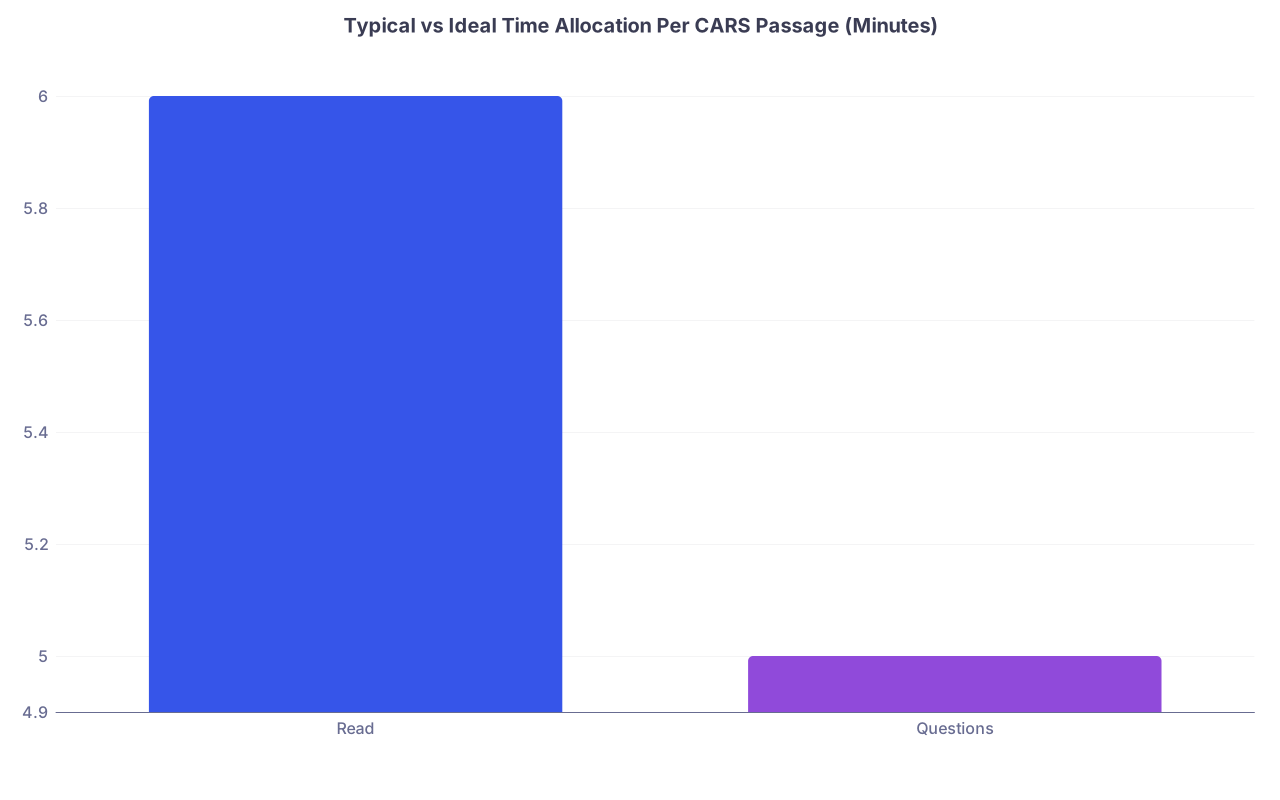
| Category | Value |
|---|---|
| Read | 6 |
| Questions | 5 |
Reality for many underperformers: 4–5 minutes reading, 7–8 minutes flailing through questions they barely anchored to a clear understanding.
For inference in particular, that is backwards.
You want:
- Slightly more time front‑loading comprehension.
- Less time agonizing between two answer choices that both feel “sort of familiar.”
Quick tactical adjustments:
- During reading, mark only three things: thesis, shifts/contrasts, and strong value words. That is enough for inference.
- For any inference question, before looking at answers, say out loud (or in your head) a 1‑sentence version of the relevant piece of reasoning. Then compare each answer to that sentence, not to the entire passage fog in your memory.
When you see yourself rereading all four options three times: stop. You have lost the skeleton. Go back to the key paragraph, reconstruct the logic, then re‑engage with the options.
7. A Systematic Drill To Train Inference Pattern Recognition
If you are serious about CARS, you need to train pattern recognition, not just “do more practice.”
Here is a very specific drill I use with students who consistently miss inference items.
Step 1: Isolate Only Inference Questions
Take 3–4 CARS passages from any reputable source. Do this:
- Read each passage completely.
- Answer only the questions that are:
- “most likely to agree,” “it can be inferred,” “suggests that,” “would support,” “would predict,” etc.
Ignore main idea, detail, and tone questions for this drill.
Step 2: For Each Inference Question, Label The Type
Use the 5‑type framework:
- Implied Belief/Claim
- Latent Relationship
- Consequence/Prediction
- Strength/Qualification
- Comparative/Counterfactual
Write your label next to the question number.
You are training your brain to classify, not just react.
Step 3: Write A One‑Sentence Skeleton Before Looking At Choices
For example:
- “Author’s core belief: critics focused too much on interiority and ignored social worlds.”
- “Relationship: Y is presented as a reaction to the limitations of X.”
- “Prediction: Since the author values community over individualism, they would likely oppose a policy that isolates individuals further.”
Then open the answer choices.
Step 4: After Reviewing Answers, Reverse‑Engineer The Question Writer
For every inference you got wrong, explicitly ask:
- What part of the passage was this question built from?
- What assumption or relationship was I supposed to see as “necessary” for the author’s view?
- Which distractor pattern got me? Overreach? New explanation? Single sentence idol? Outside world leak?
You do this for 20–30 inference questions, and the patterns stop being subtle. They become boringly obvious.

| Step | Description |
|---|---|
| Step 1 | Read Passage |
| Step 2 | Identify Inference Questions Only |
| Step 3 | Label Question Type |
| Step 4 | State 1-Sentence Skeleton |
| Step 5 | Answer Question |
| Step 6 | Review Wrong Answers |
| Step 7 | Identify Distractor Pattern |
Run this loop a few evenings in a row. You will feel your brain shifting from “I hope this is right” to “I see exactly what they are trying to test.”
8. Why High‑Scorers Make Inference Look Easy
You probably know someone who “never really studied CARS separately” and still pulls 129–131. They are not magic.
What they usually have, unconsciously, is:
Habitual skepticism of extremes
Strong language triggers their distrust unless the passage clearly matched that intensity.Instinct to stay inside the text
They treat their own opinions as irrelevant. If they cannot cite the passage, they do not pick it.Comfortable with ambiguity and partial support
They understand that “most strongly supported” rarely means “perfectly proven.” They pick the answer that is least wrong, not the one that feels philosophically complete.
You can build those habits deliberately. But you have to stop treating inference as a vague “vibe check” and start treating it as a structured reconstruction task.
9. Practical Day‑To‑Day Plan To Fix Your Inference Weakness
If you want a concrete routine rather than theory, here is one.
Week 1–2 (Foundation):
- 3 CARS passages per day (any reputable source).
- For every inference question:
- Label type.
- Write your 1‑sentence skeleton.
- Post‑review: identify distractor pattern if wrong.
Week 3–4 (Integration):
- 4–5 CARS passages per day.
- Now apply pattern recognition on full sets:
- Notice which passages produce more inference items (often denser humanities or social science).
- Track whether fatigue at the end of a section correlates with more inference errors.
Week 5+ (Simulation):
- Timed full CARS sections.
- After each section, only deeply review the inference questions you missed or guessed.
- Maintain a log: question number, passage topic, inference type, distractor pattern.
Over a few weeks, that log will show you bluntly:
“Most of my misses are Comparative/Counterfactual with Overreach + Outside World Leak.”
Good. Then you know exactly what to attack.
To visualize progress, you can track your accuracy by question type:
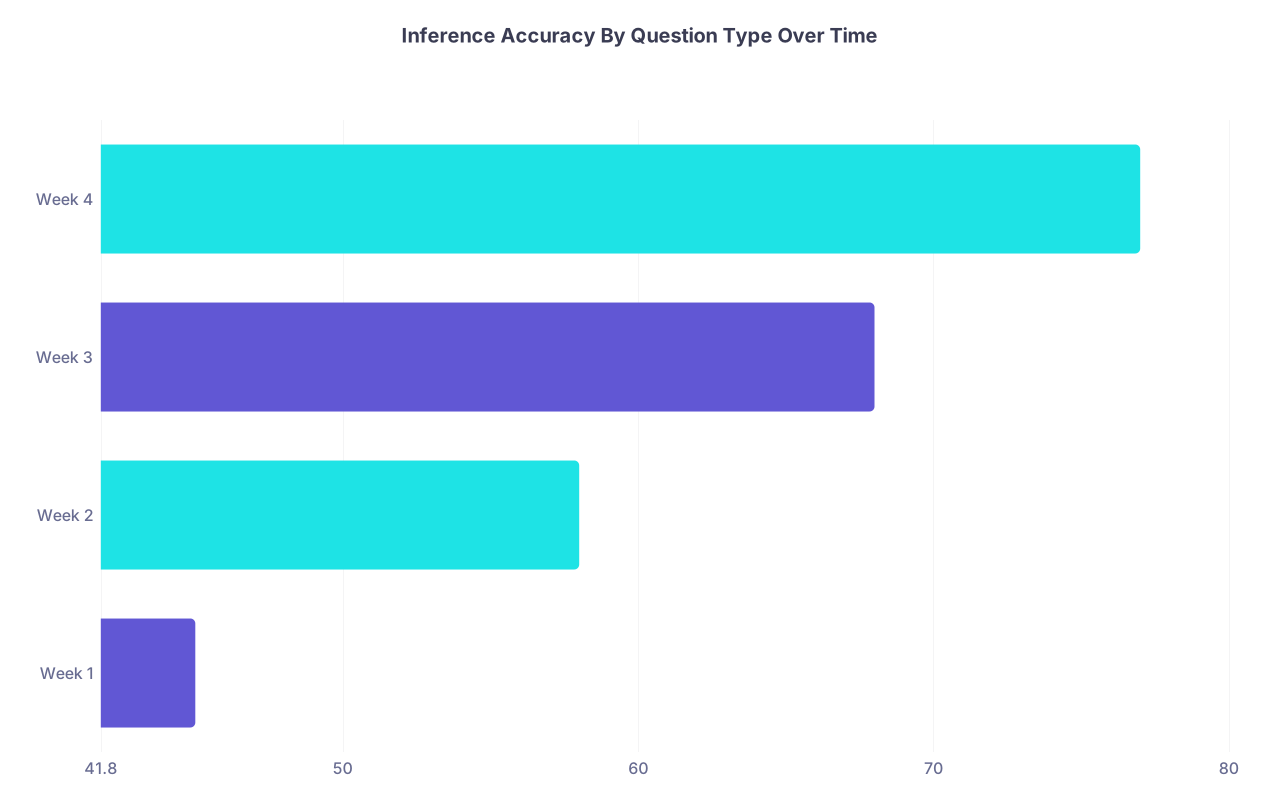
| Category | Value |
|---|---|
| Week 1 | 45 |
| Week 2 | 58 |
| Week 3 | 68 |
| Week 4 | 77 |
A steady climb from 45% to 75%+ on inference alone is usually the difference between a 125–126 CARS and a 128–129.
10. The Bottom Line
CARS inference is not mystical. It is mechanical.
Three points to leave you with:
Inference ≠ imagination.
It is the author’s argument skeleton compressed into a single new sentence. If you cannot point to multiple support points, you are overreaching.Wrong answers are built from predictable sins.
Overstating, adding new causes, idolizing one sentence, or leaking real‑world truth into a text‑only question. Spot the pattern, and you defang the trap.You train this like a skill, not a personality trait.
Classify question types, pre‑state the skeleton, and dissect your misses by distractor pattern. Do that consistently, and “I am just bad at inference” stops being true.