You are here
It is 7:45 a.m. on a Saturday. You are sitting at your kitchen table, coffee in hand, UWorld or AAMC full-length pulled up. You tell yourself, “This is my MCAT practice test.”
By 9:30 a.m. you have:
- Checked your phone twice
- Gotten up for a snack
- Paused the timer “just for a second”
And by the CARS section you are fried, annoyed, and nowhere near how you will feel on actual test day.
You finish, look at the score, and have no idea what it really means. Because this was never a true simulation. It was a long study session pretending to be a test.
You need something different: a personal MCAT simulation plan. Not vague advice like “do full-lengths,” but a step-by-step, scheduled, test-day-dry-run protocol you follow again and again until actual test day feels almost boring.
That is what I am going to build with you here.
1. What a Real MCAT Simulation Actually Means
Let us be precise. A “test day dry run” is not:
- Taking sections out of order
- Doing CARS after lunch because “I feel more awake then”
- Guessing on the last 10 questions because you got distracted for 20 minutes mid-section
A real MCAT simulation means you copy three things as tightly as possible:
- Conditions – where, when, noise, clothing, food, bathroom breaks, even the pen and scratch paper style if you can.
- Schedule – exact section order, start times, end times, break lengths, and sequence.
- Behavior – strict timing, no phone, no internet, no pausing, no music, no “just fixing this one thing.”
The goal is simple:
- On test day, your brain should say: “We have done this before. Many times.”
The way you get there is not by winging it. You build a simulation plan that:
- Fits your current phase (early, mid, late prep)
- Increases in realism and intensity over time
- Is repeatable and tracked
2. Build Your MCAT Simulation Blueprint
Start by laying out the skeleton: how many simulations, when, and with what materials.
Step 1: Decide How Many Full Simulations You Need
If you are serious, you are not doing “a couple of full-lengths.” You are building a progression.
Here is a reasonable minimum plan for most students (10–14 weeks of prep):
| Prep Phase | Weeks Out | Full-Length Sims | Section Sims |
|---|---|---|---|
| Early | 10–8 | 1–2 | 2–3 |
| Middle | 7–4 | 3–4 | 2–3 |
| Late | 3–1 | 2–3 | 1–2 |
This gives you:
- 6–9 full-length simulations
- 5–8 targeted “section simulation” days
If your content base is weaker and you have more time, push that to 8–10 full-lengths total. Any more than that and you risk burning through exams without proper review.
Step 2: Map Out Your Actual Calendar
Open your calendar. Not in your head. On screen or paper.
You are going to pin down:
- Your actual MCAT date
- All non-negotiables (work shifts, classes, exams, weddings, religious holidays)
- Your full-length days – these get locked in first
- Your section simulation days – these fill in surrounding weeks
Pattern that works well:
- One full-length every 1–2 weeks from 8–10 weeks out
- Increase to weekly full-lengths in the last 3–4 weeks
- Put section simulations on midweek days when you have at least 4–5 consistent hours
Your full-length days should be on a day where:
- You can start early
- You will not be interrupted
- You can protect your afternoon for review or rest (depending on phase)
3. Reproduce Test Day Conditions Like a Professional
Sloppy simulation = misleading scores and misplaced confidence. Fix the environment.
Step 1: Time of Day and Routine
Start your practice exams as close as possible to your actual test check-in time.
If your real test:
- Starts around 8:00 a.m. → Start your full-lengths between 7:45–8:15 a.m.
- Starts around 3:00 p.m. → You still need to train your body for an afternoon peak, not a morning one.
Three weeks out, you want all major simulations at the same time as your real exam.
Build a 90-minute pre-test routine and repeat it every simulation:
- Wake time
- Breakfast type and amount
- Caffeine amount and timing
- Shower / clothes
- When you leave home (even if your “test center” is just another room)
Do not improvise on real test day. You are rehearsing now.
Step 2: Physical Environment
Your goal: unpleasant but predictable. Testing centers are not cozy.
Simulate with:
- A hard chair and regular desk or table
- No bed, no couch, no lying down between sections
- Neutral or slightly cool temperature (bring a light layer if needed)
- Earplugs or noise-canceling headphones if you plan to use them or if your test center allows earplugs (check current rules)
You have options for location:
- Quiet library study room
- An empty classroom you can reserve
- A campus testing center (some universities rent them out)
- Worst case: your home, but with housemates warned and your phone in another room
Step 3: Tools and Materials
Match the real thing as closely as you can:
- Computer, mouse, keyboard similar to what you expect at the center
- Scratch paper replacement (white paper or laminated sheet mimic) and a single pen
- One clear water bottle
- Food in a small lunch container, like you will bring on test day
And the big rule:
- No phone, no music, no extra tabs, no internet during the test.
Only the testing interface and a timer (if the platform does not handle timing automatically).
4. The Exact Day-Of Simulation Protocol
Now let us get concrete. Here is a protocol you can literally print and tape to your wall for full-length dry runs.
Pre-Test (60–90 minutes before)
- Wake up at your planned test-day time.
- Eat your test-day breakfast (same foods, similar portion).
- Caffeine: same type, same dose, at the same time you plan for test day.
- Light movement: 5–10 minutes walk or stretching. Avoid a full workout that leaves you drained.
- Bathroom. Then a second bathroom stop 15 minutes before starting.
- Load up your exam platform, log in, have everything ready. No scrolling social media to kill time.
Section Timing and Breaks
Use this sequence for full-length simulations (approximate, adjust to actual AAMC timings if they change):
Chemical and Physical Foundations of Biological Systems (Chem/Phys)
95 minutesBreak 1
10 minutes – strict- Bathroom once
- Sip water
- Small snack if you normally eat one (practice this)
- No phone, no internet, no talking
Critical Analysis and Reasoning Skills (CARS)
90 minutesLunch Break
30 minutes – strict- Eat your planned test-day lunch (rehearse the exact food)
- Bathroom near end of break
- No new content review, no studying, no news
- Light movement (short walk, gentle stretching)
Biological and Biochemical Foundations of Living Systems (Bio/Biochem)
95 minutesBreak 2
10 minutes – same rulesPsychological, Social, and Biological Foundations of Behavior (Psych/Soc)
95 minutes
Total on-task exam time: ~6 hours.
Total “in-building” time: closer to 7.5 hours. Simulate that.
Hard Rules During Sections
Write these down:
- No pausing for any reason except true emergencies.
- No checking answers at the end of each passage.
- No “quick email” or “I just need to look this up.”
- Eyes on screen only.
- If you finish a section early, you stay seated and practice:
- Deep breathing
- Relaxation
- Light mental reset, but no phone, no reading
5. Layered Simulation: Full-Lengths and Section Sims
Not every simulation day has to be a full MCAT. You can and should use section simulations to build stamina in a controlled way.
Full-Length Simulation Days – How to Use Them
Use full-lengths for:
- Testing your endurance
- Checking your global timing
- Getting a near-real score estimate
After each full-length:
- Take an hour off. Walk, eat, decompress.
- Start a structured review, not random scrolling of incorrect questions.
- The following day: deeper conceptual review of weak areas.
You are not done when you hit “submit.” The learning happens after the simulation.
Section Simulation Days – Targeted Stress
Section simulation = 1–2 full timed sections in one sitting, under strict conditions.
Examples:
- CARS + CARS (two back-to-back CARS sections; brutal but effective)
- Chem/Phys only, full timed section
- Psych/Soc after a long morning of other work, to mimic late-day fatigue
Why these matter:
- You can attack weaknesses (for many, CARS or Chem/Phys) without burning a whole day.
- You can practice late-section focus by scheduling a tough section when your brain is already tired.
6. Tracking Data: Turn Simulations Into a Feedback Machine
If you are not tracking, you are guessing. And most students guess wrong about their weaknesses.
Create a simple MCAT Simulation Log. You can use a spreadsheet, Notion, or even a notebook, but keep the same fields every time.
Core columns to track:
- Date
- Weeks until exam
- Type of sim (Full-length / Section / Combo)
- Resource (AAMC FL 1, Blueprint FL 4, UWorld section, etc.)
- Start time and end time
- Overall score (for full-lengths)
- Section scores
- Number of questions guessed per section
- Any timing problems (ran out of time, rushed last 5, etc.)
- Sleep the night before (hours, quality)
- Caffeine intake
- Pre-test anxiety level (1–10)
- Mid-test crash? (Y/N, which section)
Over 4–5 simulations, patterns will emerge:
- Always underperforming CARS after poor sleep
- Always crashing in Bio/Biochem because lunch is too heavy
- Always rushing the last 10 questions of Chem/Phys
You fix these patterns one by one, during simulation, not just in content review.
To visualize this, a simple chart helps.
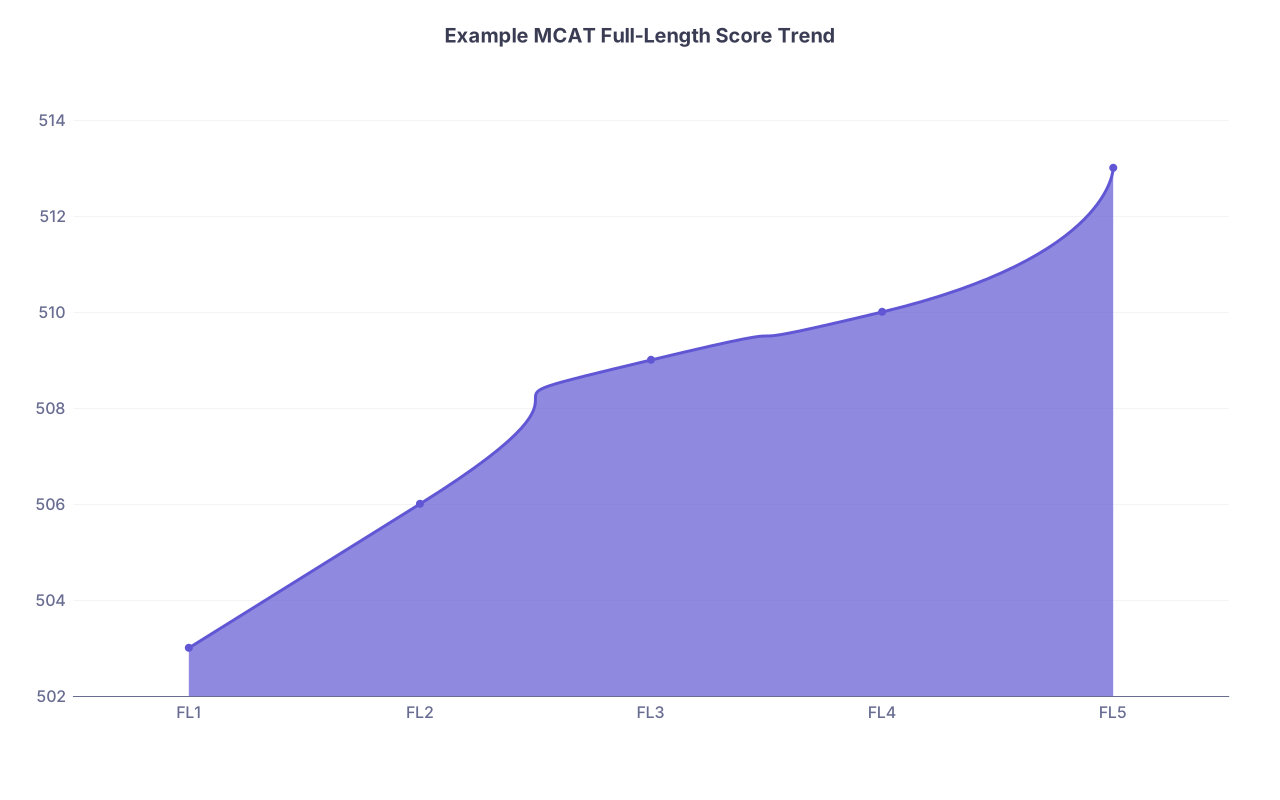
| Category | Value |
|---|---|
| FL1 | 503 |
| FL2 | 506 |
| FL3 | 509 |
| FL4 | 510 |
| FL5 | 513 |
If your score trend looks like a roller coaster instead of a staircase, there is usually a simulation problem:
- Inconsistent routine
- Erratic sleep
- Changing test environment every time
- Wildly different levels of seriousness
Standardize those before you panic about content gaps.
7. Fixing Common Simulation Problems
I have watched many students ruin the value of full-lengths with the same predictable mistakes. Let me walk you through the top problems and fixes.
Problem 1: You Keep Pausing or Restarting Sections
You are training your brain to give up.
Fix protocol:
- Pick a score floor: “I will accept whatever score comes from an unpaused test, even if it is ugly.”
- If something distracts you (dog barks, roommate knocks), you do not pause. Instead:
- Note the time and distraction on a sticky note.
- Add 1–2 minutes after the section only if it was major (like a fire alarm).
- Every time you pause “just for a second,” you mark it in your log.
If you see more than 1 pause per exam, you lose the right to call it a “simulation.”
Problem 2: You Melt Down in the Second Half
Bio/Biochem and Psych/Soc feel like a blur.
Fix protocol (over 2–3 weeks):
- Add 30–40 minutes of focused reading or question practice before most study blocks. Train your brain that focus is default, not optional.
- Start doing back-loaded practice days, where the hardest section of the day is scheduled last.
- On simulations, script your mid-day reset:
- Walk
- Deep breathing 2–3 minutes
- Quick body scan (relax jaw, hands, shoulders)
Do not assume “I will just push through on test day.” That is how people walk out at 3 p.m. stunned by how foggy they felt.
Problem 3: Your Scores Are Fine at Home but Tank on Real Practice Center or Proctored Exams
This is usually an environment over-reliance issue.
Fix protocol:
- At least 2–3 simulations must be done in a non-home location (library, rented room, campus lab).
- For one of them, intentionally introduce:
- Mild background noise
- Slightly uncomfortable chair
- Cooler room temperature
If your performance drops by more than 3–4 points outside your cozy spot, you have a problem. You want a small drop (1–2 points is acceptable), not a collapse.
Problem 4: You “Review” Tests by Just Skimming Incorrect Answers
That is not review. That is entertainment.
Fix protocol for post-simulation review (24–48 hours):
For every full-length:
Pass 1 (same day or next morning):
- Log raw scores and section scores.
- For each section, identify:
- 3 main content weaknesses
- 2 main reasoning/timing issues
Pass 2 (next 1–2 days): For each wrong or guessed question:
- Why did I miss it? (content gap, misread, timing panic, overthinking, etc.)
- Could I have eliminated more options with better strategy?
- What specific thing will I do differently next time?
You build a “Simulation Lessons” document. Every test adds 5–10 concrete rules:
- “If I am stuck between 2 CARS answers, re-check the main idea first.”
- “Stop rereading questions 3 times; pick an answer, mark and move on.”
That document is pure gold in the last 2 weeks.
8. The Final 3-Week Simulation Plan (Step-by-Step)
Here is a template late-stage plan you can adapt.
Assume test is on a Saturday.
3 Weeks Out
- Saturday:
- Full-length #1 under strict conditions, full timing.
- Sunday:
- Structured review of FL #1 (first pass).
- Midweek (Tue or Wed):
- Section sim: CARS + CARS (with a 10-minute break in between).
Goal: Stress-test focus and identify late-breakdown patterns.
2 Weeks Out
- Saturday:
- Full-length #2, same start time as real test.
- Use exact planned test-day breakfast, snacks, and lunch.
- Sunday–Monday:
- Deep review of FL #2. Build your “Simulation Lessons” document.
- Midweek:
- Section sim: Toughest section for you + second section (e.g., Chem/Phys + CARS).
Goal: Lock down routine. Fix last-mile timing issues.
1 Week Out
- Saturday (or 5–6 days before exam):
- Final full-length (preferably an AAMC exam if available).
- Sunday:
- Review, but do not brute-force every detail. Focus on:
- What went right
- What minor tweaks remain
- Review, but do not brute-force every detail. Focus on:
- Mon–Wed:
- Light section practice, emphasis on stamina and calm, not volume.
- 2–3 days before exam:
- No more full-lengths. No more heavy days.
- One short simulation block (e.g., 1 CARS section) just to stay sharp.
You want to walk into test day feeling like this is, at worst, just Simulation #10, not a mysterious one-time event.
9. Concrete Next Steps: Build Your Plan Today
Do this today, not “when things calm down.”
Open your calendar.
- Mark your MCAT date.
- Choose and block all full-length simulation days from now until then.
Create a Simulation Log.
- Add the columns I listed.
- Save it in a place you actually use.
Write your Test-Day Routine Draft.
- Wake time, breakfast, caffeine, clothes, start time.
- You will refine it after each simulation.
Schedule your first strict simulation.
- If you have never run a true full-length, do one this week.
- If that is too soon, start with a single full CARS or Chem/Phys section under real conditions.
Then actually sit down and do it. No pausing. No shortcuts.