It is 13 days before your MCAT. Your last full‑length score is on the screen. Maybe it is solid and you are terrified of blowing it on test day. Maybe it dipped for no good reason and now you are spiraling. Your calendar says “Review,” but you have no idea what that actually means in a way that will not tank your score.
Here is the honest situation: in the last two weeks, you are not “building” a score. You are protecting it. Either from panic, from bad scheduling, or from the temptation to “do more” in all the wrong ways.
I am going to give you a concrete, day‑by‑day and system‑by‑system checklist whose only job is score stability. Not fantasy improvement. Not magical hacks. Just: keep your current scoring range and show it on test day.
Big Picture: What Actually Matters in the Last 2 Weeks
Before the detailed checklist, you need the frame. The last 14 days are about four things, in this order:
- Protecting cognitive bandwidth
- Locking in timing and decision habits
- Rapidly patching high‑yield, high‑frequency weak spots
- Standardizing your test‑day routine
If what you are doing does not support one of these, it is probably noise.
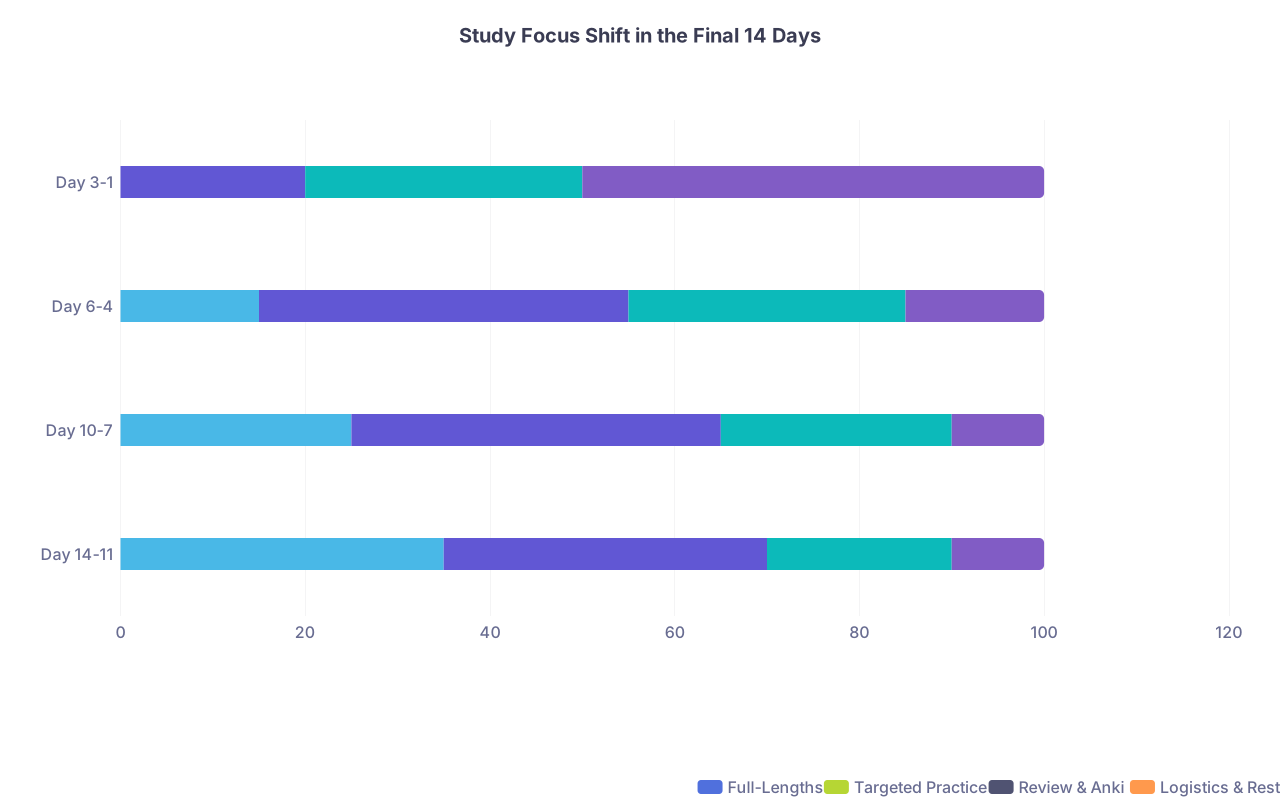
To make this concrete, here is how your effort should roughly shift in the last 2 weeks:
| Category | Full-Lengths | Targeted Practice | Review & Anki | Logistics & Rest |
|---|---|---|---|---|
| Day 14-11 | 35 | 35 | 20 | 10 |
| Day 10-7 | 25 | 40 | 25 | 10 |
| Day 6-4 | 15 | 40 | 30 | 15 |
| Day 3-1 | 0 | 20 | 30 | 50 |
Notice what happens at the end: logistics and rest take over. That is not laziness. It is how you stabilize.
Step 1: Decide Now – Are You Testing This Date or Not?
You cannot talk about stability if you are still half‑considering a postponement. That indecision bleeds into everything.
You should lock this in 10–14 days out, using objective criteria, not vibes. Quick sanity check:
| Criterion | Generally OK to Proceed | Red Flag (Consider Postpone) |
|---|---|---|
| Recent FL Scores | ≥ your target or within 2–3 points below, consistently | ≥5 points below target, trending down |
| Score Consistency | Spread of ≤4 points across last 3 FLs | Wild swings (e.g., 507 → 513 → 505) |
| Section Balance | No section >5 points below target | One section lagging massively (e.g., 129/130/127/123) |
| [Burnout](https://residencyadvisor.com/resources/mcat-prep/healing-from-mcat-burnout-a-10-day-reset-to-restart-studying) | Tired but functional | Can barely sit 30–60 minutes to focus |
| Content Gaps | Mostly details and nuance | Whole topics never learned (e.g., circuits, endocrine) |
If you are clearly in the red on multiple rows, postponing may raise your eventual score. But once you choose, commit. The rest of this checklist assumes you are going to sit on your scheduled date.
Step 2: Build a Simple 14‑Day Structure (Then Stop Changing It)
The next mistake I see constantly: people rewrite their schedule every day based on fear. That kills stability.
You want one simple template for the last 2 weeks. Adjust minor details, but do not keep reinventing.
Baseline structure by period
Days 14–8 (Week‑2):
- 1–2 full‑lengths (FLs), max
- Heavy review + targeted drills based on those FLs
- Short but daily content touch (flashcards / equation sheet / pathways)
Days 7–4 (Week‑1 start):
- 1 FL early in this window, then no more full FLs
- Section‑based practice (especially CARS and your weakest section)
- Ramp up test‑day routine practice
Days 3–1 (Final 72 hours):
- No full‑lengths
- Only light–moderate, predictable work
- More logistics, rest, and mental rehearsal than heavy drilling
Let us be explicit and practical.
Step 3: Exact Checklist for Days 14–8 (The “Tighten and Test” Phase)
You are still allowed to do substantial practice here, but we are not “kitchen‑sinking” content.
Daily non‑negotiables (every day this week)
Sleep window fixed
- Pick your test‑day sleep/wake times now.
- Go to bed and wake up within ±30 min of that window every single day.
- If your exam is at 8 AM, you should be up at 6–6:30 AM from now on. No excuses.
Light movement
- 15–30 minutes of walking / light cardio daily.
- Goal: circulation and stress bleed‑off, not training for a marathon.
Core review block (60–90 minutes)
- One of the following per day:
- High‑yield Anki deck pass
- Equations & constants review
- Biochem pathways / hormones / immune cells quick sheet
- This is maintenance, not learning brand‑new courses.
- One of the following per day:
Full‑length usage in this window
You get 2 full‑length slots max here. I strongly prefer:
- Day 13 or 12: AAMC FL (if you still have one)
- Day 9 or 8: Remaining AAMC or best third‑party FL you trust
Hard rules:
- Treat them like real test days:
- Same wake time
- Same breakfast
- Same break snacks
- Same timing / order of sections
- No phones, no texting mid‑exam, no “just checking one answer.”
- Stop after the exam. Review is done the next day, not the same day.
- Treat them like real test days:
How to review those FLs (this is where people blow it)
Most people review full‑lengths like they are memorizing an answer key. That does nothing for stability. You care about patterns.
Split review across 1–2 days per FL:
Day after FL – Macro review
For each section, capture:
- Raw score + scaled
- Number right/wrong by question type (discrete vs passage)
- Time leftover / overtime
Then categorize every missed/guessed question into one of these buckets:
- Content gap – did not know the fact/formula.
- Application mistake – knew the info, but could not apply it in the passage.
- Misread / rushing – missed a word, reversed logic, etc.
- Trap / elimination error – fell for distractors even with decent understanding.
Make a simple tally. That pattern is what you fix in the next week.
Second pass – Micro review (just for patterns)
For each section, pull 3–5 questions that represent your most common issue and do a deep autopsy:
- Why was the right answer right, in terms of:
- Concept tested
- Passage clue that pointed to it
- Wrong answer pattern (too extreme, off‑topic, wrong detail, etc.)
Then turn lessons into rules you actually write down:
- “If I see ___, then I will ___.”
- Example: “If stem asks for ‘best explains’ in a psych passage, I will first label the bias/heuristic in my head before looking at answers.”
Start building a Test‑Day Rules Document (more on that later).

| Step | Description |
|---|---|
| Step 1 | Day 14-11 |
| Step 2 | FL #1 + Full Simulation |
| Step 3 | Next Day: Macro Review |
| Step 4 | Targeted Drills from FL #1 |
| Step 5 | Day 10-8: FL #2 |
| Step 6 | Macro + Micro Review |
| Step 7 | Week -1: Section Drills + Routines |
| Step 8 | Final 3 Days: Light Review + Logistics |
| Step 9 | Test Day Execution |
Step 4: Exact Checklist for Days 7–4 (The “Lock Habits” Phase)
By now, the big shifts in score range should be done. Your job is to standardize behavior.
1. Last full‑length placement
- If you have not done FL #2 yet, it should be Day 7 or Day 6 at the latest.
- Same simulation rules as before.
- Again, do not fully review it the same day. You can do:
- 30–45 minutes to check raw scores and get a rough idea.
- Full analytic review on Day 6 or 5.
After this FL:
- No more full‑lengths. None. You are now in “protect the brain” mode.
2. Shift to section‑based work (precision, not volume)
From Day 7–4, your practice should look like this:
-
- 2–4 passages, timed.
- Full review of wrongs and “lucky corrects.”
- Emphasis: sticking to your passage‑first vs question‑first strategy; enforcing your pacing (e.g., ~10 minutes per passage).
Rotate the 3 science sections based on weakness
- Example schedule:
- Day 7: Chem/Phys focus (passages + discretes)
- Day 6: Bio/Biochem focus
- Day 5: Psych/Soc focus
- Day 4: Mixed set or weakest of the three
- Example schedule:
Use 1–2 hour focused blocks:
- 2–4 passages of one section under test timing
- Immediately followed by targeted review of those passages only
3. Build and refine your “Test Day Rules Document”
This is one of the most stabilizing tools you can create. It turns vague “I’ll try to do better” into clear behavior.
Structure it like this (one page per section is fine):
Global rules (all sections)
- How you handle:
- A passage that looks brutal at first glance
- Running behind time
- A question you genuinely have no clue about
- Fatigue or panic mid‑section
- How you handle:
Section‑specific rules
- CARS examples:
- “No re‑reading an entire passage until I have read the stem and know what I am looking for.”
- “If torn between close answers, pick the one that best matches author’s attitude, not my outside knowledge.”
- Chem/Phys:
- “If math looks too heavy, round early and choose approximate elimination.”
- “I will write units for each variable once, at top of scratch page, for calculation‑heavy passages.”
- Bio/Biochem:
- “I will sketch pathway relationships when there is any diagram with arrows and inhibition.”
- Psych/Soc:
- “Always name the concept in my own words before looking at answers.”
- CARS examples:
You are basically writing your test‑taking protocol. That document is gold for stability. Read it briefly before every practice block and on test morning.
Step 5: Exact Checklist for the Final 3 Days (Protect the Brain, Not Your Ego)
This is where people sabotage themselves. They panic‑study, pull a 7‑hour cram, sleep 4 hours, and then act surprised when their score tanks.
You do not do that.
Day −3 (Three days before exam)
Primary goals:
- Confirm logistics
- Light‑moderate review
- Moderate day overall
Concrete checklist:
Logistics:
- Confirm test center address.
- Drive or map out route at the same time of day you will travel.
- Check required documents: ID, confirmation email, any allowed items.
- Pack a simple test‑day bag:
- Snacks (carbs + some protein, nothing new/strange)
- Water bottle
- Earplugs if allowed
- Light sweater / layers
Study plan (3–4 hours total spread out):
- 1 section of light practice:
- Example: 3–4 untimed CARS passages with deep review.
- 1–2 hours of content touch‑ups on your worst specific topics:
- One page of notes per topic, not full chapters.
- 20–30 minutes: review your Test Day Rules Document.
- 1 section of light practice:
Non‑study:
- 30+ minutes of real movement (walk outside, easy run, yoga).
- Normal bedtime, same wake time.
Day −2 (Two days before exam)
This is your last “real” study day, but still not full‑tilt.
Goals:
- Light practice in all sections
- More emphasis on confidence and familiarity
Checklist:
Study (3–5 hours total):
- CARS: 2–3 passages, timed, with quality review.
- Science:
- 1 short mixed set (maybe 2 passages each from 2 different sections).
- Or a handful of high‑yield discretes from each section.
- 1 hour: flashcards / formula sheet / biochem pathways.
Test day mental rehearsal (10–15 minutes):
- Visualize:
- Waking up
- Eating breakfast
- Arriving at the center
- Sitting down for each section
- Walk through, in your head, what you do when:
- You see a brutal passage first
- You are ahead of time
- You are behind time
- You hit a weird experimental‑feeling question
- Visualize:
Evening rules:
- Stop real studying at least 3 hours before bed.
- Light activity ok (stretching, short walk).
- Bedtime same as usual, screen time dialed back.
Day −1 (Day before exam)
Non‑negotiable rule: no heavy studying. You are not moving the needle on content knowledge anymore. You can absolutely trash your sleep and stress levels though, so that is what we avoid.
Checklist:
Absolute maximum 2 hours of “study‑lite”:
- 20–30 minutes: skim formula sheet and key constants.
- 20–30 minutes: glance at your most error‑prone psych/soc terms or biochem pathways.
- 20 minutes: final read of Test Day Rules Document.
- Optional: 1–2 very easy CARS passages untimed just to keep the feel. No more.
Test day logistics final pass:
- Lay out clothes.
- Pack bag fully, put it by the door.
- Confirm alarms (yes, plural).
- Confirm transportation (gas in car, train times, etc.).
Relaxation protocol:
- Do something non‑academic:
- Walk with music.
- Light show or comedy (not a 3‑hour intense movie).
- Cook, talk to one trusted friend.
- No dramatic conversations about your score or future.
- Do something non‑academic:
Sleep:
- Aim to be in bed 8–9 hours before wake time.
- If you do not fall asleep perfectly, that is fine. Resting is still beneficial. Do not start reading anxiety posts or opening question banks.
| Category | Value |
|---|---|
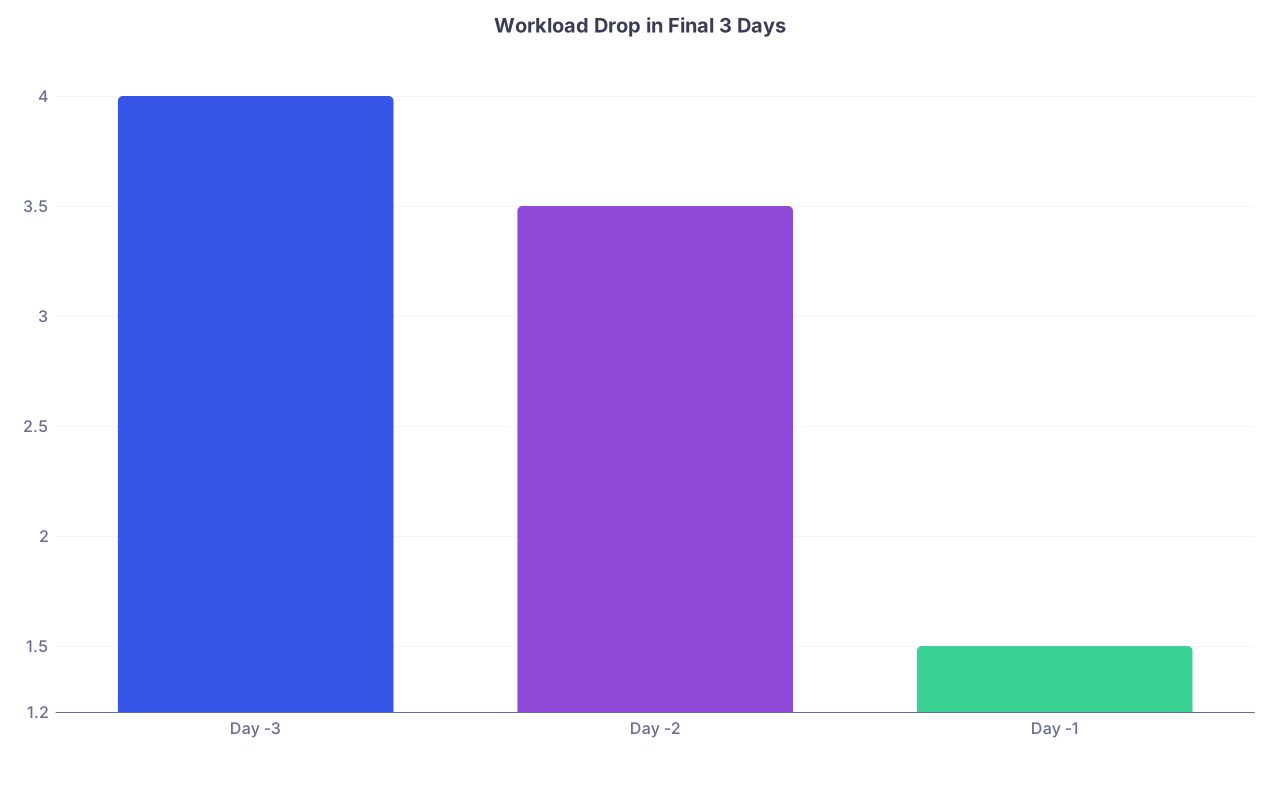
| Day -3 | 4 |
| Day -2 | 3.5 |
| Day -1 | 1.5 |
Step 6: Test Morning and During Exam – Micro‑Checklist
Score stability on game day is about how you react when things do not go perfectly.
Morning of the test
- Wake at your now‑standard time.
- Eat the breakfast you have been practicing with. Same components, same timing.
- Bring:
- ID
- Confirmation
- Packed bag with snacks, water, layers
Mental prep:
- Spend 5–10 minutes re‑reading:
- The first page of your Test Day Rules Document (global rules)
- Do 1–2 “warm‑up” items only if you want:
- A very simple discrete from a previous exam.
- One short psych/soc question.
- Purpose: wake up the brain, not measure anything.
During the test – rules to keep your score stable
Here is where you live or die.
Global section rules
First 5 minutes of each section:
- Focus on getting 2–3 questions right cleanly.
- You are signaling to your brain: “I can do this; stay calm.”
- Do not overthink the first question. If it is weird, flag it, guess, move on.
Pacing checkpoints:
- Set mental or watch‑based checkpoints:
- CARS: ~10 minutes per passage.
- Other sections: rough “time per passage” and check at halfway points.
- If behind by >3–4 minutes, accept that you will guess on a small cluster later. Do not rush every question.
- Set mental or watch‑based checkpoints:
Guessing protocol:
- If you are stuck >60–75 seconds on 1 question:
- Eliminate what you can.
- Pick one.
- Flag if you have time later.
- Stare‑fighting a question rarely converts wrong to right. It just steals time from questions you would get right.
- If you are stuck >60–75 seconds on 1 question:
Break usage:
- Actually leave the chair.
- Use the bathroom.
- Eat a small snack, sip water, quick stretch.
- Take 3–5 slow deep breaths before going back in.
What to do if disaster “hits” a section
Section feels awful?
- Assume it was hard for everyone.
- Your job is to stabilize the next section, not autopsy the last one.
You had to guess on the last 4–5 questions?
- That is not a disaster. A lot of 510+ scorers do this.
- Reset on the break; don’t burn your mental energy regretting it.
Step 7: Common Last‑2‑Week Mistakes That Wreck Otherwise Good Scores
Avoid these and you are already ahead of half your competition.

1. Taking a full‑length 1–2 days before the exam
I have watched so many students do this, score slightly lower than usual (because they are tired), panic, sleep badly, and underperform on the real thing.
- You gain nothing meaningful content‑wise.
- You risk psychological damage.
Do not do it.
2. Trying to “learn new topics” from scratch
If you have truly never learned, say, electrochemistry or Hardy‑Weinberg by Day −10, you are not going to master it now. You will bleed time and create the illusion of control.
Better use of time:
- Strengthen topics where you are at 70–80% already.
- Build habits that stop you from losing points on questions you can answer.
3. Overhauling your strategy at the last minute
Switching CARS strategies, changing from notation‑heavy to no‑notation, suddenly trying new timing games—you are asking for instability.
At this stage:
- You polish.
- You do minor tweaks: “I will more aggressively skip early if a passage looks brutal.”
- You do not adopt entirely new systems.
4. Massive lifestyle shifts
Suddenly going keto. Energy drinks for the first time. New sleep schedule 3 days before.
If you did not test it with a full‑length or at least section practice, do not introduce it now.
Step 8: Example 14‑Day Plan (Plug‑and‑Play)
Here is a compact, realistic outline you can adapt:
| Day | Focus | Key Elements |
|---|---|---|
| 14 | FL #1 | Full sim, no review same day |
| 13 | Review | Macro + micro FL review, light Anki |
| 12 | Targeted | CARS + weak science topic drills |
| 11 | Mixed | Short mixed passages + content touch-up |
| 10 | Targeted | CARS + different weak section |
| 9 | FL #2 | Full sim, no heavy review |
| 8 | Review | FL #2 review, build rules doc |
| 7 | Sections | CARS + primary weak section |
| 6 | Sections | CARS + second weak section |
| 5 | Sections | CARS + mixed science |
| 4 | Light | Mixed discretes, rules doc refinement |
| 3 | Logistics | Light review + route/packing |
| 2 | Light | Brief practice all sections + mental rehearsal |
| 1 | Minimal | Formula skim, rules doc, rest |
You are not locked to this exact layout, but the shape of it should stay: upfront FLs, then targeted work, then taper.
Step 9: Quick Self‑Audit – Are You On Track for Stability?
Take 5 minutes and answer these bluntly:
- Do you know your average of the last 3 full‑lengths and the spread?
- Do you know your weakest section, specifically (not just “CARS is bad”)?
- Do you have a written Test Day Rules Document?
- Are your sleep/wake times already matching test day within 30 minutes?
- Is your last full‑length scheduled for at least 5–7 days before your exam?
If you cannot say yes to most of these, adjust your next 2–3 days to fix that. Those items stabilize you more than cramming another chapter of physics.
Final Thoughts: What Actually Keeps Your Score Stable
Let me cut this down to the essentials.
- You are not building a new score in 14 days. You are protecting the one your last 3–4 full‑lengths already suggested. That means: front‑load full‑lengths, then pivot to targeted practice and routine.
- Habits beat heroics. A clear Test Day Rules Document, fixed sleep schedule, and consistent practice conditions will do more for your score than any last‑minute content binge.
- The final 72 hours are about your brain, not your ego. Light review, logistics nailed down, stress kept in a narrow band. No full‑lengths. No overhaul. Just executing what you already know you can do.
Do that, and the score you have been earning in practice has a very high chance of showing up when it matters.