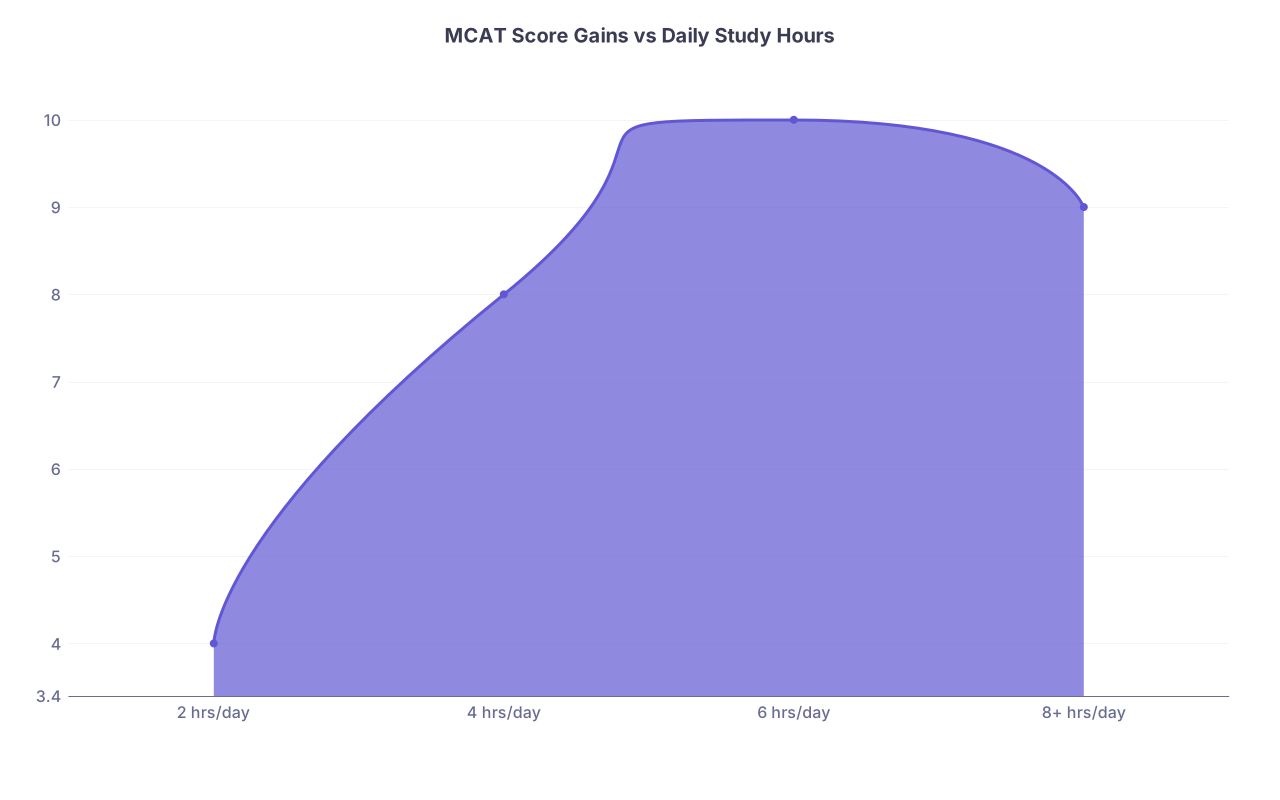
It’s six weeks into your “hardcore” MCAT study block.
Your Kaplan and Blueprint books are full of neon highlighter. Your Anki deck has thousands of cards. You’ve watched every single content video at 1.5x speed. You feel busy. You feel exhausted.
And your full-length scores?
Flat. Maybe even down a point.
If that’s you, you’re not “bad at testing.” You’re making the same content review mistakes I’ve watched hundreds of students make. The kind that devours time and energy but barely nudges your score.
Let me be blunt: a lot of what premeds call “studying” is just sophisticated procrastination dressed up as productivity. If your score isn’t moving, odds are high you’re stuck in one (or more) of these traps.
This is your warning label before you burn another month doing the wrong things.
Pitfall #1: Treating Content Review Like You’re Cramming for a College Final
You sit down, open the Biochem book, and think, “I’m going to learn everything in this chapter.”
So you:
- Read every line
- Underline and highlight
- Re-read the hard parts
- Maybe summarize a little in a notebook
Feels thorough. Feels “serious.” It’s also a trap.
The MCAT is not a content regurgitation exam. It’s a passage-based reasoning exam with content as a prerequisite, not a goal. If you study like it’s Gen Chem I, you’ll know a ton of facts and still get wrecked by passages.
The mistake:
Confusing “exposure” with “mastery.” Reading and highlighting are exposure. They’re baseline, not the end point.
What actually moves your score:
- Rapid, targeted review of high-yield topics
- Immediate application through questions
- Repeated exposure to question formats, not just content pages
If you can “teach” the electron transport chain but still miss MCAT questions about it, you have a use problem, not a knowledge problem.
Do not spend three weeks “finishing the books” before touching real questions. That is score-stagnation suicide.
Pitfall #2: Highlighting and Note-Taking as Your Main Study Method
You know that feeling when you’ve just filled three pages of notes and your hand hurts? Feels productive, right?
It’s not.
I’ve watched students write gorgeous, color-coded notes on renal physiology… and then miss 60% of renal questions because they never forced themselves to retrieve and apply anything.
The mistake:
Using passive input (reading, highlighting, rewriting) as the core of your content review.
Here’s the ugly truth:
Your brain doesn’t get good at what you look at. It gets good at what you do repeatedly.
You want to avoid this pattern:
- Read a section
- Highlight “important” lines
- Copy them into a notebook
- Feel like you now “know” the material
What to do instead (the uncomfortable version):
- Skim a short section (5–10 minutes, not 45).
- Close the book.
- On scratch paper, write everything you remember. Concepts, equations, exceptions.
- Open the book. Compare. Fill gaps.
- Immediately do 3–10 related practice questions.
That sequence feels harder. You’ll feel stupid at first. That’s how you know you’re finally using your brain in the way the MCAT will test it.
If your notebook is beautiful but your scores are ugly, you’re doing this wrong.
Pitfall #3: “I’ll Do Practice Questions After I Finish Content”
This one kills more MCAT dreams than any other single habit.
The inner monologue goes like this:
“I don’t want to waste questions while I’m still weak on content. I’ll finish content review first, then do all the practice and exams later.”
No. Absolutely not.
Here’s what actually happens when you follow that plan:
- You spend 6–8 weeks on content
- You “finish” the books, feel behind on practice
- You rush through question banks with no time to review
- You discover huge gaps very late, with no runway to fix them
You’ve effectively removed the feedback loop from your entire first half of prep.
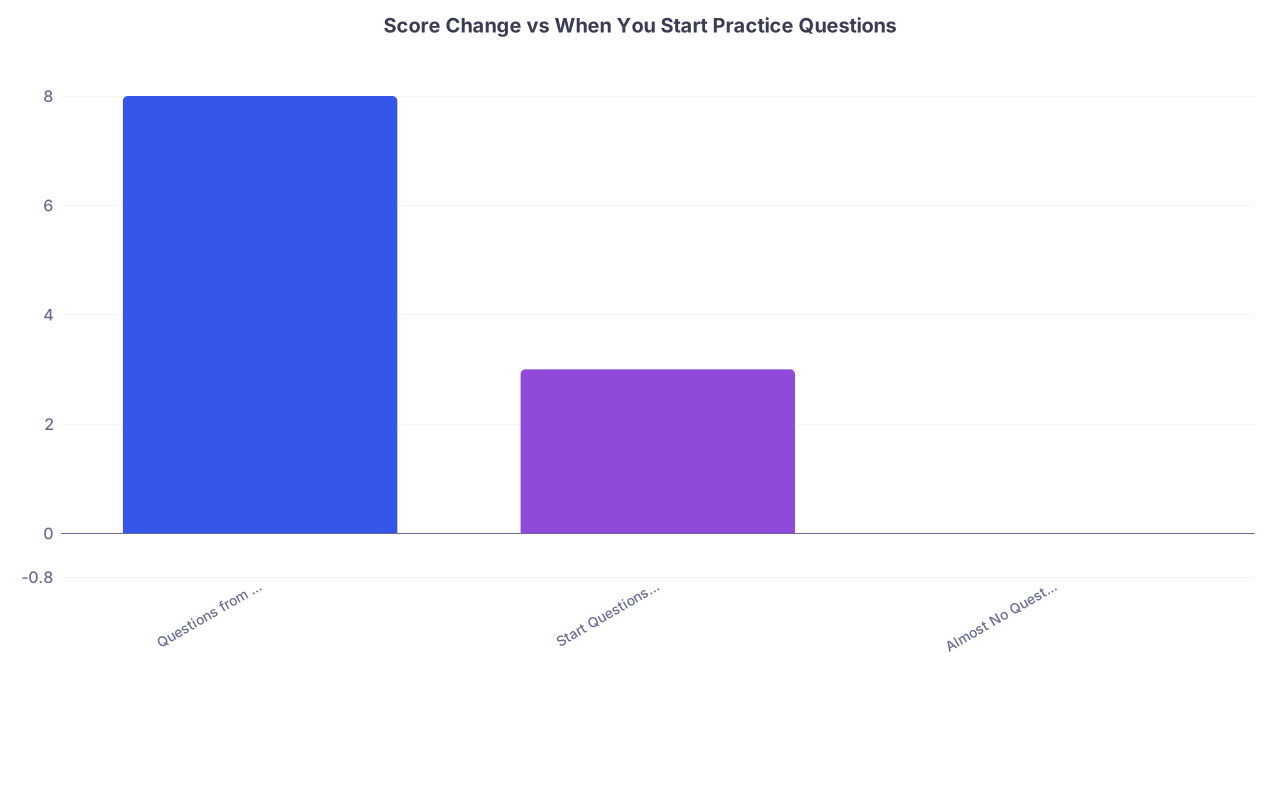
| Category | Value |
|---|---|
| Questions from Week 1 | 8 |
| Start Questions Week 4+ | 3 |
| Almost No Questions | 0 |
The numbers here are typical: students who integrate questions from week 1 average much higher score jumps than those who “save” them.
The mistake:
Thinking you’re “preserving” questions. What you’re really doing is preserving ignorance of what actually matters.
Questions are not just assessment. They’re teaching tools. Every early question you miss teaches you:
- What’s truly high-yield
- How the AAMC phrases concepts
- Which parts of “content” actually show up
- Where your understanding breaks — long before test day
If you’re more than 2 weeks into your plan and you haven’t been doing at least some questions per day, you’re sitting in this trap.
Pitfall #4: Anki Abuse – Flashcards Instead of Understanding
Anki is powerful. It’s also one of the easiest ways to waste hundreds of hours if you use it wrong.
Common Anki mistakes I see constantly:
- Decks bloated with low-yield detail (“What’s the Km of hexokinase?” Who cares.)
- Cards that are basically walls of text
- Memorizing definitions without application
- Spending 2–3 hours a day clearing reviews instead of doing questions
The mistake:
Treating Anki as the main event instead of a support tool.
If your daily routine is 90 minutes of flashcards and 30 minutes of actual questions, you’ve inverted the priority.
Anki should:
- Reinforce discrete, testable facts
- Keep high-yield formulas and definitions fresh
- Support what you’re already learning from questions
It should not:
- Replace question-based learning
- Be where you “learn” entire topics from scratch
- Eat the prime hours of your brain power every day
Harsh rule of thumb I give my students:
If your Anki sessions regularly take more than 60–75 minutes a day during MCAT prep, your deck is overgrown and hurting you.
Prune it. Or you’ll keep your dopamine streak and sacrifice your score.
Pitfall #5: Ignoring the Passage-Based Nature of the Exam
I’ve watched very smart students crash because they mastered flashcard-level content and never learned to think in passages.
MCAT science sections are not:
“Do you know what Le Chatelier’s principle is?”
They are:
“Here’s a long passage about an unfamiliar enzyme system. Can you extract what matters, connect it to principles you know, and reason under time pressure?”
If your content review never leaves the comfort of freestanding facts, you’ll be blindsided by:
- Dense, boring experimental setups
- Graphs and tables with odd units
- Questions that require 2–3 conceptual steps
You’ll say, “But I knew this topic.” And you’ll be right… in isolation.
The mistake:
Failing to train the bridge between content and application. That bridge is where the score lives.
This is why you must regularly:
- Do passage-based questions, not just discretes
- Review how you approached a passage, not just what you got wrong
- Practice extracting main ideas quickly instead of rereading passages 3 times
If your content review feels “clean” and neatly organized, and then passages feel like chaos, that’s the signal: you’re not studying in the format you’ll be tested in.
Pitfall #6: Endless “Perfect Plan” Revisions Instead of Execution
You’d be shocked how many hours premeds spend tweaking their study schedules instead of actually studying.
I’ve seen calendars color-coded by topic, subtopic, and resource, with 10–15 different blocks in a single day. It looks impressive. It’s also fantasy.
The mistake:
Using planning as a socially acceptable form of procrastination.
Common signs you’re doing this:
- You’ve rewritten your schedule more than twice in a month
- You keep “starting fresh Monday”
- You spend more time searching Reddit for “best MCAT schedule” than actually doing passages
- You feel like you’re always “behind the plan”
Here’s the painful truth:
An imperfect plan executed daily beats a “perfect” plan constantly reworked and restarted.
Better pattern:
- Set a simple, sustainable daily framework
- Lock it in for 2 weeks
- Evaluate after those 2 weeks based on scores and completion, not vibes
If your content review keeps getting “pushed back” by your own schedule tinkering, you’re setting yourself up for cramming and panic later.
Pitfall #7: Treating All Content as Equally Important
You know what low scorers have in common? They spend way too much time on low-yield rabbit holes because “it’s in the book.”
High scorers are ruthless about what gets their attention.
No, every sub-subtopic of organic chemistry mechanism detail is not equally important. Yes, certain Psych/Soc frameworks show up repeatedly and should be burned into your brain.
| Area | High-Yield Focus | Common Low-Yield Trap |
|---|---|---|
| Biochem | Enzymes, pathways, regulation | Exact structures of every AA |
| Physics | Fluids, circuits, waves, kinematics | Deriving every equation |
| Psych/Soc | Major theories, research methods | Obscure term memorization |
| Orgo | Fundamentals + spectroscopy | Niche named reactions |
| CARS | Practice and review | Reading “strategy” blogs only |
The mistake:
Equating “it exists in a resource” with “it deserves hours of my life.”
You must filter content through:
- AAMC’s emphasis (from official materials)
- Repeated patterns in practice tests
- Realistic return on investment
If you’re spending an afternoon memorizing the urea cycle step-by-step but still missing basic graph interpretation questions, you’re prioritizing wrong.
Pitfall #8: Reviewing Wrong Answers Superficially
This one is insidious because it feels like you’re doing the right thing.
Your “review” process:
- Look at the question you missed
- Read the explanation
- Think “Oh, that makes sense”
- Move on
That’s not review. That’s reading. Again.
The mistake:
Not extracting systems from each mistake.
A proper review of a missed question should answer:
- What was the exact reasoning error?
- Was this a content gap, a reading issue, or a strategy error?
- How will I recognize this pattern next time?
- What specific thing (card, note, rule) am I adding so this doesn’t repeat?
And yes, this is slower. Good. It should be.
Fast, shallow review = lots of repeated mistakes. Repeated mistakes = stalled scores.
I’d rather you deeply review 15 questions than skim 60. Students hate hearing that, but the ones who listen tend to walk into test day with calmer nerves and higher numbers.
Pitfall #9: No Real Feedback Loop – Studying in a Vacuum
You cannot improve what you don’t measure.
Yet I constantly see:
- Students doing content review without any weekly score tracking
- No log of which topics are consistently weak
- No record of timing issues vs content issues
- Just a vague feeling of “I think I’m getting better”
Feelings don’t move scores. Data does.
You need a basic feedback loop:
- Regular (weekly) blocks of timed questions
- A simple error log organized by reason for the miss
- Adjustments to the next week’s content review based on that log
No log = no learning from patterns. And yes, you have patterns.
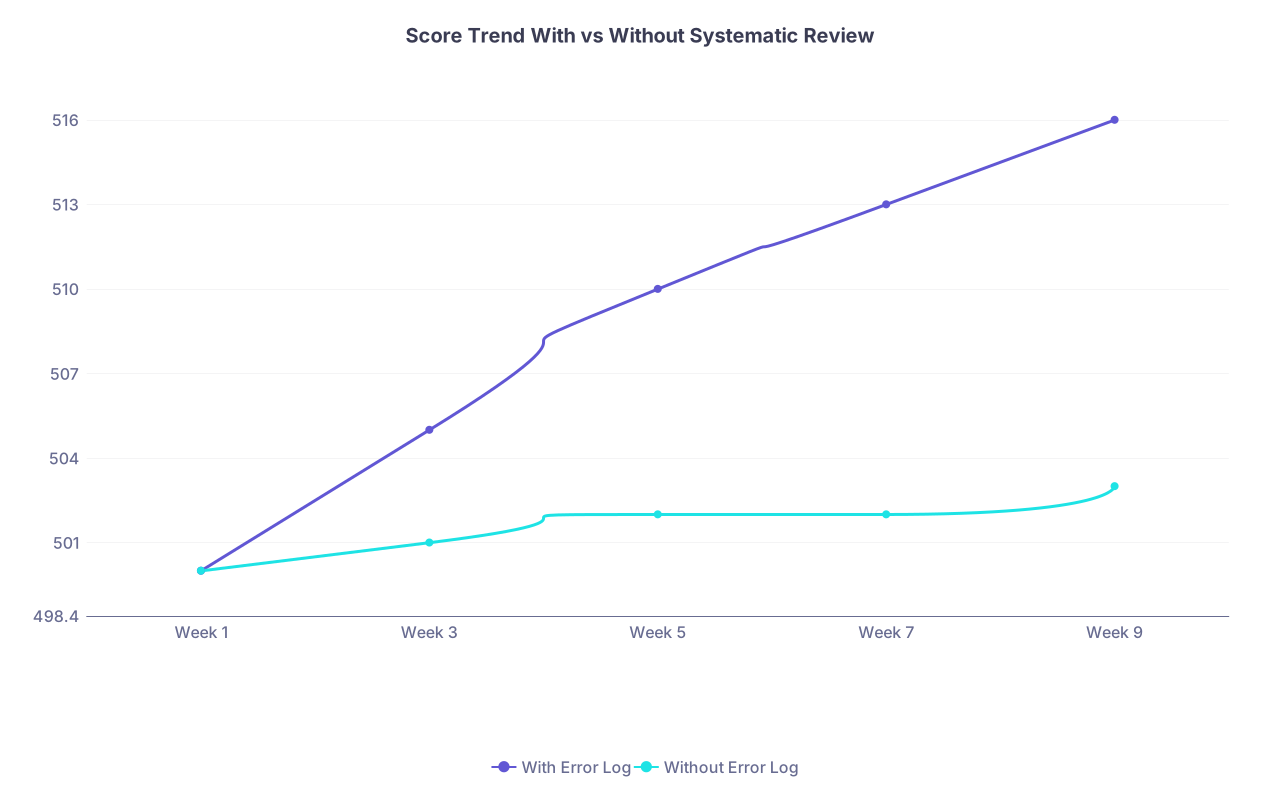
| Category | With Error Log | Without Error Log |
|---|---|---|
| Week 1 | 500 | 500 |
| Week 3 | 505 | 501 |
| Week 5 | 510 | 502 |
| Week 7 | 513 | 502 |
| Week 9 | 516 | 503 |
If your prep feels like “just studying a lot” rather than “testing, adjusting, and targeting,” you’re making this mistake.
Pitfall #10: Mismanaging Time Blocks – Marathon Study, Miserable Retention
You sit for 6-hour “study days,” brag about it, and then can’t recall half of what you covered two days later.
This is not grit. It’s bad design.
The mistake:
Overvaluing study duration and undervaluing study quality and structure.
Symptoms:
- 3–4 hour unbroken content sessions
- No real breaks, just doom scrolling for 15 minutes
- Constant fatigue and low focus by mid-afternoon
- You “cover” a lot, retain little
Your brain has limits. You can either respect them or pretend you’re special and then wonder why your test score doesn’t match your effort.
Better approach:
- Shorter, focused blocks (45–75 minutes)
- Clear objectives for each block
- Built-in review time instead of endless new content
- Dedicated passage time every day
If your content review looks like a sludge of reading all day, you’re not prepping for an 7.5-hour exam. You’re just rehearsing being tired.
Pitfall #11: Acting Like CARS Is Separate From “Content”
Huge red flag:
“I’m going to focus on science content first, then I’ll layer in CARS.”
That’s how you end up at 128/129 sciences and 123 CARS. And adcoms notice that pattern.
The mistake:
Treating CARS like an optional side quest rather than 1/4 of your score and the section that most directly reflects how you’ll handle complex information as a physician.
CARS is content review. Just a different kind: argument structure, inference, tone. If your study plan doesn’t include near-daily CARS passages from the very beginning, you are signing up for pain later.

| Step | Description |
|---|---|
| Step 1 | Weeks 1-2 |
| Step 2 | Daily: Light content + 2-3 CARS passages |
| Step 3 | Weeks 3-6: Heavier practice + full CARS session days |
| Step 4 | Weeks 7-10: Full lengths + targeted CARS review |
If your “content review phase” has zero CARS, that phase is fundamentally broken.
How to Fix Your Content Review Starting Now
Let me pull this together into something brutally practical. If you recognize yourself in multiple pits above, here’s the safer path.
For each study day, you should have:
Content in short, targeted bursts
Not “Chapter 1–3 today,” but “Today: fluid equations + 6 cardiology passages.”Questions every single day
Even early on: 20–40 mixed questions, minimum three days a week, plus CARS.Real review, not just reading explanations
Error log. Categories for why you missed. Concrete adjustments.Weekly reality checks
At least one timed block or half-length test and a block of time to actually dissect it.
If you’re not willing to do those, be honest with yourself: you’re choosing comfort over progress. And the MCAT will expose that.
FAQ (Exactly 4 Questions)
1. Should I finish all content review before taking my first full-length exam?
No. Waiting until “all content is done” is a slow-motion disaster. You should take an early diagnostic or full-length within the first 1–2 weeks of focused prep. It will feel ugly. That’s fine. The point is to see your baseline, understand how the exam actually looks, and guide your content review. Hiding from full-lengths until you “feel ready” is how people end up shocked a month before their test date.
2. How many hours per day should I spend on pure content reading?
Less than you think. For most students, 2–3 focused hours of content review mixed into a 5–7 hour study day is plenty. If you’re doing 5–6 hours of straight reading and videos, you’re over-investing in passive work. More of your time should be in questions, passage practice, and review. Volume of reading doesn’t correlate well with score; smart allocation of effort does.
3. Do I really need to keep an error log? Isn’t reviewing explanations enough?
Reading explanations without tracking patterns is the lazy version of review. You’ll “agree” with explanations and then repeat the same mistakes. An error log forces you to confront why you’re missing questions and see trends over time. It doesn’t need to be fancy—simple spreadsheet or notebook. But if you skip it, you’re throwing away one of the few high-leverage tools you have.
4. How do I know if a topic is low-yield and not worth deep diving?
Two checks: AAMC emphasis and repetition in quality practice materials. If something barely appears in AAMC content outlines, practice questions, or official full-lengths, it’s probably not worth hours of memorization. On the flip side, if you keep seeing certain concepts (fluids, enzyme kinetics, research design, major psych theories), those are high-yield. Your time should be biased heavily toward topics that show up again and again in AAMC-style material—not whatever your textbook happens to spend 20 pages on.
Open your study schedule for the next 7 days and circle every block that’s just “content review” with no questions attached. For each one, add a concrete practice component—specific question sets, passages, or a timed block. Do that right now, before you forget, and you’ll stop one of the biggest MCAT prep mistakes before it drains another week of your time.