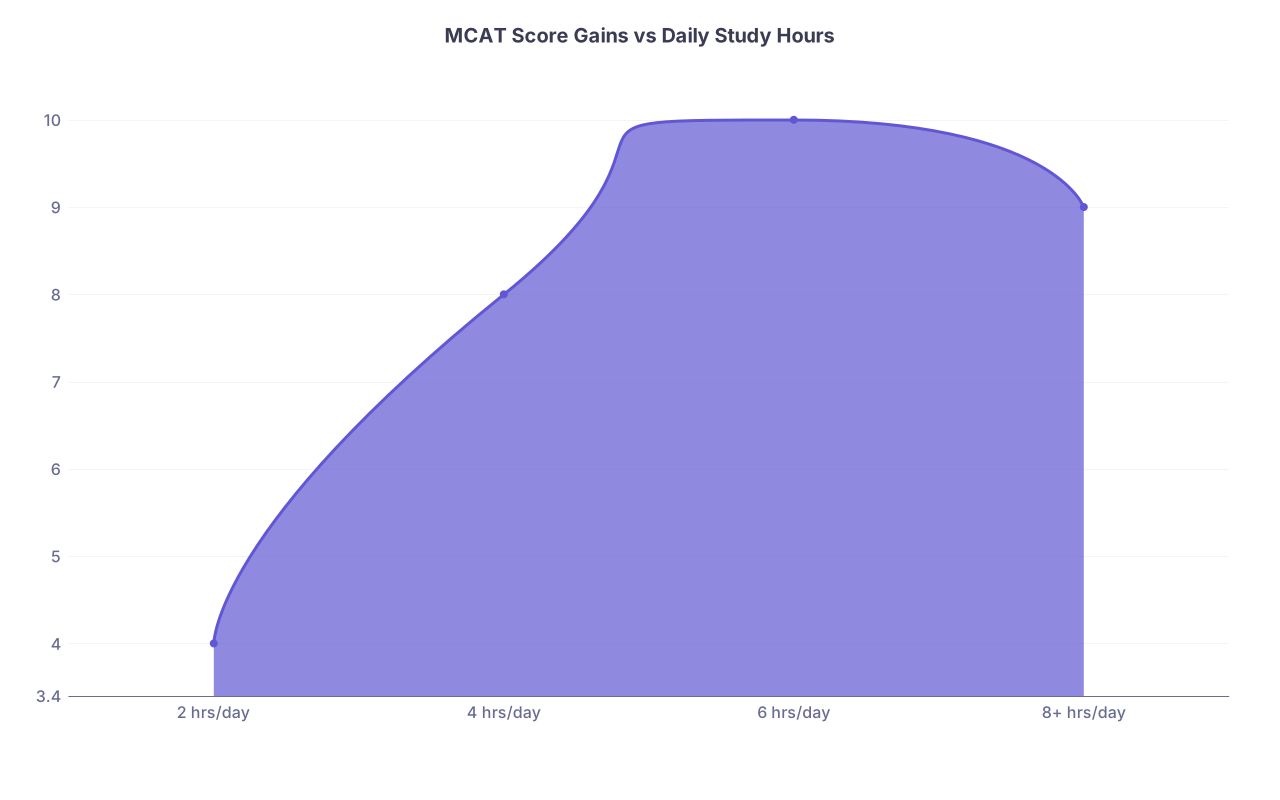
If You Must Take the MCAT Before Finishing Prereqs: Strategy Guide
You’re staring at the calendar thinking: “I need to apply this cycle, but I have not taken orgo II / physics II / biochem yet. Can I take the MCAT anyway without tanking my chances?”
You are not the first person stuck in this corner. I’ve seen plenty of students forced into it by bad advising, late career changes, financial constraints, or rigid post‑bac schedules. Some make it work. Some blow up their application year.
Let’s make sure you’re in the first group.
1. First: Are You Actually Forced Into This, Or Just Rushed?
Be honest with yourself. There’s a difference between “I would like to apply this year” and “I must apply this year.”
Here are the only situations where I think taking the MCAT before finishing prereqs is a reasonable consideration:
- You’re a traditional junior trying to apply straight through, but your school sequences a key prereq late (e.g., biochem only Spring junior year, MCAT in May).
- You’re on a visa / military timeline / scholarship requirement that makes delay costly or impossible.
- You’re in a structured post‑bac or SMP with a rigid timeline tied to this upcoming cycle.
- You’re a non‑traditional student whose life situation (family, job contract, location) really cannot accommodate another year’s delay.
If none of these are true, and the real reason is:
- “I don’t want to be older”
- “All my friends are applying this year”
- “My parents are pressuring me”
- “I just want to get it over with”
Then my honest opinion: forcing an early MCAT is a bad plan. You’re risking a low score and possibly a retake that follows you around, just to save 12 months.
But let’s say you’ve thought this through and the answer is: No, I truly do need to take it before I finish prereqs.
Fine. Then you move from “Is this smart?” to “How do I do this without wrecking myself?”
2. Step Zero: Map Exactly What Content You’re Missing
Do not start “studying harder” yet. You need a surgical map of the gap between where your coursework ends and where the MCAT expects you to be.
Pull up the AAMC MCAT Content Outline. Now, list:
- Courses completed
- Courses in progress
- Courses not yet taken that still feed into the MCAT
Typical pain points:
- Haven’t taken: Biochemistry, Organic II, or Physics II
- Took them years ago and barely remember anything
- Took them at a “lite” level (e.g., health sciences chem instead of premed chem)
Now, connect prereqs to MCAT sections. Use this as a rough truth table:
| MCAT Section | Heavy Course Foundations |
|---|---|
| Chem/Phys | Gen Chem I–II, Physics I–II, Orgo I |
| CARS | No prereqs (reading/analysis skill) |
| Bio/Biochem | Bio I–II, Biochem, some Orgo |
| Psych/Soc | Intro Psych, Intro Sociology (helpful) |
Next, highlight what’s missing for you.
Example:
- You’ve taken Gen Chem I–II, Bio I–II, Orgo I, Physics I, Psych
- You have NOT taken Physics II or Biochem (very common scenario)
That means:
- Chem/Phys: Electricity & magnetism, some waves/optics are missing
- Bio/Biochem: Most of the biochem half is DIY
Knowing exactly what’s missing is the only way to build a sane plan.
3. Decide Your Target Test Date Around Your Missing Courses
You don’t just pick a random date 3–4 months away. Your missing prereqs dictate your strategy.
Use this simple rule:
- If a prereq is in progress before your MCAT:
Plan your test for shortly after the core topics you need will be covered. - If a prereq won’t be taken before the test:
You must fully self‑teach those topics from MCAT‑level materials, not a full semester textbook.
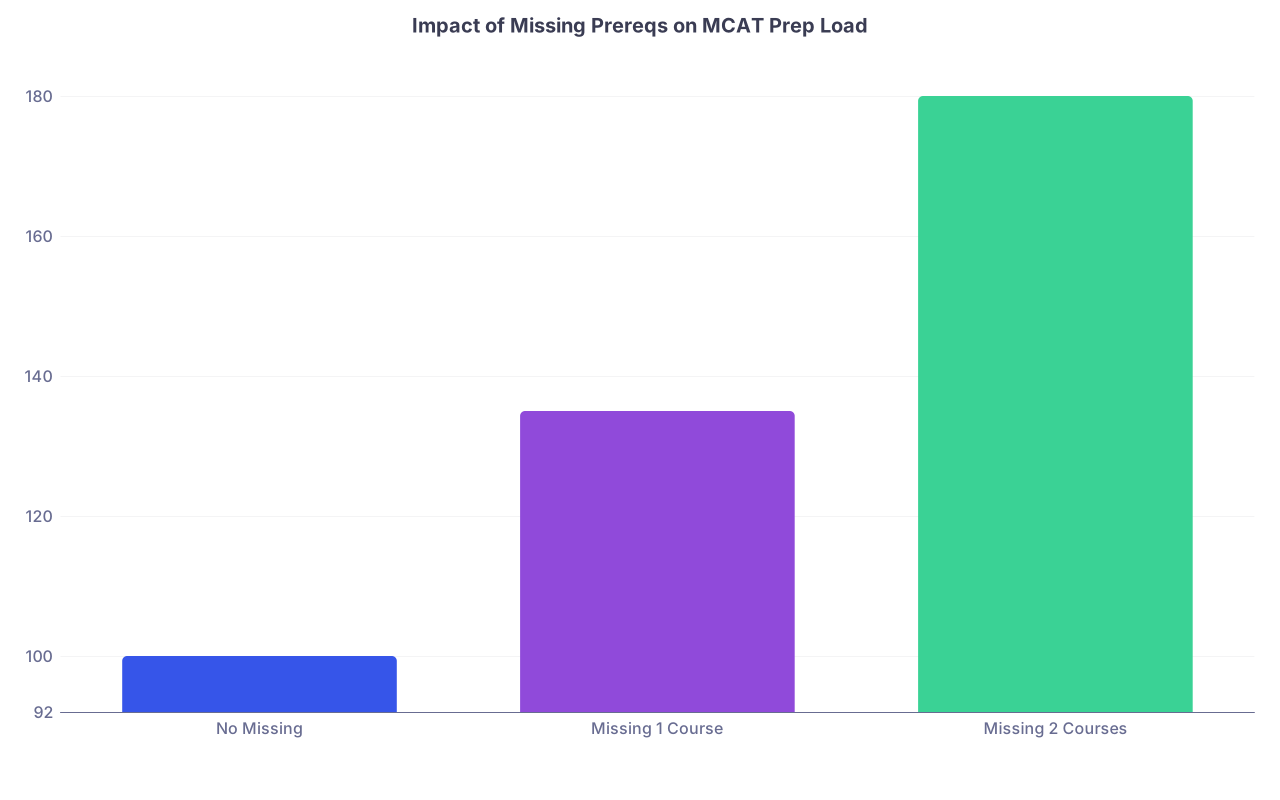
Here’s how the trade-offs usually look:
| Category | Value |
|---|---|
| No Missing | 100 |
| Missing 1 Course | 135 |
| Missing 2 Courses | 180 |
(Think of “prep load” as hours; adding missing courses easily stacks on 35–80 hours of extra work.)
Examples:
Biochem in Spring, MCAT in May/June:
You can parallel‑learn biochem with class and solidify with MCAT resources. Doable.Physics II not taken at all, MCAT in June:
You will need to self‑teach all E&M and some waves/optics from MCAT‑specific sources. Doable but heavier.Missing both Biochem and Physics II and planning March MCAT:
This is where I start telling people: either delay, or lower your expectations for your first attempt.
4. How To Self‑Teach Missing Prereqs Efficiently (Without Taking a Whole Course)
Here’s where students go wrong: They try to recreate an entire semester of university physics or biochem. You don’t have time for that, and the MCAT doesn’t need it.
Your approach needs to be MCAT‑first, not “course‑first”.
A. Use MCAT‑Targeted Resources, Not Full Textbooks
For missing content, your core toolkit should be:
- A comprehensive MCAT content review series (Kaplan, Princeton Review, Blueprint, etc.)
- Videos specifically tailored to the MCAT (Khan Academy legacy videos, Jack Westin, etc.)
- Question banks that are MCAT‑style, not random textbook problems
For biochem, something like Kaplan Biochem or Sketchy Biochem (if you’re visual) can compress what you need.
For physics II topics (E&M, circuits, waves):
- Use MCAT books for conceptual framework + basic math
- Supplement with targeted YouTube playlists (e.g., “MCAT circuits problems” not “university physics 2 full course”)
B. Reverse the Usual Order: Start From Questions
You’re not in a real class. So don’t study like you are.
Instead:
- Start with 5–10 topic‑specific MCAT‑style questions cold.
- See exactly what concepts / formulas you needed and didn’t have.
- Then go to the content review and videos to fill those gaps.
- Return to more questions to verify you can now handle that category.
This keeps you laser‑focused on test‑relevant material and prevents the “I spent 3 days on derivations I never used” trap.
C. Build a “Missing Topics” Tracking Sheet
You should have a living list of topics you’d normally get in class but must self‑teach.
Example for missing biochem:
- Amino acids: properties & structures
- Protein structure & folding
- Enzymes: kinetics, inhibition, Michaelis–Menten
- Metabolism: glycolysis, TCA, ETC, gluconeogenesis
- Lipid metabolism basics
- DNA replication / transcription / translation (at biochem depth)
You prioritize in this order:
- High-yield + frequent on MCAT (amino acids, enzymes, basic metabolism)
- Medium-yield (membrane transport, signal transduction basics)
- Low-yield details (esoteric pathways) get skimmed, not mastered.
Same idea for physics II: circuits, capacitors, E&M, waves.
If it’s not on your sheet, you probably forget to learn it. And the MCAT will find that hole.
5. Adjust Your Study Structure: You’re Not a Normal MCAT Taker
A standard 3‑month MCAT schedule won’t fit you. You’re doing content review plus teaching yourself missing courses.
You need to bake that reality into your plan.
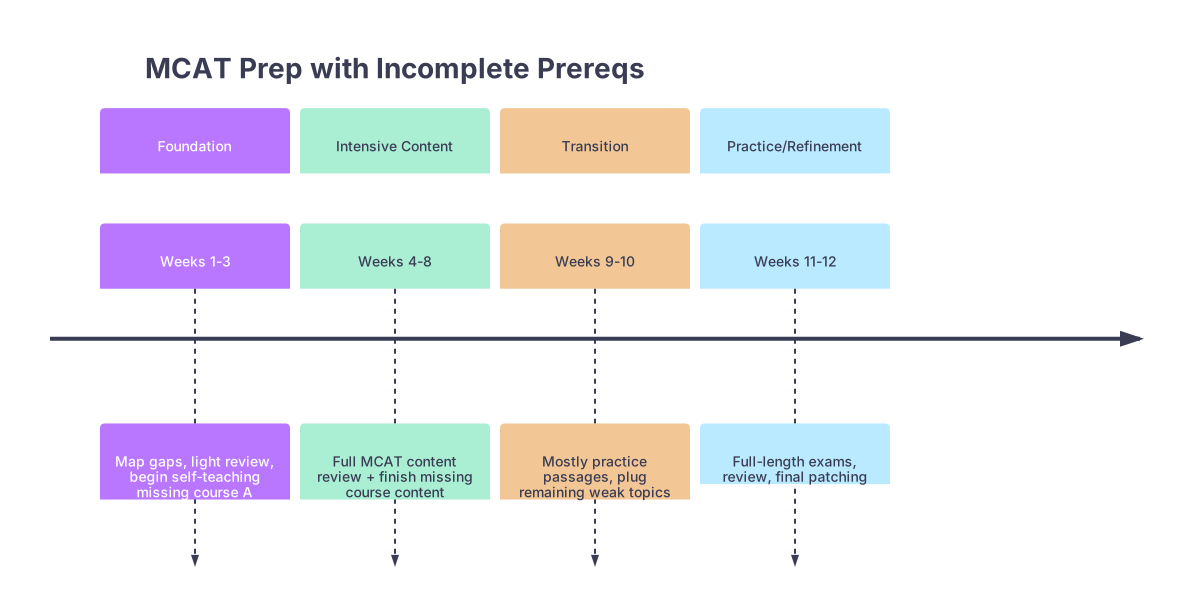
Think of your prep phases like this:
| Period | Event |
|---|---|
| Foundation - Weeks 1-3 | Map gaps, light review, begin self-teaching missing course A |
| Intensive Content - Weeks 4-8 | Full MCAT content review + finish missing course content |
| Transition - Weeks 9-10 | Mostly practice passages, plug remaining weak topics |
| Practice/Refinement - Weeks 11-12 | Full-length exams, review, final patching |
Key differences vs a “normal” student:
- Your Foundation phase is more important. You’re shoring up missing structures while others are just refreshing.
- You must block out protected hours specifically labeled “Biochem DIY” or “Physics II DIY,” not just “MCAT review”.
- You probably need slightly more total time (or more weekly hours) than a student with all prereqs complete.
6. Section‑by‑Section Strategy When You’re Missing Prereqs
Let’s be specific. This is where people really need a playbook.
Chem/Phys (Missing Physics II / Some Orgo)
Your goal is not to become a physics major. It’s to become dangerous enough on test day.
Focus on:
- Core E&M:
- Coulomb’s law
- Electric fields and potential
- Circuits: Ohm’s law, series vs parallel, power
- Waves & optics:
- Basic wave relationships
- Mirrors vs lenses: sign conventions, focal length
How to study:
- 1–2 weeks of targeted E&M and circuits content, alternating:
- 30–45 min content → 45–60 min passages
- When you learn a formula, immediately:
- Write what each symbol means physically
- Do at least 3 questions that use it in different ways
For missing Orgo II details:
- Focus on the MCAT‑relevant parts: carbonyl chemistry, carboxylic acids, amides, esters, lab techniques (NMR, IR, extraction, chromatography).
- Ignore deep synthesis and intricate mechanism memorization. The MCAT cares more about reasoning with functional groups than drawing arrows.
Bio/Biochem (Missing Biochem)
This one hurts more if it’s missing, because biochem is everywhere in the passages.
Core non‑negotiables:
- Amino acids: structures, one‑letter codes (at least for high-yield ones), properties
- Enzymes: Km, Vmax, inhibition types, basic graphs
- Metabolism: big‑picture flow (where things start and end, what uses ATP/NADH)
- Central dogma at biochemical depth: replication, transcription, translation, key enzymes
Practical advice:
- Spend an early 10–14 days doing an “Amino Acids & Enzymes Bootcamp”:
- Daily active recall on amino acid properties
- Drawing enzyme kinetics curves from memory
- Practice questions until basic Michaelis–Menten feels boring
If you miss this foundation, every biochem passage will feel like a foreign language.
CARS (Good news: no prereqs)
If you’re behind on science content, do not neglect CARS thinking “I’ll catch up later.” CARS doesn’t require coursework, which means it’s your easiest section to fix right now.
- 1–2 passages per day at first, ramp to 3–4 on off days from heavy science
- Intense review of why each wrong answer is wrong
- No content memorization excuse here; this is pure skill building.
Psych/Soc (Missing formal courses)
Intro psych/soc courses help but are not required.
Your plan:
- One good MCAT psych/soc book or deck (e.g., Anki decks like Milesdown)
- Daily 20–40 cards of terminology
- MCAT‑style passages weekly to see those terms in context
The psych/soc content is finite and heavily definitional. Very learnable even without classes.
7. How To Test Reality: Are You Actually Ready Without the Prereqs?
You cannot trust vibes here. You need data.
I use three checkpoints.
Checkpoint 1: End of Foundation Phase
By the end of your first 3–4 weeks:
- You should have at least seen all major topics once, including the DIY course material.
- You take a diagnostic full‑length (AAMC or a reputable third-party).
You are not looking for a pretty score. You’re asking:
- Are there entire passages where I have no idea what is happening because of missing content?
- Or can I at least reason through with partial understanding?
If your score is under ~495 and you’re completely blind on whole topic categories, that’s a warning sign.
Checkpoint 2: 6–8 Weeks Before Test
By now:
- All DIY prereq material should be taught, not perfected.
- You’re doing consistent timed sections and one full‑length every 1–2 weeks.
At this point, I like to see:
- Practice scores clustering at least 3–5 points below your target, trending upward
- No major content black holes remaining (e.g., “I still haven’t looked at circuits at all”)
If you’re still discovering giant “I’ve literally never seen this before” topics from your missing courses, that’s bad.
Checkpoint 3: 2–3 Weeks Before Test
Non‑negotiable reality check: AAMC full‑lengths.
- Take at least 2 (ideally 3–4) under test‑day conditions.
- Average them.
If your AAMC average is:
- 3+ points above your minimum acceptable score: You’re probably fine.
- 1–2 points below your acceptable floor: You’re in “very risky” territory; consider pushing the date if possible.
- 5+ points below what you need: I’d tell you to postpone unless there is a truly immovable deadline.
8. When an Early, Imperfect MCAT Is Actually Acceptable
Sometimes, a slightly sub‑optimal first MCAT is a trade‑off that makes sense.
For example:
- You’re a 3.9 GPA, great activities, applying mostly to mid‑tier and state schools.
- You’re missing biochem, but self‑teach reasonably well.
- You’re testing at 509–512, wanted 515+, but your life situation really cannot absorb a delay.
A 509–512 is not a tragedy. You might not hit T20 dreams, but you can still have a solid application cycle.
Where people get in trouble:
- They’re starting with weaker stats (e.g., GPA 3.3–3.4)
- They’re banking on a very high MCAT (515+) to balance it
- They compress MCAT before finishing prereqs and end up at 501–505, then need a retake
One retake is survivable. A pattern of reckless testing is not.
9. Common Dumb Moves In This Situation (Avoid These)
I’ve watched people sabotage themselves doing exactly what you’re about to attempt. Here’s what they do wrong:
“I’ll learn biochem from my class and not study it for MCAT.”
No. Undergrad courses and MCAT emphasis do not match perfectly. You will leave holes.“I’ll just memorize formulas for the physics I never took.”
That works for 2 questions, then the passage asks conceptual reasoning you’ve never seen.“I’ll fix CARS in the last month once content is done.”
CARS is skill, not content. Skills need time.“I’ll take it ‘just to see’ and retake next year if needed.”
That score is permanent on your record. Some schools average. Some heavily weight first attempts.
If you’re going to do this, do it with intent, not as a live‑fire practice test.
10. How To Talk About Missing Prereqs, If It Comes Up
Occasionally, this will come up in secondaries or interviews, especially if your MCAT is unbalanced (e.g., lower Chem/Phys or Bio/Biochem).
You do NOT say: “Yeah, I hadn’t taken those classes yet.”
You frame it like this:
- You had a clear timeline constraint (explain briefly).
- You recognized gaps and built a deliberate independent‑study plan.
- You used MCAT‑specific resources and demonstrated you could self‑direct your learning.
- Your later performance in those actual courses (if strong) backs this up.
Admissions likes evidence that you can recognize a problem, build a plan, and execute it. “I winged it” is not that.
11. Quick Reality Table: Are You In a Reasonable Position To Do This?
Be honest as you look at this:
| Scenario | Risk Level | My Verdict |
|---|---|---|
| Missing 0 prereqs, 3+ months study | Low | Go ahead |
| Missing 1 prereq, strong GPA, 4 months | Moderate | Reasonable with good plan |
| Missing 2 prereqs, 3 months rush study | High | Only if timeline is rigid |
| Missing 2+ prereqs, [weak GPA](https://residencyadvisor.com/resources/mcat-prep/low-science-gpa-mcat-pending-a-targeted-score-boost-strategy), first MCAT | Very High | Strongly consider delaying |
If you’re in the bottom right box and still charging ahead for vague reasons like “I don’t want to lose a year,” you’re gambling with a pretty expensive exam and your application narrative.
FAQ (Exactly 3 Questions)
1. Is it better to rush the MCAT before finishing prereqs or delay my application a year?
If you’re aiming for competitive schools or you need a strong MCAT to offset a mediocre GPA, I’d almost always choose delaying the application over rushing the exam. A single strong MCAT taken with full prereqs and solid prep beats an early mediocre MCAT plus a panicked retake. The only time I’d argue for rushing is when your life logistics or program structure truly make a delay impractical.
2. Can I still score 515+ if I haven’t taken biochem or physics II?
Yes, but it’s significantly harder and demands ruthless planning. You’d need: strong foundations in the other sciences, disciplined self‑teaching of the missing subjects using MCAT‑specific materials, and consistently high practice test performance (AAMC full‑lengths at or near 515+ before test day). If you’re not naturally strong in the sciences or you’re struggling to hit high 500s on practice tests, betting on 515+ without prereqs is unrealistic.
3. How many months should I plan for MCAT prep if I’m missing a prereq?
If a standard student with full prereqs might need 3 months of focused prep, someone missing a major prereq should think more like 4–5 months, or plan on significantly more hours per week if they must compress. The extra time isn’t just more “review”—it’s to build an entire course’s worth of understanding at the MCAT level and then stress‑test it with practice passages and full‑lengths.
Open your calendar right now and block out the next 16 weeks: mark your potential test date, then backward‑plan explicit “DIY Biochem” or “Physics II for MCAT” blocks alongside your regular review. If those weeks look impossibly packed or unrealistic on paper, your answer about whether to rush this exam just revealed itself.