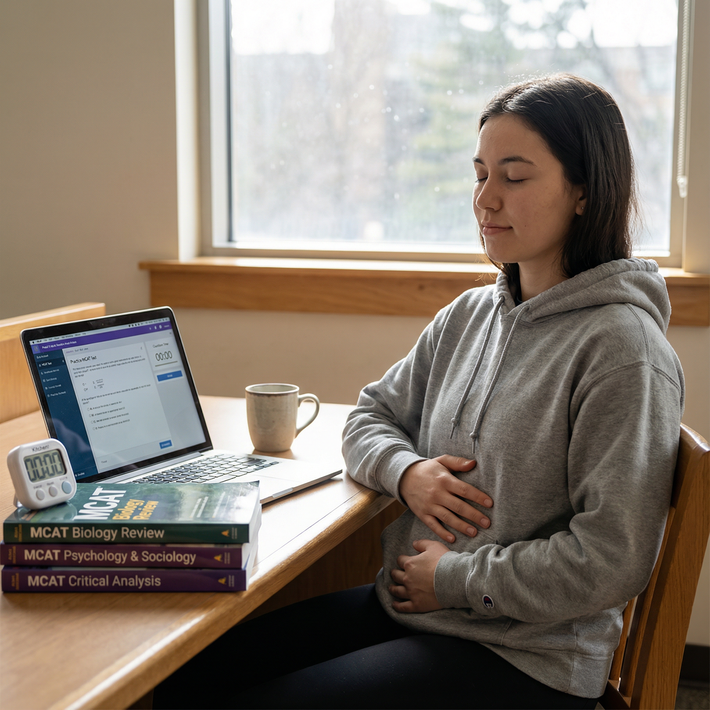
The usual MCAT advice is built for 20-year-olds with biochem degrees. That’s not you.
You’re a teacher, accountant, engineer, social worker, barista, project manager—now staring at something called “electrophilic aromatic substitution” wondering if you’ve made a terrible mistake. You have no science background, a full-time life, and an exam that assumes you’ve basically lived in a lab and a psych lecture hall for four years.
You’re not doomed. But you do need a different plan than the standard premed advice.
This is how to handle the MCAT as a career-changer with little or no science background—without burning out, quitting your job prematurely, or wasting a year on the wrong prep strategy.
Step 1: Get brutally honest about your starting point
Most career-changers skip this and then drown six months later.
You need to answer three questions right now:
- What science have you actually completed?
- What time do you control each week?
- When do you realistically want to apply?
1. Your academic baseline
If your “science” is high school chemistry from 10+ years ago, treat that as zero. Harsh but accurate.
Here’s a simple rule of thumb:
| Background | MCAT Timeline Needed |
|---|---|
| No college science | 18–24 months |
| 1–2 intro science courses | 12–18 months |
| Full prereqs but >5 years old | 9–15 months |
| Recent full prereqs | 6–12 months |
If you haven’t done at least:
- 2 semesters of general chemistry
- 2 semesters of biology
- 1 semester of physics
- 1 semester of psychology or sociology
…you’re not “just an MCAT away.” You’re in a post-bacc + MCAT situation. Whether formal or DIY, you must build the foundation first.
2. Time and life reality
Look at your real week. Not your fantasy week.
- Full-time job with kids? You’ll be in the 18–24 month lane.
- Full-time job, no kids, weekends mostly free? Maybe 12–18 months.
- Part-time or flexible work? You can compress some of this.
Do not plan an “8 hours every Saturday and Sunday” grind if your spouse, kids, or basic sanity won’t survive that. A tired, resentful version of you will not learn physics.
3. Application year vs. MCAT date
Work backward:
- You want to apply in May/June of a given year
- Your MCAT should be done by March/April of that year (earlier is better)
- Your coursework and content foundation must be done at least 2–3 months before that, so you can do full test prep, not desperately learn biochem on the fly
If you’re sitting here in January with no science and a plan to “apply this June,” that’s fantasy. Push the application year. You’ll save yourself heartache and money.
Step 2: Decide your path: post-bacc vs. DIY + MCAT timeline
If you lack the science background, you have two main routes.
Option A: Formal post-bacc (structured)
This is good if:
- You want a classroom, grades, and advising
- You may need to prove academic ability (old GPA, different major)
- You’re anxious about teaching yourself physics from YouTube at 11 PM
You’ll usually take:
- Gen Chem I & II
- Intro Bio I & II
- Physics I (sometimes II)
- Organic Chem I (sometimes II)
- Biochem (ideal, even if not required)
- Intro Psych/Soc
You can plan the MCAT for the semester right after you finish biochem/physics II, or shortly after the program ends.
Option B: DIY science + MCAT (flexible, cheaper, more self-driven)
You piece together:
- Community college or online-approved courses
- Self-study resources for some topics
- A longer, more flexible timeline
This demands discipline but can work very well, especially if you keep working full-time.
Either way, you’re looking at two overlapping tracks:
- Build the science base
- Then do dedicated MCAT prep
Trying to do both fully at the same time, from scratch, is how people burn out and score a 498 after 12 miserable months.
Step 3: A realistic 18–24 month roadmap for true beginners
Let’s say you’re starting almost from zero, working full-time, mid-30s, haven’t seen a lab since high school.
Here’s a version that doesn’t wreck your life.

| Period | Event |
|---|---|
| Months 1-6 - Gen Chem I | Science Foundation |
| Months 1-6 - Intro Bio I | Science Foundation |
| Months 1-6 - Light Psych/Soc reading | Early Exposure |
| Months 7-12 - Gen Chem II | Science Foundation |
| Months 7-12 - Intro Bio II | Science Foundation |
| Months 7-12 - Physics I | Science Foundation |
| Months 7-12 - Regular CARS practice | MCAT Skill Building |
| Months 13-18 - Organic I or Biochem | Advanced Content |
| Months 13-18 - Dedicated Psych/Soc study | MCAT Content |
| Months 13-18 - Begin MCAT-style practice questions | Transition Phase |
| Months 19-24 - 3-4 month dedicated MCAT prep | Full Prep |
| Months 19-24 - 6-8 full-length exams | Test Readiness |
| Months 19-24 - Apply in next cycle | Application |
Could you speed this up? Maybe. But if you’re balancing work, family, and this exam, this rhythm is sustainable.
During the first 12 months, your “MCAT work” is:
- Learning how CARS works (1–3 passages a day, 3–5x/week)
- Getting comfortable reading dense scientific writing
- Slowly building a habit of regular study
During Months 13–18, you gradually introduce:
- An MCAT content set (Kaplan, Blueprint, Princeton, etc.)
- Section-bank style questions for topics you’ve already learned
- Timed practice on single passages
Months 19–24 are when you treat the MCAT like a job: full-length exams, review, targeted drilling.
Step 4: Choosing MCAT resources when you don’t have the background
You don’t need to buy every book on Reddit. You do need a small, coherent set of tools.
Think of it in layers:
- Foundation learning (courses, Khan Academy, textbooks)
- MCAT-specific content (condensed review)
- Practice questions and full-lengths (how you actually improve)
Foundation layer
You need something that:
- Explains general chemistry, biology, physics, and biochem from the ground up
- Has practice problems at the basic level, not just MCAT passage-style at first
This might be:
- Your post-bacc or community college courses
- Khan Academy for content reinforcement
- A standard textbook your course uses
If a chapter feels impossible, that’s not the MCAT’s fault; it’s your base. Slow down here.
MCAT-specific content
These are your “big picture” guides once you have some basics.
Pick one major set. For example:
| Resource Set | Strength |
|---|---|
| Kaplan Books | Broad, balanced, good for beginners |
| Blueprint Books | MCAT-focused, strong explanations |
| Princeton Review | Detailed, slightly heavier reading |
| Khan Academy (free) | Great supplemental psych/soc and bio |
Don’t buy Kaplan and TPR and Berkeley Review. You’ll just use 30% of all of them and understand 0% better.
Practice questions and full-lengths
This is non-negotiable: AAMC materials are sacred. Your budget must include:
- AAMC Question Packs (CARS, sciences)
- AAMC Section Bank (brutal but gold)
- AAMC full-length exams (at least 4)
On top of that, a third-party QBank helps you build volume:
- UWorld MCAT is excellent for explanation quality
- Kaplan and Blueprint are also solid
You’re aiming for a mix: easy/medium questions early, then increasingly AAMC-style as you approach test day.
Step 5: Sample weekly schedules for working career-changers
Let’s be concrete. This is where most people fail: not enough structured hours.
Scenario A: Full-time job, no kids, 18–24 month path (foundation + MCAT)
Phase 1 (course-heavy months):
- Mon–Thu:
- 1.0–1.5 hours after work: course lectures, problem sets
- Sat:
- 3–4 hours: review week’s material, extra practice, 1–2 CARS passages
- Sun: Day off or light review (30–60 min)
Total: ~8–10 hrs/week. That’s enough to solidly learn coursework.
Phase 2 (MCAT-focused months, last 4–6 months):
- Mon–Thu:
- 1.5–2 hours: content review + 20–30 practice questions
- Sat:
- Full-length exam (once you start these) or 4–5 hour mixed block
- Sun:
- 3–4 hours: review full-length or targeted weaknesses
Total: 15–20 hrs/week. This is where you squeeze. Fewer social events. Less Netflix. Temporary.
Scenario B: Full-time job + kids, 24+ month path
You’ll probably run a lower weekly volume but for longer:
- Mon, Wed, Fri:
- 1 hour after kids’ bedtime: reading + light practice
- Sat:
- 3 hours: focused work, practice sets, CARS
- Sun: optional 1–2 hours if family bandwidth allows
Total: ~6–8 hrs/week early, then maybe 10–12 in the final MCAT push.
If that sounds impossible, adjust your timeline. Don’t expect a 515 with 4 hours/week and chaos at home.
Step 6: How to study each MCAT section as a non-science person
You’re not just “learning content.” You’re learning how the MCAT thinks.
Chem/Phys (C/P)
This is where most non-science people panic. Calm down.
Approach:
- Learn formulas, but more importantly, units and what the variables mean
- Practice translating word problems into simple math steps
- Use visual aids—sketch circuits, free-body diagrams, energy graphs
Good habit: When you see a formula, write next to it: “What does this describe in real life?” If you can’t answer, you don’t understand it yet.
Bio/Biochem (B/B)
This section becomes very doable once your foundation is there.
Approach:
- Focus on pathways (glycolysis, Krebs, ETC) as stories, not just lists
- Constantly ask: where is this happening in the cell, and why?
- Practice reading figures and tables quickly
You’re aiming for pattern recognition: “This graph looks like an enzyme inhibition curve,” not memorizing 200 enzymes.
Psych/Soc (P/S)
This is your chance to make up ground.
Approach:
- Build a strong vocabulary bank (terms, definitions, one example)
- Use flashcards with context, not just bare words
- Do lots of discrete questions early—this section is heavily memorization + logic
This section is very friendly to career-changers from social sciences, teaching, business, etc.
CARS
The section everyone whines about; career-changers can actually excel here.
Approach:
- 1–3 passages a day, 4–6 days per week, for months
- Stop trying to “game” CARS with tricks; focus on genuinely understanding arguments
- After each passage, articulate in one sentence: “The author’s main point is ___ and they feel ___ about it.”
You’re training reading stamina. If you’re coming from law, humanities, or reading-heavy jobs, capitalize on this. A high CARS score is an asset as a nontraditional applicant.
Step 7: Milestones and score expectations
You’re not chasing perfection. You’re chasing “strong enough for your school list and narrative.”
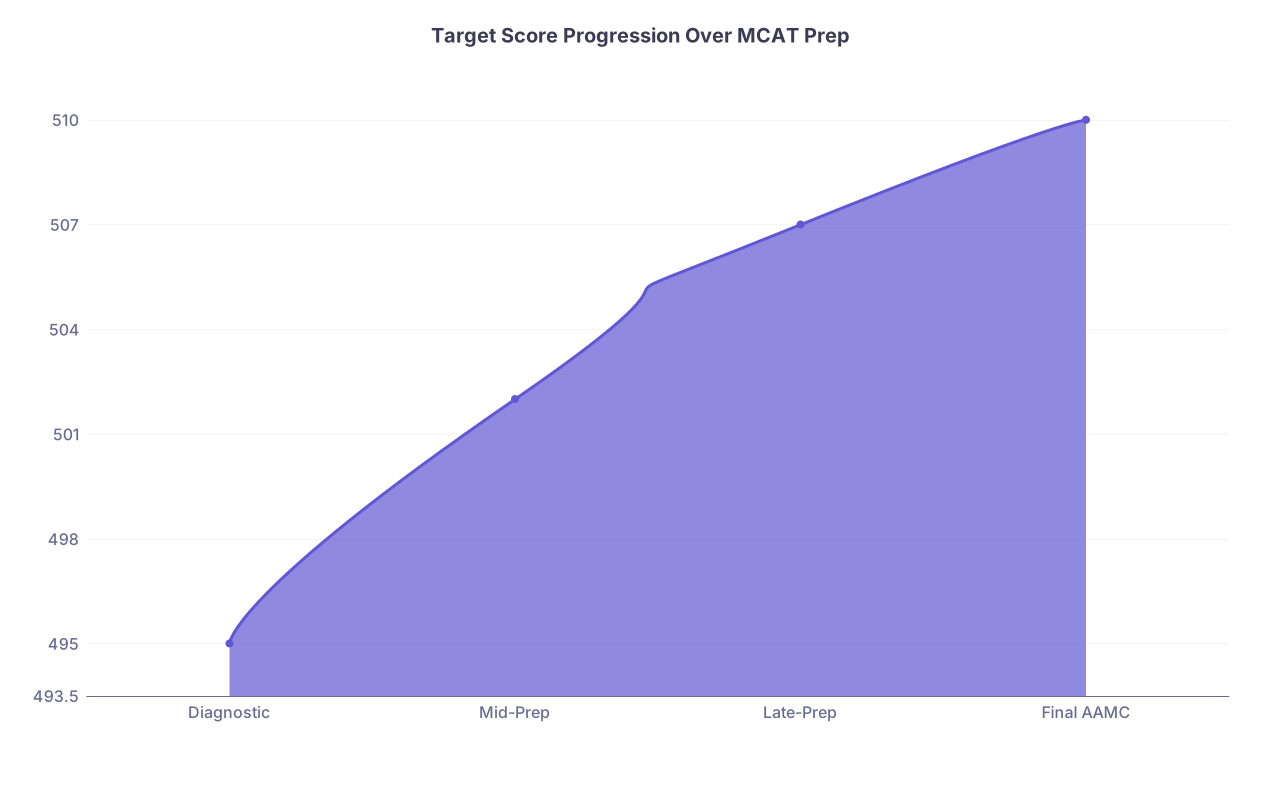
Here’s a rough progression for someone aiming for a 510+ over 18–24 months:
| Category | Value |
|---|---|
| Diagnostic | 495 |
| Mid-Prep | 502 |
| Late-Prep | 507 |
| Final AAMC | 510 |
Example milestone checkpoints:
- Early diagnostic (even if unofficial): 490–500 range is common if your science is weak. Don’t freak out.
- Midway through dedicated prep (2–3 months in): Low 500s.
- Final month before exam: Your AAMC full-lengths should cluster around or above your target.
If your AAMC exams are consistently 4–5 points below where you need to be, you’re not “saving it on test day.” You need either:
- More time (push the test)
- Or more focused, higher-quality studying (not just more hours)
Step 8: Managing burnout, doubt, and imposter syndrome
Career-changers are uniquely good at beating themselves up:
“I’m too old.”
“I’m not a ‘science person.’”
“I’ll never catch those 20-year-olds in orgo class.”
Most of that is noise. Here’s what actually matters.
Protect your energy
You cannot study 30 hours/week on top of a full-time job for a year. You will crash.
Use cycles:
- 3–4 heavy weeks
- 1 lighter week (lower volume, more review, catch up on life)
Plan actual off days. Not “I pretended to study while scrolling Reddit.” Real pauses. Your brain consolidates when you rest.
Talk to your people early
If you have a spouse, partner, or family relying on you, have the awkward conversation before you’re three months in and snappy:
“I’m going to be less available for X months. Here’s how I’m planning to protect family time. Here’s what I’ll need from you. Here’s what I’m willing to adjust if it isn’t working.”
That conversation saves relationships.
Reframe your identity
You’re not “a non-science person.” You’re someone who has solved hard things before, just in other domains:
- Managed teams
- Taught kids who did not want to learn
- Ran projects with moving parts and deadlines
Those skills transfer. Discipline, scheduling, communication, pattern recognition—these matter as much as raw memorization.
Step 9: When to postpone, retake, or walk away
Tough part. But this is Situation Handler, not cheerleading.
Postpone the test if:
- Your last 2 AAMC full-lengths are >3 points below your minimum acceptable score
- You’re still actively learning new major content areas in the final 3 weeks
- Your life just exploded (illness, family crisis, job disruption)
Pushing the date is not failure. Burning an attempt on a 496 because you were stubborn? That’s failure.
Consider a retake if:
- Your actual score is significantly below your AAMC average test scores, and you can identify clear, fixable issues (timing, test anxiety, running out of full-lengths too early)
- Your application strategy requires a higher score (e.g., 503 vs. 510+ for MD-heavy goals)
But do not jump into a retake for ego. If your 507 realistically supports a smart school list and strong narrative, don’t waste another year trying to chase a “5” in front.
Walk away for now if:
- Your mental health is tanking
- Your relationships and job are at serious risk
- You realize that the day-to-day of this path doesn’t match what you actually want
You can always come back. But forcing medicine at all costs is how people end up burned-out residents who hate their lives.
Quick comparison: traditional premed vs career-changer MCAT approach
| Aspect | Traditional Premed | Career-Changer |
|---|---|---|
| Science background | Recent, strong | Minimal or old |
| Timeline | 6–9 months | 18–24 months |
| Workload | Full-time student | Full-time job + life |
| Main risk | Procrastination | Burnout, over-commitment |
Your advantage as a career-changer? You already know how you work, when you crash, and what motivates you. Use that.
| Category | Value |
|---|---|
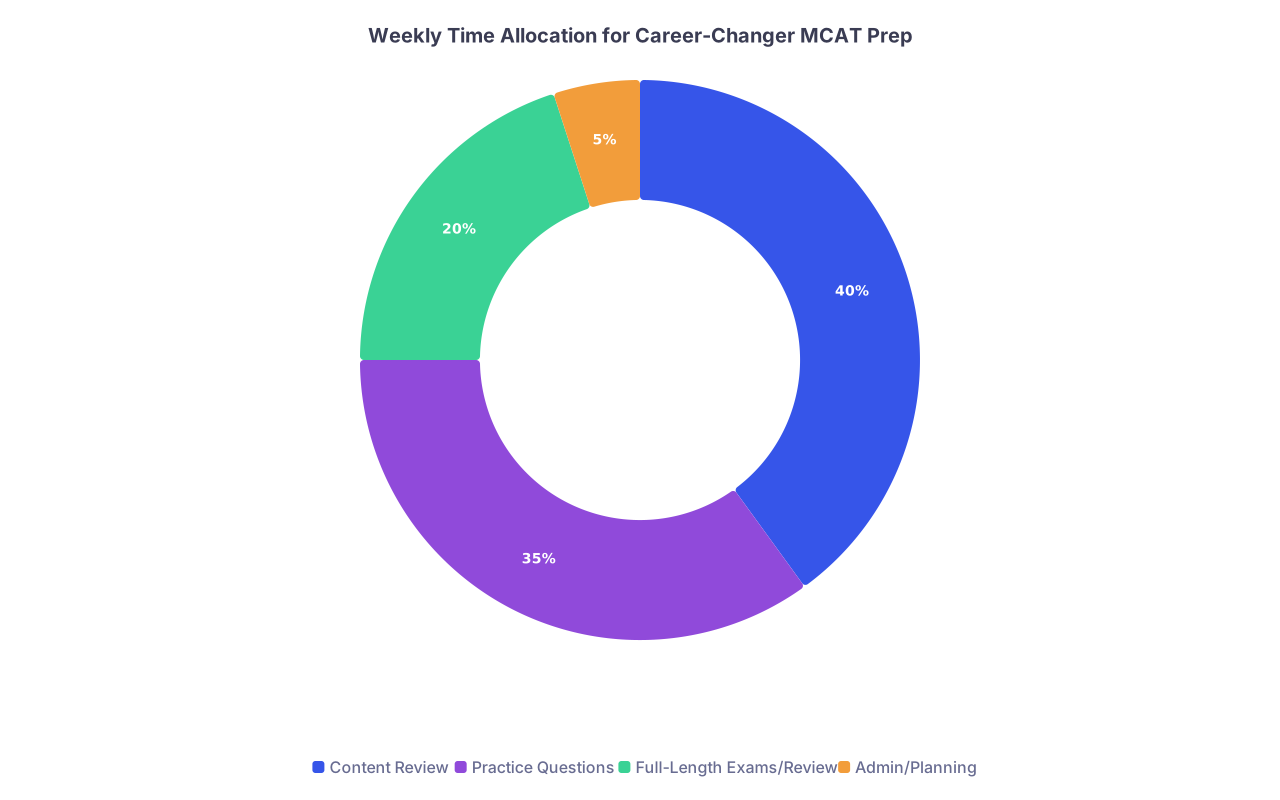
| Content Review | 40 |
| Practice Questions | 35 |
| Full-Length Exams/Review | 20 |
| Admin/Planning | 5 |
FAQs
1. Should I take a diagnostic MCAT if I have zero science background?
Yes, but treat it like an exposure, not a judgment. Do one untimed or lightly timed practice exam (even a third-party one) early on just to:
- See question formats
- Understand how passages feel
- Identify which sections are utter chaos vs. just “need work”
Don’t obsess over the number. You’re establishing a data point, not a destiny.
2. Is community college science good enough as a foundation?
For foundation purposes, yes, usually. Med schools care much more about your overall performance and MCAT score than whether gen chem was at a flagship university. I’ve seen many career-changers do:
- Community college for prereqs
- Strong MCAT scores afterward
- Acceptances at both MD and DO programs
If you can later take a higher-level course (like biochem) at a 4-year school, even better. But do not let “prestige anxiety” delay your entire timeline.
3. Can I self-study all the science instead of taking formal courses?
Technically, you can learn a lot on your own. But it’s a terrible idea to only self-study if you have no prior college science and want to apply to med school. Schools expect prerequisite coursework on a transcript. Use self-study to:
- Reinforce and preview topics
- Fill in gaps
- Tighten MCAT-specific understanding
Not as a complete replacement for having any formal science at all, unless a specific school explicitly allows it and you’re okay limiting your options.
4. What’s a realistic “good” MCAT score for a career-changer?
“Good” depends on your overall package (GPA, story, school list). But roughly:
- 505–508: Competitive for many DO schools and some MDs with strong other factors
- 509–512: Solid for a wide range of MD programs, especially with a compelling nontraditional background
- 513+: Opens more doors, especially at mid-to-upper tier schools
Don’t chase perfection. Chase aligned: a score that matches the kinds of schools you want and your academic record, without wrecking the rest of your life.
Key points, no fluff:
- If you have no science background, you’re on an 18–24 month path: build foundation first, then push hard on MCAT.
- Choose a small, coherent set of resources and protect 8–20 hours/week depending on phase; consistency beats heroic weekend marathons.
- Treat postponing or extending your timeline as strategy, not failure. Your age and background are not the problem; a bad plan is.