The standard advice for MCAT prep falls apart the second you have a full-time job.
Most people giving “3-month intensive plan” guidance are imagining a college kid with light classes, flexible afternoons, and a willing bank account. That’s not you. You’ve got 40–50 hours a week at work, a commute, and exactly one real asset: your evenings.
Let me be blunt: you can get a strong MCAT score while working full-time and only studying evenings. But not with fantasy schedules, vague goals, or “I’ll see how I feel after work.” You need a ruthless, realistic plan built around your actual life, not the life you wish you had.
Here’s how to do it.
Step 1: Accept the Tradeoffs Up Front
You cannot prep like a full-time student. So stop trying.
If you only have evenings, the game is not “how many hours can I cram in?” The game is “how do I consistently get 2–3 high-quality hours, 5–6 days a week, without burning out or getting fired?”
That means some harsh but honest tradeoffs:
- Your social life shrinks. Not disappears. Shrinks.
- Your entertainment time (Netflix, gaming, doom-scrolling) becomes tiny.
- Your weekends are not sacred anymore—they’re part of your MCAT job.
- You optimize your life for sustainability, not heroics.
The people who fail in your situation are not the “lazy” ones. They’re the ones who try to live two lives: full-time worker + full-time student. That collapses by week three.
You’re going to aim for something like this:
| Plan Type | Weekday Study (per day) | Weekend Study (per day) | Total Weekly Hours |
|---|---|---|---|
| Bare Minimum | 1.5 hours | 3 hours | 12–13 |
| Solid Target | 2–2.5 hours | 4 hours | 16–18 |
| Aggressive | 3 hours | 5 hours | 22–24 |
If you’re aiming for a strong score (510+), that “solid target” zone over 4–6 months is realistic for a full-time worker. Shorter timeline? You’ll need to push closer to “aggressive” but that comes with risk of burnout. I’ve watched people flame out in spectacular fashion trying to sprint a marathon.
Step 2: Build a Study Window That Actually Survives Real Life
You say you have “evenings free.” That phrase lies.
You do not have 6 pm–midnight for MCAT. You have a subset of that, after:
- Mental decompression from work
- Commuting
- Cooking/eating
- Life maintenance (laundry, bills, bare-minimum cleaning)
- Other people’s needs (kids, partner, family)
So your real question is: how do you reliably protect a 2–3 hour MCAT window most evenings?
The Non-Negotiable Study Block
You pick a consistent daily block and defend it like it’s a second job you’re scared to lose.
Common workable options:
- 6:30–8:30 pm: Moderate, sustainable, leaves some night left
- 7–10 pm: Heavier, but fits long commutes
- 8–10 pm: For people with kids or later shifts
- 5:30–7:30 am: If you’re a true morning person (rare, but powerful)
The key is this: you choose one primary block for weekdays and you design your life around it, not the other way around.
If I were sitting across from you, I’d force you to say it out loud:
“My MCAT block is [X–Y pm], Monday through Thursday, and [Z hours] Saturday and Sunday.”
No “I’ll try,” no “most days,” no “depends on when I get home.” That sort of softness kills consistency.
Step 3: Stretch Your Timeline, Don’t Pretend You’re a Robot
If you’re only free evenings, you should not be on a 2–3 month MCAT schedule. That’s fantasy.
Here’s a more honest pairing of work + timeline:
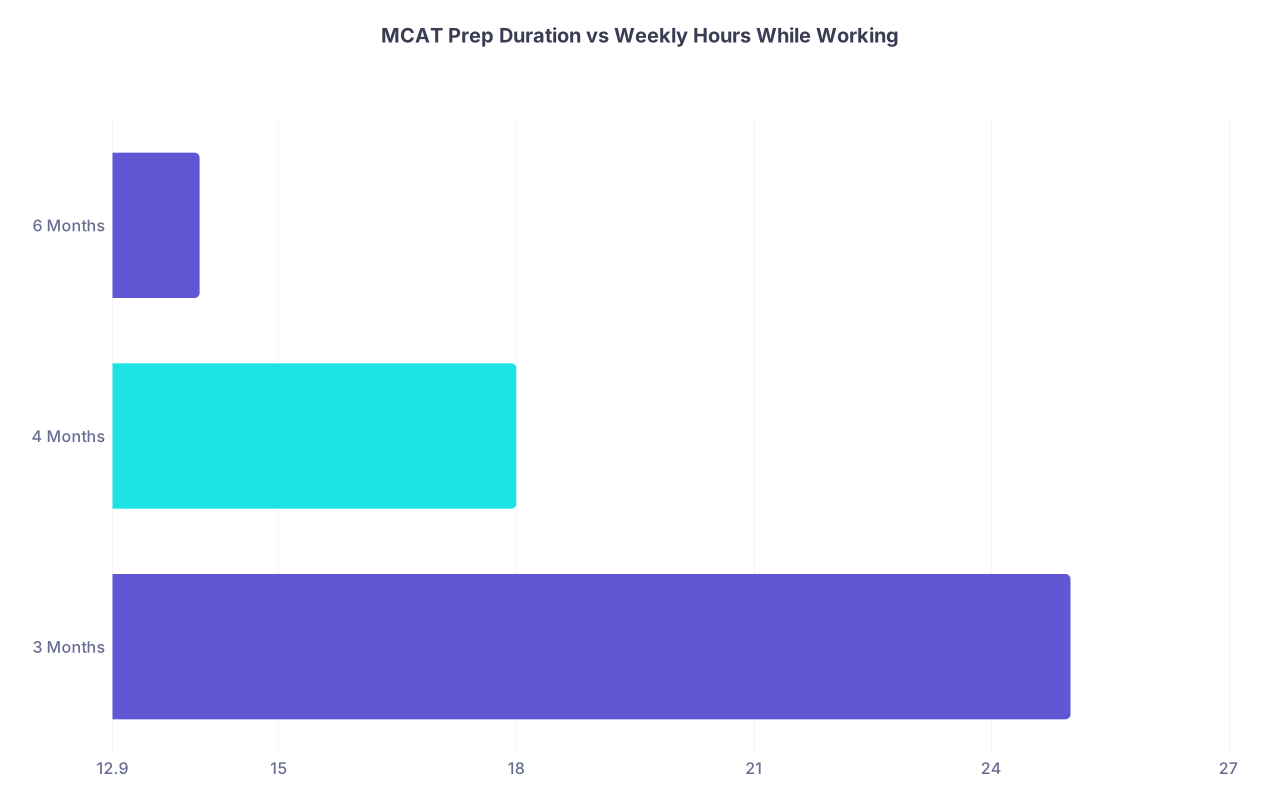
| Category | Value |
|---|---|
| 3 Months | 25 |
| 4 Months | 18 |
| 6 Months | 14 |
- 3 months → ~25+ hours/week. Hard to sustain with full-time work. Possible only if your job is light and your life is absurdly simple.
- 4 months → ~16–18 hours/week. Reasonable if you’re serious and consistent.
- 6 months → ~12–14 hours/week. Best for sanity, especially if your content foundation is weak or you have family responsibilities.
If your science background is rusty or you’ve been out of school for years, 5–6 months is not “overkill.” It’s smart.
Step 4: Daily Structure for Your Evenings
You cannot walk in the door at 6 pm, stare at your books, and decide what to do. Decision fatigue will beat you every time.
Your evenings need a script. Something like this:
Sample Weeknight Flow (Assume 6 pm Arrival Home)
- 6:00–6:30 — Quick decompression + food
Light dinner you prepped on Sunday. No scrolling into oblivion. - 6:30–6:40 — Transition ritual
Brush teeth, change into “study clothes,” set phone on Do Not Disturb in another room. 10 minutes max. - 6:40–8:40 — MCAT Study Block (non-negotiable)
– First 15–20 min: Review Anki/spaced repetition
– Next 70–80 min: Main task (content OR questions)
– Final 20 min: Review what you missed, update notes/Anki - 8:40–9:00 — Shutdown
Set tomorrow’s tasks, quick review of schedule, close everything.
Then you get your remaining time as “free.” Your brain needs to see an end to the work.
The structure matters more than the exact times. You want:
- Small warm-up (Anki / review)
- Deep work (one main objective)
- Cool down (reflection + tomorrow plan)
Step 5: What to Do Each Day: Content vs Questions
If you’re working full-time, you cannot waste time “studying” passively. Reading and highlighting whole Kaplan books like it’s undergrad? No.
Your evenings have to be focused on two things:
- Building usable understanding of high-yield concepts
- Applying them through questions to expose weaknesses
Here’s a clean weekly pattern that works with evenings:
4-Month Plan Pattern (Working Full-Time)
Phase 1 (First ~6–8 weeks) – Content-heavy, questions daily
Phase 2 (Middle ~4–6 weeks) – Content light, questions heavy
Phase 3 (Last ~4–6 weeks) – Full lengths + review, minimal new content
For a typical week in Phase 1:
- 3 evenings: Content + related practice questions
- 1 evening: CARS + discrete questions from all sciences
- 1 evening: Light/backup (review, Anki, error log)
- Weekend: One heavier review day, one moderate practice day
Example of what a Tuesday night might look like:
- 6:40–7:10 — Anki (bio + psych/soc cards)
- 7:10–8:00 — Watch targeted videos/read on enzyme kinetics + practice a few example problems
- 8:00–8:40 — Do 15–20 chem/phys passage questions focused on kinetics; review every miss
If you can’t point to specific reasoning errors or content gaps you discovered by 8:40, you didn’t really “study.” You just consumed material.
Step 6: Use Your Commute and Micro-Gaps Without Ruining Yourself
People who work full-time like to fantasize about studying “every spare moment.” Then they last 9 days.
Use small blocks strategically, not obsessively.
Good commute/micro-use ideas:
- 15–30 minutes of Anki on the train or bus
- Audio review of psych/soc or biochem concepts if you drive
- One CARS passage during lunch (only if you can focus; do not ruin your break completely)
Bad ideas:
- Forcing dense physics calculations on your phone at 11 pm in bed
- Pretending you’ll “do 3 hours after work” and “2 hours before work” indefinitely
- Studying through every lunch break for months with zero rest
You’re not a monk. You need off-ramps.
Step 7: Organize Content So Evenings Aren’t a Mess
You don’t have time to be disorganized. Your system needs to be simple and fast:
- One primary resource set for content (e.g., Kaplan books + Khan Academy or Blueprint/Princeton online material). Do not mix 5 different systems.
- One Qbank you gradually work through (UWorld is the gold standard for MCAT-style reasoning; AAMC materials are sacred and should be used more in the later phases).
- One spaced repetition system (Anki, ideally premade decks like AnKing/JP if you know how to use them).
And for the love of your future sanity: one tracking document.
A simple spreadsheet or notebook page that has:
- Date
- Study block (e.g., “Mon PM”)
- Topic focus (“Bio: gene expression + regulation”)
- Resource used (“UWorld set #12, Kaplan chapter 5”)
- Questions done + % correct
- Key weaknesses you uncovered
Two minutes of tracking per night saves hours of “wait, what was I working on last week?”
Step 8: Build a Realistic Full-Length Exam Strategy
Here’s the trap evening-only students fall into: they keep doing little question sets and never carve out time for full practice exams. Then they’re shocked by the mental stamina issue.
Full-time workers need to be extra intentional with full lengths.
Your MCAT is on a Saturday or Sunday. Emulate that.
For a 4–6 month prep:
- Full-lengths every 2–3 weeks in the middle stretch
- Then weekly in the last 4–5 weeks (if you can handle it)
Use one weekend day for:
- Morning: Full-length exam under exact test conditions
- Afternoon/evening: Light review of major patterns, not every tiny detail yet
Then use the following two or three weekday evenings to deep-dive review:
- Evening 1: Chem/Phys + CARS review
- Evening 2: Bio/Biochem review
- Evening 3: Psych/Soc review + big-picture test strategy
If you try to review a full exam in one night after work, you’ll just skim and pretend you “learned.” You didn’t. You just read.
Step 9: Protect Your Job While You Do This
Let’s be blunt about something nobody wants to say: your MCAT prep cannot wreck your performance at work. Bad reviews, getting fired, obvious burnout—that stuff travels with you.
Your attending or future residency PD will not care that you were “grinding for the MCAT” if your boss later writes a lukewarm letter.
So you need guardrails:
- No MCAT study during work hours (unless your role allows very clear, legitimate downtime and no one depends on you in those moments).
- Sleep is not negotiable. 6 hours is absolute bare minimum. 7 is far better. Under-slept you is unproductive and makes more mistakes—both at work and in prep.
- When you feel work performance slipping, you adjust the MCAT schedule slightly, not double down like a martyr.
If your job is hellishly demanding seasonally (tax season, end of quarter, holiday retail, etc.), you may need to:
- Either start MCAT prep outside that season
- Or build in 1–2 “light weeks” where you scale down to maintenance mode (Anki + 1–2 light sessions instead of full intensity)
You’re not weak for doing that. You’re strategic.
Step 10: Dealing with Exhaustion and Motivation Crashes
You will have days where you come home and feel like roadkill.
The question is: what’s the minimum version of your plan you can still hit on those days?
Have a “bad-day protocol” ready:
- 30–45 minutes instead of 2 hours
- Only Anki + 1 CARS passage, or 10 questions in your weakest section
- No new dense content—just review and light practice
That way, you keep the habit alive without nuking yourself.
If you burn out for a week and do nothing, restarting becomes psychologically harder than it needed to be.
Also, plan real days off:
- 1 scheduled day off every 1–2 weeks where you do no MCAT at all
- This is by design, not “I failed.” It’s what allows the other 10–12 days to be on point.
People love fantasizing about “no days off.” Most of them score worse than they could have because their brain is mush by test day.
Step 11: When Your Score Goals and Reality Don’t Match
Sometimes the math doesn’t work.
If you’re working 50–60 hours a week, have kids, and can truly only get 8–10 decent study hours in weekly, a 520 goal in 3 months is fake.
When I see that mismatch, there are only a few honest options:
- Push your test date and extend your timeline.
- Change your score goal for this attempt, recognize it as part of a longer journey (with a possible retake later).
- Re-engineer your life temporarily: reduce hours, switch shifts, take a lighter assignment, or even take a formal study leave if you can.
What you cannot do is cling to a fantasy: “I’ll magically squeeze in 25 hours a week.” Not while working full-time and staying sane.
If your diagnostic is, say, 500 and you want a 515+ with only evenings and moderate weekends, a 5–6 month plan is absolutely reasonable. A 2–3 month plan is gambling.
Step 12: Sample 1-Week Schedule for Someone in Your Shoes
Let’s put this all into a realistic week. Assume:
- 9–5 job, 30–45 min commute each way
- Evenings free, no kids
- 4-month total prep timeline
- Currently in the “content-heavy but questions daily” phase
Monday
- Evening: 2 hours
- 20 min Anki (bio/biochem)
- 70 min content: amino acids + protein structure
- 30 min: 10–12 related UWorld questions, review in detail
Tuesday
- Evening: 2 hours
- 20 min Anki (psych/soc)
- 40 min CARS: 3 passages timed
- 60 min: Review CARS + 6–8 discrete questions in weak area (e.g., physics formulas)
Wednesday
- Evening: 2–2.5 hours
- 20 min Anki (mixed)
- 80–100 min: Psych/soc content (learning, memory) + practice questions
Thursday
- Evening: 1.5–2 hours (lighter day)
- 20 min Anki
- 60–80 min: Bio passages only, mixed topics, focus on reasoning and data interpretation
Friday
- Optional or very light
- If exhausted: off or 30 min Anki only
- If OK: 60–90 min of review + organization
Saturday
- Morning: 3–4 hours
- Half-length practice exam (2 sections) OR ~3 blocks of UWorld timed passages
- Afternoon: 1–2 hours
- Review the worst section in detail
Sunday
- 3–4 hours, flexible timing
- Targeted content on the 2–3 topics you struggled with most Saturday
- Build or add to your error log + Anki cards
That’s roughly 16–18 hours. Sustainable for many full-time workers. Adjust down slightly if you feel performance at work slipping; adjust up slightly if your job is genuinely light.
Step 13: Emotional Reality Check
Working full-time while prepping for the MCAT often comes with a side of impostor syndrome.
You’ll see Reddit threads of people studying “10 hours a day, no job, 523 on FL3” and you’ll feel behind. Ignore them. Different lives, different constraints.
I’ve seen plenty of non-traditional applicants, career changers, parents, and full-time workers hit 510, 515, 520+ on this exam. They all had three things in common:
- They were brutally honest about their time and energy.
- They protected consistency over intensity.
- They didn’t use their job as an excuse, but they also didn’t pretend it didn’t exist.
That’s the line you need to walk.
What Comes After You Lock This Plan In
Once you commit to an evening-based schedule and give it 3–4 weeks, your life will feel weirdly structured. Slightly smaller, a bit more rigid, but also clearer.
From there, your main jobs become:
- Adjusting your plan based on practice scores instead of vibes
- Tightening your timing and stamina as full-lengths ramp up
- Deciding when your practice scores are stable enough to walk into the real thing
With a disciplined evening routine, thoughtful weekends, and realistic timelines, you’ll get there.
And when you’re sitting in med school later, listening to classmates complain about “how hard Orgo was,” you’ll have a quiet edge they don’t: you already know how to carry a full-time load and still move your dream forward, night after night.
With that foundation in place, you’ll be ready for the next big hurdle—the application year, juggling secondaries, interviews, and everything else. But that’s a situation for another day.