
The way most people tell you to study for the MCAT will absolutely wreck you if you have ADHD.
Long, unstructured days. “Just grind 8 hours.” Endless passive content review. Vague study calendars that collapse the first time life gets messy. That style works for about 5% of people with ironclad attention. If you’re reading this, you’re probably not in that 5%.
You need a focus-friendly plan. That means your system does the heavy lifting so your brain doesn’t have to white‑knuckle concentration from 9 a.m. to 9 p.m.
Let’s build that system step by step.
Step 1: Get Real About Your ADHD Profile
“ADHD” isn’t one thing. How it shows up in your MCAT prep matters.
Here’s what I want you to do before you touch another flashcard:
- Sit down with a blank sheet and write two columns:
- “What actually derails my studying”
- “What actually helps me focus”
Not what TikTok says. What you’ve seen in your own life. Examples I see over and over from premeds:
Derailers:
- Sitting in silence with a giant untouched textbook
- “I’ll start after I check email/IG/YT quickly”
- Studying on the bed or couch
- 0 external deadlines (“I’ll do it later” → never)
- Overwhelming to-do lists with 15 different tasks
Helpers:
- Working with someone else on Zoom / library (even silently)
- Timed sprints with a clear endpoint
- Physical movement every 30–45 minutes
- One clear, concrete target (“Finish 20 questions in Bio/Biochem”)
- Visual checklists / trackers
You’re going to build your study plan around that list, not around some perfect neurotypical fantasy schedule.
If you’re medicated: write down roughly when your meds kick in and when they fade. That will drive your daily schedule more than any internet advice.
Step 2: Build a 12-Week Skeleton That Works With ADHD, Not Against It
I’m going to assume ~12 weeks of focused prep. If you have more, great; you can stretch this. If you have less, you’ll prioritize more ruthlessly, but the structure stays the same.
First, decide your weekly time budget that’s actually realistic with ADHD and your life. Not fantasy.
| Situation | Target Hours/Week | Comment |
|---|---|---|
| Full-time student + light work | 15–20 | 3–4 focused hrs/day |
| Full-time work (40 hrs) | 12–15 | 2–3 hrs most days |
| [Gap year](https://residencyadvisor.com/resources/mcat-prep/gap-year-and-the-mcat-when-to-schedule-the-exam-around-work-or-research), light commitments | 20–25 | Beware burnout |
If you’re thinking “I’ll do 40 hours/week”, you’re lying to yourself. ADHD plus 40 MCAT hours is a straight line to burnout and shame.
Next, we split the 12 weeks into phases:
- Weeks 1–4: Content review with questions
- Weeks 5–8: Question-heavy, targeted content repair
- Weeks 9–12: Full-length exams, refinement, and test-readiness
Notice: No phase is “just review chapters.” Every phase has active questions because ADHD brains wake up when there’s a clear problem to solve and a bit of pressure.
Step 3: Design a Focus-Friendly Study Day
Here’s the mistake: planning around hours instead of units of focused time.
You’re not going to sit and focus for 3 straight hours. Stop pretending. Plan in “focus blocks” instead.
Pick Your Focus Block Style
Try one of these and adjust:
- Classic Pomodoro: 25 minutes focus, 5 minutes break
- Longer sprint: 45 minutes focus, 10–15 minutes break
- Mixed: 2–3 × 25 min, then a longer 20–30 minute reset
If you’re truly struggling, start with 15 minutes. I’ve had students use “10 on / 5 off” the first week just to build the muscle.
Now, turn this into a simple daily template. Example for someone with ADHD meds that work best 10 a.m.–3 p.m.:
Sample day (aiming for 3–4 high-quality hours):
- 9:30–10:00 — Warm-up, plan, set up environment
- 10:00–10:50 — Block 1: Practice questions (e.g., Chem/Phys, 15–20 questions)
- 10:50–11:05 — Break: walk/stretch, snack, no phone rabbit holes
- 11:05–11:50 — Block 2: Review & targeted notes from those questions
- 11:50–12:20 — Lunch, movement
- 12:20–1:10 — Block 3: Anki / flashcards + small content chunk
- 1:10–1:25 — Break
- 1:25–2:10 — Block 4: CARS passage set (3–4 passages)
- 2:10–2:20 — Quick review of mistakes, set tomorrow’s priorities
That’s it. You’re done. You don’t need 10 hours. You need 3–5 actually focused ones.
Notice:
- Hard stuff during peak meds/focus
- Block always has one main task
- Built-in review time, not saved “for later”
Step 4: Use External Structure So Your Brain Doesn’t Have To
ADHD brains are terrible at holding self-imposed plans. So don’t rely on your brain. You need externalized structure.
Here’s the bare minimum stack I recommend:
A big monthly wall calendar or whiteboard
Put:- Your MCAT date in bold
- Planned full-lengths (FL1, FL2, etc.) on specific weekends
- “No-study” or lighter days you pre-approve so rest doesn’t feel like failure
A daily to-do list with 3 tasks max
Anything beyond 3 becomes fantasy. Tasks should be concrete and measurable:- Bad: “Study orgo”
- Good: “Do 20 orgo practice questions + review wrong answers”
Use a small sticky note. If the list doesn’t fit, it’s too long.
Alarms + timers
- One alarm to start study
- One to end the day (no endless guilt-scrolling pretending to study)
- Timer for each block (visual timers help a lot for ADHD)
Body doubling
This is massively underused. Study while:- On a silent Zoom with another premed
- In the same library table as a friend
- In a virtual “focus room” service
ADHD brains behave better when “watched,” even gently.
Step 5: Structure Your 12 Weeks (Concrete Plan)
Let’s plug this into an actual MCAT plan. Adjust numbers to your test date and schedule, but copy the structure.
Weeks 1–4: Anchored Content Review
Goal: Touch all major content areas while doing some questions every single day.
Weekly structure:
- 3 days: Content-heavy blocks + light practice
- 2 days: Question-heavy blocks + light content
- 1 long block: CARS + Psych/Soc review
- 1 day: off or very light (Anki only)
Example Week 2 (Bio/Biochem focus):
- Mon:
- Block 1: 10–15 discrete Bio questions (mixed topics)
- Block 2: Review + notes
- Block 3: Content: amino acids + enzymes, 1–2 short videos/chapters
- Tue:
- Block 1: 3 CARS passages
- Block 2: Review CARS + itemize patterns
- Block 3: Light Anki / definitions
- Wed:
- Block 1: Bio/Biochem passages (2–3)
- Block 2: Deep review of one hardest passage
- Block 3: Content: membranes, transport
- Thu:
- Mixed Chem/Phys questions + short content repair
- Fri:
- More Bio/Biochem, shift to weak subtopics
- Sat:
- Longer CARS set (5–6 passages), then done
- Sun:
- Off or 20–30 min Anki
Key rule this phase:
Every day includes:
- At least 1 practice set (content-specific or CARS)
- At least 1 review block where you write down why you missed things
This keeps ADHD brains from drifting into pretty note-taking with zero practice.
Step 6: Question-Heavy Middle (Weeks 5–8)
Goal: Flip the ratio. More time in the trenches with passages, less fluffy review.
By now, you’ve seen most content once. It’s leaky, that’s fine. The solution isn’t rewriting your textbook. It’s targeted fixes driven by questions.
Weekly structure:
- 3 days: 2–3 passage sets (from different sections) + review
- 2 days: Section-based mini exams (e.g., 59-question section over 2–3 blocks)
- 1 CARS + Psych/Soc consolidation day
- 1 rest/light day
This is where ADHD can sabotage you with avoidance. Full sections feel scary. Your brain will want to “prepare more first.” Don’t let it. Schedule section days like appointments.
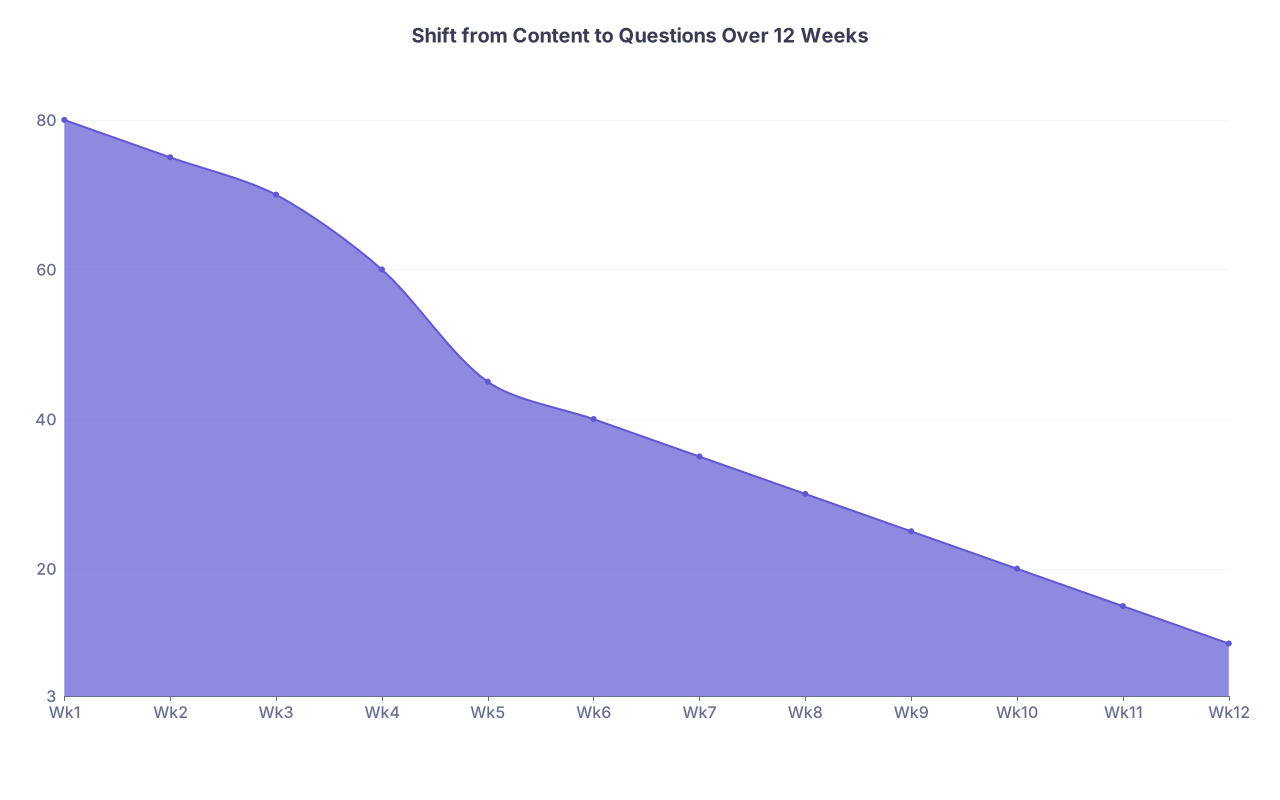
| Category | Value |
|---|---|
| Wk1 | 80 |
| Wk2 | 75 |
| Wk3 | 70 |
| Wk4 | 60 |
| Wk5 | 45 |
| Wk6 | 40 |
| Wk7 | 35 |
| Wk8 | 30 |
| Wk9 | 25 |
| Wk10 | 20 |
| Wk11 | 15 |
| Wk12 | 10 |
In this example, the percentage of time on pure content steadily drops as you go. You want that curve.
When you miss a question, categorize the reason:
- Didn’t know the content at all → short, focused content block
- Knew content but misread / rushed → timing & reading strategy fix
- Tricked by answer choices → practice identifying wrong answers on similar questions
Keep a running “Miss Log” in a notebook or doc. Not paragraphs. Just:
- Date, section, Q#
- Reason for miss in one line
- What you’ll do differently
ADHD brains forget patterns fast. The log is your external memory.
Step 7: Full-Length Phase (Weeks 9–12)
You cannot skip this, especially with ADHD. Endurance, timing, and brain stamina are half the battle.
Plan:
- Week 9: FL1
- Week 10: FL2
- Week 11: FL3
- Week 12: FL4 (optional depending on burnout and progress)
Always under near-real conditions:
- Same start time as test day
- No phone
- Real breaks
- Quiet environment
Then the crucial part: review.
Most ADHD students do the exam, peek at the score, feel bad, then half-review a bit and move on. That’s useless. You’ll repeat the same mistakes.
Here’s a manageable review structure across 2–3 days:
Day 1 post-exam:
- Go through C/P and CARS
- For each wrong Q: log it, briefly explain what went wrong
- Mark any “lucky guesses” you got right (they’re actually wrong in your brain)
Day 2:
- B/B and P/S review the same way
- Pull 3–5 priority themes to reinforce with targeted content
Day 3:
- 1–2 short mixed practice sets focusing on those themes
- Light review, Anki, rest
Protect at least one non-study evening after a full-length. ADHD + chronic mental fatigue = disaster.
Step 8: Engineer Your Environment for Focus
You can’t willpower your way out of a distraction trap. You have to design it out.
Specific, actionable changes:
Physical space:
- No bed. Ever. You’ll be horizontal in 40 minutes.
- Clear desk, only what you need for that block
- If home is chaotic, rotate: library, coffee shop, friend’s apartment, campus study rooms
Digital:
- Use website/app blockers during blocks: Freedom, Cold Turkey, StayFocusd, Forest
- Put your phone in another room, or at least face-down behind your laptop
- Disable all non-essential notifications for the entire prep period
Sensory:
- Noise-cancelling headphones + consistent background sound (café noise, lo-fi, rain)
- If you fidget, embrace it: stress ball, fidget cube, or chair that lets you move a bit
This is boring, but it’s the difference between 4 hours “studied” and 4 hours of actual work.
Step 9: Adjust for Medication and Energy
If you’re on ADHD meds, this part is non-negotiable.
Map your day around your effective window:
- When does it kick in? (Example: 45 minutes after taking)
- When does it start to die off? (You feel more distractible, more tired)
Your heaviest cognitive work (CARS, full passages, exams) must sit inside that window. Light tasks (Anki, reviewing explanations you already understand, organization) can go before or after.
If you’re not on meds:
- Front-load the day. Don’t leave the heavy lift for 6 p.m. when your brain is already fried.
- Use more, shorter blocks. 15–25 minute sprints might be your sweet spot.
- Double down on body doubling and timers. You need that external scaffolding more.
And be honest with yourself: if your ADHD symptoms are wildly out of control—like you can’t sit for 15 minutes, you’re missing work/school deadlines, impulsivity is wrecking your life—talk to a professional. The MCAT is not the main problem at that point.
Step 10: Build an Anti-Burnout Protocol
ADHD isn’t just about distraction. It’s about inconsistent energy and brutal crashes.
If you don’t proactively manage burnout, week 5 you’ll flame out, then spend two weeks in shame spiral pretending you’ll “start again Monday.”
Here’s a simple anti-burnout plan:
One protected light/rest day per week
- Rules: no heavy MCAT tasks. At most, 20–30 minutes flashcards. That’s it.
Daily minimum rule:
- On bad days, your “bare minimum” is 1–2 focused blocks, not a whole schedule
- Example: “Today is garbage. I will do exactly: 2 CARS passages + review, and 20 minutes of Anki. Then I’m done.”
This keeps your identity as “I’m still actively studying” without demanding peak performance.
Sleep:
- You will be tempted to cut sleep to “get more done.” Don’t. ADHD plus sleep debt equals useless study.
- Guard your consistent sleep/wake time harder than any fancy productivity hack.
Movement:
- Walking 10–20 minutes before a heavy block helps more ADHD students than any “focus music playlist.”
- On long days or full-length days, move lightly on each break.
Step 11: Score Goals and Reality Checks
You need a realistic target. If you’re sitting at 500 on a diagnostic and want a 522 in 8 weeks while working 40 hours, I’m going to be blunt: that’s fantasy.
Use this rough guide as a sanity check:
| Starting Score | Realistic Gain | Target Range |
|---|---|---|
| ≤495 | 8–12 points | 503–507 |
| 496–502 | 6–10 points | 504–512 |
| 503–508 | 4–8 points | 507–516 |
| 509+ | 2–5 points | 511–520+ |
Can people beat these? Yes. Most don’t. ADHD adds another layer because consistency is harder.
Use your full-length scores, not just QBank averages, to track. Expect some wobble. I’ve seen:
- FL1: 502
- FL2: 499 (panic)
- FL3: 506
The downward blip doesn’t mean you’re doomed. It means you’re human.
Step 12: MCAT Test Day with ADHD – Plan It Now
Do not wait until the week before to think about logistics. Your ADHD brain will already be near capacity from stress.
At least 3–4 weeks out, decide:
- What you’ll eat for breakfast (test it on FL days)
- What snacks and drinks you’ll bring
- What layers of clothing you’ll wear (testing centers are notoriously random with temperature)
- How you’ll handle breaks:
- Bathroom
- Snack/water
- Short movement
- One or two deep breaths, reset
And your mental script for when your brain freaks out mid-section. Something like:
- “Okay, I’m zoned out. That’s fine. Next question only. Read the stem slowly. Underline the key phrase. I don’t have to be perfect, I just need to be present for this one.”
Write that script down. Seriously. ADHD under stress forgets every coping tool you’ve ever learned. Paper doesn’t.
If You’re Starting From Chaos Right Now
If your current situation is:
- No schedule
- Random days of “5 hours” followed by 4 days of nothing
- 10 different prep resources you jump between
- Crushing shame and procrastination
Here’s the triage plan for this week:
- Pick one main QBank + one main content source. Drop the rest.
- Schedule 4 days with just 2–3 blocks each. Nothing heroic.
- Do:
- 1 CARS block every day
- 1 science passage or discrete set every day
- 20 minutes of review or Anki
That’s it. No “perfect” schedule yet. Your only job is to rebuild the habit of showing up in a way your ADHD can handle.
Once you’ve survived one week of that, then layer in more structure from the earlier sections.
Your Move Today
Do one concrete thing now, not later:
Grab a sheet of paper (or open Notes) and write tomorrow’s exact 3-task plan. Example:
- 3 CARS passages (AAMC if you have them) + review in 1 block
- 10 Bio/Biochem discrete questions + review in 1 block
- 20 minutes of Anki / flashcards
Set alarms for the start and end of your study window. Put your phone charger in another room so it doesn’t camp next to you.
Then tomorrow, don’t “study for the MCAT.” That’s too big. Just complete those 3 tasks. Then you’re done.
Do that for a week, and you’ve already built the foundation of a focus-friendly MCAT plan that actually respects your ADHD brain instead of fighting it.