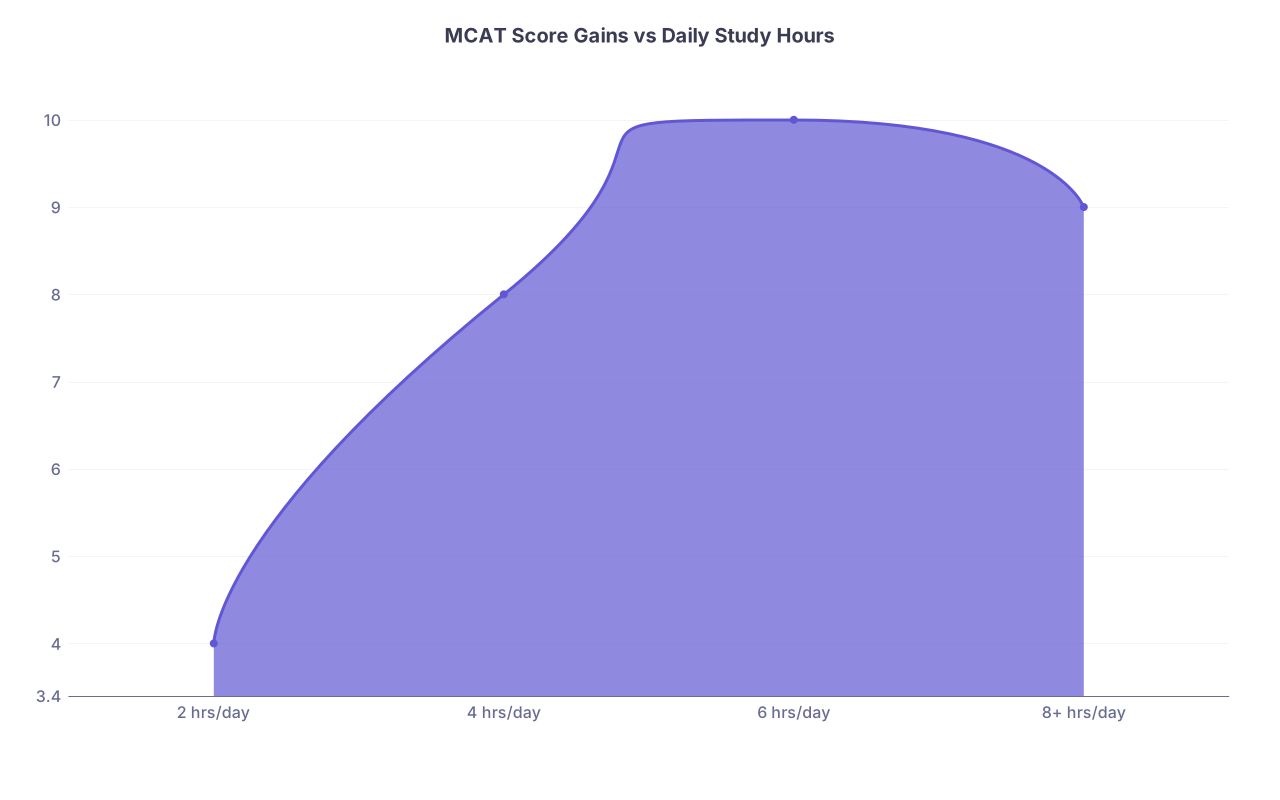
The usual MCAT grind advice falls apart the minute your life catches fire.
Step 1: Accept That “Normal” MCAT Advice No Longer Applies
You cannot prep for the MCAT during a real family crisis like a YouTube productivity guru. If you try to run a 6-hour/day Anki + 3,000-question plan while someone’s in the ICU, or your parents are divorcing, or you’re suddenly the primary caretaker—you’ll burn out and your score will tank anyway.
So the goal shifts.
Your new objective is not “crush the MCAT.”
Your new objective is: minimize score damage while keeping yourself and your family intact.
That means three things:
- Protect your floor score more than you chase your ceiling score.
- Adjust your test date only if it actually helps, not just because you “feel behind.”
- Build a ruthlessly efficient, crisis-proof study structure that survives chaos.
Let’s walk through how to do that, step by step, based on the exact kind of crisis you’re in.
Step 2: Diagnose Your Situation Like a Triage
You’re in medicine (or trying to be). Think like triage: what’s stable, what’s crashing, what can wait.
There are three main variables:
- Time until test date
- Severity and type of crisis
- Your current baseline readiness
A. Time Until Test Date
Rough rule:
| Time Until Exam | Main Goal | Likely Strategy |
|---|---|---|
| 8–12+ weeks | Preserve ceiling | Adjust schedule, keep date if possible |
| 4–8 weeks | Salvage score | Tight prioritization, maybe reschedule |
| <4 weeks | Damage control | Decide: test, reschedule, or void |
If you’re 3 months out, we can re-build properly.
If you’re 3 weeks out, we’re doing battlefield medicine.
B. Severity and Type of Crisis
Be honest (not dramatic, not minimizing):
- Acute but time-limited (e.g., grandparent in ICU, funeral week, short-term chaos)
- Chronic ongoing stress (e.g., parent with cancer, long legal case, unstable home)
- Role shift (you suddenly have to work more, babysit siblings, manage the household)
These matter because they change what’s realistic.
C. Your Baseline Readiness
Look at your last legit full-length (AAMC or solid third-party):
- 515+ and you were trending up → You have buffer.
- 505–514 → Mid-range; you can’t afford to hemorrhage points.
- Below 505 or no FL yet → You’re not ready to eat much score loss.
If you don’t have a recent FL (in last 3–4 weeks), your first task is to get one on the books. You can’t make smart decisions blind.
Step 3: Decide Whether To Postpone (Without Lying to Yourself)
People mess up here. They either stubbornly refuse to postpone (“I already told everyone this is my date”) or they use postponing as an emotional escape (“If I move the test, all this anxiety will just go away”).
Here’s a cleaner, no-BS decision framework.
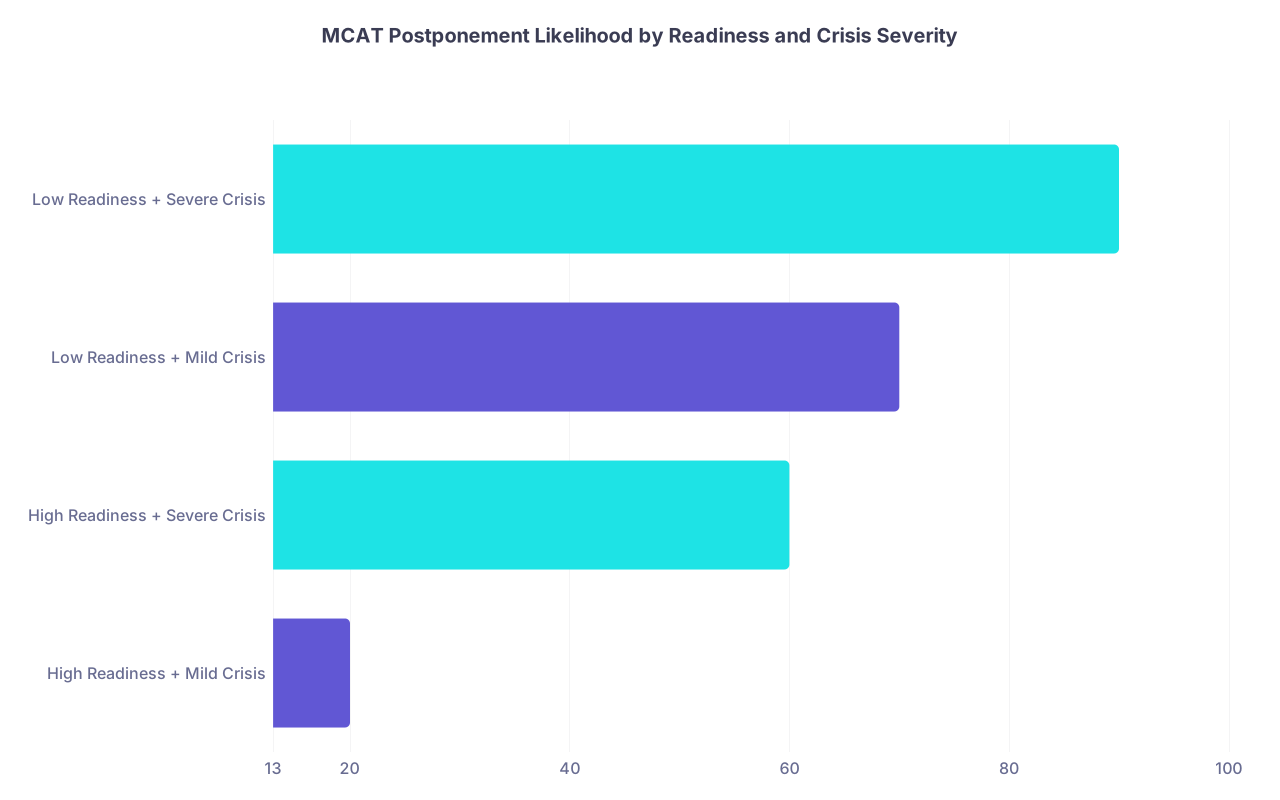
| Category | Value |
|---|---|
| High Readiness + Mild Crisis | 20 |
| High Readiness + Severe Crisis | 60 |
| Low Readiness + Mild Crisis | 70 |
| Low Readiness + Severe Crisis | 90 |
Interpretation: number ≈ probability (in %) that postponing is the better choice.
You Should Strongly Consider POSTPONING if:
- Full-length scores are:
- Below 505 and your exam is within 4–6 weeks, and
- Your crisis is not resolving in the next 2 weeks.
- Or:
- You are the primary caregiver / decision-maker, and the daily unpredictability is extreme.
- Or:
- You haven’t finished content review at all and you’re <6 weeks out.
Postponing makes sense if it buys you real capacity, not just more calendar days.
You Should Likely KEEP Your Date if:
- You have:
- 510+ practice scores,
- You’ve done at least 3 full-lengths, and
- The crisis, while painful, still leaves you 2–3 hours most days.
- Or:
- The crisis is strongly time-limited (e.g., a one-week funeral trip) and you’re otherwise on track.
- Or:
- Application timing is critical (e.g., you’re in a tight reapplicant timeline) and postponing would push you a full cycle, and your scores are already near your target.
What I’ve seen work: students with a 513–516 baseline who go through 2–3 horrible weeks but preserve their routine—those students often end up 1–3 points below potential, not 10.
Students who are at 500 with zero FLs and a long-term unstable home situation? They benefit from backing up, regrouping, rebuilding.
Step 4: Build a “Crisis-Proof” Study Plan (2–3 Hours/Day Max)
Let’s say you’re staying registered or you don’t have the option to delay. You can’t do 6 hours a day. Fine. We compress.
You need a minimal viable MCAT routine: the smallest consistent plan that preserves as much score as possible.
General structure: 2–3 hours/day, 5–6 days/week. That’s it.
Your Non-Negotiable Daily Blocks
- Passage work (CARS + one science) – 60–90 minutes
- Review of those passages – 45–60 minutes
- Micro content touch (Anki / notes) – 20–30 minutes
That’s your skeleton.
If you have more time on some days, add:
- Once weekly: full-length OR half-length test block (3–4 hours)
- Once weekly: deeper content patching (1–2 hours)
But don’t assume those longer days. Treat them like bonuses.
Step 5: Prioritize by Score Damage, Not Ego
You can’t do everything. So you only do what actually moves the score.
If your family crisis steals your time, you must be vicious about what stays:
Most score-protective activities (in order of importance):
- AAMC materials (Section Banks, Question Packs, AAMC FLs)
- High-quality full-lengths
- Reviewing your own mistakes deeply
- Targeted patching of high-yield weak topics
Least necessary when time is crushed:
- Rewriting pretty notes you never review
- Watching 3-hour YouTube lectures passively
- Second-tier resources you’re using “because everyone else is”
- Excessive content review in topics you already consistently get right
If you have 2.5 hours on a given day, this is what it might look like:
- 30 min – CARS (3 passages, timed)
- 30 min – 1 science passage set (Chem/Phys or Bio/Biochem)
- 45–60 min – Review those questions: why wrong, why right, patterns
- 20–30 min – Anki / flashcards for your real weak zones (amino acids, hormones, physics formulas, etc.)
That, done 6 days a week, is more powerful than a blown-up 8-hour “perfect” schedule you only follow twice a week and feel guilty about.
Step 6: Make a Specific Plan for the Most Chaotic Days
You need a bare-minimum day plan for when everything goes wrong: someone’s rushed to the ER, court hearing goes late, child care implodes, whatever.
On those days, your only mission is: prevent total atrophy.
Here’s your “disaster day” minimum:
- 15–20 minutes: CARS or science passages (even 1–2 is fine)
- 10–15 minutes: Review just those
- 10 minutes: Core content cards (amino acids, equations, basic orgo, high-yield psych/soc)
That’s 35–45 minutes. Done at 10pm is still done.
The real value isn’t content. It’s keeping the MCAT cognitively “warm.” That way, when you have 2–3 good days, you ramp back up fast.
Step 7: How to Study When You’re Emotionally Fried
Let’s not pretend your brain is operating at 100%. It is not.
Here’s how to reduce the mental tax:
Study in tiny sprints.
25 minutes on / 5 minutes off. Or even 15/3 if you’re barely functioning.Don’t doom-scroll between blocks.
Bad habit: finishing a passage set → check text from family → 20 minutes lost in anxiety. Set a rule: during a block, airplane mode. During breaks, water/stretch, not group chats.Use “pre-decided” tasks.
Make a small list each night for tomorrow:- 3 specific CARS passages (which resource, which numbers)
- 1 science topic for passages
- One small content target
So you don’t waste brainpower deciding what to do when you’re already wrecked.
Lower your ego about performance swings.
During crisis weeks, your accuracy will dip. The point is to keep practicing in test-like conditions so your floor doesn’t collapse.
Step 8: Handling Specific Crisis Types
Different crises hit your schedule in different ways. The response is not one-size-fits-all.
1. Hospital/ICU Situation
Pattern: long stretches of waiting, emotional spikes, unpredictable visiting hours.
What works:
- Bring a small, portable MCAT kit: tablet or slim laptop, one notebook, a pen, headphones. That’s it.
- Do:
- Question practice during waiting-room stretches
- Light content review (flashcards) bedside if appropriate
- Avoid:
- Full-length exams right after overnight vigils (your data will be garbage)
- Adjust:
- Schedule FLs for the least intense days you can predict (e.g., when another family member is covering)
2. Sudden Caretaking Responsibilities
Pattern: You’re managing siblings, elderly relatives, transportation, maybe meals.
What works:
- Anchor 1–2 study blocks to fixed events you know will happen:
- After kids are in bed (9pm–11pm)
- During someone’s nap time (even 45 minutes counts)
- Early morning before the house wakes
- Simplify meals, chores, and errands. This isn’t the time to cook elaborate meals; you’re in survival mode.
- Ask directly for carved-out blocks:
- “I need 2 uninterrupted hours on Tuesday and Thursday evenings for this exam. Can someone cover X during that time?”
People underestimate this: one reliable 2-hour block, twice a week, can be the difference between complete derailment and a salvaged score.
3. Financial/Work Crisis
Pattern: extra shifts, side jobs, unstable schedule, exhaustion.
What works:
- Identify your protected non-work time and literally wall it off.
- Use your best-brain time (usually first 2–4 waking hours) for MCAT, not for scrolling or errands.
- Batch MCAT on your lighter-work days:
- Example: heavy shifts Fri–Sun → make Mon–Wed your bigger MCAT days.
Step 9: Protecting Sleep Enough To Protect Your Score
People try to bargain with sleep. That usually backfires.
On 4 hours of sleep, your MCAT brain is trash. Verbal reasoning tanks, working memory craters, and your stress tolerance goes to zero. I’ve watched students “study” 5 hours in this state and retain maybe 30 minutes’ worth.
So during crisis MCAT prep:
- Aim for 6–7 hours, not perfect 8–9. That’s already a win.
- If you have to choose: 2.5 hours of study + 6.5 hours sleep > 4.5 hours of study + 4.5 hours sleep.
You’re not weak for needing sleep. You’re being strategic.
Step 10: Mental Health and When To Hit the Brake
Here’s the line: if your mental health is collapsing, the MCAT must move down the priority list. Period.
Warning signs I take seriously:
- You’re crying daily and can’t stop once you start.
- Panic attacks about the exam or the crisis.
- Zero appetite or sleeping 3–4 hours a night consistently.
- Thoughts like “I don’t care what happens to me” or “They’d be better off without me.”
If this is you, your next steps are:
- Tell one person in real life (friend, sibling, mentor, advisor).
- Get professional support if you can: campus counseling, therapist, physician.
- Re-examine your MCAT date with the assumption that your health comes first, not last.
I’ve seen students push through and “still take the test” in this state. Scores are often far below potential, and the emotional fallout is worse.
You’re allowed to say: “I’ll take a later exam and apply a cycle later because I want to be alive and functional.” That is not weakness. That’s maturity.
Step 11: Communicating With Schools (If Timing Shifts)
If your crisis forces you to delay the MCAT and possibly your application, you’re not doomed.
Things you can do:
- If you’re delaying to a later MCAT in the same cycle, just keep prepping and submit primary/secondaries when you can; your file won’t be complete till your score comes in, but that’s fine for many schools if you’re not months behind.
- If you’re delaying a whole cycle:
- Use this extra time to strengthen the rest of your app (clinical hours, volunteering, GPA trend, etc.)
- Later, in secondaries or interviews, you can briefly explain:
“During my planned MCAT timing, my family went through [brief description]. I postponed the exam to support them and take it when I could perform to my potential.”
Adcoms are humans. I’ve heard them say in committee rooms: “This person delayed for a serious family issue and then scored well. That tells me they have judgment.”
Step 12: The Week Before the Exam During a Crisis
Last week is about stabilizing, not heroics.
Goals:
- One last full-length 7–8 days before test day if you’re up for it.
- Light, focused review of:
- Your highest-yield weaknesses
- Equation sheets, amino acids, key psych/soc lists
- Sleep and routine as calm and predictable as possible.
Practical tweaks:
- Tell your family: “My test is on [day]. For the 48 hours before, I need to be mostly left alone to focus and rest. If something non-emergency comes up, please handle it or tell me after.”
- Plan logistics early:
- How you’re getting to the test center
- What time you’re waking up
- What you’re eating
You do not need to have had the perfect month. You just need your brain working decently on that one day.
Step 13: If Test Day Itself Goes Sideways
Sometimes the crisis hits on test day. Someone calls with bad news that morning. There’s another emergency. You’re emotionally wrecked before you even sit down.
You’ve got two main options:
Sit for it and be willing to VOID
- If you know halfway through that your performance is far below your typical practice, voiding is a rational choice. One bad official score is not the end of the world, but voiding avoids a 10+ point underperformance anchoring your application.
Don’t sit and reschedule
- If something genuinely huge happens (death, accident, etc.) and you know you can’t think straight, you’re allowed to not walk through that door.
MCAT is high-stakes, but it’s not higher than human life. Act accordingly.
FAQs
1. Is it even worth studying if my family crisis is constant and I don’t know when it’ll end?
Yes—if you scale your expectations. Think of it as “maintenance mode.” You’re not trying to hit peak performance; you’re trying to keep skills from decaying. Do 30–60 minutes most days: a couple of passages, quick review, a small set of crucial flashcards. When life finally opens up again, you’ll ramp faster because you didn’t fully disconnect.
2. How many full-lengths do I really need if I’m in the middle of a crisis?
Under normal circumstances, I like 6–8. In a genuine crisis, I’d say minimum 4 total, and at least 2 of those should be AAMC. If you can only manage 1 FL every 2 weeks, that’s still usable. What matters more is doing them under realistic timing and reviewing them in detail, even if that review is spread over 2–3 days.
3. What if my parents don’t understand and keep saying “the MCAT is just a test, focus on family”?
You’re allowed to care about both. Try a direct, calm script:
“Supporting the family matters to me. So does this exam, because it affects my entire future. I’m going to carve out [X hours] per day for studying so I can still move forward, and the rest of my time I’ll be fully present here.” They may not fully get it, but often they’ll respect clear boundaries more than vague complaining.
4. I feel guilty taking any time for myself when my family is suffering. How do I deal with that?
Guilt doesn’t mean you’re doing something wrong; it means you care. Reframe it: you’re not abandoning your family for the MCAT, you’re investing a few focused hours so that in 5–10 years you can help people—including them—at a much higher level. Set a rule: “I give [X hours] per day to my future, and the rest to my family.” Then honor both. That’s not selfish; that’s sustainable.
Open your calendar for the next 7 days and block off your absolute minimum MCAT hours—even if it’s just 45 minutes a day. Color-code them, protect them like appointments, and decide tonight exactly what you’ll do in tomorrow’s first block.