You walked out of the testing center, palms sweaty, heart pounding, and when the screen popped up with that “Void or Score” option… you bailed.
Maybe your timing crashed in C/P. Maybe you guessed on the last 15 questions in Bio/Biochem. Maybe anxiety steamrolled you so hard you barely remember CARS. Whatever the exact flavor, you hit “Void.” Now you’re home, your AAMC account shows no score, and your second MCAT date is on the calendar.
And you’re asking yourself: Did I just screw my entire application cycle? Am I actually getting better, or am I about to repeat the same disaster, just more expensively?
Good. Those are the right questions. Let’s rebuild this properly.
Step 1: Be Brutally Clear About Why You Voided
Before you touch a single flashcard, you need to diagnose. A void isn’t random. It has causes. And unless you’re honest about those, you’re likely to recreate them on test day again.
Here are the big buckets I’ve seen:
- Content gap – you genuinely didn’t know half of what you saw.
- Timing collapse – you knew a lot of it but couldn’t finish sections.
- Anxiety / panic – you melted down even on questions you could have answered.
- Unrealistic practice – your prep never actually simulated a real MCAT day.
- Life chaos – sleep, illness, family crisis, or burnout made you a zombie.
Most people have a mix of at least two. Your job now is to label them clearly.
Take 20–30 minutes and write this out on paper or in a doc. Not in your head.
Use headings like:
- “On test day, what specifically pushed me toward void?”
- “What was different from my practice FLs?”
- “What did I feel in each section (C/P, CARS, B/B, P/S)?”
Force concrete answers, not vague hand-waving:
- “CP: I ran out of time with 9 questions left. Spent way too long on first two passages.”
- “CARS: My first 2 passages felt impossible, panicked, then rushed everything else.”
- “BB: Content felt off — lots of experiments I didn’t know how to interpret.”
- “PS: Honestly felt ok. I was just mentally fried by that point.”
Once you have that, tag each problem:
- Content
- Timing
- Anxiety
- Stamina
- Logistics (sleep, nutrition, test center issues, etc.)
- Unrealistic prep (too many untimed questions, etc.)
Do not skip this step. If you refuse to dissect what went wrong, you’re basically agreeing to spin the roulette wheel again.
Step 2: Understand How a Void Actually Looks to Schools
You probably already spiraled on Reddit. Let me cut through the noise.
Here’s how voids usually play in admissions land:
- A single void: Mild yellow flag at worst. Often ignored if your actual score is solid and the rest of your app is strong.
- Multiple voids or cancellations: Now we’re in “pattern” territory and people start asking questions.
Most schools can see that you sat for an MCAT that has no score reported. They can’t see the score because there isn’t one, but they’ll see an attempt and a void. Some will shrug. Some might wonder if anxiety is an ongoing issue. But if your second attempt is strong and your overall narrative is consistent, it’s rarely fatal.
The real danger is not the void itself. The real danger is:
- Taking a second MCAT too soon and scoring low.
- Taking a second MCAT with the same issues and voiding again.
- Letting the void destroy your confidence and prep quality.
So your mindset now should be: The void bought you information. Expensive information, but still information. You got a real-time, real-test stress test of your prep. Use it.
Step 3: Decide If Your Second Date Is Realistic (Or Needs to Move)
Now that you’ve diagnosed the causes, ask a harder question: Can you realistically fix these in the time remaining before your scheduled retake?
Look at the calendar. Not theoretically. Pull it up.
Then ask:
- How many true study hours per week can I sustain? Not fantasy hours.
- What exactly has to be fixed? Content? Timing? Endurance? Test anxiety?
- How much improvement did my practice FLs show before the voided exam?
If you’re, say:
- 6–8 weeks out
- Working 20–25 hours/week
- Sitting at 502–505 on AAMC FLs
- Wanting a 512–515
…you’re probably not set up for a smart second attempt unless something changes drastically. You need either more time or fewer life obligations. Preferably both.
Let me be blunt: rescheduling is better than walking into a second MCAT you’re not ready for. A 498 on your record looks worse than a single void with no score.
You should keep or move the date based on evidence:
| Situation | Smart Move |
|---|---|
| Within 5 points of goal on official FLs | Usually keep |
| 10+ points below goal, <6 weeks left | Strongly consider moving |
| Massive timing/anxiety issues unaddressed | Move and fix first |
| Life chaos (work, family, illness) ongoing | Move unless life stabilizes |
If your gut is already screaming “I’m not going to be ready,” listen. Then adjust the date and commit to a real rebuild.
Step 4: Rebuild Your Study Plan Around Your Actual Weaknesses
Your second attempt is not a “do-over.” It has to be a different exam experience from the inside out. That means your plan must look different too.
If your main problem was content
You cannot “test-taking-strategy” your way through major holes in understanding.
Here’s how to fix it intelligently:
- Identify which content, exactly. Not “I suck at physics.” More like:
- Kinematics and projectiles
- Lenses and mirrors
- Circuits: resistors in series/parallel, capacitors
- Amino acids, enzyme kinetics, endocrine hormones
- For each weak topic:
- 1 focused content review session (video/chapter)
- Immediately followed by 15–25 focused practice questions
- Then a 5–10 minute reflection: What traps did I fall into? What do I keep forgetting?
Stop passively reading. Reading alone is why you felt “fine” until the real exam punched you in the mouth.
If your main problem was timing
Timing is a skill you train, not a miracle that appears on test day.
You need:
- 2–3 timed CARS sets per week (3 passages, 30 minutes, strict).
- 2–3 timed science passage blocks per week (3–4 passages, 35–40 minutes).
- 1 full-length practice every 1–2 weeks, with full breaks, starting and ending like the real deal.
After each timed block, you must review like a surgeon, not a tourist. For each passage:
- Which question(s) ate too much time?
- Did I over-read? Under-read? Get lost in the figures?
- Where did I change right answers to wrong ones?
Timing collapses often come from two habits:
- Over-investing in early questions/passage (perfectionism).
- Refusing to skip and move on when stuck.
You have to practice “controlled abandonment”: give a question your best 60–75 seconds, choose the best option, move on, and accept that some questions will be guesses.
If anxiety was the main enemy
Test anxiety doesn’t disappear because you “hope” it will. You can’t brute-force willpower past it. You have to train your nervous system.
Three practical tools that actually move the needle:
Ritualized breathing
Before and during practice blocks, use a simple box breath: inhale 4, hold 4, exhale 4, hold 4. Do that 3–4 cycles.
Do this during practice when your heart rate spikes—do not save it for the real test.Scripted self-talk
Write a 2–3 sentence phrase you’ll tell yourself when panic hits:- “I’ve seen this confusion before. I don’t need 100% to crush this test. One question at a time.”
Say it out loud before timed blocks. Train it in now.
- “I’ve seen this confusion before. I don’t need 100% to crush this test. One question at a time.”
Exposure to discomfort
Stop doing all your work in perfectly quiet, comfortable settings. Occasionally:- Practice at a library with some background noise.
- Use a slightly uncomfortable chair.
- Do a full-length while mildly tired.
You’re teaching your brain: “I can perform under less-than-perfect conditions.” Because real test day won’t be perfect.
If anxiety is severe—like full-blown panic attacks—talk to a professional. I’ve seen students get short-term therapy, sometimes meds, and then absolutely crush their second attempt. That is not weakness. That’s using all available tools.
Step 5: Get Serious About Full-Lengths and Review (Especially AAMC)
On your second attempt, the AAMC practice exams are not optional. They’re mandatory.
You should be treating them like precious finite resources:
- Save at least 3–4 for the final 6–8 weeks.
- Take them exactly like the real thing: wake-up time, breakfast, break snacks, no phone, no pausing.
- Do not rush through them just to “get them done.”
Then comes the part most people butcher: review.
For every FL, budget at least as much time to review as you spent taking the exam (ideally more). That means 6–10 hours of review spread across 2–3 days.
For each section:
- Tag each question:
- Knew it cold
- Right for the wrong reason
- Wrong because of content
- Wrong because of reasoning
- Wrong because of rushing / panic / misread
- For your wrong and “right for wrong reason” questions, write out:
- What I was thinking
- Where that thinking went off track
- What a better thought process would look like
Yes, it’s tedious. That’s the point. You’re rewiring the way you think under MCAT conditions.
Step 6: Build a Weekly Structure That You Can Actually Sustain
Your second attempt cannot be built on vibes and guilt. You need structure that matches your life.
Here’s a simple but solid weekly template for someone working part-time or in light classes:
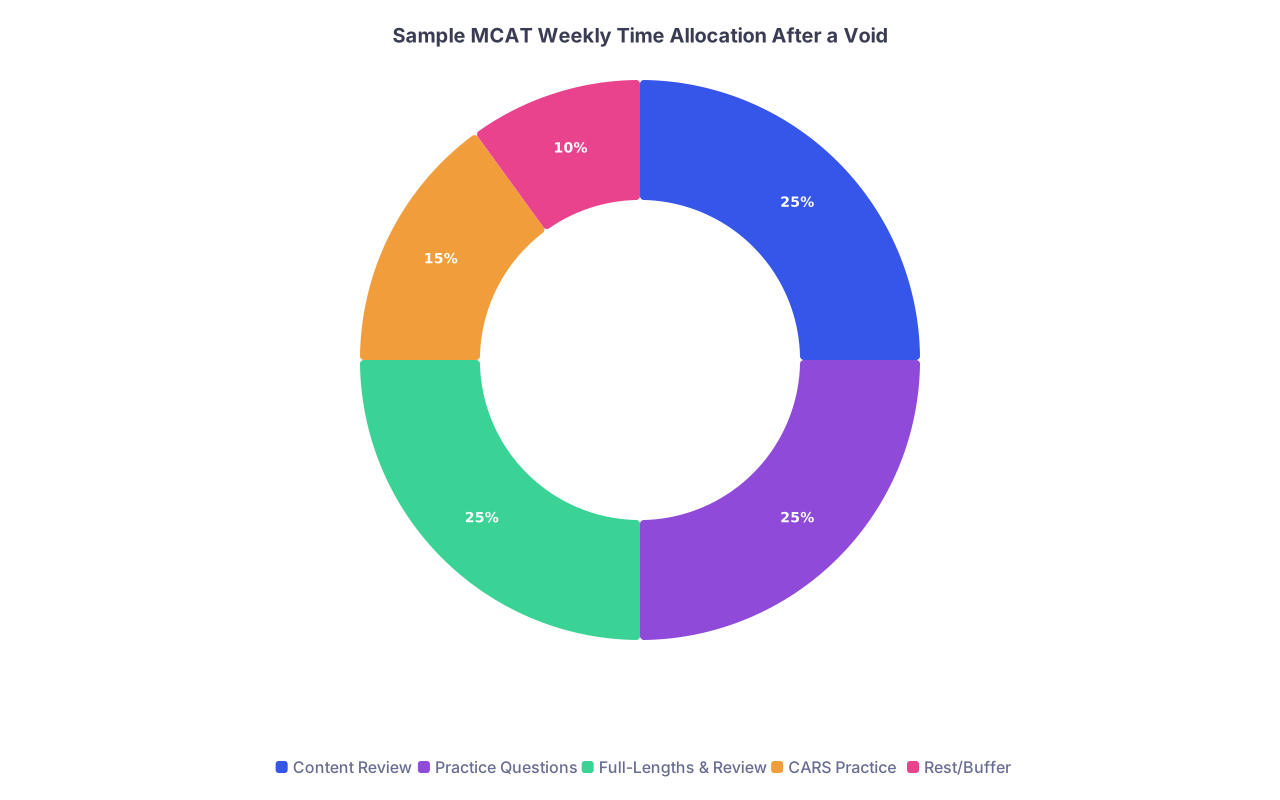
| Category | Value |
|---|---|
| Content Review | 25 |
| Practice Questions | 25 |
| Full-Lengths & Review | 25 |
| CARS Practice | 15 |
| Rest/Buffer | 10 |
Translate that into real days:
- 3 days/week:
- 2–3 hours content + 1–2 hours timed practice
- 1 day/week:
- Long CARS-focused day (3–4 passages timed + review + strategy tuning)
- 1 FL day every 1–2 weeks:
- Full exam + break
- 1 big review day after each FL
- 1 lighter / rest day
If you’re full-time in school or working, you dial the total hours down but keep the structure:
- Less time each day.
- Still some timed practice.
- Still regular CARS.
- Still full-lengths with real review.
Step 7: Fix the Non-Academic Stuff That Killed You the First Time
Plenty of people know the content and still tank test day because they treat sleep, food, and logistics like background noise. Then they’re shocked when their brain gives up halfway through P/S.
Be smarter:
- Sleep: For at least 7–10 days before the second exam, you should be waking and sleeping on the exact schedule you’ll use for test day. Not “almost.” Exact.
- Nutrition: Rehearse your test day breakfast and snacks during at least one FL. Find what keeps you steady, not sleepy or nauseous.
- Caffeine: Use on FLs the way you’ll use on test day. Don’t experiment on the real thing.
- Test Center Recon:
- Drive there once at the same time as your test.
- Time the commute.
- Figure out parking, bathrooms, vending machines, nearby coffee.
- Body logistics: If you’ve got IBS, migraines, or anything else that flared the first time, plan now:
- Talk to your doctor.
- Get accommodations if appropriate.
- Test any meds before the exam, never for the first time that morning.
If test day last time felt like chaos, your goal this time is boring predictability.
Step 8: Watch Your Identity Narratives
This part sounds soft. It’s not.
After a void, your brain loves to generate identity-level stories:
- “Maybe I’m just not a good test taker.”
- “Real premeds don’t void; I’m not cut out for this.”
- “If I mess up the second time, my whole life is over.”
These are garbage. But if you don’t catch them, you will unconsciously start studying from a place of fear and shame, which quietly wrecks your performance.
You need new scripts that are both honest and useful:
- “I mismanaged test day once. I’m rebuilding smarter with real data.”
- “My brain can learn this exam. It already has. I’m just tightening the gaps.”
- “A void is a data point, not a destiny.”
And you anchor those to behaviors:
- You show up to your scheduled study blocks.
- You review your mistakes thoroughly instead of avoiding them because they’re uncomfortable.
- You measure progress by full-length performance trends—not by one bad day.
This is how people go from void → 510+ or better. I’ve watched it happen more times than I can count.
Step 9: Know When to Pause the Application Cycle
Ugly truth: Sometimes the right move after a void is to slow down your entire timeline.
You should strongly consider pushing your application cycle back a year if:
- You will not have a solid second attempt score ready by mid- to late-summer.
- Your current GPA or extracurriculars are also weak and need strengthening.
- You’re barely holding your life together with work, family, and school.
Taking one extra year to:
- Get a strong MCAT score
- Boost your GPA with a solid post-bacc or upper-level science courses
- Build real clinical and service experiences
…is infinitely smarter than trying to force your way into a marginal cycle with a rushed score.
An extra year feels catastrophic when you’re 21. It feels like nothing when you’re 32 and matched in a good residency.
Step 10: How to Use the Next 7–10 Days, Starting Now
You don’t fix this in an abstract way. You fix it block by block.
Here’s a concrete short-term plan to snap you out of post-void limbo:
Day 1–2: Post-mortem + baseline
- Do the detailed reflection on your voided exam (what we talked about early on).
- Take a half-length practice (e.g., two sections) to see where you’re starting.
- Build a rough 4–6 week calendar based on your remaining time.
Day 3–7: Hit your top two problem areas hard
Example:
- If it’s timing + CARS:
- 3 timed CARS sets
- 2 science passage timing drills
- 1–2 hours/day reviewing past practice in detail
- If it’s content + BB:
- Pick 3–4 BB topics
- Deep review + 20–30 practice Qs for each
- 1 timed BB passage block
At the end of a week like that, you should feel one of two things:
- “This is starting to feel doable if I keep this pace and polish.”
- “Even at this intensity, there is no way I’ll be ready by my current date.”
If it’s the second one, you’re not failing; you’re listening to reality. Adjust the test date and keep going.
Your Next Concrete Step (Do This Today)
Do not just “feel motivated” and close this tab.
Right now, before you do anything else:
- Open your calendar.
- Pick a day in the next 48 hours to run a simulated half-length exam (C/P + CARS or B/B + P/S) under strict timing.
- Block off a second chunk of 3–4 hours the NEXT day labeled “Review half-length in detail.”
That one move does three things:
- Forces you back into real timed conditions.
- Gives you fresh data about where you actually stand, not where your fear says you stand.
- Creates immediate structure for your rebuild.
You voided once. Fine. That story is already written.
Now you decide whether the next chapter is “panicked repeat” or “calculated comeback.”