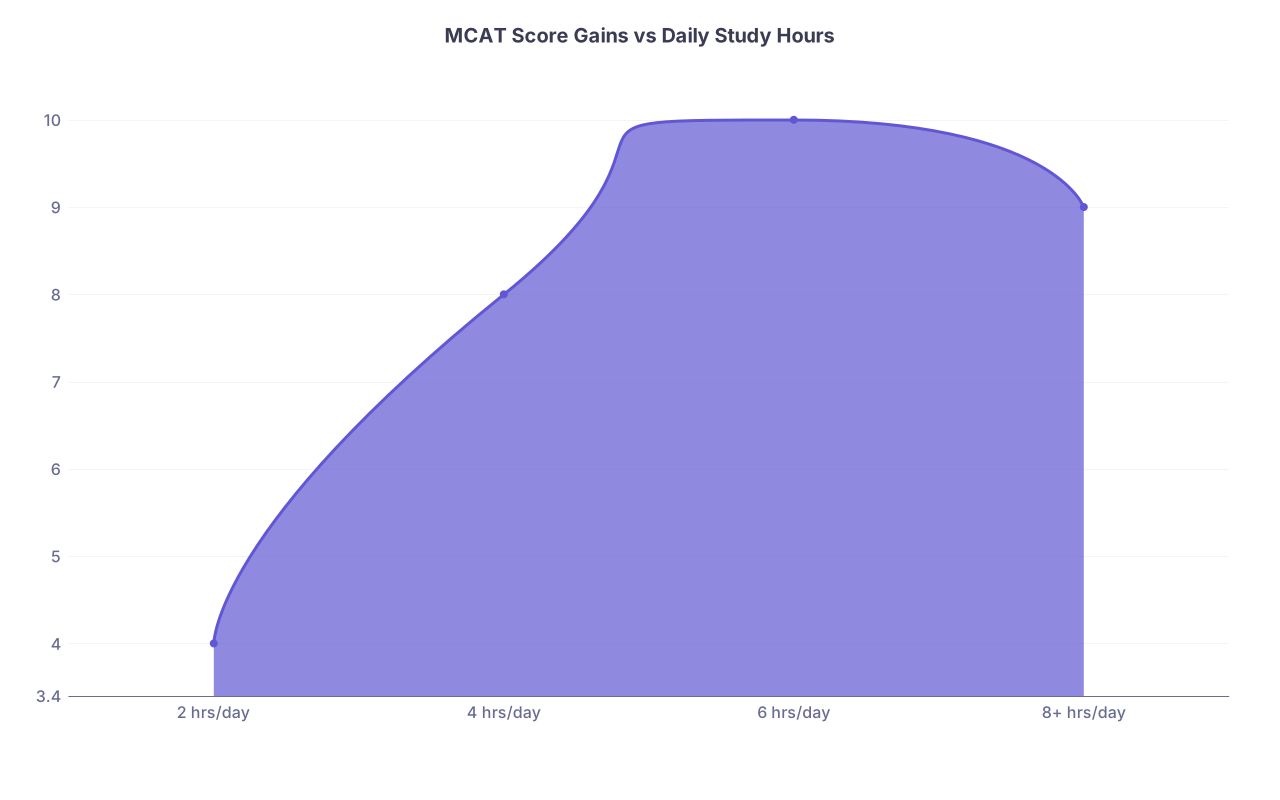
The usual “just aim for a good MCAT” advice is useless if your science GPA is already dragging you down.
If your science GPA is low and your MCAT is still pending, you are not trying to be “average.” You are trying to compensate. Different mission entirely. You need a deliberate, targeted score-boost strategy that recognizes you are playing catch-up on the academic side.
Let me be blunt:
- A mediocre MCAT with a low science GPA is application poison.
- A strong MCAT with a low science GPA is a story: “This student turned the corner.”
Your job now is to make that story true. Here is the step-by-step way to do it.
1. Get Honest About What “Low GPA” Really Means
You cannot design a smart MCAT plan until you know how far you need to overperform.
A quick reality check
Use this as a rough calibration (U.S. MD and DO combined thinking):
| Science GPA | How Schools See It | MCAT Target Range |
|---|---|---|
| 3.4–3.5 | Slight concern | 511–514 |
| 3.2–3.3 | Moderate concern | 512–516 |
| 3.0–3.1 | Significant concern | 513–518 |
| 2.7–2.9 | Major liability | 515–520+ |
| < 2.7 | Extreme outlier | 518+ and special plans |
Are there exceptions? Sure. But aiming below these ranges when your science GPA is low is like bringing a butter knife to a gunfight.
Do not lie to yourself with “trend” alone
Upward trend helps. But a 2.8 → 3.0 upward trend is not a golden ticket. Commit to this mindset:
“My MCAT must be uncomfortably strong for me.”
If you are thinking, “I would be happy with a 505,” with a 3.0 science GPA, you are not actually trying to fix the problem.
2. Diagnose the Exact Problem: Content, Skills, or Habits
Low science GPA usually reflects one or more of three issues:
- Content gaps – Never truly learned Gen Chem, Physics, Orgo, etc.
- Exam skills – You know the facts, but you misread, rush, or get trapped by distractors.
- Work habits – Poor time management, low consistency, burnout cycles.
You probably have all three to some degree, but we need to know which one dominates.
Do this in the next 7–10 days
Take a baseline full-length exam
- Use an AAMC full-length if your test is 6–10+ weeks away.
- If you are further out (3–6 months), start with a third-party full length (Blueprint, Kaplan, NS, etc.) and save AAMC for later.
Score is secondary. Analyze pattern first
After your baseline, answer these honestly:- Did you run out of time in most sections?
- Did you change answers from right to wrong frequently?
- Did you recognize content but could not reason through passages?
- Or did many questions reference content that felt like a foreign language?
Use this simple classification
| Pattern You See | Primary Problem Type | Fix Focus |
|---|---|---|
| Many unfamiliar topics | Content gaps | Heavy content review |
| Many “50/50” choices, many traps | Reasoning/skills | Passage practice with review |
| Good accuracy but low questions attempted | Timing | Section drills with strict timing |
| Wild score spread by section | Mixed | Section-specific strategy |
Your score-boost strategy changes depending on which box you live in. Most low-GPA students fall into “content + habits”.
3. Set a Realistic But Aggressive Timeline
You cannot cram your way out of a low GPA.
If you want your MCAT to actively repair your academic profile, you need enough runway to:
- Rebuild weak science foundations.
- Turn that into consistent practice-test performance.
- Avoid peaking early or burning out.
Choose your lane
Assuming you can commit serious hours each week:
| Plan Length | Weekly Hours | Best For | Realistic Goal |
|---|---|---|---|
| 12 weeks | 20–25 | Strong base, some GPA damage | 510–515+ |
| 16 weeks | 15–20 | Mixed base, 3.0–3.3 GPA | 512–518 |
| 20–24 weeks | 10–15 | Big gaps, <3.0 GPA | 513–520+ |
If your science GPA is under 3.0 and you are trying to rush with a 6–8 week plan while working 40 hours per week, you are not taking your situation seriously.
Hard rule
If you cannot put in at least 10–15 truly focused hours per week, postpone.
You are better off testing later with a monster score than earlier with a forgettable one. “I tested early” never impressed an admissions committee. “I crushed it” does.
4. Build a GPA-Compensation Study Architecture
You do not need a fancy app. You need a structure you stick to.
Here is the architecture I push for low-GPA students:
Phase 1: Content Stabilization (4–8 weeks)
Goal: Turn your weakest subjects from “I dread this” into “I can passably teach this to a friend.”
Weekly structure (example for 16-week total plan; adjust hours up/down as needed):
- 10–12 hours content review
- 3–5 hours targeted practice (end-of-chapter, discrete questions, short passages)
- 1–2 hours dedicated review of why you missed questions
Subject rotation (do not camp in your favorite):
- 2 sessions: Bio/Biochem
- 2 sessions: Chem/Phys
- 1 session: Psych/Soc
- 1–2 sessions: CARS practice every week (no exceptions)
CARS is not optional. A low GPA plus weak CARS screams “academic risk.”
Phase 2: Practice-Dominant (6–10 weeks)
Goal: Convert knowledge into timed performance under MCAT conditions.
Weekly structure:
- 2 full-lengths every 2 weeks (or 1 FL/week closer to test)
- 6–8 hours reviewing each full-length in brutal detail
- 4–6 hours topic-targeted practice (question banks, sections)
- 4–6 hours surgical content review on your true weak spots (not your ego’s opinion)
Phase 3: Polishing & Protection (2–3 weeks pre-test)
Goal: Protect your peak and smooth volatility.
- 1 full-length per week, topped out at 2 in the final 2 weeks
- Heavy focus on:
- Consistent sleep
- Test-day routine practice
- Anxiety management strategies
- Quick drills in your highest-yield weaknesses, not everything
You are not rebuilding content here. You are protecting the score you have earned.
5. Learn Like Someone Who Cannot Afford To Forget
Low science GPA often means this: you “studied” for exams and then flushed the content.
You cannot do that with the MCAT. You need durable learning.
Use the only 3 tools that actually embed knowledge
Spaced repetition (Anki or equivalent)
- Premade decks (Milesdown, AnKing MCAT) are fine, but do not use them lazily.
- Add your own cards for every question you miss. Especially:
- Formulas you blanked on
- Concept connections you misunderstood
- Traps you fell for (“I always confuse X with Y”)
Active recall before you reread
- Before a chapter, write down everything you remember about the topic from memory.
- After reading, close the book and teach it out loud.
- If you cannot explain it without notes, you do not know it.
Interleaving
- Do not study entire weeks of just physics.
- Mix topics: a day might look like:
- 60 minutes: Bio enzymes and kinetics
- 60 minutes: Physics circuits
- 45 minutes: CARS passage set
- 45 minutes: Psych memory + practice items
The MCAT is an integrated exam. Your study should mimic that.
6. Design a Score-Boost Strategy for Each Section
You cannot just “study for the MCAT.” You need section-specific gameplans, especially with a low GPA.
Chem/Phys (C/P): Fix the math and the formulas
Common low-GPA pattern: “I sort of remember the concept but freeze on equations.”
Core moves:
Build and review a formula sheet weekly
- Kinematics, work/energy, circuits, fluids, gases, logs/pH, optics.
- For each formula, write:
- What every variable means
- Common trap substitutions
- A quick sample plug-in
Do timed discrete-only drills
- 15–20 discrete questions in 25–30 minutes, then review.
- Focus: dimensional analysis, orders of magnitude, proportional reasoning.
Relearn how to approximate
- Stop reaching for a calculator mentally. Practice:
- Rounding
- Scientific notation
- Ratio logic (“If x doubles, what happens to y?”)
- Stop reaching for a calculator mentally. Practice:
CARS: Raise your floor, not chase a unicorn
You do not need to love CARS. You need to be consistently “not terrible.”
Key habits:
- 1–3 passages every single day from now until test day. Non-negotiable.
- One day per week, do a 90-minute CARS block under test conditions.
- During review, ignore the passage at first and focus only on:
- Why you chose each answer
- Why the wrong answer was tempting
- What in the passage actually supports the correct answer
You are training pattern recognition. Do not treat CARS like English class.
Bio/Biochem: Turn memorization into mechanisms
Students with low science GPAs often brute-memorized for biology tests.
That collapses on the MCAT.
You need to know processes:
For every pathway, be able to say:
- Where it happens
- Inputs and outputs
- What happens if you knock out one step
Practice heavy with passage-based questions:
- Highlight:
- Independent/dependent variables
- Experimental controls
- What is actually being measured
- Highlight:
Your mantra: “Describe the experiment in one sentence before answering anything.”
Psych/Soc: Fast, systematic points
This section is your best chance to outrun your GPA.
- Build a concept list of the top 150–200 terms (conditioning, bias types, group dynamics, theories, etc.).
- Use Anki daily for these. They are pure pattern recognition.
- Do at least 30–40 Psych/Soc questions twice a week and annotate:
- Keyword → concept
- Concept → right answer pattern
This is where you can pull a 129–132 even if your undergrad science life was a mess.
7. Review: Where Your Score Actually Increases
Your score does not rise when you do a thousand questions. It rises when you review them properly. Most students, especially those with GPA issues, review badly.
Here is the protocol I insist on:
For every missed or guessed question
Write down:
What did I think the question was asking?
What should I have noticed in the stem that I ignored?
Which step of my reasoning was wrong?
- Misread the passage
- Mis-applied a fact
- Did not know the content
- Rushed elimination
What rule or note will prevent this next time?
Turn these into:
- Anki cards
- A “mistake log” Google Doc or notebook sorted by section and topic
If you are not tired after deep review, you are not doing it right.
8. Time Management for People Who Historically Struggle in School
Low science GPA almost never happens in a vacuum. It is tied to:
- Overcommitting (jobs, clubs, family responsibilities)
- Under-scheduling (“I’ll get to it later”)
- Panic-studying before exams
You cannot run that playbook for the MCAT.
A simple weekly structure that actually works
Block fixed MCAT sessions on your calendar like a job
- Example:
- Mon–Thu: 7–9 pm
- Sat: 9 am–1 pm
- Sun: 2–5 pm
Protect these. Treat them as shifts. Phone in the other parts of your life before you cancel these.
- Example:
Decide in advance what each block is for
- Monday: Bio content + short quiz
- Tuesday: CARS + Psych/Soc
- Wednesday: Chem/Phys + math drills
- Thursday: Review + mixed practice
- Weekend: Full-length or section tests + review
Do not study “until exhausted”
- Use 50–60 min focused / 10–15 min break cycles.
- Aim for consistency over hero days. 2 hours daily for 5 days is better than one 10-hour crash day that burns you out.
9. If You Are Close to Test Day: Triage, Not Panic
Let us say your exam is 4–6 weeks away and:
- Your science GPA is low.
- Your practice scores are still below target.
You have three choices:
- Keep the date and hope for a big jump.
- Keep the date but execute a hyper-focused final push.
- Postpone strategically.
When you should seriously consider postponing
Look at your AAMC full-length scores (not third-party):
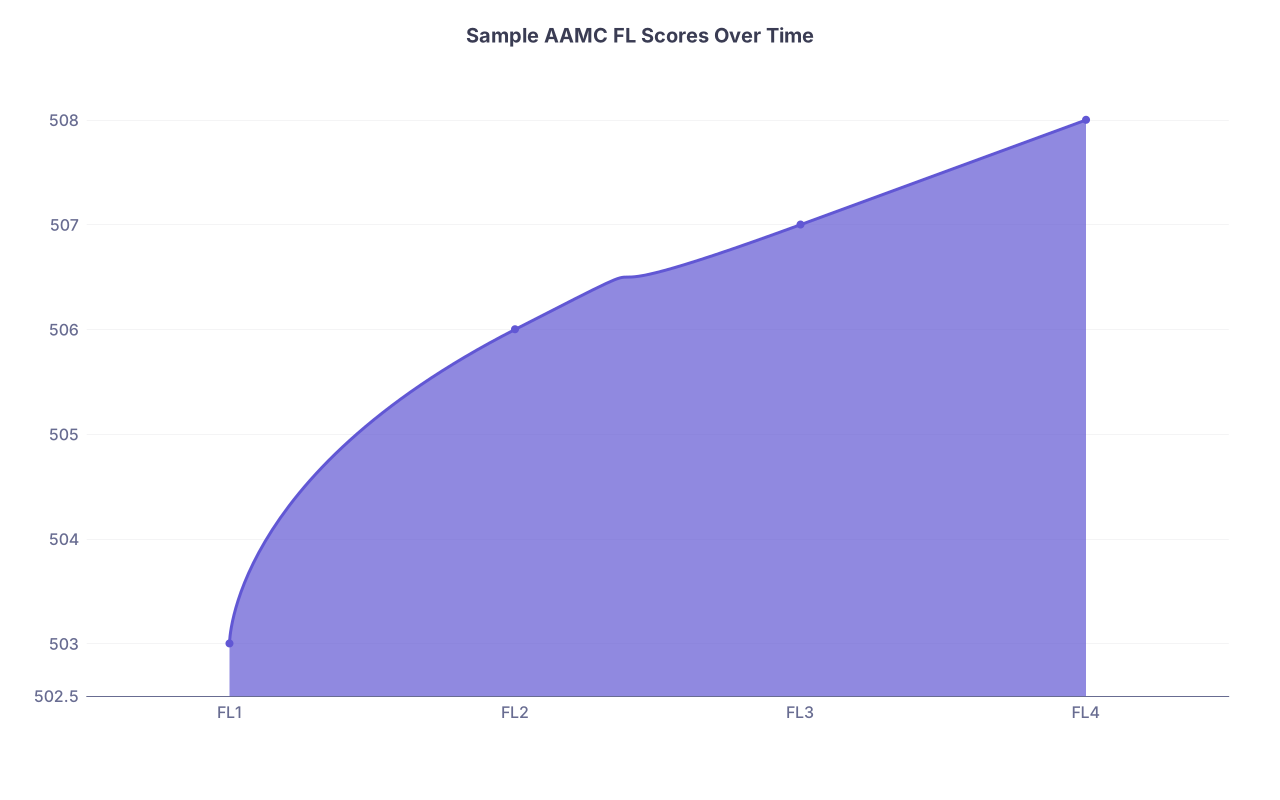
| Category | Value |
|---|---|
| FL1 | 503 |
| FL2 | 506 |
| FL3 | 507 |
| FL4 | 508 |
Rules of thumb:
- If your last two AAMC FLs are more than 5 points below your needed score and you have less than 3 weeks left, postponing is smart.
- If you have not yet taken any AAMC FLs and your test is less than 3 weeks away, you are flying blind. Also a warning sign.
Postponing is not failure. A mediocre official score with a low GPA is failure. That follows you.
If you decide to keep the test date
You must go into triage mode, not “review everything” mode:
- Identify the 2 weakest sections by score and confidence.
- Within those, identify the 3–4 highest-yield topics that keep burning you.
- Spend 70% of your remaining study time on:
- Targeted content review for those topics
- Dozens of questions on those topics
- Timed section practice for those sections
The last 30% goes to:
- Maintaining CARS frequency
- Light review of your strongest section (protect the 129–130+ if you have it)
- Sleep, physical health, and test-day simulation
You are tightening the spread, not trying to become a different person in 3 weeks.
10. Integrate MCAT Prep With Your “Redemption Narrative”
One more layer people ignore: how your MCAT fits the story of your low GPA.
You want admissions committees to say, “Yes, the GPA was rough early, but the MCAT and recent work prove this student is now academically solid.”
So your MCAT plan should sync with:
Recent course work
- If you are taking upper-level sciences now, aim for A’s while prepping. That combo is powerful: “New trajectory + strong MCAT.”
Personal statement and secondaries
- Do not whine about the past. Do not over-explain.
- Briefly own it: you were immature, stretched too thin, or had life events.
- Then point to concrete change: structured MCAT approach, recent As, disciplined schedule.
Letters of recommendation
- Ideally, a science professor who has seen your improvement. Someone who can say:
- “They were not top of the class early on, but they have become one of the most diligent, consistent students I have taught.”
- Ideally, a science professor who has seen your improvement. Someone who can say:
The MCAT is the quantifiable proof that this is not just talk.
11. Mental Game: You Cannot Panic Your Way to a 515+
I have watched plenty of low-GPA students overcorrect. They study 6–7 days a week, burn out mentally by week 4, and then spiral.
Your brain is your score. You have to protect it.
Practical mental rules
- One true off day per week. No MCAT. Let your brain file memories.
- Short daily check-in: “What are my top 2 objectives today?” Write them. Stay honest.
- Stop comparing yourself to Reddit score reports. They are cherry-picked and meaningless for you.
If you catch yourself thinking, “I am dumb” or “I always mess up,” translate it into something actionable:
- “I am dumb at physics” → “I have not drilled forces and circuits enough. I will do 20 questions on that today.”
Emotion is allowed. Let it push action, not self-destruction.
12. Concrete 6-Week Sample Plan (For Someone Around 505 Aiming 512+)
You like specifics. Fine. Assume:
- Science GPA: 3.1
- Baseline AAMC FL: 505 (127/125/126/127)
- MCAT in 6 weeks
- 20 hours/week available
Here is a high-level structure.
Weeks 1–2
Mon:
- 60 min CARS (3 passages)
- 90 min Chem/Phys content (fluids, circuits) + 20 min math drills
Tue:
- 60 min Bio/Biochem (enzymes, kinetics)
- 60 min Psych/Soc content + 30 min practice
Wed:
- 60 min CARS
- 90 min mixed content review from last FL mistakes
Thu:
- 120 min Chem/Phys practice + review
Sat:
- AAMC FL2 (or third-party if you are still saving AAMC)
Sun:
- 3–4 hours FL review (C/P + CARS in detail)
Weeks 3–4
- One AAMC FL each week
- 6–8 hours detailed review
- Remaining hours:
- Timed section practice:
- One 59-question C/P block
- One 53-question B/B block
- CARS every other day (2–3 passages)
- Focused Psych/Soc review with Anki daily
- Timed section practice:
Weeks 5–6
- Week 5: AAMC FL3
- Week 6: AAMC FL4 about 7–8 days before test
- Review pattern:
- Deep dive into the two weakest sections each time
- Last 5–6 days: short mixed sets, light review, sleep focus
No all-nighters. No “I’ll learn Orgo from scratch this week” fantasies. You execute what is realistic and high-yield.
13. The Data Story You Want to Tell
When you are done, the picture you want is simple:
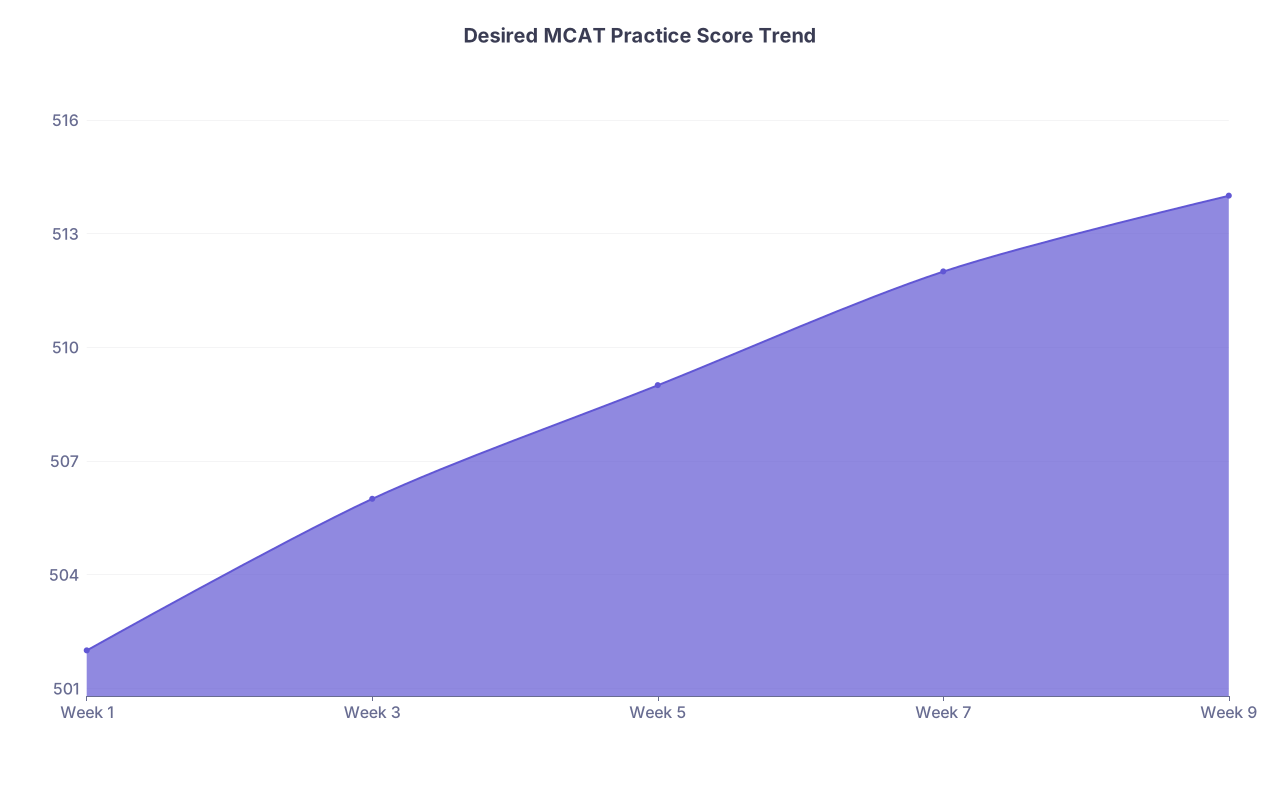
| Category | Value |
|---|---|
| Week 1 | 502 |
| Week 3 | 506 |
| Week 5 | 509 |
| Week 7 | 512 |
| Week 9 | 514 |
- Not perfectly linear.
- Not starting high.
- But trending upward with your last 2–3 full-lengths in or above your target range.
Pair that with:
- Recent strong science coursework
- A direct, mature explanation of your past
- A clear, disciplined study narrative
Now your “low science GPA” is not the headline. It is context. The headline is: This applicant built themselves into a different student.
Strip it down to essentials
- If your science GPA is low, you do not need an “okay” MCAT. You need a decisively strong one, with a clear, ruthless plan tailored to your specific weaknesses.
- Structure your prep: content stabilization → practice-dominant → polishing. Review every missed question like it is a lesson, not a wound.
- Protect your trajectory. Postpone if your AAMC scores are not close. Use your MCAT, recent grades, and your story together to prove you are not the same student your transcript shows.