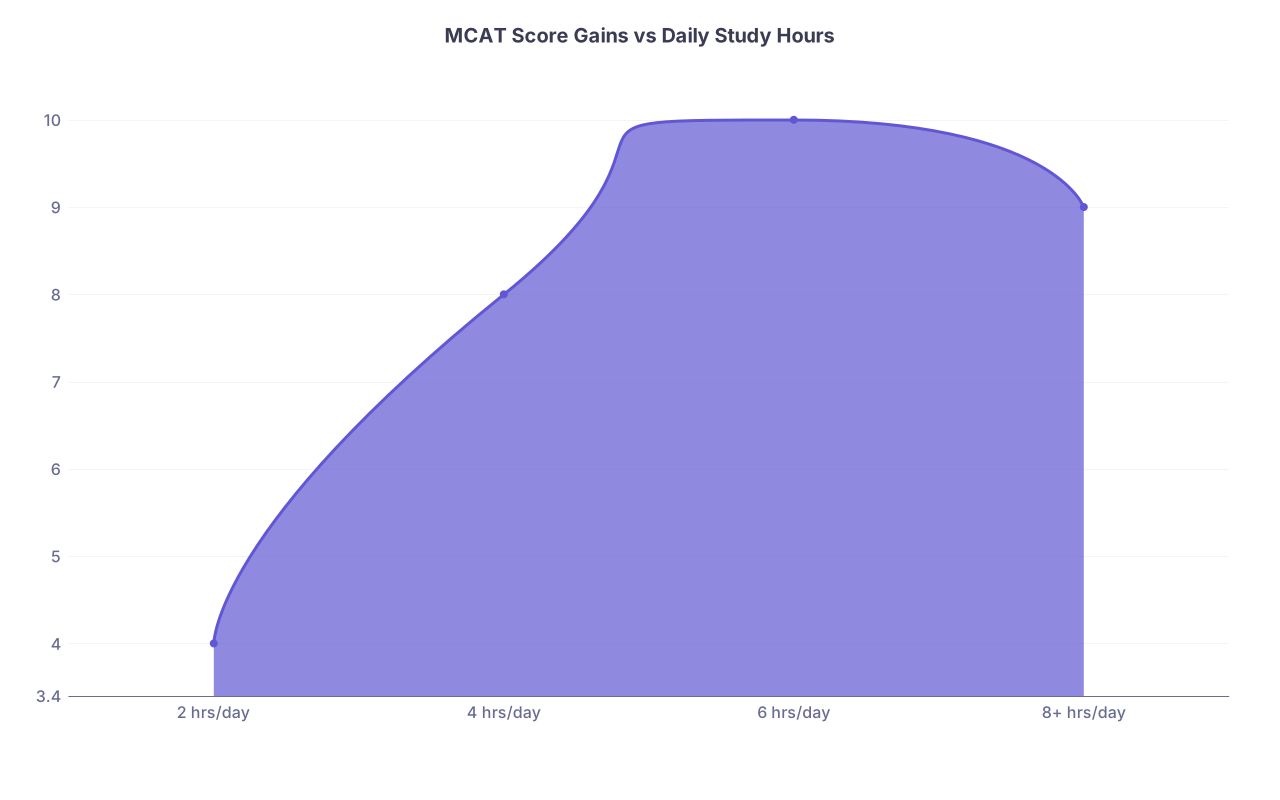
The usual MCAT advice collapses the second you’re drowning in a 20-credit STEM semester.
If you’re in orgo II, physics, biochem, plus a lab, maybe research, maybe a job—and you cannot drop anything—then the typical “just study 3–4 hours a day for the MCAT” plan is fantasy. You’re not lazy. The plan is just wrong for your reality.
Here’s how you handle MCAT prep when your semester is already brutal and your schedule is not negotiable.
1. First, Decide: Are You Studying To Take The MCAT, Or Studying To Learn The Exam?
Let me be blunt: many students in your situation burn themselves out trying to do a full MCAT prep and a killer STEM semester and end up with:
- mediocre grades,
- a mediocre MCAT,
- and several months of lingering burnout.
That’s the worst-case scenario. Your first job is to not walk into it blindly.
You need to decide which game you’re playing this semester:
- Full-score push: You’re actually taking the MCAT within 2–4 months and aiming to be fully ready.
- Foundation semester: You’re building skills, content, and test familiarity now, then doing a focused push in a lighter term / summer.
- Survival mode: You’re postponing the MCAT but need to do the bare minimum now to not fall behind long-term.
If you’re carrying 16–20 credits of heavy STEM and can’t drop:
- Full-score push is rarely wise unless your baseline is already strong (e.g., 510+ on a diagnostic or prior prep).
- Most students are better off doing a Foundation semester with a calm, deliberate plan.
So before we talk schedules, answer honestly:
- Do you already have a test date booked?
- Are you locked into applying in the very next cycle, or could you shift one year?
- What was your last MCAT practice test (or diagnostic) score?
You don’t have to tell me—but you do have to be honest with yourself. The plan changes depending on those answers.
2. Hard Truths About Time: What You’re Actually Working With
Stop guessing. Count your hours.
Take one normal week and map it out roughly. If you don’t know, you’ll keep trying to cram a 30-hour MCAT plan into a 7-hour slot and feeling like a failure.
Let’s run a realistic example.
You’re taking:
- Orgo II (with 3-hr lab)
- Physics I (with 3-hr lab)
- Biochem
- Upper-level bio elective
- Maybe a 10-hour/week job or research
Classes + labs + commuting around campus: ~20–25 hours
Studying/assignments for those: often 2 hours outside per hour in-class for hard STEM → 40–50 hours
Job/research: 10 hours
Sleep: please tell me at least 7 hours/night → 49 hours
You’re at ~119–134 hours/week already.
There are 168 hours in a week. That gives you:
168 – (119 to 134) = 34–49 “free” hours
Now subtract:
- Eating / basic hygiene / errands: 10–14 hours
- Walking around, random life friction, mental breaks: 7–10 hours
You realistically have about 15–25 usable hours per week where MCAT could even fit. And that assumes you’re not already behind in classes.
So no, you’re not going to do 4 hours/day of MCAT on top of this and stay functional.
For a heavy semester, a serious but sustainable MCAT commitment usually looks like:
- 1–1.5 hours on weekdays (4–5 days)
- 3–4 hours total over the weekend
That’s 7–11 hours/week of MCAT, max. If you’re thinking “I’ll just do 20,” you’re borrowing from sleep and focus. The bill comes due.
3. If Your MCAT Date Is This Semester: Triage Mode
If your exam is within 8–12 weeks and rescheduling isn’t possible—financially, logistically, or timing-wise—then you’re in triage mode. Not ideal. But not hopeless.
You need three priorities:
- Don’t tank your GPA.
- Build test-taking stamina and familiarity with the real exam.
- Patch the worst content gaps that repeatedly cost you points.
You do not have time for:
- Endless content review from page 1 like it’s a regular class.
- Watching full-length lecture series for every topic.
- Perfect notes on every tiny detail.
You have time for focused, diagnostic-driven work.
Step 1: One immediate diagnostic (if you haven’t already)
Within the next 7 days, block one full day and:
- Take a full-length exam under real conditions (AAMC if possible, or a solid third-party).
- Review that test slowly over the next 3–4 days in 30–60 minute blocks.
You’re not doing this to boost your score. You’re doing it to find:
- Which sections are bleeding points (e.g., CARS vs Chem/Phys).
- Which question types kill you (e.g., multi-step math, experimental passages, inference).
- Which content areas you flat-out don’t know (e.g., circuits, amino acids, endocrine).
Write those patterns down in a running doc or notebook. You’ll use that list to drive everything else.
Step 2: Ruthlessly narrow your weekly MCAT goal
With ~8–12 weeks and a packed semester, each week’s MCAT work should answer one question:
“What few things can I fix this week that will move my score the most?”
Not “what chapter am I supposed to be on?”
Examples of strong weekly goals:
- “Raise my accuracy on easy-medium CARS passages from 60% to 75%.”
- “Stop missing basic circuit questions (Ohm’s law, series vs parallel).”
- “Solidify the 20 core amino acids and enzyme basics.”
Then you design your 7–11 MCAT hours/week around that, not around some generic schedule.
Step 3: Switch from “content-first” to “questions-first”
Under time pressure, you get more score per hour from:
- Doing practice questions and passages, then
- Studying only the content you miss or guess on.
So a weekday study block might look like:
- 40 minutes: 2–3 MCAT-style passages in your weakest section.
- 20–30 minutes: Deep review of every question—why the right answer, why the wrong ones. Then 10–15 minutes light content review on what repeatedly tripped you.
That’s it. No “two hours of reading a chapter” without touching questions.
Step 4: Be realistic about score expectations
If your baseline is 495 and your semester is crushing, aiming for 520 in 10 weeks is fantasy.
You can usually expect something like:
- +5–10 points with disciplined, targeted, question-heavy work and minimal burnout.
- More than that might require a lighter future semester or dedicated study time.
If this cycle absolutely depends on a strong score and your diagnostic is far from your target (say <500 aiming for 510+), start planning now for a possible retake with protected time. Hope is not a strategy.
4. If Your Exam Is 4–12+ Months Away: The “Foundation Semester” Plan
This is where you actually have leverage. A heavy semester is not the enemy if you use it correctly—it’s content you’ll later see again on the MCAT.
Your main job in a foundation semester:
- Turn your classes into MCAT prep instead of treating them as separate worlds.
- Build habits and skills (CARS, data interpretation, stamina) that pay off later.
- Avoid burnout so you still have gas in the tank when your full MCAT push starts.
Here’s what that looks like.
Strategy A: Integrate your STEM classes with MCAT topics
Stop duplicating effort. If you’re in:
- Orgo → tie mechanisms and functional groups directly to MCAT-style questions.
- Physics → prioritize kinematics, forces, energy, circuits, fluids.
- Biochem → hammer amino acids, enzymes, metabolism, cell biology.
When you study for exams:
- After you finish a chapter for class, do 5–10 MCAT questions on that specific topic.
- When you review a problem, ask: “How would the MCAT wrap this into a passage with graphs, experimental data, or annoying wording?”
Your brain learns how the test thinks while you study for school.
Strategy B: Make CARS non-negotiable, but small
CARS is the easiest section to keep warm in a busy term, and the hardest to “cram” later.
Do this:
- 3–4 passages, 4–5 days/week. That’s 30–40 minutes per session.
- Use any solid CARS resource, but treat it like going to the gym: small, consistent workouts.
The goal isn’t speed at first. It’s building reading stamina and comprehension:
- What is the author’s main point?
- Where in the passage would you find support for X?
- Why is each wrong answer wrong, not just why the right answer is right?
Over months, this habit alone can be the difference between a 124 and a 128+ in CARS.
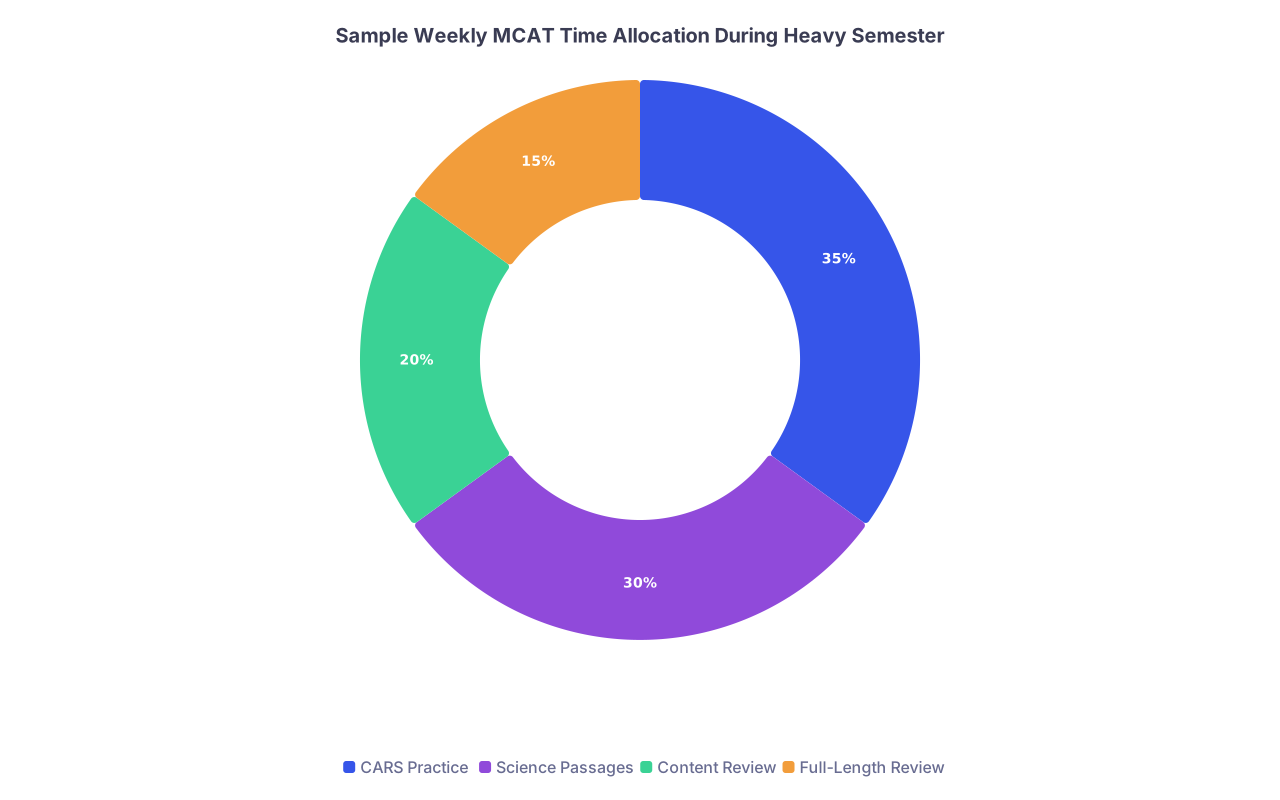
| Category | Value |
|---|---|
| CARS Practice | 35 |
| Science Passages | 30 |
| Content Review | 20 |
| Full-Length Review | 15 |
Strategy C: Weekly structure that actually fits
In a brutal semester where you’re in “foundation mode,” a realistic week might look like:
- 4 weekdays: 30–45 minutes CARS + 15–20 minutes of one science passage or discrete set.
- 1–2 weekdays: 30–45 minutes organizing your content gaps from class into an MCAT-focused list.
- Weekend: 2–3 hours split into two blocks:
- One block on science passages and reviewing them.
- One block on flashcards or targeted content for your weakest topics.
That’s still only about 7–9 hours/week. But it’s deliberate.
You’re not “doing MCAT” randomly. You’re sharpening yours skills in small, cumulative ways.
5. Micro-Planning Your Actual Week: What To Do Day-To-Day
The hardest part in a heavy semester is not understanding what to do. It’s execution when you’re exhausted and behind.
So build your plan at the week level and micro level.
Sunday 30–minute planning ritual
Every Sunday, sit down with:
- Your class syllabi.
- Your exam/quiz due dates.
- Your work/research schedule.
- Your MCAT target date (even if approximate).
Then:
- Mark your non-negotiables for the week: tests, labs, shifts.
- Identify 3–4 “MCAT windows” of 45–60 minutes that you can reasonably protect.
- Decide the theme of your MCAT week:
- Example: “Data analysis in bio/biochem passages + amino acids,” or “CARS + circuits.”
Write this down. If it only lives in your head, it’ll lose to Netflix and emergency orgo cramming.
Daily micro-rules that keep you honest
A few rules that work well in heavy terms:
- No zero days for CARS: even 1 passage is fine if you’re wrecked. But not zero.
- Never study MCAT after midnight: post-midnight time is the most expensive and least effective.
- Hard class week (exams stacked)? Cut MCAT in half, but don’t fully stop. Momentum > intensity.
An example week around a big orgo exam:
- Mon: 3 CARS passages (30–35 min). That’s it.
- Tue: 3 CARS + 1 short physics discrete set (45 min).
- Wed: Zero MCAT. Orgo exam tomorrow.
- Thu: 3 CARS + review last week’s missed questions (40–45 min).
- Fri: 2 CARS + 1 bio passage (40 min).
- Sat: 2-hr block: focus on the one weakest area from last week’s work.
- Sun: Rest or light flashcards for 20–30 minutes.
Is this heroic? No. But it’s sustainable. And sustainable wins.
6. Protecting Your GPA While Still Moving MCAT Forward
Med schools do not care that you were studying for the MCAT when you tanked Orgo II and Physics I. They just see the grades.
If something has to give in a week, it’s MCAT, not your semester performance—especially if:
- You’re not taking the MCAT for another 6–12 months.
- You’re hovering near a GPA threshold that matters (e.g., 3.4 vs 3.6).
The trick is avoiding the “all or nothing” trap:
- “I’m too behind in classes, I’ll just stop MCAT for the rest of the month.”
Bad idea. You lose skills and habit, then have to rebuild from scratch.
Instead, think in tiers.
| Week Type | MCAT Hours | Core Focus |
|---|---|---|
| Normal Week | 7–11 | CARS + weakest science |
| Midterm Week | 3–5 | Short CARS only |
| Finals Week | 1–3 | Minimal CARS/flashcards |
Tier down, don’t fully shut off.
A single CARS passage and 10 minutes of flashcards takes less time than scrolling your phone before bed, and it keeps your head in the game.
7. Burnout Management: If You Break, Your Plan Breaks
I’ve watched too many students go all-out for 3 weeks, then spend 3 more weeks half-functioning.
You cannot afford emotional ICU during a semester like this.
A few guardrails:
- Protect sleep like an exam grade. Less than 6 hours/night for more than a few days destroys MCAT performance and memory. That’s not drama; that’s physiology.
- Drop the guilt narrative. “I should be doing more MCAT” is useless if the reality is 5 exams in 10 days. Do what fits the week. Then move on.
- Put your phone somewhere else during MCAT blocks. You don’t have enough time to waste half of it checking texts.
Watch for these red flags:
- You’re rereading the same sentence three times and nothing sticks.
- You feel dread every time you see an MCAT book.
- You’re regularly skipping meals or going to bed at 2–3 a.m. just to keep up.
When that happens:
- Cut your MCAT load by 30–50% for a week.
- Keep the bare minimum: 2–3 CARS days + one short science block.
- Then reassess.
This is not quitting. It’s preventing a crash that costs you far more later.
8. When You Truly Cannot Move The Test Date
Sometimes the reality is:
- Committee letter timeline.
- Visa constraints.
- Personal or family circumstances.
- School’s linkage program schedule.
You have to take the exam during or right after this brutal semester. Dropping isn’t possible. Postponing isn’t realistic.
In that scenario, two more moves matter.
Move 1: Use your classes as forced content review
You don’t have time for separate, full MCAT content runs. So you:
- Treat every lecture as a potential MCAT passage seed.
- When you learn a concept, you immediately ask:
- “What would this look like in an experiment?”
- “What kind of graph or table would they give me?”
- “What conceptual twist would they add to make this non-obvious?”
Then, when possible:
- Find 5–10 MCAT-style questions that touch that concept within 24–48 hours.
- It locks the idea in and doubles as MCAT prep.
For example:
- Finish a lecture on enzyme kinetics → do 5–10 questions on Vmax, Km, Lineweaver-Burk plots.
- New physics unit on fluids → do a few MCAT problems on pressure, Bernoulli, continuity.
You’re not adding “more studying.” You’re bending your existing study toward the exam.
Move 2: Make your full-lengths count
During a heavy STEM semester, you probably cannot do a full-length test every week and properly review it.
Aim for:
- Every 2–3 weeks near the endgame, if your exam is close.
- Non-negotiable: spend at least as much time reviewing each full-length as taking it.
And when you review, don’t just mark answers right or wrong. Look for:
- Patterns in timing—where you consistently rush or run out of time.
- Repeated content misses—topics that show up multiple times and still confuse you.
- Thought process errors—misreading questions, second-guessing correct answers, overcomplicating simple ones.
Take notes in one running “MCAT brain” document:
- Sections: CARS patterns, Chem/Phys patterns, etc.
- Bullet points on “Lessons learned” from each full-length.
That document is gold in your last 3–4 weeks.
9. A Simple Example Plan: 10-Week Crunch + Heavy Semester
Let me put this together as a concrete sample scenario.
You:
- Are in a 17-credit STEM semester with labs.
- Work 8–10 hours/week.
- Have an MCAT 10 weeks from now that you cannot move.
Your high-level plan might look like this:
Weeks 1–2:
- One diagnostic full-length.
- 2–3 MCAT sessions on weekdays (45–60 min).
- 1 longer weekend block (2–3 hours).
- Focus: CARS habit + identifying top 2 weakest content areas.
Weeks 3–6:
- Every other week: one full-length on a low-academic-load day.
- 3–4 short weekday sessions (40–60 min): mix of CARS + targeted science passages.
- Weekend: 2–4 hours, mostly full-length review and reinforcing patterns.
- Focus: fix repeated mistakes; get timing under control.
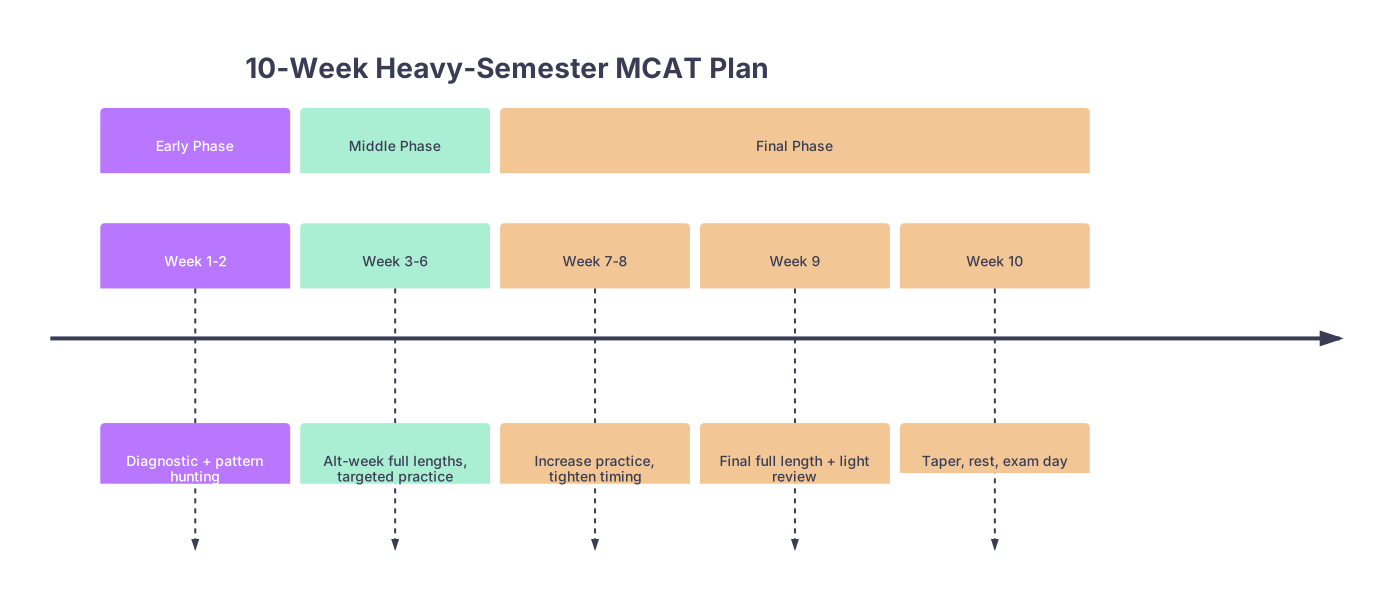
| Period | Event |
|---|---|
| Early Phase - Week 1-2 | Diagnostic + pattern hunting |
| Middle Phase - Week 3-6 | Alt-week full lengths, targeted practice |
| Final Phase - Week 7-8 | Increase practice, tighten timing |
| Final Phase - Week 9 | Final full length + light review |
| Final Phase - Week 10 | Taper, rest, exam day |
Weeks 7–8:
- 2 full-lengths total (e.g., start of week 7 and 8).
- Weekdays: 3–4 short sessions focused mostly on reviewing those full-lengths and doing extra passages in chronic weak spots.
- Be prepared to cut MCAT by 30–40% during any week where school exams spike hard.
Week 9:
- One final full-length early in the week.
- Light CARS + targeted warm-up sets.
- Protect sleep ruthlessly.
Week 10:
- 2–3 days of short, calm sessions reviewing error logs, formulas, and high-yield topics.
- Day before exam: no heavy study. Glance at your summary notes, go for a walk, and go to bed early.
Is this ideal? No. Does it work for students who cannot move their classes or exam date? Yes. I’ve seen it.
10. Final Non-Negotiables: What You Do Not Sacrifice
No matter how tight your semester is, do not sacrifice:
- Sleep down to 4–5 hours/night for weeks.
- Your entire GPA for a single shot MCAT attempt.
- Every shred of downtime until you hate studying.
If you feel cornered, your instinct is to do everything, all the time. That’s how you end up with:
- C’s in core prereqs
- a 503 MCAT
- and a personal statement about “resilience” that admissions sees right through
You’re better off:
- Protecting your GPA now.
- Building MCAT skills incrementally.
- Taking the test when you’ve built a real base.
If that means shifting your application cycle, that’s not failure. That’s strategy.
Key points:
- You can’t run a normal “full-time MCAT plan” on top of a maxed-out STEM semester. You need a lean, targeted, question-driven plan tied tightly to your classes.
- Protect your GPA and your sleep first, then fit 7–11 focused MCAT hours/week around that, adjusting down (not to zero) during exam-heavy weeks.
- Decide clearly whether this semester is a foundation-building phase or a true test-prep sprint—and commit to a plan that matches your actual time and energy, not your wishful thinking.