What do you do when your gap-year job wants 40 hours a week, your PI wants three abstracts, and the MCAT gods demand 300+ hours of studying?
This is the exact choke point for a lot of premeds: you took a gap year thinking, “I’ll work, save money, beef up my app, and crush the MCAT.” Then reality shows up: clinic shifts, lab meetings, commute, maybe family obligations. And you suddenly realize: I cannot just ‘fit in’ MCAT prep whenever.
Let’s sort this out like an adult, not like a fantasy schedule on a whiteboard.
Step 1: Decide What Your Gap Year Is Actually For
You cannot optimize for everything at once. You have to pick a priority.
There are usually three competing goals in a gap year:
- Make money (scribe/MA/EMT/other job)
- Do research / clinical work to boost your app
- Crush the MCAT
You only get to pick one true priority. The others become “important but flexible.”
Here’s the rule I use:
- If your GPA is average or shaky, or you have no score yet → MCAT is priority #1.
- If you already have a strong MCAT score → research/clinical narrative can take the lead.
- If you’re applying this upcoming cycle and have no MCAT yet → MCAT trumps basically everything.
I’ve seen students try to split attention perfectly: full-time job, heavy research, 5–10 hours MCAT a week. They drag this out for 8–10 months, burn out, and end up with a mediocre first score and a re-take. Re-takes are brutal to explain and expensive in time and stress.
So be blunt with yourself: is this gap year mostly to repair/improve your academic profile (MCAT + GPA)? Or mostly to add experiences (work, research, leadership)? Answer that, and the exam timing becomes much easier.
Step 2: Understand the Non-Negotiable Timing Constraints
There are three calendars you’re juggling:
- The MCAT testing calendar
- AMCAS/AACOMAS application timeline
- Your work/research schedule
At a minimum, you want your score back before you submit your primary application or soon after.
Score release is ~1 month after your test date. So:
- April exam → early May score
- May exam → early June score
- June exam → early July score
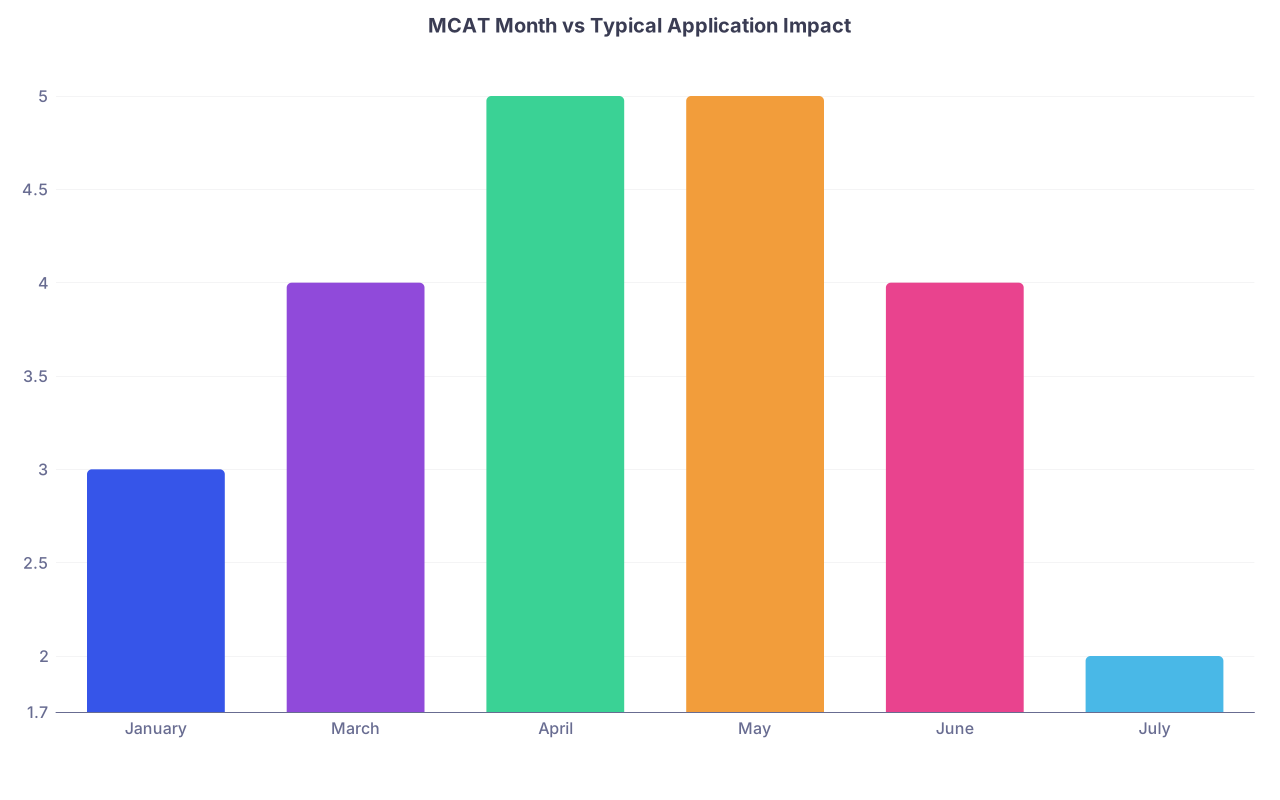
| Category | Value |
|---|---|
| January | 3 |
| March | 4 |
| April | 5 |
| May | 5 |
| June | 4 |
| July | 2 |
(Here, 1 = poor timing, 5 = ideal timing for typical applicants.)
If you’re applying in June of your gap year:
- Best testing window: January–May of that same year.
- Late but workable: early June.
- Risky: late June or later (your application likely sits incomplete at some schools).
If you’re in an earlier gap year and not applying this upcoming cycle, you have more freedom, but the logic is the same: don’t push the MCAT so close to application season that you’re rushed, panicked, or forced to apply late.
Step 3: Match Test Date to Your Work/Research Reality (By Scenario)
Now we get specific. I’ll walk through the common gap-year situations and tell you what tends to work. And what absolutely does not.
Scenario A: Full-Time Scribe / MA / EMT (40+ hours, Shifts)
You’re doing patient-facing work, probably:
- 3–4 10–12 hour shifts
- Occasional nights/weekends
- Commute baked in
Here’s what I’ve seen actually work:
Plan A (Best): Test in the first 6–8 months of your gap year
Example: You graduate in May, start scribing in June, want to apply the following June.
Solid plan:
- June–August: Settling into job, light content review 5–8 hours/week
- September–December: Ramp to 10–15 hours/week MCAT
- Test: January–March
- Score: February–April
- Application work: April–June
You’re balancing work and MCAT, but you’re done with the exam before application season insanity.
Plan B (OK, but more painful): Cut work hours 2–3 months before exam
If you absolutely cannot move the test earlier:
- Maintain full-time job while doing 8–10 hours/week studying for a few months
- Then 2–3 months before test: drop to 24–32 hours/week if at all possible
- Use that freed time to hit 20 hours/week+ of focused prep
If your employer claims they “can’t” reduce your hours, decide what you care about more: that job, or the score that determines where you’ll be for the next decade.
Let me be direct: trying to do a real 40–50 hour/week shift job + 20 hours MCAT every week for months is how people end up rescheduling twice and still walking in under-prepared.
Scenario B: Research Assistant (Mostly Weekdays, Some Flexibility)
Research jobs often look like:
- 9–5 lab / office hours
- PI who may or may not respect boundaries
- Some crunch times around conferences or data deadlines
You have more control here than shift work, if you’re willing to set boundaries.
Two sane approaches:
Option 1: Early-morning student
- Work: 9–5
- MCAT: 6–8 AM, 4–5 days/week
- Weekend: 4–6 hours total
You get 14–20 hours/week consistently. After 3–4 months of that, you’re in very solid shape. Test in January–April.
This only works if you actually go to bed on time and don’t pretend you can be productive at 1 AM and 6 AM. You can’t. Pick one.
Option 2: Front-load research, then pivot
First 3–4 months: heavy research focus, maybe 45–50 hours/week, minimal MCAT.
Then next 3–4 months: cut to 30–35 hours/week research, add 15–20 hours/week MCAT, and test at the end of that block.
This works well if your PI is semi-reasonable and you can say: “I’m planning to take the MCAT in March, so from January on I’ll need to be closer to 30 hours/week.”
Scenario C: Two Part-Time Roles (e.g., 20 hr research + 20 hr scribing)
This is when you thought you were being smart (“I’ll diversify my experiences!”) and now you’re just tired.
The good news: you can usually restructure.
Your target: never let all obligations add up to more than ~50 hours/week max including MCAT. Ideally 40–45.
So if you want 15 hours of MCAT/week:
- Research + job should stay ≤ 25–30 hours/week in the 2–3 months before the exam.
- If they don’t, you’re lying to yourself about bandwidth.
In practice, this often means:
- Dropping one role temporarily or permanently
- Or telling one supervisor you’ll scale back hours Feb–April, test in April, and then increase again
Yes, it’s awkward. Yes, you still need to do it.
Scenario D: You’re Living at Home, Working Part-Time, Low Expenses
This is actually the MCAT luxury tier, even if it doesn’t feel like it.
If you’re only working 15–25 hours/week and not stressed by money:
Do not drag the MCAT out over 9–12 months “since you have time.” That’s how people lose content, restart Anki decks three times, never build momentum.
Do a focused 3–5 month push where MCAT is your main “job” and work is secondary.
Example schedule:
- Work: 20 hours/week
- MCAT: 25–30 hours/week
- Duration: 12–16 weeks
- Result: You’re ready, or you know early that you’re not on track and can adjust the date.
Test in January–May of your application year, or anytime the calendar year before if your prereqs are fresh.
Step 4: Use This Simple Table to Pick a Test Window
Here’s a quick “rough reality” guide based on weekly work hours.
| Weekly Work Hours | MCAT Study Hours/Week | Typical Prep Duration | Recommended Test Window (for June apps) |
|---|---|---|---|
| 0–10 | 25–35 | 10–14 weeks | Jan–May of app year or earlier |
| 10–25 | 20–30 | 12–16 weeks | Jan–May of app year |
| 25–35 | 15–20 | 16–20 weeks | Jan–April of app year |
| 35–45 | 10–15 | 20–28 weeks | Nov–March before app year |
| 45+ (shifts) | 5–10 (not ideal) | Usually not realistic | Reduce work hours or delay test |
If you’re in that bottom row (45+ hours) and unwilling or unable to change it, I’m blunt: you probably shouldn’t be taking the MCAT in the next 3–4 months. Not if you care about a top score. You either stretch prep out over almost a year (lots of forgetting) or you adjust the job.
Step 5: Align Your Study Phases With Your Work Life
You don’t just pick a date. You pick a build-up that fits your schedule.
Think of MCAT prep in three phases:
- Content Review
- Practice / Question-Heavy
- Full-Length / Refinement
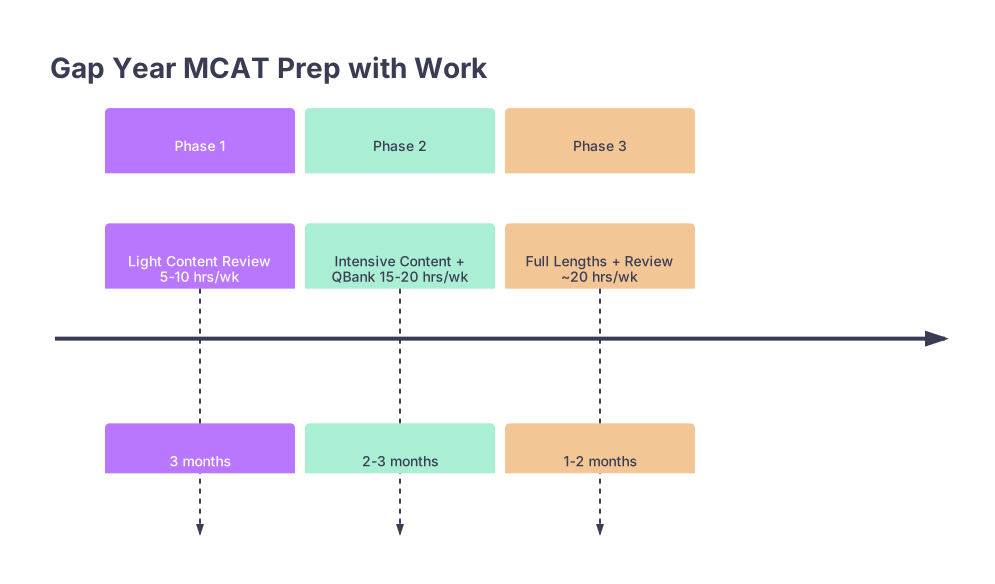
| Period | Event |
|---|---|
| Phase 1 - Light Content Review 5-10 hrs/wk | 3 months |
| Phase 2 - Intensive Content + QBank 15-20 hrs/wk | 2-3 months |
| Phase 3 - Full Lengths + Review ~20 hrs/wk | 1-2 months |
Now, overlay that on your job reality.
Example: Full-time scribe, planning April test.
September–November:
5–8 hours/week content review. You’re just rebuilding foundations, not going insane with FLs.December–February:
Ask for slightly lighter shifts if you can. Aim 12–15 hours/week: content finish + question banks.March–early April:
Drop hours to 3 shifts/week or fewer if at all possible. You want most of your study time here: full-length exams, deep review, targeted fixes.
Opposite example: Flexible research assistant, planning February test.
October–November:
12–15 hours/week, mostly content.December–January:
18–20 hours/week, practice + FLs. Ask for time off around the heaviest testing weeks. Nobody remembers your 30th Western blot; they remember your MCAT score.
Step 6: Specific Red Flags That Your Date Is Wrong
If any of these are true, your test date is probably too early or poorly chosen for your gap-year life:
- You’re planning to consistently study after 10 PM on days you work a full shift.
- You “hope” to hit 15 hours/week but can’t show me a realistic weekly calendar that adds up.
- You’re more than 8 weeks from test day, and:
- You haven’t finished most of content review
- Or you haven’t done a single half-length timed exam
- You’re depending heavily on “I’ll use my vacation to cram right before.”
That last one is common with scribes and techs. They think 1–2 weeks off before the exam will magically fix six months of low-intensity, unfocused prep. It doesn’t.
MCAT performance is built over months. Final weeks refine, they don’t transform.
Step 7: How Gap-Year Money Pressure Changes the Equation
This part matters, especially if you’re supporting yourself or family.
Here’s the trade-off in unpleasant but real terms:
- Cutting work hours for 2–3 months might cost you a few thousand dollars.
- A significantly higher MCAT score changes which schools you can realistically attend, which can translate into:
- Better financial aid at higher-tier schools
- Better residency options → long-term earning potential
- Shorter path vs. reapplying (which costs another entire year of full-time low pay + app fees)
So if you’re choosing between:
- Working 50 hours/week, scoring 506, and needing a re-take or reapply
- Or working 30–35 hours/week, scoring 514, and applying once…
The second path, long-term, is almost always “cheaper,” even if your bank account looks worse this month.
If you truly cannot cut hours—no backup, no family support, no loan option—then you stretch out prep, accept a slower path (maybe 6–9 months), and test when you’re ready, not when some arbitrary calendar says so. That might push applications back a year. Annoying, yes. Smarter than bombing the test, also yes.
Step 8: When You Should Take the MCAT Before the Gap Year
Quick side case.
You might be better off taking the MCAT before your gap year if:
- Your prereqs are very fresh (you just finished biochem, physics, orgo)
- You can carve out a clean 3–4 month block during or right after undergrad (e.g., spring semester with light course load, or immediately post-grad)
- Your gap year is going to be brutal (full-time + overtime, or something like a demanding fellowship)
In that case, your gap year becomes:
- Work/research
- Application building
- No MCAT stress
If you’re a junior or senior reading this and your future gap-year job looks insane, strongly consider front-loading the MCAT.
Step 9: Simple Decision Path
If you want a clean “if this, then that,” here you go.
Are you applying this upcoming cycle?
- No → take the exam whenever your schedule allows a strong 3–5 month prep block, ideally Jan–Sept of the year before you apply.
- Yes → keep going.
Can you reduce work/research to ≤ 30–35 hours/week for at least 2–3 months pre-exam?
- Yes → fine. Target Jan–May test date.
- No → likely need to:
- Delay MCAT to give yourself time to save money, then cut hours, or
- Push your application back a cycle.
Are you willing to treat the MCAT like a part-time job (15–25 hours/week) during that period?
- Yes → pick a date 3–5 months after your start of serious prep.
- No → you’re not ready to schedule. Be honest and adjust expectations.
FAQs
1. Should I take the MCAT while working full-time if I want to apply this upcoming cycle?
You can, but only if you’re willing to do one of two things: either extend prep over a longer period (6–9 months with 8–12 hours/week) or reduce work hours in the final 2–3 months to ramp up. If you can’t or won’t adjust anything—no fewer shifts, no earlier bedtime, no social trade-offs—then yes, technically you can take it, but you’re gambling your score and your first application cycle. I’d rather see you delay and do it right than spray applications with a weak score.
2. Is it better to test early in my gap year or closer to the application date?
Earlier is usually better, as long as your content is fresh and you can prepare properly. Testing in January–March of your gap year gives you time to recover from a bad score (retake in May/June) or refine your app. Testing in May–June compresses everything and leaves almost no room for a retake without compromising your application timing. The only reason to push late is if you truly won’t be ready earlier.
3. How many months should I dedicate to MCAT prep during my gap year?
Most gap-year students do well with 3–5 months of focused prep. “Focused” means at least 15 hours/week if you’re working a normal job, 20–30 hours/week if you’re part-time or not working. If you’re working full-time in a demanding role with shifting hours, you might need 5–7 months with a more modest weekly load, but it still has to be real, scheduled time—not wishful thinking.
4. What if my PI or boss won’t let me cut my hours before the exam?
Then you’re choosing between two priorities: that role vs. your score. You can try negotiating first—offering to front-load work, help with key deadlines earlier, or shift tasks so your heaviest MCAT weeks are lighter at work. If they still refuse and you can’t afford to leave, you either lengthen your prep timeline (test later, maybe delay applying) or accept that this might not be your best possible score window. It’s harsh, but pretending you can “just power through” 50+ hours of work and intense MCAT prep is how you end up with a disappointing result.
5. Can I study effectively with only weekends free during my gap year?
If “only weekends” means maybe 5–8 hours total, then no, not for a strong score. You’ll move too slowly and forget too much between sessions. If you can reliably create 6–8 hours on weekends plus 1–2 hours on 3–4 weekdays (so 12–15 hours/week total), then yes, it can work over a longer timeline. But that requires strict discipline: no “I’ll catch up next week.” If weekends are your main study time, you probably need 5–6 months of consistent effort, and even then you should find at least a short period (4–8 weeks pre-exam) where you increase total hours.
Key Takeaways
- Pick a true priority for your gap year. If you need a strong MCAT, it sits at the top, not third behind job and research.
- Align your test date with a realistic 3–5 month prep window that fits your actual work schedule, not the one you wish you had.
- If your current job or research setup makes real prep impossible, change the setup or change the timeline—do not just “hope” it’ll work out.