The reflex to retake a strong MCAT “just to be more competitive” is one of the fastest ways to waste 3–6 months and potentially hurt your application.
If you already have a good or great MCAT score and you’re itching to retake, you’re not dealing with an academic problem. You’re dealing with a strategic problem—and sometimes an anxiety problem. Let’s sort out which one you have.
Step 1: Define “Strong” For Your Situation (Not Reddit’s)
First thing: a “strong” MCAT score is not universal. It depends on where you’re trying to go and who you are on paper.
Use this as a rough, honest benchmark:
| Total Score | General Category | Typical Impact |
|---|---|---|
| 507–510 | Solid | Fine for many MD, strong for DO, depends heavily on GPA |
| 511–514 | Strong | Competitive at many MD, including some mid‑high tier |
| 515–518 | Very strong | Competitive almost everywhere outside top 10–15 |
| 519+ | Elite | You are not retaking for score reasons |
Now overlay reality:
- A 512 with a 3.9 GPA and solid ECs? Very strong for many MD programs.
- A 512 with a 3.2 GPA and weak ECs aiming only for top‑20 MD? Not “strong enough” for that list.
- A 509 as an ORM (over‑represented in medicine) applicant targeting only top‑25 MD? That’s borderline.
If your score is 515+, any thought of retaking needs to be treated as “guilty until proven necessary.” You’re not optimizing; you’re gambling.
To sharpen this, look at the 25th–75th percentile MCAT range for your target schools (MSAR for MD, chooseDO Explorer for DO). Compare honestly:
- If your score is within or above the 50th percentile at most of your realistic schools → your MCAT is already an asset.
- If your score is around or below the 25th percentile at almost all of your target schools → then we can talk about a retake.
Step 2: Run the “3 Tests” Before You Even Consider a Retake
If you’re thinking “maybe I should retake,” you must pass all three of these tests. If you fail even one, do not retake.
Test 1: The Score Gap Test
Ask: “Is my current score clearly below what I need for my realistic goals?”
You’re in “retake might be reasonable” territory if:
- Your MCAT is:
- Below 510 and you’re set on MD only, and
- Below or at the 10–25th percentile for most of your realistic schools
OR
- You have a clearly lopsided section (like 129/130/127/123) that:
- Drags your total down
- And is significantly out of line with your GPA and the rest of your profile
- And you genuinely know why it happened (e.g., illness, panic, timing mismanagement) and can fix it
You are not in “retake” territory just because:
- People on SDN / Reddit / Discord say “everyone has a 520 now”
- You got a 515 but wanted a 520
- You’re worried about “top schools only” when your GPA and ECs are not top‑school level
If your current score is already roughly in line with your school list’s mid‑range, the Score Gap Test fails. You do not retake.
Test 2: The Practice Reality Test
If you sat for the MCAT and your official score landed within the range of your AAMC practice exams (say, within ±2 points), that’s your plateau with your current approach.
So before deciding, ask yourself:
- What were your last 3 AAMC FL scores?
- What was your trend?
- Were you already studying flat‑out?
You can consider a retake only if both of these are true:
- Your AAMC practice scores were consistently and clearly higher than your actual test (by 3–4+ points, not 1–2),
- Or your practice scores were garbage because you truly under‑prepared or mis‑prepared (you know exactly what you’d do differently and have time to do it).
If you scored a 513 and your last three AAMC exams were 513, 514, 512, that’s not “bad test day.” That’s who you are right now. Retaking with the same life circumstances and same study strategy is fantasy.
Test 3: The Life Bandwidth Test
Retaking the MCAT is not a study decision. It’s a life‑allocation decision.
Ask yourself, bluntly:
- Do I actually have 10–20 hours per week for 2–3 months (minimum) to study well, not just “squeeze in a few questions”?
- Will this studying significantly hurt:
- GPA (especially if it’s already not stellar)?
- Clinical hours / volunteering?
- Research productivity?
- Application prep (personal statement, secondaries, letters, school research)?
- Is there anything major going on (family, health, financial, work) that made the first prep hard and would still be there?
If the answer to bandwidth is “not really” or “it’ll come at the cost of GPA / experiences,” the retake is almost always a net negative. A small score bump does not outweigh a drop in GPA or thin extracurriculars.
Step 3: Understand When a Strong Score Retake Backfires
Here’s the part some advisors don’t say out loud: retaking a strong score can make adcoms raise an eyebrow.
Why? Because it suggests poor judgment.
I’ve seen this pattern too many times:
- Student scores a 516 on their first try.
- Obsesses over a slightly weaker section (e.g., 127 CARS) and dreams of a 520+.
- Retakes, lands a 512. Now they’ve:
- Lost 4 points,
- Wasted months,
- And signaled to schools that they don’t understand opportunity cost.
Even if you go from 516 → 518, committees are not gasping in awe. They’re thinking: “So they gave up a whole summer to add 2 points to an already excellent score?”
Most schools either:
- Use your highest overall score, or
- Use your most recent score, but look at the whole record.
If you already have a 515+, outcomes of a retake usually fall into three buckets:
- Score drops: you just hurt yourself for no actionable benefit.
- Score stays similar (±1–2): you sacrificed time and energy for a lateral move.
- Score nudges up (2–3 points): meaningful only for the top‑10‑or‑bust crowd whose entire app is already strong.
And that third group is tiny. Most people who want to retake an already strong MCAT don’t actually have a top‑10 caliber GPA, research, or letters to match.
Step 4: Scenario‑By‑Scenario: Should You Retake?
Let’s get concrete. Find the situation that looks most like you.
Scenario A: 519+ and Anxious About “Elites”
Details: You have a 519–525. You’re annoyed one section is a 128, or your friend got a 522, or you’re eyeing Harvard/Stanford/NYU.
Verdict: Do. Not. Retake.
Unless you completely tanked one section (like a 123 while the others are 130+ because of a documented acute issue), your MCAT is already more than sufficient. Top‑tier schools reject countless 522s every year because of unremarkable activities and essays, not because they “needed” a 525.
Your time is drastically better spent on:
- Building a distinctive narrative,
- Strong letters,
- Impactful clinical and non‑clinical work,
- A focused school list.
Scenario B: 515–518, Targeting Mostly Mid‑High MD
Details: Good GPA (3.6–3.8+), OK‑good ECs, you’re aiming for a mix of state schools, regionals, and maybe a few reaches.
Verdict: Very rarely worth a retake.
Your MCAT is pulling its weight. If you feel pressure to retake, it’s usually:
- Comparisons with friends,
- Noise from online forums,
- Or an attempt to “fix” weaknesses in other parts of your app with a few more points on one test.
Instead of a retake, fix the real weaknesses:
- Shaky clinical exposure? Get more.
- Generic personal statement? Rewrite.
- Lopsided school list (only reaches)? Fix that.
Scenario C: 511–514 With Solid But Not Stellar GPA (3.5–3.7)
Details: You’re applying broadly. Some state MDs, some mid‑tier MDs, possibly some DOs. You’d like to be more competitive, especially if you’re an ORM.
This is the gray zone.
Here’s how I’d call it:
- If your recent AAMC FLs were 514–517 and you scored a 511 due to clear, fixable test‑day issues, AND
- You have a realistic 2–3 months where you can truly commit,
→ Retake might make sense.
But if your tests were in the 511–514 range and your real score matches that, the likelihood of hitting 518+ is lower than you think. And those months might be better spent building the rest of your app and applying smartly.
Scenario D: 507–510 MD‑Or‑Bust Applicant
Details: GPA maybe 3.5–3.8. You really want MD, and your school list is mostly MD with perhaps token DOs.
Here, retaking is more often reasonable—if:
- Your AAMC practice tests were already higher (e.g., 511–514) and your 508 was a fluke, or
- You know you under‑studied or used bad materials the first time,
- And you can realistically push your score up 3–5+ points with a better plan.
If your actual score is fully consistent with your best practice exams, then the limiting factor may not be the test. It might be how you study, how much time you have, or your baseline reading/science skills. A retake without major changes in those areas is wheel‑spinning.
Scenario E: Strong MCAT, Weak GPA (e.g., 513 with 3.2)
Details: You’re hoping a higher MCAT will “compensate” for GPA.
Reality: It helps some, but it doesn’t erase years of grades. And another few MCAT points isn’t going to transform a 3.2 into a 3.7 in adcoms’ minds.
Your priority should be:
- Post‑bacc or SMP,
- Ace future coursework,
- Longer time horizon.
Retaking a strong MCAT is almost never the main lever for GPA‑damaged applicants.
Step 5: If You Do Retake, Make It a Calculated Strike, Not Therapy
Sometimes, a retake is actually rational. You have a clear gap, clear evidence you can do better, and real time.
If that’s you, you need two things written down:
- A score target range based on data, not vibes
- A specific, different plan of attack
Set a Real Target (Not “520 or Bust”)
Your target should be:
- Based on your last 2–3 AAMC FLs,
- Ambitious but aligned with reality.
Example: If your last three were 511, 512, 513 and you scored a 509, a realistic target might be 512–515. That’s meaningful improvement.
Build a New Plan, Not a Repeat
Ask: “Why did I score what I scored?”
Common real reasons:
- CARS tanked because you never did timed, full‑passage sets,
- Ran out of time on science sections from poor pacing,
- Content gaps in psych/soc because you rushed that section at the end,
- Burnout from 10‑week, 50‑hour study weeks.
Your new plan must attack those specifically:
- If CARS was weak:
- Daily 3–4 passages, full timing, review each wrong answer deeply.
- If timing killed you:
- Strict section timing drills, not just full‑lengths.
- If content holes:
- Focused content review with high‑yield lists, followed by targeted question sets (UWorld, AAMC QPacks, etc.).
And you must schedule this around your life so it doesn’t wreck your grades or kill your activities.
Step 6: Don’t Use the MCAT to Avoid the Harder Work
There’s one more uncomfortable truth: a lot of “should I retake?” questions come from avoidance.
It’s easier to grind another 500 practice questions than to:
- Rewrite a weak personal statement that doesn’t say anything specific about you,
- Ask for feedback on your interview style and realize you sound rehearsed,
- Accept that your clinical exposure is shallow and you need more time before applying.
The MCAT feels “controllable.” The rest of the app is messy, subjective, and uncomfortable. So you latch onto the exam as the thing you can fix.
If you already have a strong MCAT but a weak overall app, the MCAT is not the bottleneck. Raising it a few points won’t fix letters that say “hard worker” and nothing else, or 50 hours of shadowing and no longitudinal engagement.
So before you register for a retake, force yourself to write a brutally honest one‑page “app inventory”:
- GPA trend, not just final number
- MCAT (with section scores)
- Clinical hours (depth and consistency)
- Non‑clinical service (real service, not checkbox half‑days)
- Research (if relevant for your goals)
- Leadership / teaching / unique experiences
- Quality of relationships with potential letter writers
Then circle your weakest two. If MCAT isn’t one of them, you have your answer.
A Visual Reality Check: Where Extra Points Actually Matter
Here’s how impact typically looks when you already have a solid baseline score:
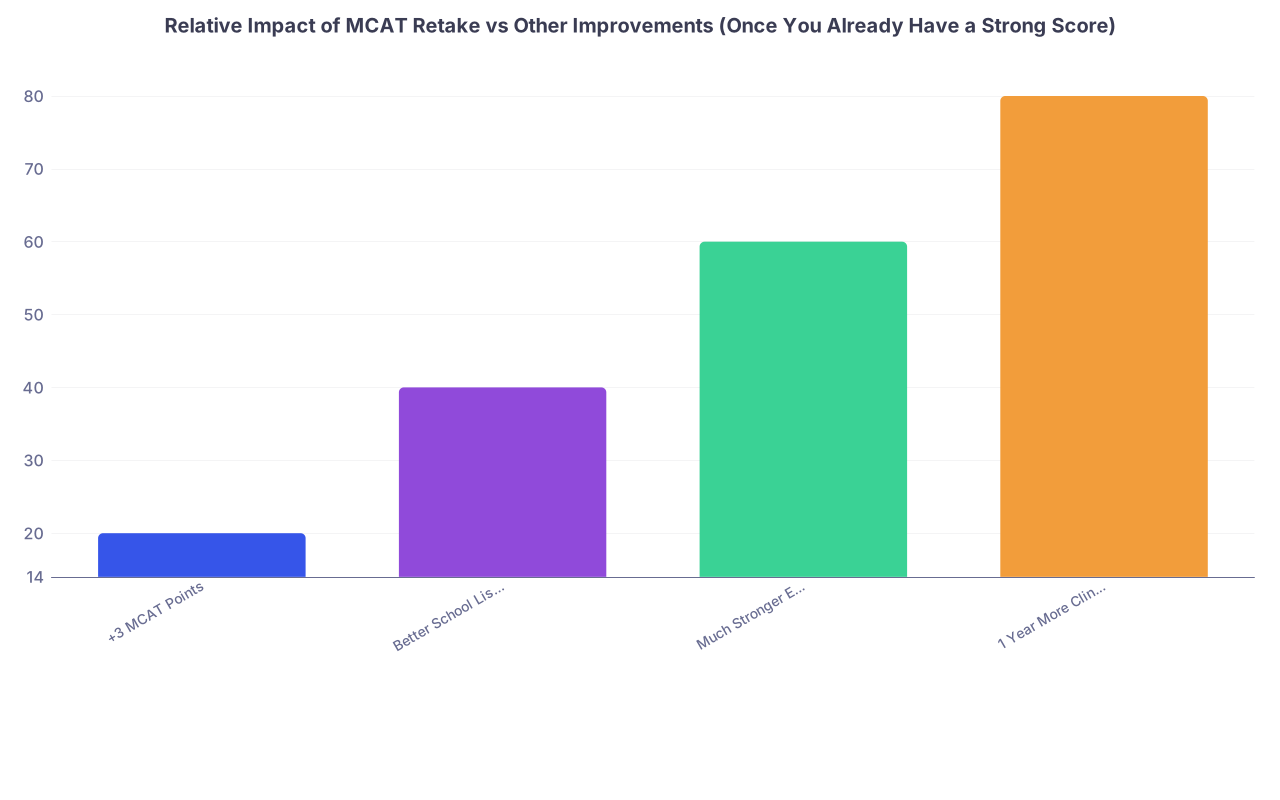
| Category | Value |
|---|---|
| +3 MCAT Points | 20 |
| Better School List Strategy | 40 |
| Much Stronger Essays | 60 |
| 1 Year More Clinical & Service | 80 |
That’s not a scientifically precise chart. It’s how adcoms actually behave when sorting through thousands of applications. A 516 vs 519 doesn’t rescue a generic, shallow file.
When You Should Absolutely Ignore the Retake Urge
To be very explicit: do not retake if any of these are true:
- You have 515+ and no catastrophic section outlier.
- Your official score matches your AAMC FL range.
- Retaking would collide with:
- Heavy coursework,
- A crucial semester for GPA repair,
- Or major life stressors.
- The main driver is envy, perfectionism, or online flex culture.
- You can’t clearly explain how your next 8–12 weeks of prep will be materially different from last time.
In those cases, hit pause. Close the test registration page. Go work on the parts of your application that will actually move the needle.
Quick Decision Flow
Here’s the logic in plain English:

| Step | Description |
|---|---|
| Step 1 | Current MCAT Score |
| Step 2 | Do NOT retake |
| Step 3 | Do NOT retake |
| Step 4 | Focus on rest of app |
| Step 5 | Do NOT retake |
| Step 6 | Retake with focused new plan |
| Step 7 | 515 or higher? |
| Step 8 | Score below target schools ~25th percentile? |
| Step 9 | AAMC FLs clearly higher OR underprepared? |
| Step 10 | Have real time & can change strategy? |
If you trace yourself honestly through that, the answer is usually obvious. People just do not like it.
FAQ (Exactly 3 Questions)
1. Will schools see multiple MCAT scores and judge me for retaking?
Yes, most schools see all MCAT attempts. Many say they consider the highest score, but they’re not blind to the pattern. One retake with clear improvement is fine, especially from a borderline score. Multiple retakes, or retaking a strong score for a trivial bump, can look like poor decision‑making or an inability to prioritize.
2. What if I had a valid excuse—sickness, family emergency, etc.—on test day?
If it was severe enough that it materially affected your performance, you should have voided. If you didn’t, you’re now in cleanup mode. A retake can make sense if your official score is far below your consistent practice range and you now have a stable situation and time to prepare. In that case, keep both attempts, mention the context briefly if needed, but don’t build your whole narrative around excuses.
3. How many points do I need to improve for a retake to be “worth it”?
As a rule of thumb, you want at least a 3–4 point real improvement, and you need to be crossing a meaningful threshold for your school list (e.g., from being below most schools’ 25th percentile to around or above their median). Going from 516 to 518 doesn’t transform your candidacy. Going from 507 to 513 might, especially for MD. But you don’t get those jumps by hoping—you get them with a different and better plan, enough time, and an honest look at why you underperformed the first time.