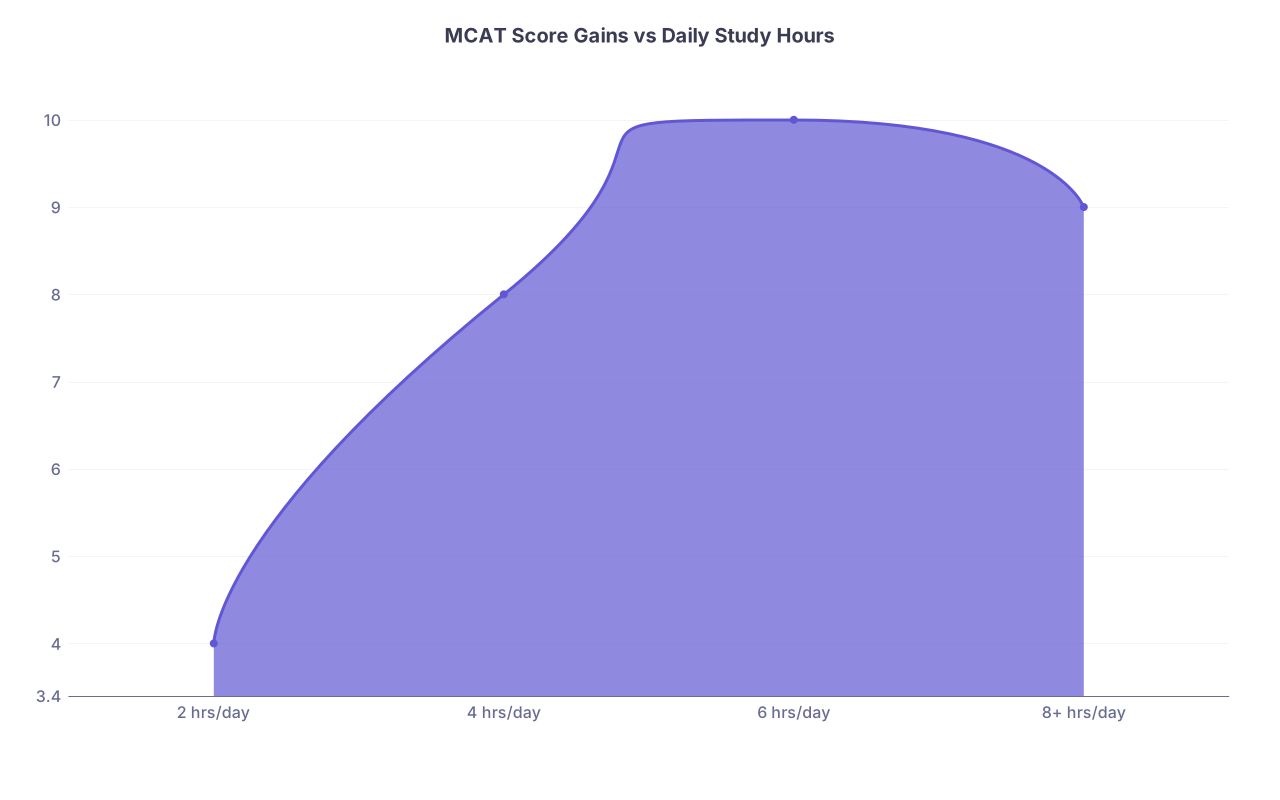
The MCAT will not beat you. Your logistics mistakes will.
Most people obsess over Anki decks and full-length scores, then casually “figure out” test day details the week before. That is backwards. I have watched strong 515+ practice testers walk out with 505-ish real scores because of avoidable, boring, logistical errors.
Let me walk you through the mistakes that quietly wreck MCAT day and how to shut every single one of them down.
1. Underestimating the Test Center: The Silent Score Killer
You are not just taking an exam. You are entering a controlled environment with rules that do not care about your feelings, schedule, or months of prep.
Mistake: Not Doing a Test Center Recon
Showing up to a Prometric (or other site) for the first time on test morning is amateur behavior.
Common failures:
- Misjudging commute time (traffic, construction, limited early trains)
- Not realizing parking is:
- Paid only
- Street-only
- Limited to 2–3 hours (MCAT is longer than that)
- Assuming the building entrance is obvious (it is often not)
- Not realizing the suite is on floor 7 but the elevators are slow and backed up at 7:45 a.m.
What you should do instead:
- One week before:
- Drive or commute there at the exact time you would for test day
- Find:
- The exact entrance
- The exact suite
- Where you will park or which train/bus stop you will use
- Time:
- Door of your home → test center check-in area
- Then add a 20–30 minute buffer to that number
If you are thinking “that seems excessive,” that is precisely the mindset that gets people to the door sweating at 7:58 a.m.
Mistake: Ignoring the Check-In Bottleneck
Check-in is not quick. There is:
- ID check
- Palm vein scan or fingerprint
- Photo
- Locker assignment
- Metal detector and pocket checks
Three people in front of you can easily cost 15+ minutes.
Do this instead:
- Aim to walk into the building 45–60 minutes before your scheduled start
- Assume:
- 10–15 minutes to find the right room/floor
- 20–30 minutes for check-in + waiting
- 10+ minutes for bathroom and mental reset
Show up early enough that if the staff is running slow, your heart rate does not spike.
2. ID, Names, and the “You’re Not Testing Today” Disaster
The fastest way to lose your entire test is paperwork sloppiness. I wish I was exaggerating. I have seen a student turned away because their ID had a different last name than their MCAT registration and they brought no supporting documentation. Months of prep. Gone.
Mistake: Mismatched Names or Expired ID
The MCAT is not flexible about ID.
You risk being turned away if:
- Your ID:
- Is expired (even by one day)
- Will expire before test day and you do not renew it
- Your MCAT registration name does not perfectly match your ID:
- Nicknames vs legal names (Mike vs Michael)
- Missing middle name where registration includes it
- Different last names after marriage/divorce
Fix this early:
- At least 30 days before test day:
- Check:
- Driver’s license/passport expiration
- Name spelling and format on your AAMC account
- If there is a mismatch:
- Contact AAMC immediately to correct it
- If your ID will expire close to test day, renew it now
- Check:
And on test day:
- Bring:
- Your primary ID (license or passport)
- A backup government ID if possible
- Put your ID in:
- Your wallet
- And in a clear bag in your test-day kit
- Double redundancy. Because showing up without ID is a non-recoverable mistake.
3. Time Mismanagement Before You Even Sit Down
You can torpedo your focus before question one loads.
Mistake: Cutting Sleep for Last-Minute Cramming
Pulling a “light review” until midnight is still a bad idea. Execution > new content on MCAT eve.
What goes wrong:
- Fragmented sleep → slower processing speed
- Increased anxiety from reading borderline topics
- Fixation on the last thing you studied, whether or not it appears
Better approach for the day before:
- No heavy studying
- Max:
- 1–2 hours of light review of:
- Formula sheet
- High-yield facts
- A few flashcards to feel warm, not exhausted
- 1–2 hours of light review of:
- Hard stop:
- 12 hours before your planned wake-up
Mistake: Not Rehearsing Your Morning Timeline
“Wake up at 6, leave by 7” is not a plan. It is a fantasy.
You must time-block:
- Wake-up
- Shower
- Breakfast
- Transit
- Check-in buffer
Try this:
- A week before:
- Practice your test-day morning:
- Wake at the same time
- Eat the same type of breakfast
- Time yourself getting out the door
- Note how your stomach and brain feel with that meal and timing
- Practice your test-day morning:
Then adjust. Some people realize:
- The breakfast they thought was “light” makes them sluggish
- They need an extra 15 minutes for their stomach to settle
- Coffee timing needs to shift (too close to check-in = bathroom emergency)
You do not want these discoveries on the actual day.
4. Food, Water, and Bathroom Strategy Errors
MCAT day is a stamina test. Not just a knowledge test. Poor break planning is a hidden points leak.
Mistake: Random Food Choices on Test Day
Trying new snacks or meals because “they seem healthy” is reckless.
Common bad choices:
- Heavy, greasy breakfast → mid-morning crash + nausea
- High-sugar snacks → quick spike, then energy cliff
- Massive caffeine dose that you never practiced → jitters, palpitations, bathroom trips
Do it correctly:
- Use the last 2–3 full-lengths as dress rehearsals:
- Eat:
- The exact breakfast
- The exact snacks
- The same amount of coffee/tea
- At:
- The same relative times as your scheduled test
- Eat:
Your test-day menu should feel boring and familiar, not new and “optimized.”
Mistake: Wasting Break Time on Decisions
Indecision destroys breaks:
- Standing at your locker thinking:
- “Should I pee now or after the snack?”
- “Do I want the bar or the nuts?”
- “Should I review that formula sheet?”
You lose precious minutes, and your brain never downshifts.
Instead:
- Pre-plan each break:
- Break 1:
- Bathroom
- Half of snack A
- Few sips of water
- Break 2:
- Bathroom
- Second half of snack A
- Break 3:
- Bathroom only or light snack B if needed
- Break 1:
Print this or write it on a small card (if allowed in locker only, not inside) so you are not improvising under stress.
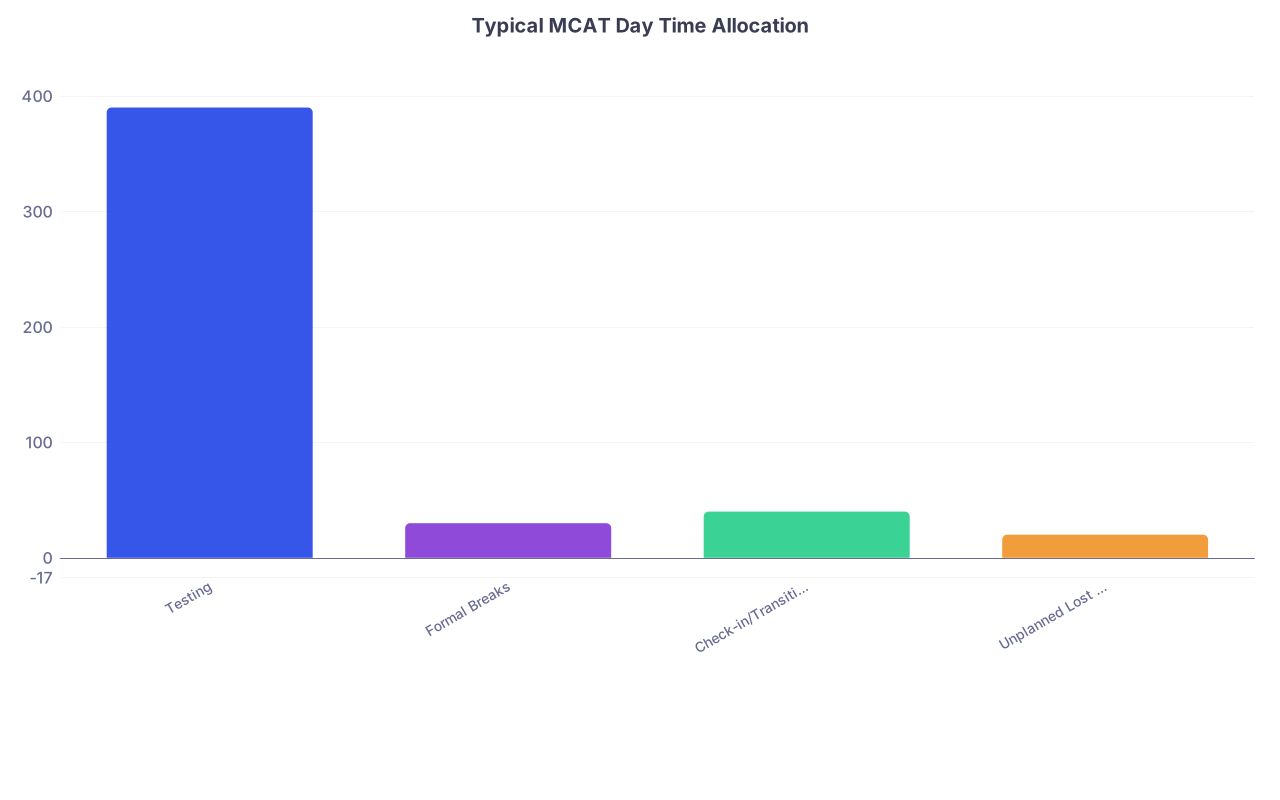
| Category | Value |
|---|---|
| Testing | 390 |
| Formal Breaks | 30 |
| Check-in/Transitions | 40 |
| Unplanned Lost Time | 20 |
5. Clothing, Comfort, and Environmental Blind Spots
You are in a chair for 7+ hours. Any physical irritation magnifies by 10x under stress.
Mistake: Wearing New or Untested Clothes
New shoes, new bra, new jeans, new anything. Bad idea.
I have seen:
- Students shifting constantly because of:
- Tight waistband
- Itchy tag
- Shoes that dig into heels
- Sweaters that felt “fine” at home but suffocating in a warm room
- Thin shirts in freezing rooms (and you are not allowed to repeatedly go to your locker for layers once a section starts)
Your test-day outfit needs to be:
- Previously worn for 6–8 hours straight
- Temperature-flexible:
- Base layer (T-shirt or long sleeve)
- One removable layer (zip hoodie or cardigan, no huge logos)
- Quiet:
- No jangly jewelry
- No noisy zippers
Mistake: Ignoring Sensory Distractions
MCAT centers are not monasteries. You may get:
- Keyboard clacking
- Coughers, sniffers
- Foot tappers
- Doors opening/closing
- People checking in mid-test
Two problems:
- You are surprised
- You have never tested with noise before
To avoid this:
- Practice at least a few sessions:
- In a library
- Or a campus computer lab
- Or with a noise app playing background office/test-center sounds
- Practice with:
- Foam earplugs or
- Noise-canceling headphones if the center provides them (most do)
You will not be able to bring your own headphones, so get used to the generic ones.
Do not let the first time you hear keyboard pounding be during chem/phys passage 1.
6. Locker Rules, Prohibited Items, and Tech Traps
You cannot bring half the things you use to feel “comfortable” into the actual test room. Thinking you can “just leave it in your pocket” is how you get flagged, delayed, or worse.
Mistake: Bringing Disallowed Items to the Workstation
Common prohibited items that must stay in the locker:
- Smartwatches (Apple Watch, Fitbit with notifications)
- Phones (must be completely powered off and in locker)
- Study notes, notebooks, flashcards
- Loose papers
- Personal tissues (they usually provide their own)
- Mechanical pencils
- Calculator (MCAT sections have built-in calculators where allowed)
If the proctor sees:
- You glancing at your watch mid-section
- A folded piece of paper falling out of your pocket
- A phone accidentally vibrating in the locker area
You are now in “testing irregularity” territory. That word should scare you.
Fix:
- The night before:
- Empty your bag, wallet, and pockets of:
- Old notes
- Study scrap papers
- Extra tech
- Empty your bag, wallet, and pockets of:
- On test day:
- Bring the minimum:
- ID
- Keys
- Wallet
- Simple analog watch (if allowed; some centers disallow all watches, check ahead)
- Food and water
- Comfort items that are clearly permitted per AAMC policy
- Bring the minimum:

| Step | Description |
|---|---|
| Step 1 | Arrive at Center |
| Step 2 | Check-In & ID |
| Step 3 | Locker Assignment |
| Step 4 | Security Screening |
| Step 5 | Seated for Exam |
| Step 6 | Sign Out & Locker Access |
| Step 7 | Return & Re-Screen |
| Step 8 | Exam Complete & Sign Out |
| Step 9 | Break? |
7. Break Misuse and Pacing Errors
Even students who prepare logistics well often sabotage themselves with how they use breaks.
Mistake: Obsessively Reviewing Performance During Breaks
Thoughts like:
- “I blew that CARS passage.”
- “Did I misread that torque question?”
- “I am off pace; I am doomed.”
That is break-time brain poisoning.
You are not to:
- Mentally replay questions
- Check your phone (you are not allowed to anyway)
- Try to “diagnose” your score mid-test
Your only jobs on break:
- Reset your physiology:
- Bathroom
- Hydrate
- Snack if planned
- A few deep, slow breaths
- Reset your attention:
- “New section, fresh start. Last one is gone.”
Repeating to myself “That section is over” between sections has saved many students from spiraling.
Mistake: Not Practicing Under Official Timing + Break Rules
Plenty of people do:
- 90-minute sections with:
- “Quick 2-minute” phone check
- “Short pause” to answer a message
- Extra few minutes when they go over
Then they are surprised when they feel rushed and flustered on test day.
You should:
- Take at least 4–5 full-lengths:
- In a single block
- With exact MCAT timing:
- Section lengths
- Break lengths
- No phone
- No pausing
- Physically stand up on breaks
- Eat only from your pre-planned break snacks
Treat practice like a dress rehearsal, not a “pretty similar” simulation.
8. Mental Game and Catastrophe Thinking
MCAT logistics errors often cascade because of poor mental control. One small disruption turns into full-blown panic.
Mistake: Having No “What If Things Go Wrong” Script
Things that can and do happen:
- Your Uber is late
- You get a bad seat near a loud test taker
- The room is colder than you like
- Your computer has to be restarted
- The proctor interrupts you to fix something
Students without a mental script interpret this as: “Everything is ruined.” Then their score follows.
You need pre-written responses:
- If I am late:
- I breathe, cooperate with staff, and remember I can still perform well even if flustered at the start
- If the room is noisy:
- I ask once to change seats or get fresh earplugs, then I refocus hard
- If I feel behind pace:
- I skip more aggressively and protect my mental energy for questions I can answer
You are not trying to guarantee a perfect day. You are building resilience to an imperfect one.

9. The Minimalist MCAT Day Kit (And What People Forget)
You do not need much. But missing one critical item can spike your stress.
Here is a simple reference:
| Category | Recommended Item |
|---|---|
| ID | Valid government ID + backup |
| Time | Simple analog watch (if allowed) |
| Food | 2–3 small, familiar snacks |
| Hydration | One medium water bottle |
| Comfort | Tested layered clothing |
| Tech | Phone (off, in locker only) |
Common things people regret not bringing:
- A tested, comfortable hoodie
- Their usual caffeine source (in appropriate dose)
- A second snack for the later break
- Tissues (if the center’s are rough or limited)
Common things people bring that cause problems:
- Study notes (just tempt you and add anxiety)
- Energy drinks they have never used before
- New “MCAT lucky outfit” they have never worn for 8 hours
10. The Night Before and Morning Of: A Simple No-Mistake Checklist
You do not need a 20-step ritual. You need a clean, repeatable routine.
Night Before
Do:
- Pack:
- ID (check twice)
- Wallet, keys
- Snacks and water
- Layers of clothing
- Set:
- 2 alarms (phone + separate device)
- Check:
- Test center address
- Route and backup route
- Parking or train times
Do not:
- Start new content
- Review full practice exams
- Stay up late “just going over one more thing”
Morning Of
Follow a script:
- Wake up at planned time
- Eat your practiced breakfast
- Minimal conversation and stimuli (no doom-scrolling)
- Dress in your tested outfit
- Leave home with a buffer that feels almost ridiculous
By the time you sit down:
- Logistics should feel boring
- All your attention goes to the passages, not your heart rate
FAQ (Exactly 5 Questions)
1. What time should I actually arrive at the MCAT test center?
Aim to enter the building 45–60 minutes before your scheduled test time. That gives you room for parking issues, slow elevators, and a backed-up check-in line. Cutting it closer than 30 minutes is asking for preventable stress.
2. Can I use my nickname on the MCAT registration if it is on my school records?
No. Your MCAT registration name must exactly match the legal name on your government-issued ID. Use your full legal name, including middle name if it appears on the ID. If there is any mismatch, contact AAMC to fix it well before test day.
3. How many full-length practice tests should I take under “true” test-day conditions?
At least 4–5 full-lengths should be done:
- Start to finish
- With official section and break timing
- No phone, no pausing
- Sitting at a desk or computer like test day
These also serve as rehearsals for your clothing, meals, caffeine, and break routine.
4. What should I eat on MCAT day to avoid energy crashes or stomach issues?
Use only foods you have already tested during full-lengths. Usually:
- Moderate breakfast: protein + complex carbs, low grease, low sugar
- Snacks: simple, easy-to-digest items (nuts, a familiar bar, maybe a banana)
Avoid new foods, heavy meals, large sugar spikes, or drastically increased caffeine doses.
5. Is it worth doing a test center visit before my exam, or is Google Maps enough?
Do the visit. Google Maps will not show:
- Confusing building entrances
- Elevator delays
- Where people actually park
- How long the route feels at your test time
A physical walkthrough a week before reduces uncertainty, lets you time your commute accurately, and removes one entire category of avoidable test-day stress.
Key points to remember:
- Logistics errors are preventable, but only if you treat them as seriously as content prep.
- Rehearse your exact test-day routine—commute, food, clothing, timing—before the real thing.
- Your goal is boring, predictable execution on MCAT day. No surprises, no drama, just you and the exam.