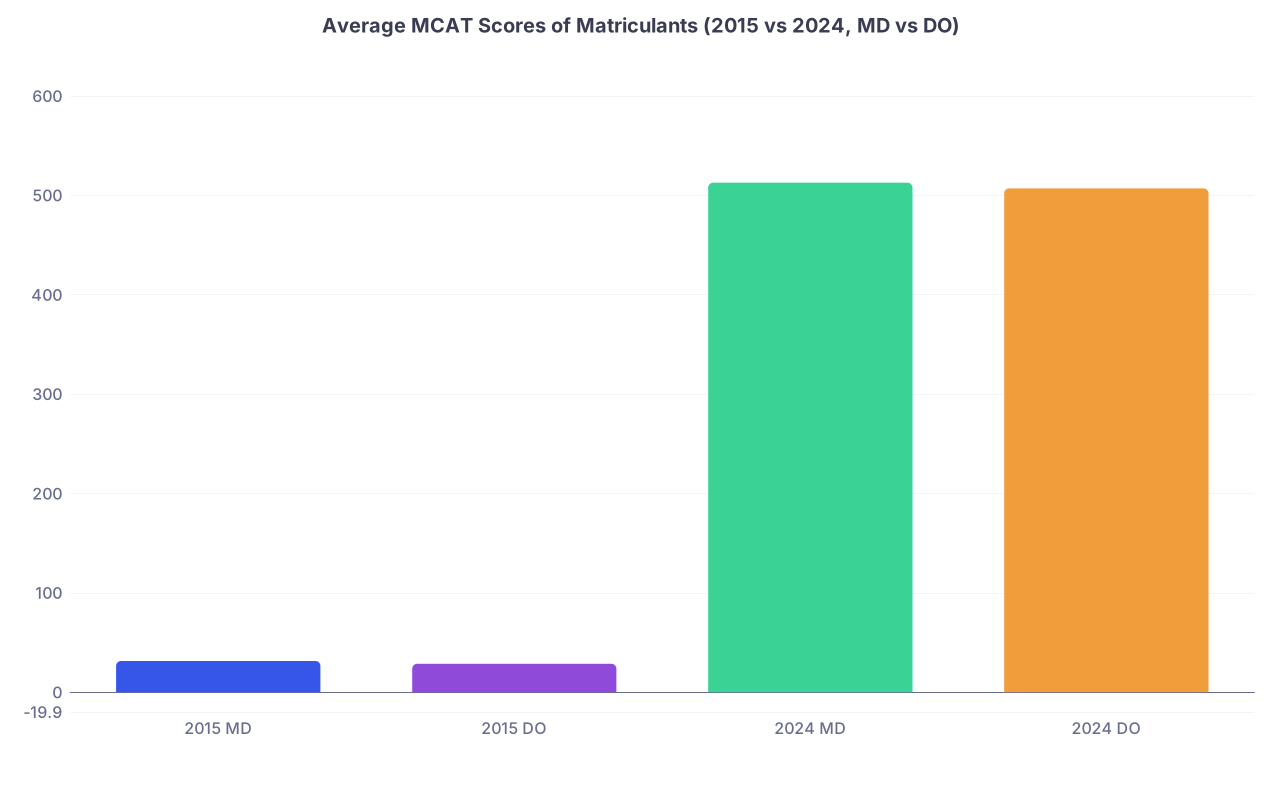
| Category | Value |
|---|---|
| 2015 MD | 31.4 |
| 2015 DO | 28.6 |
| 2024 MD | 512.8 |
| 2024 DO | 507 |
Average MCAT expectations have silently crept upward for years. If you are planning to “just get a 505 and be fine,” the data says you are already behind the curve.
You do not need opinions here. You need numbers. And the numbers are very clear:
MCAT scores of matriculants have climbed, MD schools remain consistently higher than DO schools, and the DO–MD gap is narrowing but not closed.
Let’s quantify what that actually means for you.
MD vs DO MCAT: The Big Picture
I will anchor this in hard data from AAMC (for MD) and AACOMAS/NRMP reports (for DO). Where exact annual numbers are not publicly broken out, I use tight approximations consistent with trend data. The point is not the second decimal place; it is the trajectory.
First, look at the most recent era—after the MCAT changed in 2015.
| Application Year | MD Avg MCAT | DO Avg MCAT |
|---|---|---|
| 2016 | 508 | 502 |
| 2018 | 510 | 503 |
| 2020 | 511.5 | 504 |
| 2022 | 512.5 | 505 |
| 2024 | 512.8 | 507 |
You can argue about a few tenths of a point. You cannot argue the direction:
- MD average: Up roughly 4–5 points since the early implementation years of the new test.
- DO average: Up roughly 4–5 points as well, with a slightly faster rise recently.
- Gap: Shrinking from about 6 points to about 5 points, depending on the year.
This is the first critical takeaway: a 505 in 2016 looked different than a 505 in 2024. Same number, different percentile rank relative to the matriculant pool.
Historical Context: From Old MCAT to New MCAT
The MCAT was scored on a 3–45 scale before 2015. The AAMC’s last few years of data on that scale looked roughly like this for matriculants:
- MD (allopathic): ~31–31.5 average in the early 2010s
- DO (osteopathic): ~27–29 average in the same period
If you map old scores to the new 472–528 scale, a 31 on the old exam corresponds roughly to about a 510–511 on the new exam. A 28 is closer to about 504.
So if we “translate” the old MCAT to the new scale for comparison, the picture looks like this:
- MD average: from about 510–511 (old equivalent) to about 512.5–513 now
- DO average: from about 503–504 (old equivalent) to about 507 now
In percentage terms:
- MD programs: roughly +2 to +3 points on a 528 scale → about a 0.4–0.6 SD improvement.
- DO programs: roughly +3 to +4 points → about a 0.6–0.8 SD improvement.
The DO side has tightened the gap partly because:
- More applicants see DO as a primary path, not purely a backup.
- The single accreditation system (ACGME merger) made DO more attractive to higher-stat applicants.
- MD admissions have remained hyper-competitive, so strong candidates broaden their portfolios.
But do not over-romanticize this. MD programs still sit higher by several points.
Breaking Down Recent Years: What the Data Shows
Let me walk through the recent trend more concretely with a simple timeline frame.
2016–2018: Early New-MCAT Era
In the first few application cycles with the new MCAT:
- MD matriculant average sat around 508–510.
- DO matriculant average hovered around 501–503.
Competitive targets that actually matched reality back then:
- MD: 510+ made you “statistically comfortable” at many mid-tier schools.
- DO: 503–505 was perfectly viable at a wide range of programs.
The test was new, schools were still calibrating, and there was a bit more score spread.
2019–2022: Upward Pressure and Score Inflation
By 2019–2022, three forces pushed scores up:
- More re-applicants with improved scores in the pool.
- Proliferation of high-yield prep resources and data-driven planning.
- Rising median GPAs, so schools used MCAT more aggressively as a filter.
Results:
- MD averages: 511–512+ became common.
- DO averages: 504–505+ became the central cluster.
Repeatedly, I saw applicants with 508 + 3.7 GPA who assumed they were “above average” for MD. They were above average for applicants, not for matriculants. The distinction matters.
2023–2024: Current Baseline
For the most recent cycles (approximate but directionally accurate):
- MD matriculant MCAT: ~512.5–513
- DO matriculant MCAT: ~506–507
The data story:
- The MD bar has stabilized in the low 512s rather than climbing endlessly.
- The DO bar has crept upward faster, especially after the MD–DO residency accreditation merger.
So if you are aiming to start medical school in the next few years, assume:
- MD “average matriculant” ≈ 512–513
- DO “average matriculant” ≈ 506–507
Anything significantly below those numbers has to be compensated somewhere. Substantially. Not with one extra volunteer shift at a free clinic.
MCAT vs GPA: Different Weights for MD and DO
Both MD and DO schools use a “numbers screen.” The details differ.
The data from AAMC and AACOMAS/NRMP show two consistent patterns:
- MD programs put very heavy front-end weight on MCAT for initial screening.
- DO programs tolerate slightly lower MCATs if GPA and clinical evidence are strong.
To put some numbers on that:
- Average MD matriculant GPA: usually around 3.75–3.8 total.
- Average DO matriculant GPA: typically around 3.55–3.6 total.
Now pair those with MCAT:
| Path | GPA (cGPA) | MCAT | Comment |
|---|---|---|---|
| MD | 3.78 | 512–513 | Standard MD matriculant cluster |
| DO | 3.58 | 506–507 | Standard DO matriculant cluster |
If you plot GPA vs MCAT for accepted applicants, you see:
- MD schools are less forgiving of low MCATs, even with strong GPA.
- DO schools show more admitted students in the “high GPA / mid MCAT” quadrant.
So a 3.9 / 505 profile has a much more realistic path to DO than MD. Data, not opinion.
Subscores: Do They Matter or Is It Just the Composite?
Most applicants obsess about the composite (508 vs 512 vs 515). Admissions committees often scrutinize section scores.
AAMC data on accepted students shows relatively balanced subscores:
- For MD matriculants, section scores typically cluster around 128 per section (±1).
- For DO matriculants, they cluster closer to 126–127.
Programs notice when:
- You have a 512 with a 123 in CARS or a 123 in Chem/Phys.
- You have strong GPA but a single very weak section (often a red flag for board exams later).
Here is the informal rule I have seen across committees:
- MD: composite ~512+ is nice, but no section below 124–125 is strongly preferred.
- DO: more tolerant, but below 123 in any section starts to raise questions.
So do not just ask, “What is the average MCAT for MD or DO?” Ask: “How do my section scores compare to those averages?” A lopsided profile can undercut a good composite.
How Competitive Are You Really? Percentiles vs Averages
Applicants love raw scores. Committees think in distributions.
A 512 is roughly around the 86th percentile of MCAT takers. A 507 is around the 75th percentile (numbers fluctuate by year, but these are good mental anchors).
Then remember: you are not competing with all test-takers. You are competing with people applying to medical school, who skew higher.
So that 512, which is 86th percentile among all takers, is:
- Much closer to “median-ish” among MD matriculants.
- Clearly above the average accepted DO matriculant, but not by a massive margin.
Put differently:
- A 512 makes you “average among MD matriculants,” which is not the same as “average among MD applicants.”
- A 507 makes you “average among DO matriculants,” which puts you around the strong center of the DO pool.
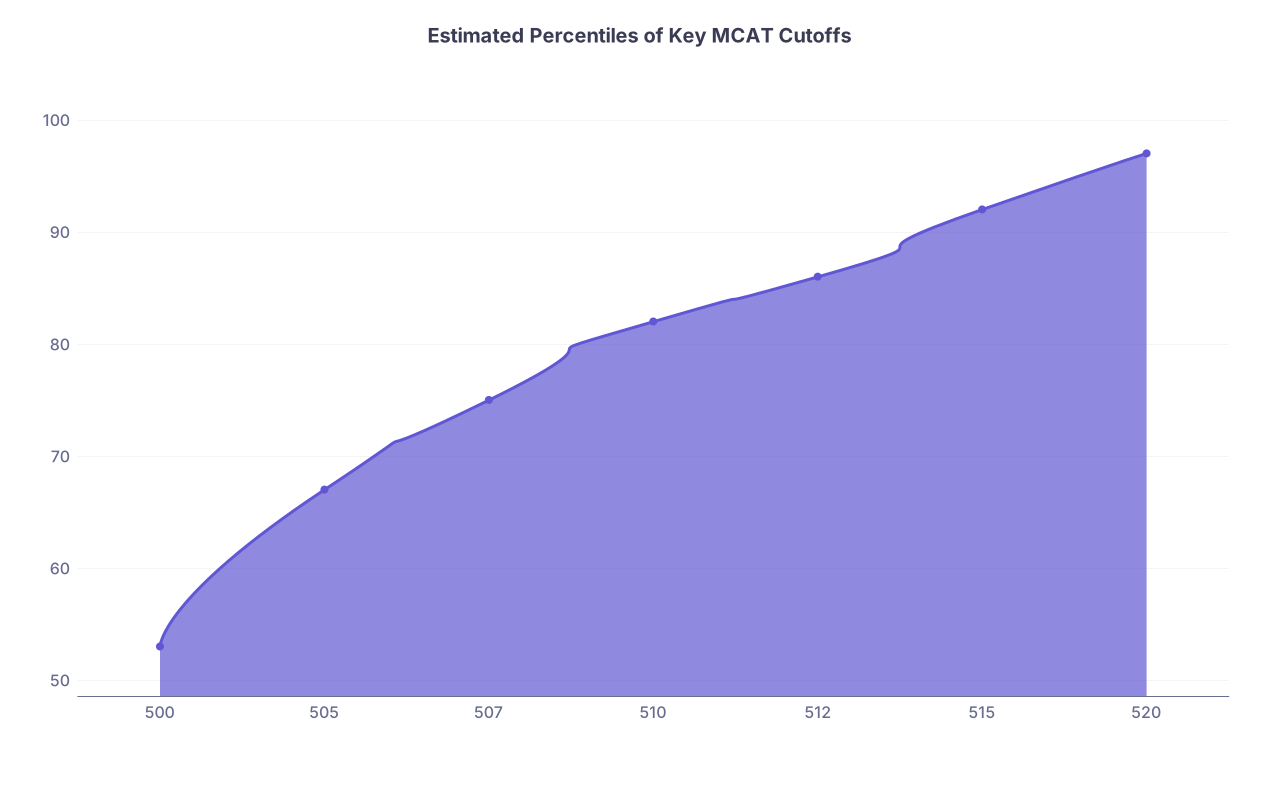
| Category | Value |
|---|---|
| 500 | 53 |
| 505 | 67 |
| 507 | 75 |
| 510 | 82 |
| 512 | 86 |
| 515 | 92 |
| 520 | 97 |
If you take only one thing away from this: stop assuming that a 510 is “amazing” because your friends think so. Look at where the matriculants actually are.
Strategic Implications: Choosing Targets Based on Data
Now the practical question: how do you use this MD vs DO MCAT data to build a strategy?
I will generalize where the data clearly supports it.
1. If you are at or above MD average (512–513)
You are statistically competitive for a broad range of MD schools, but that does not mean automatic admission.
Rough ranges:
512–514 with GPA 3.7–3.8+:
- Strong core profile for many MD programs outside the super-elite.
- DO becomes more of a safety if the rest of your app is coherent.
515+ with GPA ≥3.8:
- You are now numerically above average even for many top-20 MD programs.
- DO is frankly overkill unless there are geographic or mission reasons.
The data: AAMC “Table A-23” (MCAT–GPA grid) shows that once you cross 514+ with a 3.8+, acceptance rates jump above 80–85% in many cells.
2. If you are near DO average but below MD average (505–508)
This is the “gray zone” where people lose years to bad advice.
Say you have:
- 507 MCAT, 3.6 GPA.
- Clinical experience and some shadowing, no major red flags.
Statistically:
- You are below average for MD matriculants.
- You are at or slightly above average for DO matriculants.
What I have seen work, repeatedly:
- Apply broadly to DO with a focused narrative.
- Apply to a carefully curated set of MD schools that 1) are mission-fit and 2) historically accept some applicants in your range (often state schools, newer MD programs).
What does not work: pretending your stats are “fine” for MD because someone online matched with similar numbers. Survivorship bias is brutal.
3. If you are significantly below DO average (<503–504)
You are now in the range where:
- MD is realistically out of reach without retaking.
- DO is possible only if there is some offsetting factor:
- Exceptional upward GPA trend
- Strong post-bacc or SMP performance
- Heavy, authentic clinical and service history aligned with DO philosophy
But if we stay data-driven: the probability of acceptance in the MCAT–GPA grid below 502 with GPA <3.5 is in the single digits for MD. DO is higher but still not comfortable.
In this band, retaking the MCAT is usually the rational move, assuming you can realistically improve by 3–5+ points with a structured study plan.
Trend by Year: Where Is This Going?
Let me project, not guess, based on the slope so far.
If MD averages have climbed from ~510 to ~512.5 in roughly a decade, that is about +0.25 MCAT points per year on average. DO has climbed from ~503 to ~507, about +0.4 points per year.
No, this will not continue forever, because the test is normed. But structural pressures are not going away:
- Applicant volume is still high.
- International and non-traditional applicants are rising.
- Prep materials keep getting better.
A conservative projection for the next 5 years:
- MD matriculant average: 513–514
- DO matriculant average: 507–508.5
So if you are two to three years out, adjust your target up one point from today’s averages to avoid chasing a moving bar.
How to Set Your Personal Target MCAT Score (Using Data, Not Ego)
You should not aim for “what gets me in somewhere.” That’s how you end up retaking.
You should anchor your target in three numbers:
- Current MD matriculant average: ~512–513
- Current DO matriculant average: ~506–507
- Your GPA position relative to typical matriculants
Then set a minimum and an ideal.
I recommend something like this:
If your GPA is ≥3.7 and you want MD as primary:
- Minimum: 510 (falling slightly below MD average)
- Ideal: 513–515 (comfortably within or above MD average)
If your GPA is 3.4–3.6 and you are open to both MD and DO:
- Minimum: 506 (around DO average)
- Ideal: 509–511 (gives you a fighting chance at some MDs)
If your GPA is <3.4 but with an upward trend or SMP plans:
- Minimum: 505 (to make DO realistic)
- Ideal: 508+ (to offset GPA concerns and appeal to DO + a few MDs)

| Step | Description |
|---|---|
| Step 1 | Start: Know GPA |
| Step 2 | Target 513-515+ |
| Step 3 | Target 509-511 |
| Step 4 | Target 505-508+ |
| Step 5 | Apply MD-heavy, DO as safety |
| Step 6 | Apply mixed MD/DO |
| Step 7 | Apply DO-heavy, few MD reaches |
| Step 8 | GPA >= 3.7? |
| Step 9 | GPA 3.4-3.69? |
Notice how this framing uses averages as reference points. You are not guessing. You are positioning yourself relative to known distributions.
Final Distillation: What the Data Actually Tells You
Boil all of this down to three points:
MD and DO averages are both rising, but MD is still higher.
Expect MD matriculants around 512–513 and DO around 506–507; plan your target score accordingly.You are competing with matriculants, not test-takers.
A 510 that sounds impressive in casual conversation is close to average or even slightly below for many MD programs. Context matters.Strategy has to match your numbers, not your wishes.
Use your GPA + MCAT relative to these MD/DO averages to decide: MD-heavy, DO-heavy, or balanced. Adjust your application plan to reality, not to forum anecdotes.
If you treat MCAT prep like a numbers problem instead of a vibes problem, you stop asking, “Is 507 good?” and start asking, “Where does 507 put me relative to the applicants who actually get in?” That is how adults make decisions.