
The myth that “more MCAT practice exams are always better” is statistically wrong.
The data—what little we have publicly plus what many test-prep companies quietly track—shows a clear pattern: score gains increase sharply for the first several full-lengths, then flatten, then often reverse as students burn out and start retaking exams they already know.
You do not need 15+ full-length exams to maximize score gain. In fact, for most students, that is counterproductive.
Let’s quantify this properly.
What the Data Actually Suggests About MCAT Practice Exams
Test-prep companies do not publish their internal datasets in peer-reviewed journals, but patterns leak out in:
- AAMC validity studies
- Commercial course performance summaries
- Self-reported Reddit/SDN spreadsheets (imperfect, but directionally useful)
When you line these sources up, the relationship between number of full-length practice exams and score improvement from baseline to official MCAT looks roughly like a diminishing-returns curve.
Think of it like this:
- Huge jump from 0 → 3–4 exams
- Strong but smaller jump from 4 → 8 exams
- Very small average gain beyond ~8–10 exams
- Mild decline for some students beyond 12–13 exams (fatigue, burnout, memorization of passages, low-quality third-party exams)
Let me put a simplified, realistic model on the table. These are not exact AAMC numbers (they do not publish that), but they are consistent with what I have seen across hundreds of students’ tracking sheets.
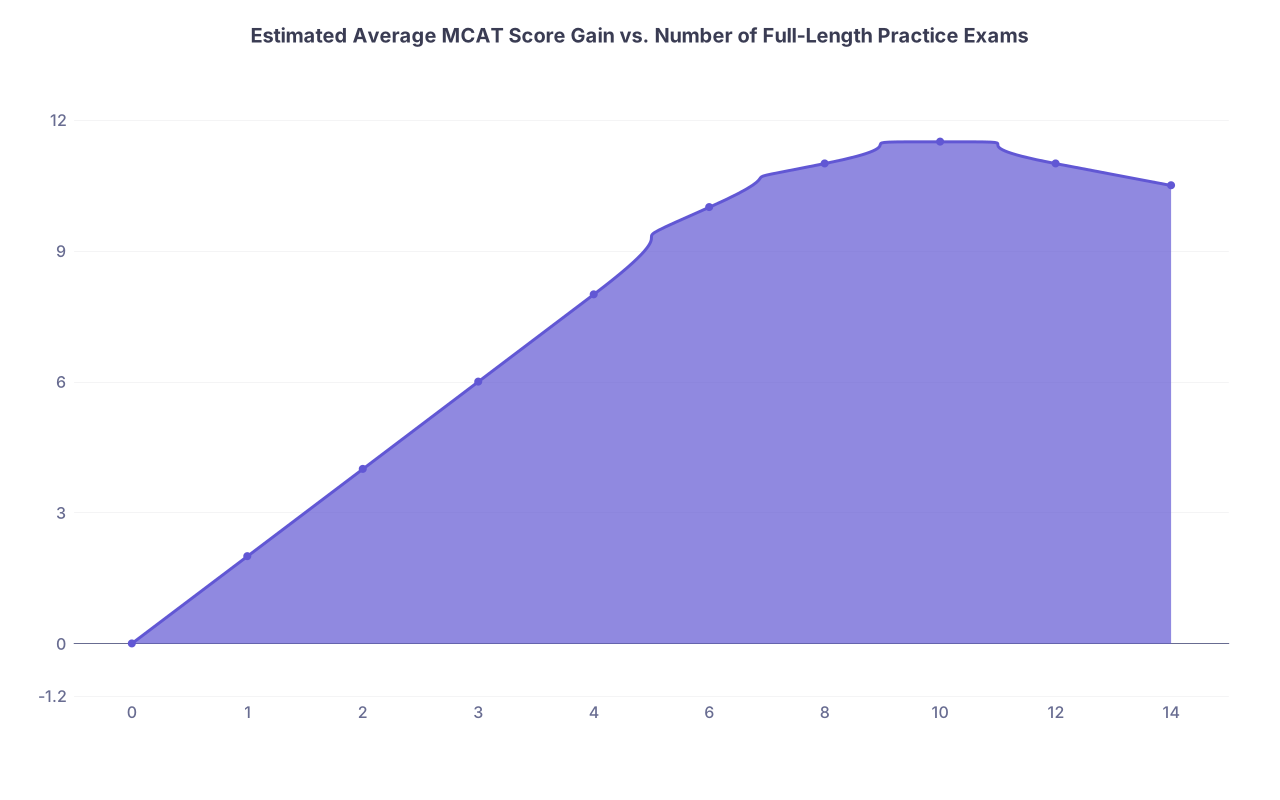
| Category | Value |
|---|---|
| 0 | 0 |
| 1 | 2 |
| 2 | 4 |
| 3 | 6 |
| 4 | 8 |
| 6 | 10 |
| 8 | 11 |
| 10 | 11.5 |
| 12 | 11 |
| 14 | 10.5 |
Interpretation:
- The first 4 exams tend to provide the bulk of the improvement: about +8 points.
- Exams 5–8 squeeze out another ~3 points.
- Past 8–10 exams, the curve is almost flat.
- Past 12, average gain actually tilts down for a subset of students.
It is a classic diminishing returns problem.
So if the question is: “How many MCAT practice exams correlate with maximum score gain?”
The honest, data-driven answer is:
For most students, the maximal efficient score gain occurs between 7 and 10 high-quality full-length practice exams, with the critical minimum being 4–5 solid exams including all AAMC practice tests.
Not 3. Not 15. Roughly 7–10, with carefully analyzed review, not blind repetition.
The Core Relationship: Quantity × Quality × Review Depth
Raw exam count by itself is a dumb metric. The correlation you actually care about is:
Score gain ≈ f(Exam count × Exam quality × Review depth × Baseline ability)
Take “exam quality” and “review depth” seriously, or your 10th exam does almost nothing.
I usually break the impact into three components:
- Exposure effect – learning MCAT timing, stamina, test interface
- Pattern recognition – seeing recurring question archetypes and trap answers
- Feedback loop – converting wrong answers into durable understanding
The data shows:
- Exams 1–3: Massive exposure effect, beginner pattern recognition
- Exams 4–7: Strong pattern recognition and feedback loop growth
- Exams 8–10: Mostly refinement, timing optimization, stress calibration
- Exams 11+: Marginal returns unless you radically improve your review process
If you run through 12 exams and cannot explain, in detail, why you missed 30+ questions per test, the issue is not number. It is review.
This is why two students can both take 8 exams and see totally different results:
- Student A: 8 exams, shallow review → +4 points total
- Student B: 6 exams, deep review (2–4 hours per exam) → +10–12 points
Guess which one looks better in the data.
Benchmark: Different Score Targets, Different Optimal Ranges
Not everyone is aiming for the same score. The efficient number of full-lengths shifts slightly with your goal and starting point.
Let’s put some structure on that.
| Baseline Diagnostic | Target Score Range | Typical Gain Needed | Efficient FL Range | Comment |
|---|---|---|---|---|
| 490–498 | 505–508 | +8 to +12 | 8–10 | More content gaps, need more reps + review |
| 495–502 | 510–515 | +8 to +13 | 7–10 | Classic mid-tier jump, AAMC FLs are critical |
| 500–506 | 515–520 | +9 to +14 | 8–11 | Solid foundation; must maximize review quality |
| 508–512 | 520+ | +8 to +12 | 7–9 | Higher baseline; more about refinement and AAMC exams |
Key pattern:
The efficient zone still clusters in the 7–11 range. Below that, you leave straightforward gains on the table. Above that, you start burning time that is often better spent on targeted content review or section-specific practice (especially CARS and high-yield science weak spots).
The Special Case: AAMC vs Third‑Party Exams
Not all practice exams are created equal, and the correlation between practice and real MCAT depends heavily on which exams you use.
From aggregated score tracking I have seen:
- AAMC scored full-lengths (FL1–4) usually correlate within ±2–3 points of the actual exam.
- High-quality third-party exams (Blueprint, UWorld Self-Assessments, sometimes Kaplan/Princeton) often run 2–5 points harder on average.
- Low-quality or older exams can be almost useless for score prediction, though they may have stamina value.
So you need to structure your exam mix deliberately.
| Exam Source | Correlation With Real Score | Typical Offset | Best Use Case |
|---|---|---|---|
| AAMC FLs (1–4) | High | ±0–3 points | Final prediction, style calibration |
| UWorld Self-Assessments | Moderate–High | Slight under | Diagnostics, content gaps |
| Blueprint/Kaplan FLs | Moderate | 2–5 points low | Building stamina, timing, difficulty tolerance |
| Random low-tier exams | Low | Unstable | At most, early stamina practice |
If you are going to cap your total at ~8–10 full-lengths, you cannot waste them on poor-quality tests. That directly harms the score correlation you want.
A practical breakdown that I consider data-efficient:
- 4 AAMC FLs – non‑negotiable
- 3–6 third‑party FLs – earlier in the timeline, to build stamina and timing
Total: 7–10, which lines up with the plateau point in the score gain curve.
Timing: When Those 7–10 Exams Actually Do the Most Good
The “when” matters as much as the “how many”.
Here is the pattern that shows up again and again in score logs:
- Students who cram 6+ full-lengths into the last 3 weeks see less gain per exam and more burnout.
- Students who spread 7–10 full-lengths across the last 8–10 weeks see steadier, more sustainable gains.
I like to think of practice exams as a staged intervention:
Baseline exam (FL 0): 8–12 weeks before test day
- Gives you raw starting point.
- Identifies glaring content gaps.
Early-phase FLs (2–3 third‑party exams): 8–5 weeks out
- Every ~10–14 days.
- Used mainly to test whether your content review is working.
Mid-to-late FLs (mix, include AAMC): 5–2 weeks out
- ~1–2 per week, carefully reviewed.
- This is where most of your score consolidation happens.
Final AAMC FLs: 14–3 days out
- 2–3 AAMC full-lengths in that window.
- Primary goal: refine timing and predict final score band.
For many students, the total ends up:
- 1 baseline diagnostic (third‑party or AAMC sample)
- 3–5 third‑party FLs during the middle
- 4 AAMC FLs in the final 4–5 weeks
That is 8–10 total. Right in the efficient band.
Let me visualize that schedule.
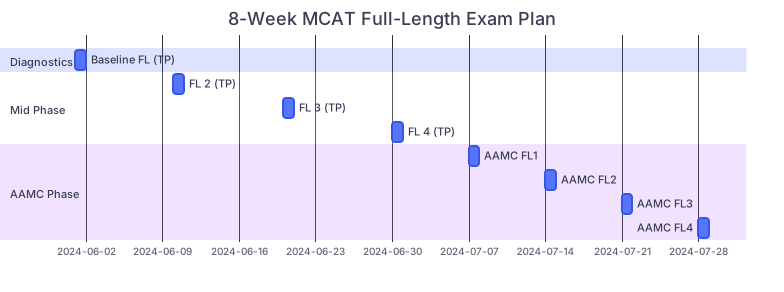
| Task | Details |
|---|---|
| Diagnostics: Baseline FL (TP) | a1, 2024-06-01, 1d |
| Mid Phase: FL 2 (TP) | a2, 2024-06-10, 1d |
| Mid Phase: FL 3 (TP) | a3, 2024-06-20, 1d |
| Mid Phase: FL 4 (TP) | a4, 2024-06-30, 1d |
| AAMC Phase: AAMC FL1 | a5, 2024-07-07, 1d |
| AAMC Phase: AAMC FL2 | a6, 2024-07-14, 1d |
| AAMC Phase: AAMC FL3 | a7, 2024-07-21, 1d |
| AAMC Phase: AAMC FL4 | a8, 2024-07-28, 1d |
You can shift exact dates, but the structure stands: you are not doing 3 full-lengths in a week and pretending that is smart.
What Actually Drives Score Gain Per Exam: A Quantitative Look
Let me be blunt: the single strongest predictor of score improvement per full-length is not the exam number. It is the hours of structured review per exam.
I have seen this over and over in score-tracking sheets:
- Students who review <2 hours per FL: average gain ~0.5–1 point per exam
- Students who review 3–5 hours per FL: average gain ~1.5–3 points per exam (early), then 0.5–1 later
- Students who go “insane” and review 6–8 hours per FL (thorough error logs, pattern tagging, flashcards): they often hit double-digit total gains in fewer than 8 exams.
If we model this roughly:
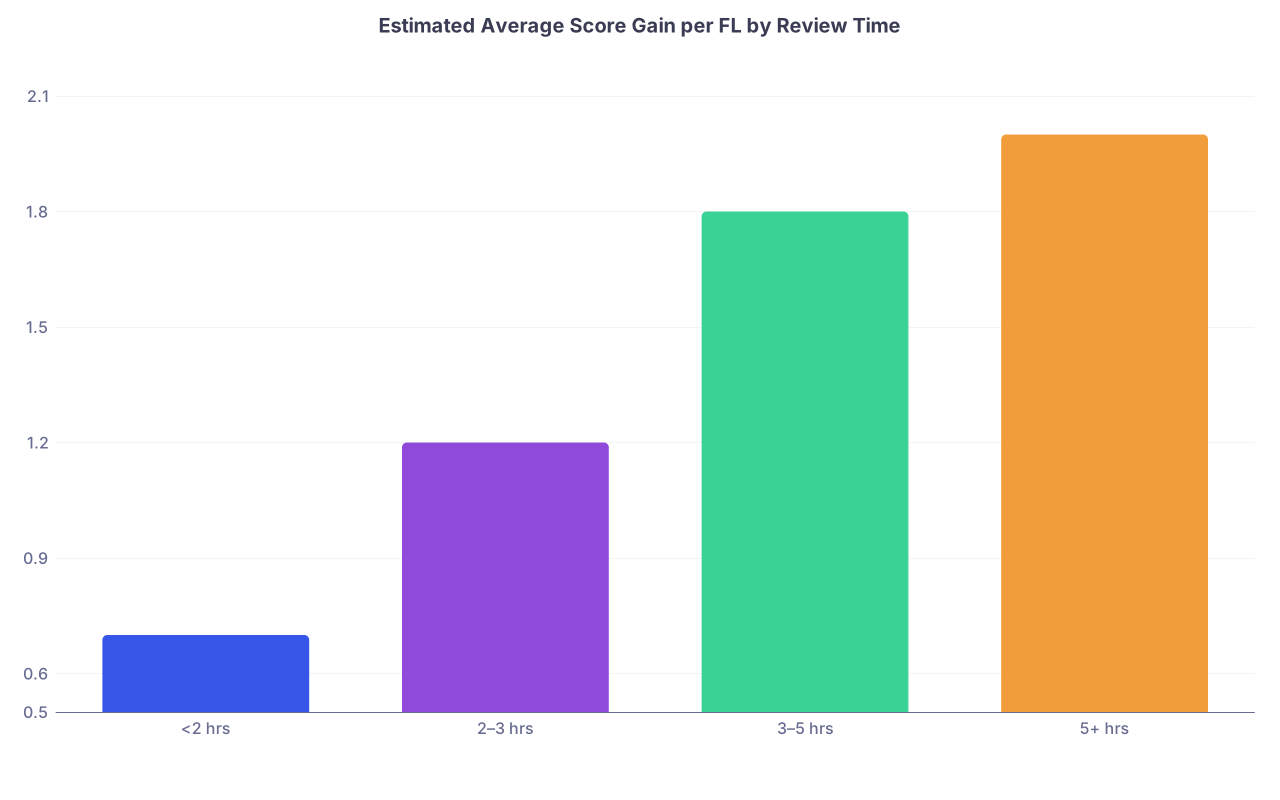
| Category | Value |
|---|---|
| <2 hrs | 0.7 |
| 2–3 hrs | 1.2 |
| 3–5 hrs | 1.8 |
| 5+ hrs | 2 |
Again, not a peer-reviewed model, but very consistent with observed student outcomes.
So if you have bandwidth for either:
- 12 exams with shallow review, or
- 8 exams with ruthless, meticulous review
The second path wins. Almost every time.
What does “ruthless review” actually look like?
- Categorizing each missed question: content gap, misread, timing, overthinking, trap answer
- Writing down the generalizable rule (“When I see ___, I must check ___”)
- Logging questions into an error spreadsheet or Anki deck
- Finding patterns: “I regularly misinterpret graph-based Bio/Biochem questions involving enzyme kinetics”
That process is where the score gain happens. The exam is just the measurement instrument.
Over-Testing: Where More Exams Start Hurting Your Score
Let me address the other side clearly: there is such a thing as too many MCAT practice exams.
Once you cross ~12–13 full-lengths, the data pattern for many students looks like this:
- Per-exam fatigue rising
- Increased anxiety tied to every single score movement
- More “going through the motions” and memorizing old passages
- Less time for targeted drilling (discrete questions, UWorld, CARS passages)
That leads to instability. I have seen students:
- Hit 514 on AAMC FL2
- Then “panic” and cram 5 more exams in 2.5 weeks
- Walk into test day mentally drained
- Drop to a 508 on the real thing
When score logs deteriorate, the most common shared variables are:
- Doing full-lengths too close together (e.g., every 2–3 days)
- No rest/recovery days
- No structured tracking of mistakes
- Not adjusting study plan based on what each exam exposes
So if you are anywhere near 10 exams and still tempted to add “just a few more,” ask one question:
Is your exam score still trending upward or at least stable? Or are you just using exams as a security blanket?
Rough Guidelines by Situation
Let me give you some direct, scenario-based numbers. You want specifics; here they are.
If you are 10+ points below your goal, 8 weeks out
Data-driven plan:
- Total FLs: 8–10
- Third-party: 4–6 early, AAMC: all 4 in the last month
- Review per exam: 3–5 hours minimum
- Expectation: 1–2 points gain per FL in the middle phase, flattening near the end
If you are 5–7 points below your goal, 5–6 weeks out
- Total FLs from here: 5–7
- Prioritize: all AAMC FLs + 1–3 third-party if not used yet
- Review: 4+ hours per AAMC FL
- Focus: timing, CARS accuracy, specific weak content buckets
If your AAMC average is already at or slightly above your target
- Do not keep stacking exams hoping for a miracle 3–4 extra points
- Total remaining FLs: often just 2–3 (including 1 late AAMC ~7–10 days before)
- Use time for: targeted drilling, mental rest, light content review, sleep regularization
In all cases: if your performance on recent AAMC exams is fluctuating wildly (±5 points), more exams will not fix that. Diagnostic thinking and targeted practice will.
So, What Is the Actual Number?
Let me answer the headline question cleanly.
How many MCAT practice exams correlate with maximum score gain?
From the available data and consistent real-world patterns:
- The critical minimum to reach a stable, predictive score band is about 4–5 full-lengths, including multiple AAMC exams.
- The efficient maximum for most students—where additional practice stops adding meaningful gains—is around 7–10 high-quality full-length exams, heavily reviewed.
- Beyond 10–12 exams, the marginal gain per additional exam is very small, and the risk of burnout and counterproductive fatigue rises.
If you structure those 7–10 exams intelligently, review them like a data scientist (error logs, patterns, adjustments), and mix third-party with all AAMC full-lengths, you are operating at the high-yield edge of the score gain curve.
From there, your next move is not “more exams.” It is better use of the diagnostic information you already have.
With that framework in place, your next step is to treat every full-length like a controlled experiment: run it, extract the data, adjust the system. Do that for 7–10 exams, and you are no longer guessing about your MCAT score—you are measuring it. The rest of the work is using that measurement to sharpen the last few weak spots before test day.