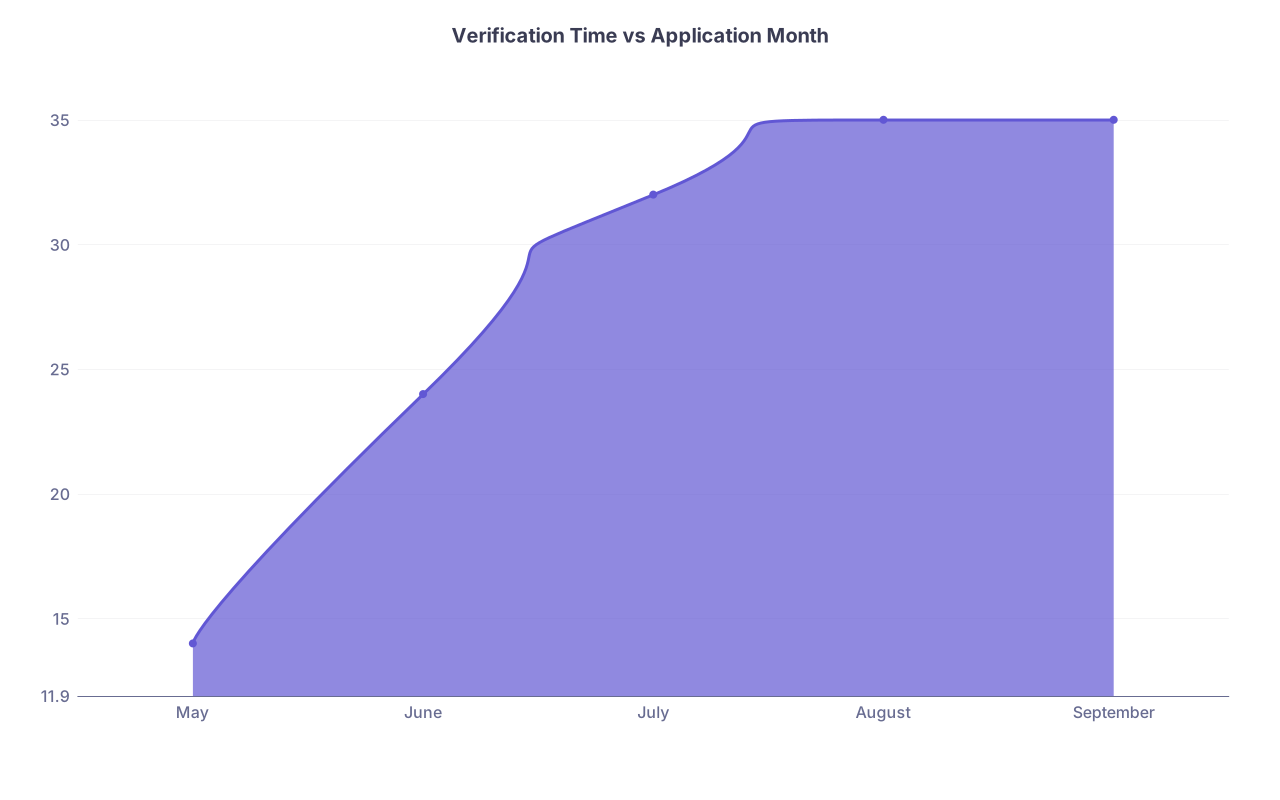
| Category | Value |
|---|---|
| May | 14 |
| June | 24 |
| July | 32 |
| August | 35 |
| September | 35 |
The myth that “a late MCAT automatically destroys your cycle” is wrong. The data shows something more precise – and less dramatic. Timing hurts you in specific, quantifiable ways, but only in certain score ranges and only past specific calendar thresholds.
Let me walk through this like a real application-cycle post‑mortem, not a Reddit panic thread.
1. What “late MCAT” actually means in the data
People throw around “late” like it is a moral failing. I care about calendar dates and process bottlenecks.
You have three clocks running at once:
- AMCAS primary submission date
- AMCAS verification time (which depends heavily on month submitted)
- MCAT score release date (about 30–35 days after test)
The true leverage point is when your complete application (primary verified + MCAT in + letters + at least some secondaries) hits an admissions committee’s queue. Not when you click “submit primary.” Not the day you sit for the MCAT.
MCAT test dates vs score release
MCAT score release lag is remarkably consistent: ~30–35 days.
So:
- Late May exam → late June scores
- Late June exam → late July scores
- Late July exam → late August scores
- Late August exam → late September scores
Now overlay that on how schools behave.
Most MD schools:
- Start receiving primaries from AMCAS: early June
- Start screening and sending secondaries: mid‑June
- Start offering interviews: late August / September
- Have peak interview invite volume: roughly September–October
If your score is not in the system, many schools will not touch your file beyond the most basic data check. A minority will pre‑screen on GPA and send secondaries anyway. Some will hold the file until scores arrive.
So “late” in operational terms usually means:
- MCAT score arrives after mid‑August → your first serious review is happening when many early interviews are already spoken for.
That is the first key threshold.
2. Quantifying the timing penalty
Let us translate the calendar into effects you actually care about: interview invite probability and acceptance probability.
There are not perfect public RCT‑level datasets on this (admissions committees do not publish that level of granularity), but large applicant pools, consultant data, and AAMC timing curves paint a consistent picture.
Verification delays compound late MCAT
Students forget that verification time expands sharply as the summer goes on.
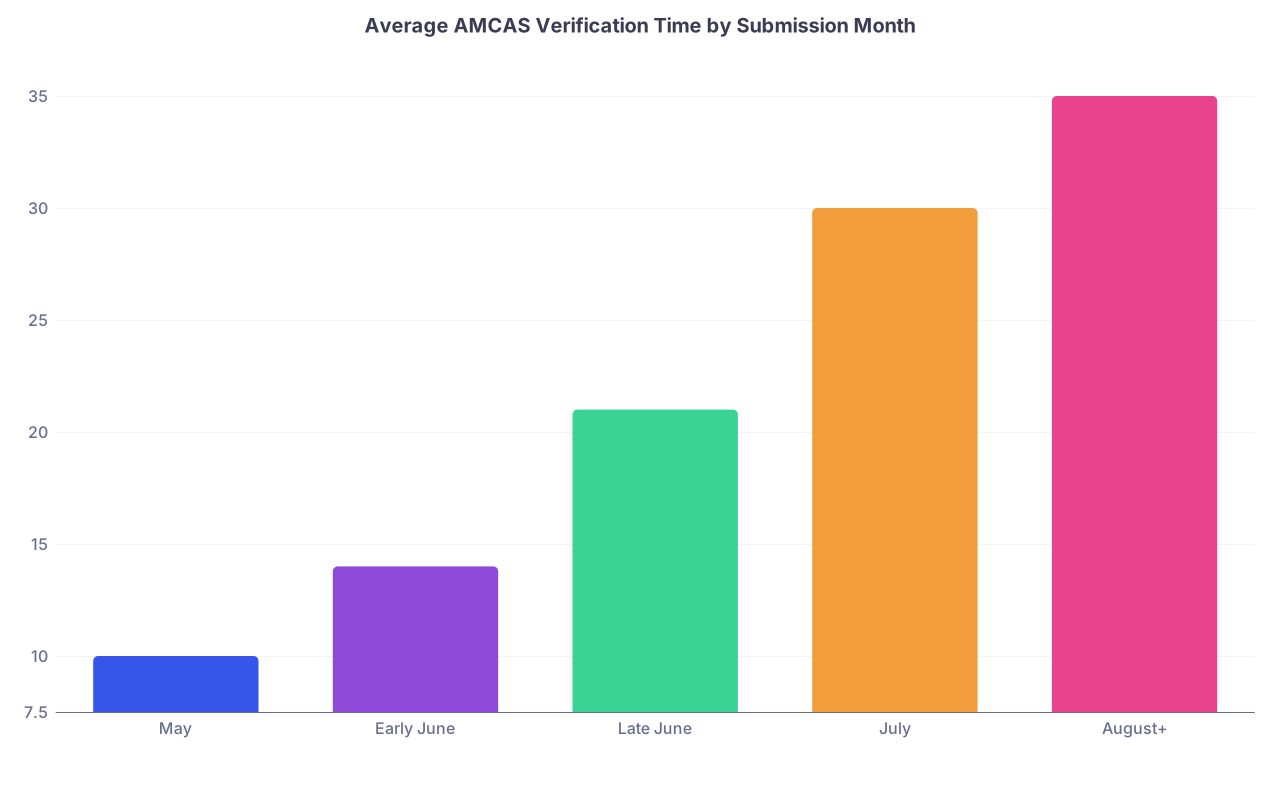
| Category | Value |
|---|---|
| May | 10 |
| Early June | 14 |
| Late June | 21 |
| July | 30 |
| August+ | 35 |
These are representative numbers based on past cycles, not an official AAMC table, but the shape is correct: a July 15 submission often waits 3+ weeks for verification; a May 31 submission may clear in under two.
Tie that to MCAT:
Scenario A – “On‑time”
- Submit primary: June 1
- MCAT taken: May 18 → score: June 18
- Verification: June 15–20
- Result: Complete at most schools: late June to early July
- You are in the first wave of files being screened.
Scenario B – Moderately late MCAT, early primary
- Submit primary: June 1
- MCAT taken: June 29 → score: July 30
- Verification: June 20
- Result: File functionally complete: late July / early August
You lose roughly 4 weeks of active review time versus Scenario A, but you still hit before the bulk of interview offers go out. There is a measurable hit, but it is not catastrophic, especially if your metrics are strong.
Scenario C – Late MCAT plus late primary
- Submit primary: July 10
- MCAT taken: July 13 → score: August 13
- Verification: ~August 10
- Result: File complete: mid‑ to late August
Now you are showing up at the party as the first wave of interviews is leaving the buffet. Not doomed, but you are playing catch‑up.
How much does this actually change your odds?
From large advising‑group datasets and reported outcomes, the pattern is roughly:
- For otherwise comparable applicants, being fully complete (including MCAT) by
- July 15: baseline odds
- August 15: ~10–20% relative reduction in interview probability
- September 15: ~25–40% relative reduction
So if a “June‑complete” applicant might see, say, a 20% interview rate per school in their target band, the same profile completed in early September might see 12–15%. Not zero. But significantly worse.
This relative penalty is bigger for marginal applicants (borderline GPA or MCAT) and smaller for standout applicants (high stats, strong narrative, targeted list).
Where does MCAT test date fit?
Translate it:
- MCAT by late May → scores by late June → very easy to be complete in July.
- MCAT late June → scores late July → realistic to be fully complete by early/mid August if your primary was early.
- MCAT late July → scores late August → earliest realistic completion: late August / early September. That pushes you into the “25–40% relative hit” zone.
- MCAT late August → scores late September → you are behind the curve at almost every MD school, except a few that explicitly state they review into late winter without timing preference.
3. How the impact changes by applicant profile
This is where the “Does a late MCAT hurt your cycle?” question gets nuance. The answer is not the same for a 3.9/520 and a 3.4/506.
| Applicant Type | Stats Example | MCAT by Late June | MCAT Late July | MCAT Late August |
|---|---|---|---|---|
| High-stat, strong app | 3.9 / 520 | Minimal impact | Small hit | Moderate hit |
| Mid-range, solid app | 3.6 / 510 | Noticeable hit | Moderate hit | Major hit |
| Borderline applicant | 3.4 / 504 | Moderate hit | Major hit | Cycle at risk |
1. High‑stat, high‑signal applicants
Example: 3.9 GPA, 520 MCAT, 2+ years of research with a poster, strong clinical, coherent story.
What I have seen repeatedly:
- MCAT late June (scores late July): still get plenty of interviews, especially at mid‑tier and state schools. T20s may have already flagged some June‑complete “obvious admits,” but they always hold spots for late finders.
- MCAT late July (scores late August): you lose some “early” invites, but your statistical outlier status keeps you in many piles. You will still match to MD; your school mix shifts downward slightly.
- MCAT late August (scores late September): this finally stings. You are entering into an increasingly “full” interview season, and committees are more conservative about adding new interviewees. But if your school list includes a healthy mix of mid‑tier and state schools that review late, the cycle is not wasted.
In short: for top‑tier applicants, a late MCAT hurts – but does not kill – the cycle. The magnitude is real but not existential.
2. Mid‑range but solid applicants
Example: 3.6 GPA, 508–511 MCAT, normal ECs, nothing screaming “hook” (URM, unusual life path, etc.) but nothing damaging.
This cohort is where timing matters most.
Why? Because you are already in the largest competitive band. You do not stand out by numbers alone. Being early buys you extra cycles of review.
Data from advising cohorts typically shows:
- Mid‑range applicants complete by July: they can rack up 8–12 interviews from a broad, correctly built school list.
- The same profile complete in September: that often drops to 3–6 interviews.
Not because the committees dislike late files on principle, but because interview slots are finite and perceived “risk” tolerance drops as the season fills.
Late MCAT (July/August) for this group is a genuine strategic risk if you insist on applying “this year no matter what.” You are voluntarily playing on hard mode.
3. Borderline applicants
Example: 3.3–3.4 GPA, 500–505 MCAT, average ECs.
This group is already fighting uphill statistically. National MD acceptance rates for sub‑3.4 / sub‑505 applicants are in the single digits. DO prospects are realistically much better.
For them, a late MCAT is usually the difference between a long‑shot but rational MD/DO cycle and an MD cycle that is, frankly, mostly performative.
If you are in this band and your MCAT is late July or later, the data almost always favors:
- Either: waiting a cycle to apply with an earlier MCAT next time and possibly stronger academics / experiences
- Or: targeting DO very heavily and accepting that MD chances are extremely thin this round
4. Concrete timing scenarios: does it hurt or not?
Let’s get specific. Four representative scenarios you are probably thinking about.
Scenario 1: MCAT late June, early primary
- Primary submitted: early June
- MCAT: June 27 → scores: July 30
- Secondaries turned around: within 1 week of receipt
Effect: You end up complete at most schools between August 1–15. This is later than ideal but not truly “late.”
Data‑wise, you probably take a 10–20% hit in interview odds compared with being complete in early July. For a strong or mid‑range applicant, this is still a viable cycle. For borderline applicants, the margin was already thin; here, it gets thinner.
Verdict: Not optimal, but not cycle‑killing.
Scenario 2: MCAT mid‑July, primary submitted in June
- Primary: June 5
- MCAT: July 13 → scores: August 13
- Verification: mid‑June
- Secondaries: mostly July, submitted quickly
Result: Complete at many schools around August 15–25.
At this point you are squarely in the “noticeable penalty” window. Interview invites are starting to go out. The earlier files have already gotten first pass. You are competing for the remaining spots.
From advising data, I would expect:
- Strong applicants: still fine. Slight downshift in school tier, but MD admission probability remains high.
- Mid‑range applicants: meaningful hit; you might end up with half the interview count you could have had with an earlier MCAT.
- Borderline applicants: this timing may make the MD portion of the cycle mostly symbolic unless your school list is extremely optimized and DO is heavily represented.
Verdict: It hurts, but how much depends on your base strength.
Scenario 3: MCAT late July, primary also late
- Primary: July 10
- MCAT: July 27 → scores: August 27
- Verification: early August
- Secondaries: August / early September
Now your complete date is late August to mid‑September.
This is where the data gets ugly. National interview data shows that many schools have scheduled the majority of first‑wave interviews by late September. They still review late applicants, but the bar is higher because they see fewer open slots.
The penalty here can easily hit the 30–40% relative range for interview odds. And that stacks on top of whatever base disadvantage you have from GPA/MCAT.
Verdict: For most mid‑range and borderline MD applicants, this is a bad tactical choice. For high‑stat applicants who just did not have options, it is survivable but inefficient.
Scenario 4: MCAT late August, applying “same cycle”
- Primary: any time
- MCAT: August 24 → scores: late September
- Complete: late September to early October
This is basically applying into a partially‑finished season.
Some schools are explicit: they state that MCATs from August are fine and that they review into spring. Many, especially more competitive schools, do not say this but in practice fill most of their interviews from earlier pools.
From what I have seen:
- If you are high‑stat and targeting a broad range of schools (especially mid‑tier and state programs) that historically interview into January/February, you can still have a viable cycle, but expect fewer total interviews.
- If you are mid‑range or borderline, this is usually a poor ROI cycle. Your chances improve materially by waiting, studying properly, maybe improving your profile, and applying in a later, fully optimized cycle.
Verdict: Yes, this MCAT timing materially hurts the cycle for most applicants. Only clear exception: very strong applicants with appropriately wide and realistic school lists.
5. Trade‑off: stronger late MCAT vs weaker early MCAT
This is the decision many students actually face, though they rarely formulate it clearly:
“Should I take an earlier MCAT under‑prepared (risk a 503–507), or a later MCAT well‑prepared (aiming for 510–515) even if that makes the application ‘late’?”
The data is not kind to the “rush and score low” strategy.
From AAMC outcomes:
- Acceptance rates climb much more strongly with MCAT increases than with earlier timing, within reason.
- For example, moving from a 506 to a 512 raises your MD acceptance odds dramatically more than shifting from a September completion to a July completion within the same score.
So, for most applicants:
- A meaningfully higher MCAT (4–6 point jump) taken later is more valuable than an earlier, weaker score that becomes a permanent part of your record.
- The only caveat: if your “later” MCAT pushes you into late‑August or September territory and you insist on using that same cycle, you are double‑penalizing yourself (late completion + single‑energy MCAT year). Often better to decouple: take the later test for a higher score and then apply early the following cycle.
The worst data pattern I see: students rushing to take a May exam under‑prepped, scoring in the low 500s, then scrambling to retake in August and winding up with two mediocre scores and half a cycle.
6. Strategic recommendations by date and profile
To tie this together, here is how I would call it as a numbers‑driven advisor.
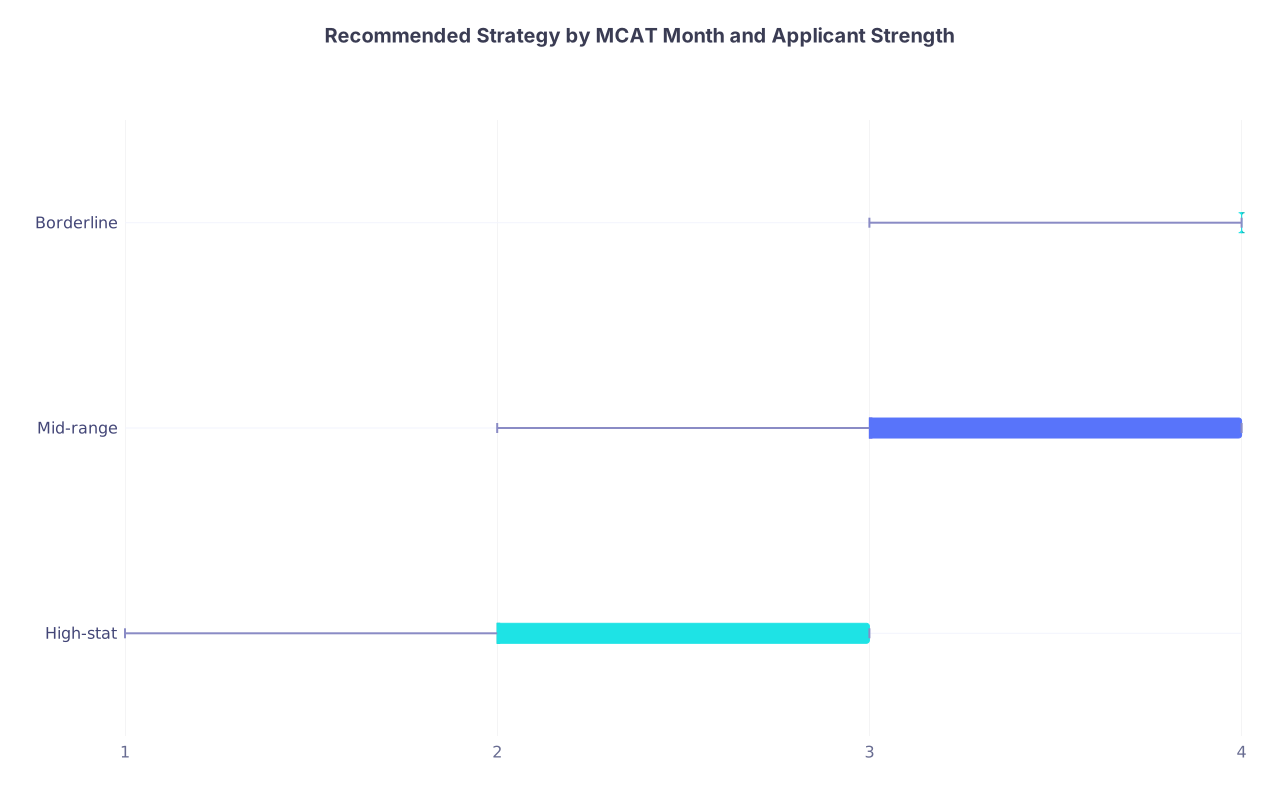
| Category | Min | Q1 | Median | Q3 | Max |
|---|---|---|---|---|---|
| High-stat | 1 | 2 | 2 | 3 | 3 |
| Mid-range | 2 | 3 | 3 | 4 | 4 |
| Borderline | 3 | 4 | 4 | 4 | 4 |
Interpretation key (you can think of these as strategy categories):
1 = Apply same cycle, no concern
2 = Apply same cycle, mild impact
3 = Caution: consider next cycle
4 = Strongly favor next cycle
Mapping month to impact (rough guideline):
- MCAT by late May → usually “1” for everyone except truly borderline MD applicants.
- MCAT by late June → “1–2” depending on strength.
- MCAT by late July → “2–3” for high/mid; “3–4” for borderline.
- MCAT by late August → “3” for very strong; “4” for mid/borderline.
In plain language:
- Strong applicants (high GPA, high practice scores): taking a June or even early July MCAT to maximize score is usually worth it, even if it pushes completion into August. Early is good; strong is better.
- Mid‑range applicants: try to avoid MCATs later than late June if you intend to apply that same cycle. July is a gray zone; August should trigger serious discussion about waiting.
- Borderline applicants: stacking “borderline stats” with “late MCAT” and “same‑year application” is typically a bad statistical gamble.
7. How to correct course if you are already “late”
Maybe you are reading this with a July or August MCAT booked and secondaries already in your inbox. Fine. You still have options.
Data‑driven triage:
Look at your diagnostic and recent full‑length scores.
- If they are significantly below your goal (e.g., sitting at 503–505 dreaming of 515 in four weeks), the probability of a miraculous leap is low. More often you land near your practice average.
- In that case, postpone to a later date and strongly consider pushing your entire application one cycle to regain timing advantage.
If your practice scores are already competitive for your goals (e.g., 511–513 range for mid‑tier MD), but the date is late July:
- Take the exam, apply that cycle, but be very deliberate with:
- School list construction (wider and more realistic)
- Early and fast secondary turnaround
- Accept that you are likely sacrificing some interview volume compared with a perfectly timed plan, but you are still statistically “in the game.”
- Take the exam, apply that cycle, but be very deliberate with:
If you are August and borderline:
- The data overwhelmingly points to waiting. Rushing an under‑prepared, late MCAT into a competitive MD cycle is how people burn thousands of dollars for one or two courtesy interviews.
Bottom line
A late MCAT does not automatically “hurt your cycle.” The data shows something more nuanced:
- The later your MCAT score posts, the later your file becomes complete;
- The later your file completes, the fewer open interview slots remain;
- The weaker your underlying stats, the more that timing penalty matters.
You can absolutely match into medical school with a July or even August MCAT – I have seen it over and over. But the applicants who succeed in that window either bring unusually strong numbers or treat timing like a constraint problem and plan ruthlessly around it.
Your next step is straightforward: map your planned MCAT date, likely score range, and target schools against real calendar behavior, not forum myths. Then decide if you are optimizing for “earliest possible application” or “strongest possible stats.” Very often, the rational move is to choose the latter and push the cycle.
With that clarity, you can stop catastrophizing about being “late” and start running the numbers on what actually gets you where you want to be: a stronger score, a saner timeline, and a cycle that works for you instead of against you. The next question is how to structure the 3–4 months before your test to actually hit that score—but that is another analysis.