
A 508 is not a “good” or “bad” MCAT score. It’s a signal with very specific meanings that admissions committees quietly agree on but rarely explain to you.
I’ve sat in those rooms. I’ve watched faculty glance at an application, see “508,” and their body language shifts in a very particular way. Not disgust. Not excitement. A little head tilt. A mental calculation. “All right… show me the rest.”
Let me walk you through what that actually means.
What a 508 Looks Like From the Adcom Side
Here’s the first unfiltered truth: most physicians and faculty do not think in percentiles; they think in buckets.
They’re not parsing 507 vs 508 vs 509. They’re asking:
- Below comfort zone
- In the gray zone
- Safely above our bar
A 508 sits almost perfectly in the “gray zone” at many MD schools and solidly “above bar” at a lot of DO schools.
If you’re at a mid-tier MD program meeting, someone sees a 508 and thinks:
“OK, academically viable. Not a stats slam dunk. What else have they got?”
If you’re at a top-20 MD program, the reaction is more like:
“This isn’t a score-based admit. If we take this person, it’s for something special elsewhere.”
If you’re at a DO program, it’s closer to:
“Academically fine, move on. Let’s see if they fit our mission and won’t be miserable here.”
That’s the key mental move committees make. A 508 closes some doors automatically, keeps many others wide open, and forces your file into a very particular lane: “Convince me.”
The Quiet Math: Where 508 Really Sits
You’ve probably seen the official numbers, but here’s how committees use them in real life.
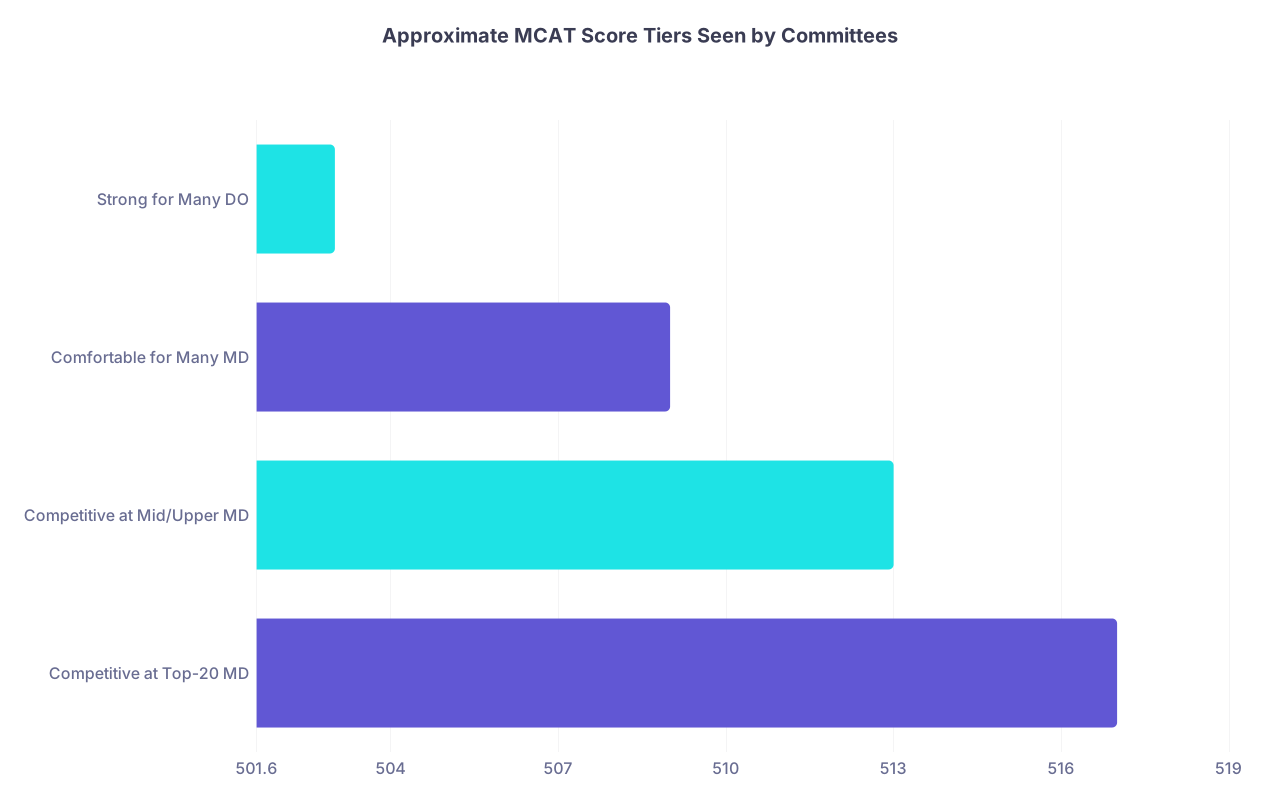
| Category | Value |
|---|---|
| Competitive at Top-20 MD | 517 |
| Competitive at Mid/Upper MD | 513 |
| Comfortable for Many MD | 509 |
| Strong for Many DO | 503 |
Nobody’s reading this chart out loud in admissions committee. But they know the terrain:
- 520+ screams “top-of-the-pile academic strength”
- 515–519 is “highly competitive almost anywhere”
- 511–514 is “solid to strong for many MDs”
- 507–510 is “borderline to solid, depends on the school and the rest of the app”
Your 508 lives right in that last bracket.
At many state MD schools, 508 is around or just under their median. You’re viable. They won’t toss you just for that. But you’re not getting any free passes on the rest of your application.
At higher-ranked MD schools? 508 sets off a simple internal rule: we’re only moving this forward if the story, mission fit, and experiences are truly exceptional.
At DO schools, a 508 often counts as reassuring: “This person can handle our curriculum.”
Now let’s talk about the more interesting part: what a 508 actually signals about you as a candidate.
What a 508 Tells Them About You (That No One Says Out Loud)
Committee members read scores like personality traits. They’ll deny it if you ask them on a panel. But you hear the comments behind closed doors.
A 508 quietly suggests several things.
1. “This person is likely to pass our exams… but I want to see proof”
A 508 tells them you’re not reckless, not disengaged, and not completely out of your depth. You put in work. You have baseline academic horsepower.
But it does not scream “no worries.” It whispers, “Check the transcript. Check the trend. Check discipline.”
So they look at:
- Your science GPA: 3.7+ with a 508 feels very different than a 3.2 with a 508.
- Course rigor: Did you take biochem, upper-level physiology, real labs… or the softest schedule possible?
- Trends: Upward trajectory with a 508? They relax. Downward trend with a 508? They start to doubt resilience.
What they’re trying to answer is: “Will this person struggle with Step 1/Level 1 and our in-house exams, or will they handle it fine if they work?”
2. “This person probably didn’t completely optimize the test”
A 508 often reads like: “capable, but something was off.” That “something” can be:
- Late or compressed prep
- Poor strategy (timing, review, question selection)
- Life chaos (family, work, illness during prep)
- Weakness in one section dragging the rest down
If they see a lopsided score, say: 126/130/126/126, someone on the committee will say it out loud:
“They clearly didn’t manage CARS or psych/soc as well, or they weren’t taking practice under real conditions.”
They’re not judging you morally. They’re thinking about how you handle complex, multi-domain stress. Medicine is one long, integrated exam.
3. “This person is not getting in here on stats alone; do they bring something else?”
At a 508, your file is no longer in the “numbers might carry you” pool. You are not a statistical auto-admit anywhere competitive.
You are judged as:
- Mission-fit candidate
- Story-based candidate
- Experience-based candidate
When a 520 applicant writes a boring personal statement, it’s annoying—but committees will still debate them because of their raw numbers.
When a 508 applicant writes a boring personal statement, you’re dead in the water. Nobody is fighting for that file. There’s nothing to hang the argument on.
That’s harsh, but it’s how selection meetings actually play out.
Section Scores: Where a 508 Can Help or Kill You
A 508 means almost nothing by itself without the section breakdown. This is where committees start psychoanalyzing you.
Let’s lay out a few typical patterns.
| Profile (CP/CARS/BB/PS) | Likely Interpretation | Risk Level |
|---|---|---|
| 127/127/127/127 | Steady, balanced, no major gaps | Low |
| 125/128/126/129 | Inconsistent prep, some strengths, some real weaknesses | Moderate |
| 124/127/128/129 | Concerning CP, might struggle with heavy science coursework | High |
| 128/124/128/128 | CARS red flag, critical reasoning concern | High |
| 126/126/128/128 | Gradual improvement across sciences, okay but not stellar | Moderate |
Here’s how those get talked about.
The Balanced 508 (127s across the board)
Committees like balance. A 508 made of even 127s feels less risky than a 508 with one 124 and a couple of 129s.
You’ll hear something like:
“Not amazing, not scary. Let’s see their GPA and experiences.”
Translation: You’re academically boring. Which is fine, as long as the rest is interesting.
The Science-Weak 508 (low CP/BB, higher others)
If your CP or BB is 124–125 and the other sections prop you up, the suspicion is:
“They may have crammed content, didn’t deeply master it, or have genuine gaps in foundational science. That can haunt them in M1.”
If the school has had issues with Step failure rates, this matters. Some schools are gun-shy now. They simply won’t take the risk if they have a huge pile of alternative applicants.
The CARS-Weak 508
This is the one faculty complain about the most in private.
A significantly lower CARS (say 123–124) with stronger sciences gets comments like:
“Good at memorizing, not great at reading and reasoning.”
“We’re going to have trouble with this on clinical notes and complex cases.”
Is that totally fair? Not always. But that’s the mental shortcut.
If you’re a CARS-weak 508, you must show reading, writing, communication, and reflection elsewhere: humanities coursework, strong essays, publication writing, teaching, scribing with excellent LORs about your communication.
Lopsided Excellence at 508
A 131 in one section with 124–125s in others does not impress them the way students think it will. It reads as erratic.
The thought is:
“They clearly can rise to the occasion… when they choose to.”
Committees don’t like “selective excellence.” Medicine needs boring, consistent reliability more than it needs occasional brilliance.
MD vs DO: How a 508 Plays Differently
Let me be explicit because people dance around this.
For MD programs, a 508 usually means:
- At lower/less selective MDs: “We’ll look, but we need GPA and mission alignment to be strong.”
- At mid-tier MDs: “You are not carried by stats; convince us you belong.”
- At top-20 MDs: “Unlikely unless you’re exceptional in a very specific way (first-gen with heavy adversity, unique research, NCAA athlete, etc.).”
For DO programs, a 508 usually means:
- “Academically reassuring. We’re more focused on: will you thrive here and do you understand osteopathic medicine?”
I’ve seen DO committees be much more forgiving of uneven section scores at the 508 level than MD committees, especially if the applicant shows maturity, clinical commitment, and some understanding of OMM/DO philosophy.
So if you’re sitting on a 508 and clinging only to MD as a concept of self-worth, understand: the committees do not share your prestige obsession. They care far more about: Will you succeed and represent us well?
When a 508 Helps You More Than a Retake
Nobody tells you this: in a lot of scenarios, retaking a 508 is a politically bad move unless you’re very confident of a jump.
Here’s the reality from the other side of the table:
- A 508 → 509 or 510 is functionally meaningless for many committees. They won’t reward the 2–3 point grind.
- A 508 → lower score raises eyebrows: “They didn’t learn from the first go. That worries me.”
- A 508 → 513+ changes your category. Now someone can argue for you on stats alone.
So committees interpret a retake like this:
“Did this person show substantial growth, or did they just spin their wheels?”
If your diagnostics and FLs were already plateaued around 506–509, and you’re fantasizing about a 518 with sheer willpower, you’re misreading how this works.
On the other hand, if you hit a 508 while sick, working full-time, or with clear prep errors, and now your practice tests are consistently 512–515? That’s a case where retaking makes sense—and committees will actually respect the improvement.
What Committees Expect To See With a 508
Here’s the part students don’t get: with a 508, you don’t get to be average everywhere else. If you are, you blend into a massive, forgettable middle.
The subtext in the room is:
“If their MCAT isn’t carrying them, what is?”
So what do they want to see?
1. A Clear, Coherent Story
Not random clubs and 37 scattered activities.
I’ve watched adcoms pause on 508 applicants because of a tight narrative:
- 3–4 years of consistent clinical exposure in one setting
- A real leadership progression (not just titles)
- A personal statement that actually reads like a human being, not a template
They’re asking: “Would I be proud to tell someone this person came from our school in 15 years?”
2. Strong Letters That Argue You’re More Than Your Score
Good committees don’t just read letters for “hardworking” and “diligent.” They read for phrases like:
- “Top 5% of students I’ve worked with in 10 years”
- “Handles complex tasks and ambiguity with maturity beyond typical premeds”
- “Learns rapidly from feedback and independently goes deeper than required”
For a 508 applicant, letters like that are oxygen. They let someone on the committee say:
“Look, the stats aren’t amazing, but this PI/attending is clearly staking their reputation on this student.”
That matters far more than you think.
3. Evidence of Real-Life Functioning Under Stress
A 508 is sometimes read (fairly or not) as: “They’re okay at standardized tests, but not a natural killer.”
So committees look for other forms of proof:
- Working substantial hours while in school
- Caregiving responsibilities with solid grades maintained
- Leadership in crisis situations (EMS, scribe supervisor, charge MA, etc.)
That kind of evidence can offset a lot of MCAT mediocrity. It shows operational resilience—what matters when medicine stops being theoretical.
How to Package a 508 So It Works For You
Let me be blunt: you can’t change the number, but you can absolutely change the story the number is sitting inside.
A few concrete strategies I’ve seen work for 508 applicants who ended up at solid MD programs:
Make Your Academic Trajectory Impossible to Ignore
- Strong upward trends (e.g., 3.3 → 3.7 → 3.9) with tough science courses
- Post-bacc or SMP work with As across the board
- Thoughtful, specific explanations (where appropriate) in secondaries about earlier academic stumbles with clear evidence that the issue is resolved
You want the committee to say:
“The 508 is actually an underestimate of who they are now.”
Use Your Personal Statement to Reframe the Score
Not by whining about it. By making it almost emotionally irrelevant.
When a committee member reads your statement and thinks, “This person is obviously going to be a good physician,” the MCAT score shrinks in their mind.
Your job is not to be impressive. It’s to be undeniable in your sincerity, reflection, and fit for medicine.
Target Schools Intelligently
Here’s another thing insiders know: some schools are far more MCAT-sensitive than others. Some are GPA-sensitive. Some are mission-sensitive. Some care heavily about in-state status.
If you throw your 508 at 25 schools whose medians are 516–518, that’s not “ambitious.” It’s wasteful.
You want a mix where:
- Your 508 is near or just below the median at many
- Your GPA is at or above the median
- Your story fits their publicly stated mission (rural, underserved, research, primary care, etc.)
Committees notice when someone clearly belongs at their school. They’re tired of reading generic, copy-paste applications.
The Harsh Truth and the Hopeful One
Here’s the harsh part: a 508 will not open the doors you see plastered all over SDN and Reddit screenshots. You’re not waltzing into top-10 MD purely on numbers.
But here’s the hopeful truth committees won’t say on stage: many of the best medical students I’ve seen did not have flashy MCAT scores. They were 506–510 types with grit, maturity, and focus that don’t show up in a scaled score.
And adcoms know that.
So they use 508 as a filter, not a verdict. The score says:
“You’re allowed in the conversation. Now prove you belong.”
If you treat 508 as a death sentence, you’ll apply like someone who’s already lost. If you treat it as a demand to sharpen every other part of your application until it bleeds, you give committees something they actually want: a clear reason to bet on you despite the noise.
FAQs
1. Should I retake a 508 MCAT?
Retake only if you have hard evidence (recent FLs from AAMC, not hope) that you can consistently hit 512+ under real conditions. A 1–3 point bump doesn’t materially change how most committees view you. A drop can hurt. If your GPA is strong, your sections are reasonably balanced, and your practice tests aren’t improving, your time is better spent strengthening your application and targeting schools wisely.
2. Can I get into an MD program with a 508?
Yes, and plenty of people do every cycle. But not at random. You’re aiming mostly at mid/low-tier MD programs, often state schools or mission-focused schools where your story, background, and fit line up well. You will not be the stats superstar; you’ll get in because the rest of your file convinces someone to argue for you in committee.
3. Is a 508 “good enough” for DO schools?
For most DO programs, a 508 is comfortably above their floor and often at or above their median. It usually shifts the focus away from “Can they pass boards?” to “Are they actually a good fit for osteopathic medicine and our culture?” If you’re open to DO, a 508 is a strong academic foundation—as long as your experiences and essays are solid.
4. How much do section imbalances matter with a 508?
They matter more than you think. A single 123–124 in CARS or CP with a 508 composite can raise real concern, especially at MD programs sensitive about Step performance. Balanced 126–127s are often safer than a flashy 130 paired with a 123. If you have a lopsided profile, you need compensating evidence: strong grades in related coursework, excellent writing and reasoning in essays, and letters that speak to your abilities in that domain.
Key takeaways:
A 508 doesn’t define you, but it does force you out of the “stats carry me” lane. Committees read it as “prove it elsewhere.” If you respond by tightening your story, sharpening your school list, and backing your application with real performance and maturity, that “gray zone” score becomes just one line in a compelling file—not the headline.