What if the MCAT retake you’re convinced will “fix everything” actually makes your application harder to defend, not easier?
I’ve watched strong applicants tank their cycles not because they were “bad testers,” but because they retook the MCAT for the wrong reasons, at the wrong time, with the wrong plan. They assumed “higher score = better” and ignored how schools really read multiple MCAT attempts.
Let’s go through the traps that catch smart people. The ones that look reasonable on the surface. And the specific situations where not retaking is actually the safer, more strategic move.
How Schools Really See Multiple MCAT Scores (And Why This Matters)
Before the 9 traps, you need to understand one thing: adcoms don’t read your MCAT like you read your MCAT.
You see:
- One number.
- One percentile.
- One emotional reaction.
They see:
- Score trend.
- Attempt count.
- Section balance.
- Timeline relative to coursework and grades.
- Whether your self-judgment matches reality.
This is where students mess up: they think a retake is “just another chance to go higher.” Schools see patterns. And patterns of poor judgment matter.
Here’s the core mistake: assuming any higher score is a win.
Wrong. There are several ways a retake can actively hurt you:
- It can highlight inconsistency.
- It can expose poor decision-making (“Why did you retake a 514?”).
- It can show lack of insight (“Student doesn’t understand what’s ‘good enough’ for their target schools.”).
- It can lock you into applying later, thinner, more rushed.
Keep that in mind as we walk through the 9 specific traps.
Trap #1: Retaking a Score That’s Already Competitive for Your Targets
This is the ego trap.
You’ve got a 511–513. Or maybe a 508 with a strong GPA and powerful story. Objectively fine for a realistic school list. But you keep staring at Reddit threads where everyone seems to have a 520.
So you say, “I’ll retake and turn my 512 into a 518.”
Here’s the problem: that’s not a retake plan. That’s a fantasy.
Retaking a good score is dangerous when:
- Your current score is already in (or near) the middle 50% of your realistic target schools.
- The rest of your app (GPA, experiences, letters, story) is the real bottleneck.
- You don’t have a demonstrably different preparation plan—just “more of the same but harder.”
You don’t get bonus points for overkill. You do get extra scrutiny for:
- Multiple MCAT attempts.
- A small gain that doesn’t change your school list.
- Burning time that could have been used fixing letters, essays, or clinical exposure.
If your current score:
- Puts you in range for your in-state schools,
- Keeps DO options wide open,
- And doesn’t have a fatal section imbalance (like a 124 CARS dragging everything down),
then retaking just to “feel more competitive” is usually a bad call.
Mistake to avoid: chasing a vanity number when you already have a functional one.
Trap #2: Retaking Without Fixing the Root Cause of Your Score
Here’s the brutal pattern I see over and over:
- Student gets a 502.
- They’re disappointed (understandably).
- They register for the next available date.
- They “study harder.”
- They get a 503 or 504.
- Now they’ve got two mediocre scores and are even more confused.
The trap isn’t the retake. It’s the unchanged system:
- Same weak content foundation.
- Same inconsistent study habits.
- Same “I’ll just do more practice tests” approach.
- Same life chaos (work, family, stress) left unaddressed.
If you can’t clearly answer this question:
“What will be concretely different about my prep this time?”
Then you shouldn’t be registering again.
“Concretely different” means:
- You found and fixed specific content gaps (e.g., you finally learned acid-base, circuits, endocrine).
- You’ve changed your schedule (less work hours, structured daily plan).
- You’re using different resources in a targeted way, not just adding more.
Otherwise, you’re gambling. And the house (MCAT) usually wins.
Mistake to avoid: signing up for a retake driven by emotion, not a clear, evidence-based change in strategy.
Trap #3: Retaking Too Soon After a Disappointing Score
You got your score back. It stung. You immediately went to the AAMC calendar and grabbed the next open day.
This is how people stack mediocre scores.
MCAT improvement is not instant. Especially if your problem was foundational content or test-taking under stress.
Big red flags you’re retaking too soon:
- You’re scheduling a retake within 4–6 weeks of your previous exam.
- You haven’t taken even one slow, low-pressure week to autopsy what went wrong.
- You can’t show measurable improvement in practice FL scores yet—but you’re “hoping it goes better.”
You need data before a retake date, not the other way around.
A safer approach:
- Do a full post-mortem: section-by-section, question-by-question, what actually failed?
- Run at least 2–3 new full-lengths under realistic conditions.
- Only sign up when practice scores are consistently above your target.
Retaking too soon screams panic and poor judgment. Schools see your test dates. They can read the timeline.
Mistake to avoid: letting your emotions pick your retake date instead of your actual readiness.
Trap #4: Retaking When Your GPA Is the Real Problem
Harsh truth: an MCAT retake won’t rescue a chronically weak academic record.
If your GPA is:
- Cumulative 3.1 with heavy downward trends,
- Science GPA significantly below 3.2,
- Multiple withdrawals, repeats, or low grades in core sciences,
then the bottleneck is not your 505 vs 509. The bottleneck is how you’ve historically handled academic rigor.
In this situation, common bad idea:
“I’ll crush the MCAT to ‘prove’ I can handle med school.”
Here’s why that logic backfires:
- A high MCAT with a low GPA raises eyebrows: “Why couldn’t this student perform in class?”
- It suggests inconsistency, not reliability.
- Schools trust multiple semesters of work more than one exam day.
What actually helps more than an MCAT retake:
- Post-bacc or SMP with excellent grades.
- Several semesters of upper-division sciences showing a rock-solid upward trend.
Then, if your MCAT is truly below your new potential, you consider a retake.
But if you ignore GPA repair and cling to MCAT retakes, you’ll waste cycles and fees and wonder why no one’s biting.
Mistake to avoid: using the MCAT as a band-aid for years of weak academics.
Trap #5: Retaking With Unrealistic Score Jumps in Mind
You have a 498. You want a 515. You “need” a 17-point jump in 8 weeks.
No. You don’t need that. You’re just not going to get it.
Can people improve 10+ points? Yes. With time, structure, and brutal honesty. But many students base their retake on fantasy projections:
- “I didn’t sleep well; I’m really a 505.”
- “I didn’t study that hard; I’ll get serious and jump 15 points.”
- “I’ll just grind UWorld and it’ll all come together.”
Here’s where this blows up:
- You plan application timing around a hypothetical massive jump.
- You ignore backup paths (like DO, post-bacc, SMP) because “future 515 me” will fix everything.
- You take the test again, land at 503, and now have two low scores and a destroyed timeline.
A retake is safest when:
- Your target improvement is realistic: 3–7 points, based on current practice scores.
- You’ve already seen upward trends on full-lengths over several weeks.
- You aren’t staking your entire career plan on a miracle number.
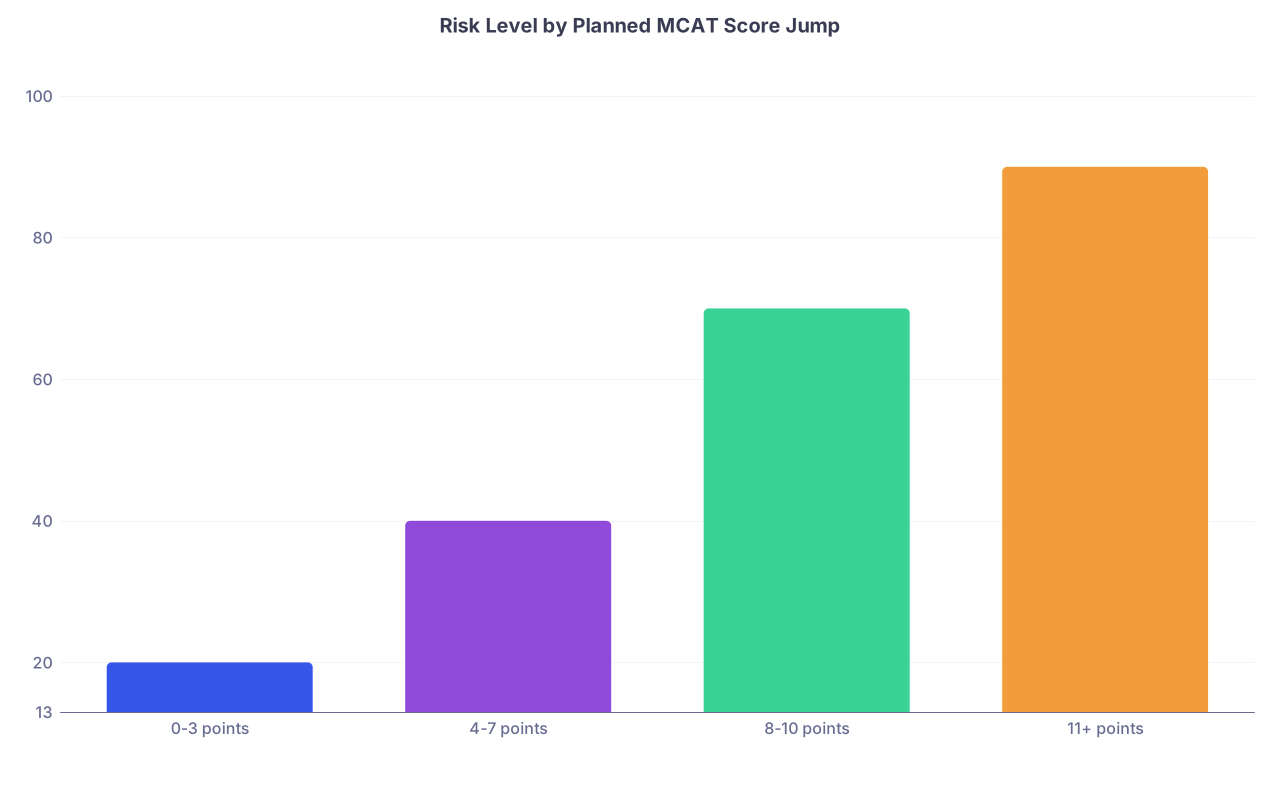
| Category | Value |
|---|---|
| 0-3 points | 20 |
| 4-7 points | 40 |
| 8-10 points | 70 |
| 11+ points | 90 |
Mistake to avoid: designing your future around a score jump that exists only in your head, not in your practice data.
Trap #6: Ignoring Section Imbalances (Or Making Them Worse)
Medical schools don’t just see “510.” They see:
- 128 / 129 / 123 / 130
And then they start asking questions.
Retaking is especially treacherous when you already have a lopsided score:
- Strong total, but one section is glaringly low (often CARS).
- Or one science section is significantly lower than others.
Here’s how students mess this up:
- They retake trying to “fix” the low section.
- They neglect maintaining strengths in the other sections.
- New score: the weak section improves slightly, but one previously strong section drops.
So now you have:
- First attempt: 511 (with 123 CARS).
- Second attempt: 509 (with 125 CARS, but 126 Bio down from 129).
Some schools average scores. Others look at the highest total but still see the spread. You’ve added complexity and risk for a marginal gain.
Retakes focused on section repair make sense only if:
- The weak section is truly out of line (e.g., three sections 128–129, one section 123–124).
- You have proof from practice exams that you can fix that section without sacrificing others.
- The section in question is something schools particularly care about (yes, CARS, I’m looking at you).
Otherwise, you risk trading one red flag for another.
Mistake to avoid: tinkering with a decent, if imperfect, score and ending up with multiple, conflicting datapoints that are harder to explain.
Trap #7: Letting a Retake Ruin Your Application Timing
This is the “I’ll just push my whole timeline” mistake.
Scenario I’ve seen too many times:
- You planned to apply in May/June with your current score.
- You decide to retake “to be safer.”
- You book a July/August exam.
- Now schools won’t see that score until late August or September.
- You’re suddenly a late applicant in a rolling admissions system.
A small improvement in score can’t always compensate for being months late in the cycle. Especially for MD.
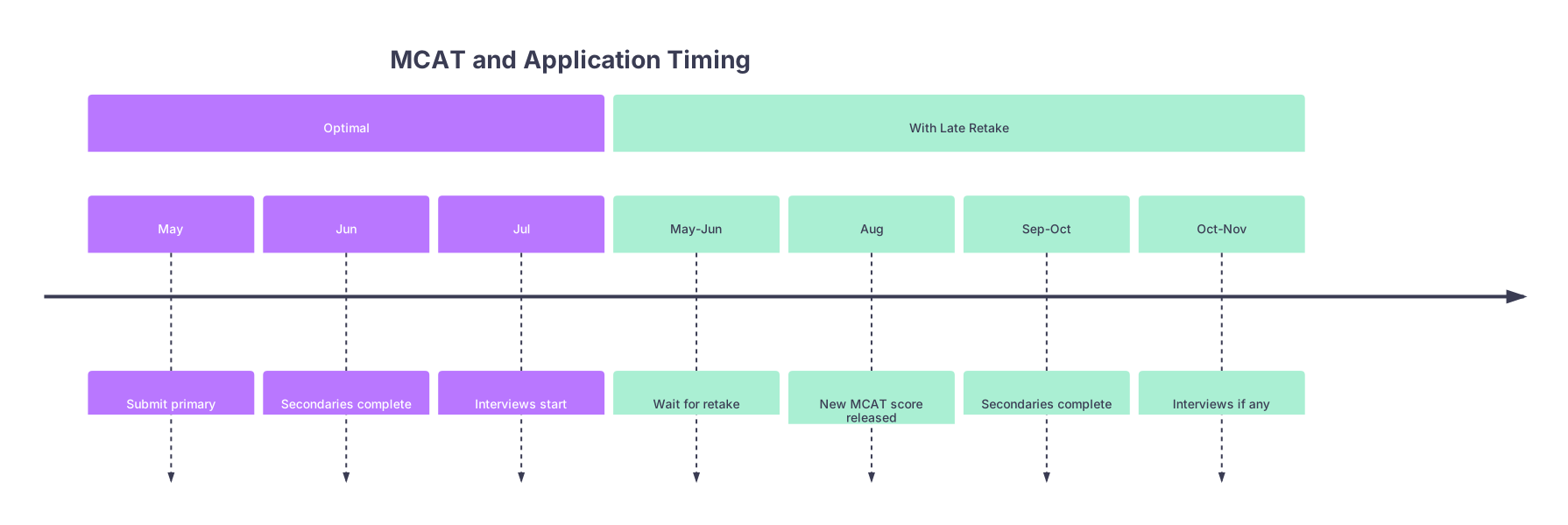
| Period | Event |
|---|---|
| Optimal - May | Submit primary |
| Optimal - Jun | Secondaries complete |
| Optimal - Jul | Interviews start |
| With Late Retake - May-Jun | Wait for retake |
| With Late Retake - Aug | New MCAT score released |
| With Late Retake - Sep-Oct | Secondaries complete |
| With Late Retake - Oct-Nov | Interviews if any |
Retakes are most dangerous when they:
- Delay submission of your primary or secondaries.
- Push your “complete” date into August/September for MD.
- Are done during the same cycle you’re applying, instead of planning ahead a year.
Sometimes the honest answer is:
“You’re better off applying next cycle with a strong retake and early submission, than sabotaging this cycle with a late score.”
Mistake to avoid: sacrificing early, strong applications just to chase a modest MCAT bump.
Trap #8: Accumulating Too Many Attempts
You don’t want to be the “four-time MCAT taker” if you can help it.
Yes, AAMC allows multiple attempts. Yes, some people genuinely need more than two tries. But there’s a point where the number of attempts becomes its own problem.
Patterns that look bad:
- 4–5 attempts with minimal improvement.
- Multiple scores clustered in the same range (e.g., 502, 503, 503, 504).
- Scores that go up, then down, then sideways.
Some schools have explicit or implicit limits on attempts they’ll seriously consider. Others don’t have hard rules but will absolutely question:
- Why did this person keep retaking?
- What kept going wrong?
- Why wasn’t there a clear improvement pattern?
If you’re already at:
- 2 attempts with small movement,
- or 3 attempts with inconsistent outcomes,
you can’t treat another retake like it’s “no big deal.”
At that point, you should:
- Talk to an advisor who actually understands admissions strategy (not just a test-prep salesperson).
- Consider alternate paths: DO, post-bacc, SMP, different cycle, different country in extreme cases.
- Be brutally honest about whether your approach to learning and testing can really change.
Mistake to avoid: treating the MCAT like an unlimited-use lottery ticket instead of a signal schools use to judge your judgment.
Trap #9: Retaking Because of External Pressure, Not Internal Strategy
Parents. Peers. Reddit. That guy in your orgo class who got a 523 and won’t shut up about it.
A lot of retakes start from:
- “My parents think 510 isn’t good enough for medicine.”
- “Everyone I know scored higher.”
- “My pre-health advisor said I should ‘aim for top-tier schools’ even though my GPA is 3.4.”
Retaking to satisfy someone else’s expectations is a huge red flag, because:
- Those people aren’t the ones whose name is on AMCAS.
- They’re often chasing prestige, not realistic outcomes.
- They rarely understand your full profile: GPA, trends, ECs, letters, state residency, story.
You know who has to defend your choices? You. In your secondaries. In interviews. In your own head when you’re reapplying after wasting a cycle.
If your gut says, “My score is fine for my goals, my data is stable, my improvement odds are modest,” and the only thing pushing you to retake is pride or pressure—listen to your data, not the noise.
Mistake to avoid: letting other people’s anxiety or vanity write your test registration.
When a Retake Does Make Sense (So You Don’t Overcorrect)
Let’s be clear: I’m not anti-retake. I’m anti-stupid retake.
A retake is usually reasonable when:
- Your score is clearly below the 10th percentile of your realistic target schools, and
- You have solid evidence from recent practice tests that you can significantly improve, and
- You have a new, well-structured study plan and enough time, and
- Retaking won’t wreck your application timing or give you 4+ total attempts.
| Profile | Safer to Retake | Risky to Retake |
|---|---|---|
| Current Score | 498 aiming for 505–508 | 512 aiming for 518+ |
| Practice FLs | Trending 4–8 pts above old score | Same or lower than old score |
| Attempts So Far | 0–1 | 3+ |
| GPA | Strong (3.6+ with good trends) | Weak (≤3.2 with no repair) |
| Timing | Retake months before applying | Retake during late application cycle |
The key is that your retake should be:
- Strategic, not emotional.
- Data-driven, not guess-based.
- Part of a bigger plan, not your only plan.
The One Question You Need to Answer Before You Click “Register”
Here’s the filter I wish more students used:
“If my retake score ends up 1–2 points higher or 1–2 points lower than my current score, will it have been worth it?”
If the honest answer is “no”—because the potential gain doesn’t change your school list, your timing, or your fundamental competitiveness—then you’re walking into a trap.
If the answer is “yes”—because even a modest bump would meaningfully change your options and you have data to justify expecting that bump—then a retake might be reasonable.
Your next step today
Open your score report and your last two full-length practice exams. Side by side. Ask yourself, in writing:
- “What exactly went wrong?”
- “What would be concretely different next time?”
- “Am I chasing realism or fantasy with this retake?”
If you can’t write specific, believable answers to those three questions, don’t register for a retake today. Fix the plan first—or accept that your current score might already be enough.