
You are walking back from a three-hour orgo lab. It is 8:30 p.m. You still have a problem set due tomorrow, a quiz Friday, a lab write‑up this weekend—and your MCAT date is exactly 11 weeks away. Your MCAT books are stacked on your desk like a silent accusation.
You do not need more motivation posters. You need a weekly system that actually works when you are taking 15–18 credits, maybe working a part‑time job, and you cannot disappear for 10 hours a day to “grind.”
That is what this blueprint is for.
I am going to walk you through a concrete weekly structure you can plug into your life: hours, days, what to do in each block, and what to cut. Not ideals. Reality.
Step 1: Decide Your MCAT Role This Semester
Before you talk hours or schedules, you need to decide one thing:
Is this semester MCAT‑primary or MCAT‑secondary?
That answer drives everything.
Use this quick rule.
| Factor | MCAT-Primary Semester | MCAT-Secondary Semester |
|---|---|---|
| Time to test | ≤ 12 weeks | ≥ 16–20 weeks |
| Current practice FL | Already at/below goal-10 | Well below goal-15+ |
| Course load | ≤ 14–15 credits | ≥ 16–18 credits or heavy labs |
| Application cycle | Applying this upcoming cycle | Applying in ≥ 1 year |
If you are ≤ 12 weeks from test day and applying this cycle:
MCAT is primary. Your weekly blueprint will protect 18–22 MCAT hours no matter what.
If you are 16–24+ weeks out or applying in a year or more:
MCAT is secondary but still real. Aim for 8–12 high‑quality hours per week, focus on foundation and CARS, then ramp up later.
For the rest of this article, I will assume you are in the common, painful situation:
- Full course load (15–18 credits)
- MCAT in 10–16 weeks
- Want to do more than “survive” both
I will show you:
- A 20‑hour MCAT week on a full course load
- A 10‑hour “lighter” version if you are earlier in the timeline
- How to protect those hours when your semester tries to blow them up
Step 2: Know the Minimum Weekly MCAT Dose
Stop thinking “I’ll study MCAT whenever I have time.” That is how you end up studying hard on Sunday and nothing Monday–Thursday.
You need a minimum effective dose per week.
If you are ≤ 12 weeks from test day (MCAT‑primary)
Target:
- 18–22 MCAT hours / week
Rough split:
- 8–10 hrs: High‑quality practice (Qbanks, section banks, full‑length review)
- 6–8 hrs: Content review (videos, reading, active notes)
- 4–5 hrs: CARS (almost daily, short sessions)
If you are 12–24 weeks out (MCAT‑secondary but serious)
Target:
- 8–12 MCAT hours / week
Rough split:
- 4–5 hrs: Content building aligned with your classes
- 2–3 hrs: CARS
- 2–4 hrs: Light practice + review
Those are floors. Not ceilings. You can go above if life allows, but you never drop below without a conscious decision and a recovery plan.
Step 3: Lock in Your Fixed Weekly Skeleton
You cannot build a schedule around vague ideas. Start with a skeleton:
Put in:
- Class meeting times
- Lab blocks
- Work shifts
- Non‑negotiables (commuting, religious services, essential family time)
Add realistic daily capacity:
- Most students can squeeze 3–4 total high‑focus hours on a heavy class day
- And 5–7 hours on lighter days / weekends
Now you drop in MCAT blocks before you sprinkle in everything else.
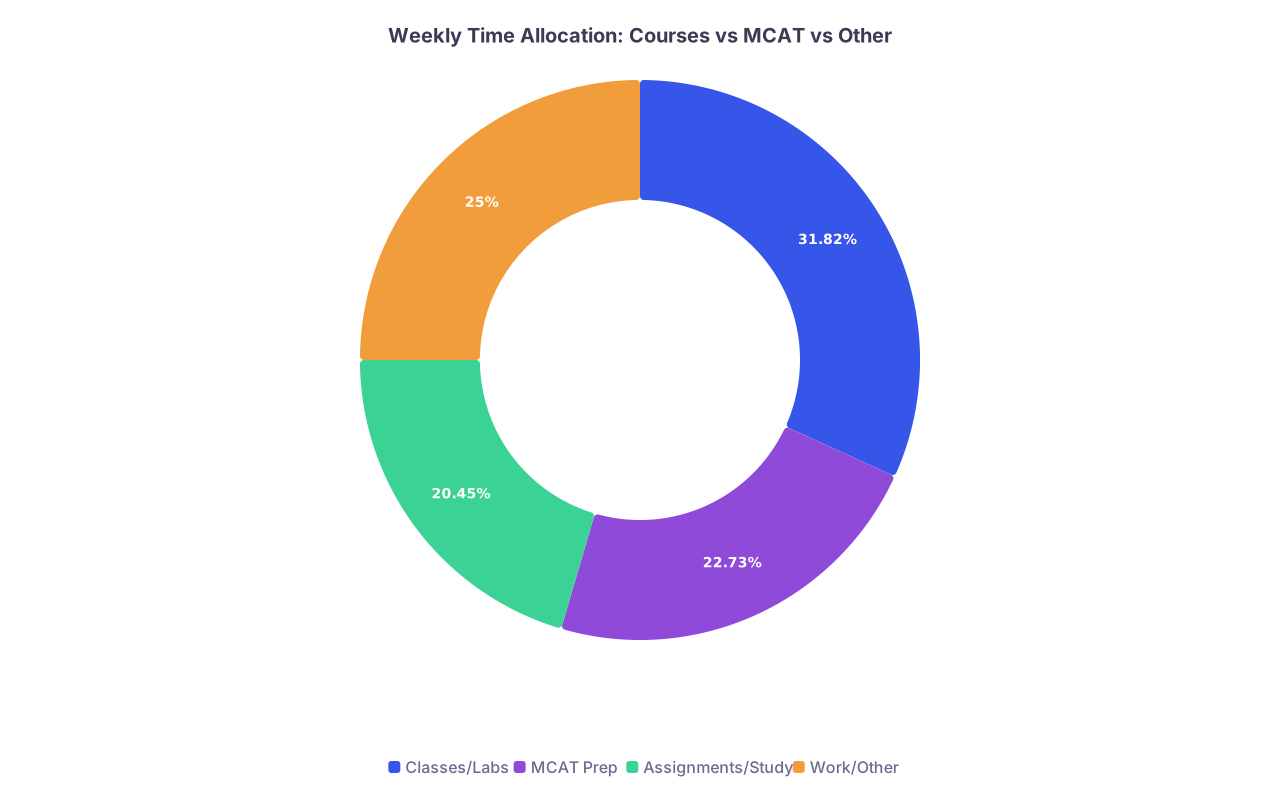
Here is a sample skeleton for a very typical premed week (16 credits + lab). MCAT‑primary scenario.
Sample Weekly Time Distribution
| Category | Value |
|---|---|
| Classes/Labs | 28 |
| MCAT Prep | 20 |
| Assignments/Study | 18 |
| Work/Other | 22 |
Assumptions:
- 28 hrs class/lab
- 20 hrs MCAT
- 18 hrs assignments/studying for courses
- 22 hrs work/commute/other
Totally doable over 7 days if you are intentional.
Step 4: The Actual Weekly Blueprint (MCAT‑Primary, ~20 Hrs)
Here is what you actually came for. A concrete week.
You can tweak days, but keep the structure.
Anchor Rules
- MCAT every weekday morning or evening at the same time
- One longer MCAT block Saturday
- Sunday mostly coursework + light MCAT
Think of your MCAT week in blocks:
- Short block: 45–60 minutes
- Medium block: 90 minutes
- Long block: 2.5–3 hours
Now plug them.
Monday – Thursday (Heavy Class Days)
Goal: ~2.5–3 MCAT hours/day
Morning (if you have late classes)
- 7:30–8:15: CARS (1 passage timed + review) or 2 passages untimed with deep review
- 8:15–8:30: Quick Anki / flashcard session (biology, psych/soc, equations)
Evening
- 7:30–9:00: Focused practice block
Examples by day:- Mon: Chem/Phys passage set (6–8 passages) + review
- Tue: Bio/Biochem passages
- Wed: Psych/Soc passages
- Thu: Mixed section bank / tough topics
Total: ~2–2.5 hours per day
4 days = 8–10 hours
If your mornings are impossible (early labs every day):
Flip it:
- 4:00–5:00 p.m.: CARS + review right after class before dinner
- 8:00–9:30 p.m.: Practice block
The key: same windows, every weekday. They become non‑negotiable, like class.
Friday (Lighter Academic Day)
Goal: ~3 MCAT hours
Example:
- 7:30–8:15: CARS
- 1:00–2:30: Content review:
- Watch targeted videos or read content on topics you bombed M–Th
- Build or update concise summary sheets / flashcards
- 8:00–8:45: Quick mixed practice (discrete questions) + Anki
Total: ~3 hours
Saturday (Long MCAT Day)
Goal: 5–7 MCAT hours, depending on whether it is full‑length week
You alternate weeks:
Week A: Full‑Length Exam Day
- 8:00–2:00: Full‑length (with short breaks, simulate real conditions)
- 3:30–5:30: High‑yield review of:
- Missed questions you do not understand
- Questions you guessed correctly
- Pattern recognition: what content keeps showing up?
That is 7–8 hours if you include snack breaks. This is your heaviest day.
Week B: Non‑FL but Deep Practice Day
- 8:30–10:30: Content‑anchored passages (e.g., 3 Chem/Phys + 3 Bio/Biochem)
- 11:00–12:30: Review those passages in detail
- 2:00–3:30: CARS set (4–5 passages) + review
Total: ~5–6 hours.
Sunday (Academic Catch‑Up + Light MCAT)
Goal: 2–3 MCAT hours, rest of day coursework/admin
Example:
- 9:00–10:00: Review mistakes from the week (make an error log)
- 4:00–5:30: Light content review or flashcards while you do laundry / reset your week
Important: Sunday is where many students let MCAT disappear “just this week.” That is how you slide from 20 hours to 14 and wonder why scores stall.
Step 5: A Lighter Blueprint (~10 Hrs/Week, 16–24 Weeks Out)
If your test is > 4 months away, or your semester is brutal (multiple labs, 20+ work hours), you still need structure—but you can scale.
Here is a 10‑hour version that maintains momentum.
Mon–Thu
- One 45–60 minute MCAT block each day
Recommended: - 2 days: CARS + review
- 2 days: Short science passage sets (3–4 passages)
That is ~4 hours.
- One 45–60 minute MCAT block each day
Friday
- 90 minutes: Content review tied to what you are learning in class
(e.g., covering glycolysis in class → do MCAT‑level glycolysis content and questions) - 30 minutes: Flashcards
~2 hours.
- 90 minutes: Content review tied to what you are learning in class
Saturday
- 2–3 hours: Mixed passages or a half‑length practice, plus review
Sunday
- 1–1.5 hours: Error log + light content or CARS
Now you are at 9–10 hours. Consistently. For months. That builds a strong base so your later intensive period actually works.
Step 6: Balance Practice vs Content (Week by Week)
Most students get this backward. They hide in content review (videos, highlighting) because it feels safe, and delay hard practice.
With a full course load, you cannot afford that. You must get the ratio mostly right from early on.
Use this as a guideline by phase:
| Time to Test | Practice : Content Ratio | Main Focus |
|---|---|---|
| 20–16 weeks | 40% : 60% | Foundation + basic passages |
| 16–8 weeks | 60% : 40% | Passage-heavy, targeted content |
| 8–0 weeks | 75% : 25% | Full-lengths, refinement |
With a full course load, that means:
In the 16–8 week window (most of you)
Your weekly 20 MCAT hours should look roughly like:
- 12 hours practice / review:
- 2–3 CARS sessions
- 3–4 science passage sessions
- 1 FL every other week with long review
- 8 hours content:
- Targeted to your error log and FL results
- Aligned with topics you are seeing in class when possible
If you find yourself watching videos 10 hours a week but doing only 2 hours of passages, that is not “your learning style.” It is avoidance. Fix it.
Step 7: Protect MCAT Hours From Your Courses
Your classes will try to eat every spare minute you have. They will expand to fill the container you give them.
You need a rule: My MCAT hours are real appointments. Not optional.
Here is how you enforce that without tanking your GPA.
1. Do a 15‑Minute Weekly Triage (Sunday)
Every Sunday, quickly map:
- Exams and quizzes this week
- Big assignments / lab reports
- Heaviest days
Then:
- Keep your core MCAT blocks (especially mornings or first thing after class)
- Only expand course time into flex areas, not into those core MCAT blocks

| Step | Description |
|---|---|
| Step 1 | Sunday 15-min Triage |
| Step 2 | Mark 1-2 High-Intensity Course Nights |
| Step 3 | Keep Standard MCAT-Course Balance |
| Step 4 | Protect Morning/Anchor MCAT Blocks |
| Step 5 | Adjust Flex Time for Coursework |
| Step 6 | Exam or Major Deadline This Week? |
2. Use “Exam Compression” Instead of “MCAT Deletion”
On a week with 2 midterms:
- Do shorter MCAT blocks (30–45 minutes) instead of cutting MCAT to zero
- Prioritize:
- CARS (easy to maintain in short bursts)
- Reviewing previous mistakes
- Flashcards
That keeps the MCAT wiring alive so you do not lose ground.
3. Align Class Study With MCAT When Possible
Example:
- You are doing renal phys in class.
Fine. That week:- MCAT content: renal phys + related biochem
- MCAT passages: kidney/physiology heavy
Now your course study is MCAT prep. That is efficient.
Step 8: Handle the Big Problem: Energy, Not Just Time
You do not just have a time problem. You have an energy problem. A three‑hour orgo lab will nuke your ability to do three more hours of dense MCAT physics at 10:00 p.m.
So you set rules:
1. Hard Task Before Easy Task
If you try to “just finish this lab report first” and then plan to do MCAT after, you already know what will happen.
Flip it when possible:
- 60–90 minutes MCAT → then course work
Your MCAT blocks should be:
- Earlier in the day, or
- Right after a meal / short break, not at the ragged end of the night
2. Use “Micro MCAT” on Brutal Days
On the one or two worst days of your week (long labs + work shift):
- Do a Micro MCAT plan:
- 30 minutes CARS or discrete questions
- 15 minutes flashcards Total: 45 minutes. That is it.
No zero days.
You will be surprised how much this matters after 10–12 weeks.
3. Guard Sleep Ruthlessly
If you routinely trade sleep for late‑night MCAT marathons after full days of class, your retention tanks, your mood tanks, and your scores stall.
Non‑negotiable target: 7 hours/night minimum.
If you are at 5–6, you do not need more willpower. You need to cut something else.
Step 9: Track Weekly Output and Adjust
You cannot improve what you do not measure. And no, “I studied a lot this week” is not data.
Make a simple weekly log. Not fancy. Just:
- Hours per day on MCAT
- What you did (CARS, passages, content)
- One line on what went well / what did not
Over 4 weeks, you should see:
- Total weekly MCAT hours in your target band
- Practice:Content ratio matching your phase
- CARS at least 3x/week
If not, something is off.
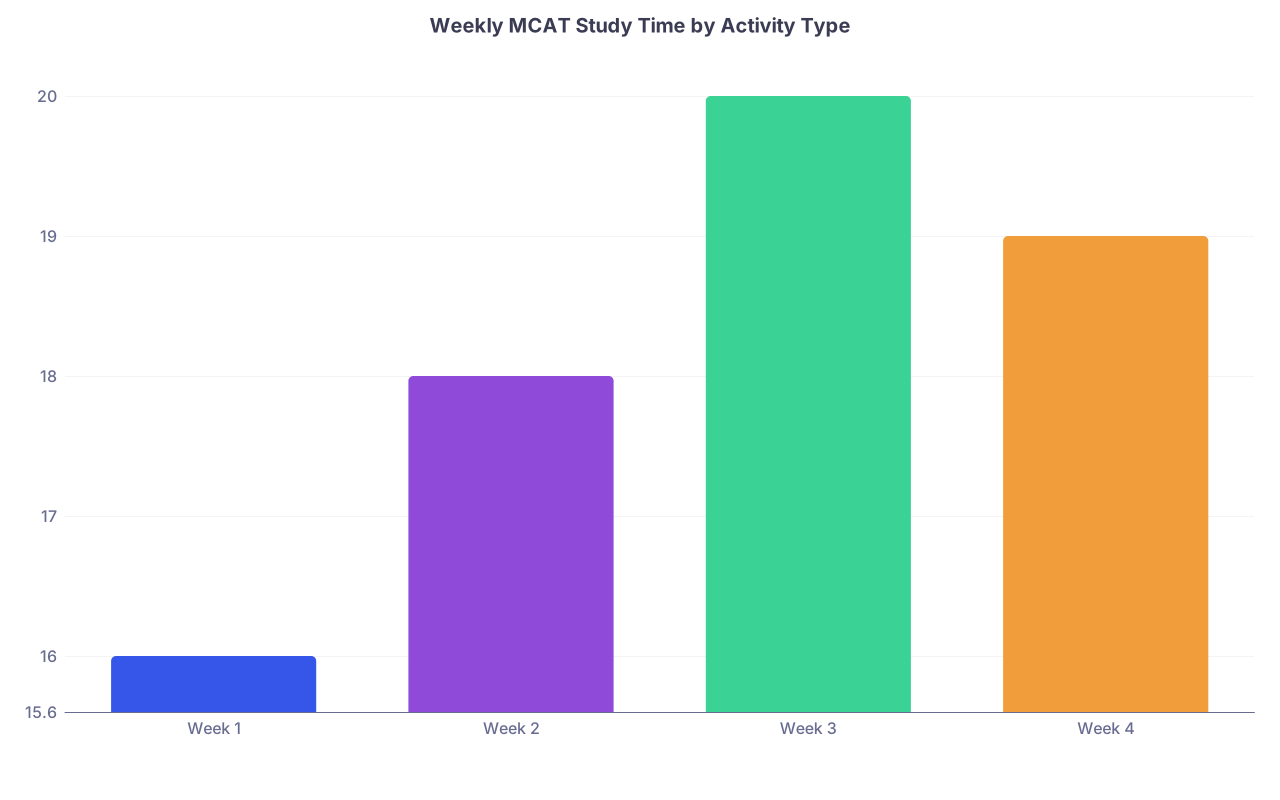
Here is a useful way to think about your study modes:
| Category | Value |
|---|---|
| Week 1 | 16 |
| Week 2 | 18 |
| Week 3 | 20 |
| Week 4 | 19 |
Now break that 16–20 into:
- Practice + review
- Content
- CARS
If you have 12 hours “content” and only 4 practice, you shift. Next week, you deliberately:
- Schedule more passage blocks
- Cap content videos to, say, 2–3 per day max
Step 10: Avoid the Common Failure Patterns
I have seen the same disasters repeat every semester. Here are the big ones and how you avoid them.
Failure Pattern 1: “Catch‑Up Sundays”
Student logic:
- “I’ll do MCAT on the weekend when I have more time.”
Reality:
- Weekdays: 0–1 hours total
- Saturday: get pulled into social / family / work
- Sunday: try to survive course deadlines
Result: You are “prepping” but averaging 4–5 MCAT hours/week. Scores do not move.
Fix:
- Non‑negotiable weekday MCAT blocks (even if short)
- Weekend is for volume, not the only time you touch MCAT
Failure Pattern 2: All‑Content, No Practice
Variation:
- 10 hours of videos
- 0 timed passages
- Fear of practice because “I’m not ready yet”
You never feel ready. Meanwhile, you are training yourself to be a passive learner.
Fix:
- Practice from week 1. Even if you bomb. That is the point.
- Rule: Any piece of content you study should be followed by at least a few related questions
Failure Pattern 3: Full-Length Without Full Review
Some students love the “I did a full‑length every week for 8 weeks” story. Then you ask how many they fully reviewed and get silence.
If you cannot explain:
- Why you missed something
- What pattern that miss fits into (content gap vs reasoning vs rushed)
- What you changed afterward
…you are wasting expensive exams.
Fix:
- Never schedule a full‑length without at least one solid 3–4 hour review block in the next 48 hours
- You learn more from the review than from the 7 hours of taking the test
Step 11: What If You Are Already Behind?
You might be reading this thinking, “My exam is in 7 weeks. I have not been this systematic. Now what?”
Fine. Triage.
Audit the last 2 weeks:
- How many MCAT hours did you actually do?
- How many were real practice vs. passive content?
Pick your starting target:
- If you did 5 hours last week, you are not jumping to 25.
Go to 12–15 this week, then 18–20 next week.
- If you did 5 hours last week, you are not jumping to 25.
Front‑load CARS and practice:
- 50–60% of your time on passages + review
- 30–40% targeted content on your worst topics
- 10–20% CARS (almost daily)
Cut something concrete:
- One club meeting
- One social night
- One shift if possible, just for a few weeks
This is the part no one likes to hear: you cannot “time‑manage” your way around a fundamentally overloaded plate. You may need to drop something for 2 months. That is not failure; that is triage to protect your MCAT and GPA.
Step 12: Put This Into Practice Today
Reading this does nothing. You need to translate it into your actual week.
Here is your one actionable step for today:
Take out your calendar and block the next 7 days as follows:
- Add all your fixed commitments (class, lab, work).
- Choose:
- One 45–60 minute MCAT block on each weekday at a realistic time.
- One 3–5 hour MCAT block on Saturday.
- One 1–2 hour MCAT block on Sunday.
- Label each block with exactly what you will do:
- “CARS (3 passages) + review”
- “Bio/Biochem passages (6) + 45‑min review”
- “Psych/Soc content + 20 discrete questions”
- Set alarms or reminders for each block.
That is it. Not “plan my whole semester.” Just lock in the next 7 days into a real weekly blueprint.
Once those blocks are on your calendar, highlighted in a color you cannot ignore, you have moved from “hoping to balance MCAT and classes” to actually doing it.