The fear of forgetting MCAT content ruins more scores than actual forgetting ever does.
I’m not exaggerating. The number of people who mess up because of panic, self-doubt, and “oh my god I don’t remember anything” spirals is way higher than the number who truly fail because they didn’t memorize enough content. And yet every premed I talk to says some version of: “What if I blank on exam day?” or “What if I forget everything from the early chapters?”
Let me say this bluntly: you are overestimating how much you need memorized and underestimating how much the test lets you figure out on the fly.
You’re not crazy for worrying, though. The MCAT is built to make you feel like you’re always missing something. You do some questions and think, “Wait, I don’t remember this pathway,” or “I’ve definitely seen this term but it’s gone now.” Cue panic. Cue doom spiral. Cue ‘maybe I need to restart from chapter 1.’
Let’s unpack this like someone who’s actually lived inside UWorld, Anki, and AAMC question packs for a year and had the same stress dreams you’re probably having.
The Hard Truth: The MCAT Is Not a Giant Flashcard Test
If the MCAT were just “who memorized the most random facts,” it’d be easier. Brutal, but simple. Memorize every table in Kaplan, every slide in your biochem lecture, win.
That’s not how it works.
The MCAT leans way more on:
- whether you recognize patterns
- whether you can follow logic in a passage
- whether you understand big-picture relationships
…than whether you remember the third intermediate in some obscure metabolic pathway.
It feels like a memory test because:
- All the prep companies make giant content books that imply you must know All The Things
- Everyone on Reddit flexes their 10,000-card Anki decks
- Your classmates brag about memorizing every amino acid property on day 3
But when you actually sit in front of real AAMC questions, a lot of what matters is:
- “Do you know concept X well enough to reason with it?”
not - “Can you recite definition X word-for-word?”
You absolutely need a content foundation. If you don’t know what a pKa is, no amount of “critical reasoning” is going to save you. But you do not need to have every single premed fact jammed into perfect recall.
Let’s get specific, because vague reassurance is useless.
What You Really Need Memorized (Versus Just Familiar)
Here’s the part that might actually calm you down: a lot of the content doesn’t have to be memorized to perfection. It just has to be familiar enough that, plus the passage, gets you to the right reasoning.
Think of MCAT knowledge in three tiers:
| Tier | Priority | Example Topics |
|---|---|---|
| Tier 1 | Must memorize cold | Amino acids, common equations, hormones |
| Tier 2 | Strong familiarity | Metabolic pathways basics, immune system, psych terms |
| Tier 3 | Recognize + reason | Rare enzymes, niche diseases, obscure details |
Tier 1: Stuff you really do need cold
This is the part that actually is a memory test. If you blank here regularly, it will hurt you. This is the stuff to obsess over (within reason):
-
- full name, 1-letter, 3-letter
- polar vs nonpolar vs charged
- acidic vs basic
- aromatic vs not
- who’s positive, who’s negative
If they show you a peptide and you don’t immediately know which side chain is hydrophobic or which is likely deprotonated at physiological pH? That’s a problem. Fixable. But a real one.
Core formulas/equations:
Things like:- Ohm’s law (V = IR)
- Power (P = IV)
- Kinematics basics
- pH = –log[H⁺] and pOH relationship
- Henderson–Hasselbalch (at least conceptually, if not perfectly word-for-word)
- Ln and log10 rough conversions (ln2 ≈ 0.7, etc., or at least approximation thinking)
-
- What major hormones do and where they come from (thyroid, pituitary, pancreas, adrenal)
- Insulin vs glucagon basics
You don’t need full step-1-level pathways, but if I say “cortisol,” you should instantly think “chronic stress, gluconeogenesis, immunosuppression.” Not stare at the wall.
Basic math operations without a calculator:
- Percent changes
- Rough mental division/multiplication
Not like “engineer speed,” but competent.
This is the stuff you hammer with flashcards, daily recall, writing from memory, drilling until your brain is annoyed. Forgetting these on test day is more about nerves than capacity.
Tier 2: Strong familiarity, not word-perfect
Here’s where people freak out for no reason.
You don’t need to recite glycolysis front to back, every enzyme, every intermediate. You do need:
- where it happens (cytoplasm)
- net ATP/NADH
- aerobic vs anaerobic fate
- relationship with gluconeogenesis
Same with:
- TCA cycle
- electron transport chain basics
- immune system (innate vs adaptive, B vs T cells, basic cell types)
- big psych/soc theories (conditioning, major identity theories, basic sociology frameworks)
If you vaguely remember, “Oh yeah, this process creates NADH, that feeds into ETC to make ATP,” the passage will usually give enough context that you can reason through. The MCAT often gives a figure, a pathway diagram, or hints.
If you’re thinking “But what if they don’t?” — yeah, that’s the anxiety talking. I’ve seen so many passages that look terrifying at first glance and then 70% of what you need is literally on the page.
Tier 3: Recognize and reason, don’t memorize
This tier is things like:
- a specific rare enzyme deficiency you saw once in a textbook
- some ultra-specific receptor subtype
- weird psych study details, names, years
You see them in prep books and think, “I must memorize every detail just in case,” and that’s where burnout comes from.
Reality: The MCAT will often:
- give you the mechanism in the passage (“Enzyme X converts A to B and requires NAD⁺…”)
and you just have to reason from there: - what happens if you inhibit it?
- what happens if NAD⁺ levels drop?
- what’s the downstream effect?
You don’t get extra points for memorizing every exotic disease. You get points for using the information in front of you.
You Will Forget Things. The Question Is: Does It Matter?
Here’s the terrifying but freeing truth: you will forget content. A lot of it.
You’ll be on question 37 of a practice exam and think, “Wait, I definitely learned this last month and it’s just… gone.” Then your brain will instantly leap to: “If I’m blanking now, I’ll blank on test day, I should probably reread my entire biochem book.”
This is the trap.
Forgetting the first time you see a question on a topic again is normal. It doesn’t mean:
- you’re stupid
- you’re not working hard enough
- you’re doomed to a low score
It usually just means:
- that fact hasn’t been refreshed recently
- your anxiety is blocking recall
- that detail was never actually that high-yield to begin with
The real test is:
When you review the explanation, does it click quickly? Do you go, “Oh right, I knew that,” or does it feel like brand-new information?
- If it feels familiar once you see it → your brain has the “file,” you just need more retrieval practice.
- If it’s brand new → then maybe it’s a gap worth patching.
Most premeds treat every forgotten detail like a five-alarm fire. It’s not. Some stuff is just low-yield noise.
How Much Content Retention Is “Enough” For a Strong Score?
Here’s where everyone wants a number. “What percentage do I need to truly know?” There’s no clean metric, but I can give you something closer to reality than the “memorize the entire textbook” mindset.
Think of it this way:
- If your content understanding (not memorization, understanding) is like 80–85% solid on the high-yield stuff…
- And your reasoning/critical thinking is strong…
- You can absolutely score 515+.
The people who convince themselves they need like 98% perfect recall of every detail end up:
- re-reading more than practicing
- constantly “resetting” their content review
- never letting themselves move into the higher-level skill of solving questions
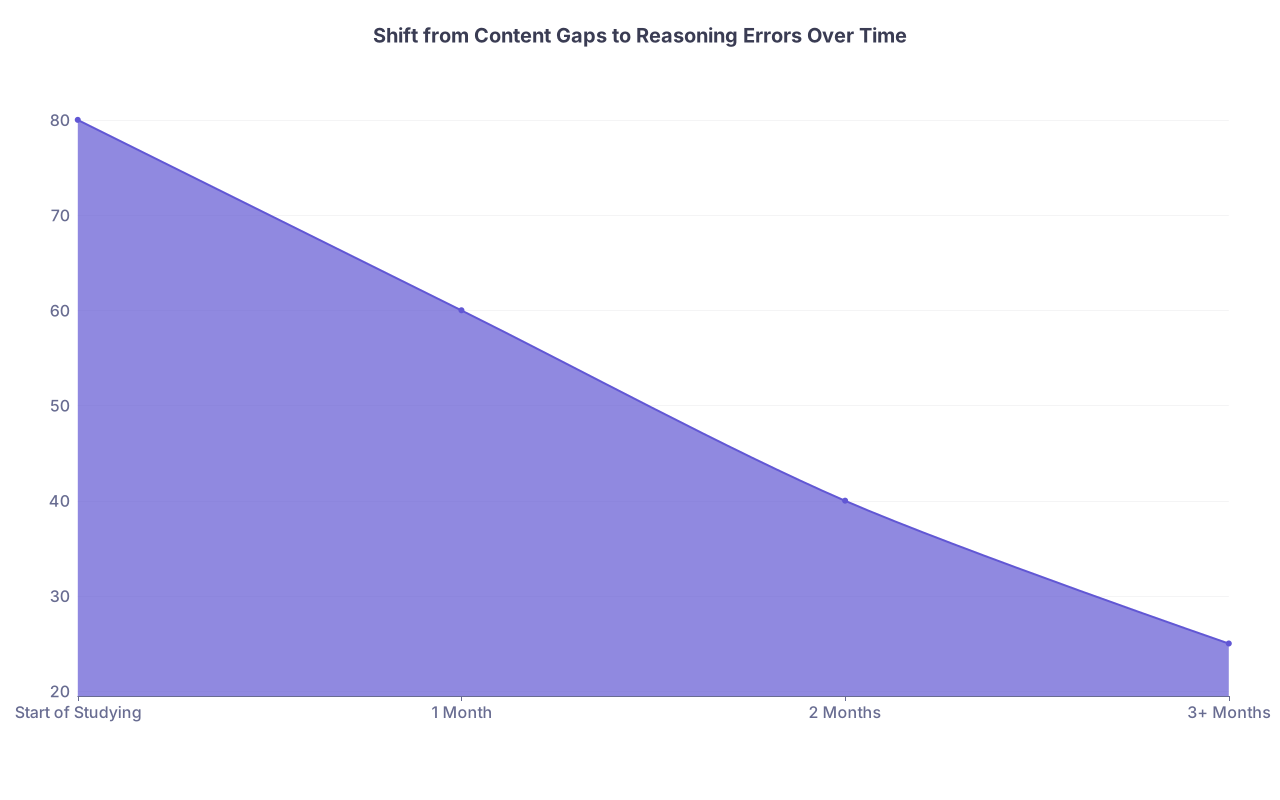
Here’s what performance usually looks like as you improve:
| Category | Value |
|---|---|
| Start of Studying | 80 |
| 1 Month | 60 |
| 2 Months | 40 |
| 3+ Months | 25 |
Rough idea: early on, 70–80% of your misses are content gaps (“I literally didn’t know that”). As you go deeper, your misses should gradually shift to reasoning/interpretation errors. That doesn’t mean your content is perfect. It just means the remaining gaps are more subtle and less worth obsessive patching.
If after 2–3 months you’re still telling yourself, “I miss questions only because I don’t know enough content,” that’s usually not fully true. It’s often:
- panic mid-question
- misreading what they’re actually asking
- refusing to use clues given in the passage because you don’t trust yourself
Practical Ways to Deal With “I’m Forgetting Everything” Anxiety
Let’s talk tactics. Things that help both your memory and your anxiety at the same time.
1. Separate “Must Memorize” from “Nice to Know”
Sit down with your content list or syllabus and literally mark:
- Tier 1: non-negotiable memorization
- Tier 2: review regularly, but don’t obsess
- Tier 3: trust the passage / light cursory familiarity
If everything is Tier 1, your brain will melt. Be ruthless.
2. Use active recall, but don’t drown in Anki
Anki is powerful. It’s also where people go to waste hours mindlessly pressing “good” on cards while their soul leaves their body.
Good use of active recall:
- writing from memory
- drawing pathways from scratch
- closing the book and listing concepts you remember, then checking what you missed
- targeted flashcards for Tier 1 topics (amino acids, hormones, formulas)
Bad use:
- 800 random fact cards a day, half of them low-yield
- feeling guilty if you miss a day and then trying to “catch up” 1600 cards
- letting cards replace practice passages
You’re trying to build reliable access to high-yield facts, not create a museum of everything you’ve ever read.
3. Reframe forgetting as data, not doom
When you miss a question because you forgot something, instead of:
“I’m so dumb, I can’t believe I forgot that, I’ll probably forget it again.”
Try:
“Okay, my brain didn’t have quick access to that. Do I want this in Tier 1 or Tier 2? If yes → I’ll make a simple recall card and hit it a few more times.”
Small, surgical response. Not a nuclear response like “I must reread the entire chapter on fluids again.”
On Test Day: What If You Blank?
Let’s get to the real nightmare scenario that probably keeps you up: you’re sitting in front of the MCAT, and your mind just… empties.
This is what actually happens for most people:
- You feel like you’re blanking way more than you actually are.
- You stare at a question and think, “I’ve never seen this before,” but when you calm down and look at the answer choices, pieces start clicking.
- Adrenaline makes recall harder for the first 10–20 questions, then your brain finds a rhythm.
The worst part isn’t the blanking. It’s the story you tell yourself when it happens:
- “I’m blowing this section.”
- “This proves I didn’t study enough.”
- “Everyone else probably knows this. I’m the only idiot guessing.”
Once that story starts playing, your working memory gets hijacked by panic. And then you really do start missing questions you actually know, just because your focus is torn.
You need a script for when you blank. Something like:
- “Okay, I don’t have this instantly. That’s fine. What does the passage give me?”
- “Can I eliminate 1–2 answers just by logic?”
- “Is there a relationship I recognize, even if the exact term is fuzzy?”
And a brutal truth: on a 7.5-hour exam, you are going to guess on some questions. Everyone does. Even people who score 520. You do not need perfect recall to get a great score. You need “mostly correct + emotionally stable enough not to fall apart when you’re uncertain.”
Here’s what the mental flow should look like when you hit a hard item:

| Step | Description |
|---|---|
| Step 1 | See confusing question |
| Step 2 | Use recall + passage clues |
| Step 3 | Slow down, reread stem & answers |
| Step 4 | Eliminate obviously wrong options |
| Step 5 | Pick best remaining choice |
| Step 6 | Mark if needed, move on |
| Step 7 | Do I recognize concept? |
Notice what’s not in there: “spiral about how this means your whole exam is ruined.”
How To Know You Actually Have “Enough” Content Before Test Day
Here’s a simple, brutally honest checklist for whether your content level is probably okay:
- On practice exams, do you usually know what topic a question is about, even if you miss it?
- When you review, do a lot of explanations feel like, “Oh yeah, I kind of knew that,” rather than “Never heard this in my life”?
- Are your wrong answers often because you misinterpreted a graph, rushed a calculation, or misread the question — not because the content was completely foreign?
- Do you miss maybe 1–3 questions per section due to truly “never seen this before” info?
If you’re nodding along to most of that, your content foundation is likely sufficient, and your return-on-investment now comes more from:
- practice passages
- timed full-lengths
- learning to stay calm when confused
Not from re-reading the same content book for the third time and pretending that’s safer.
Quick Reality Check Before You Go Back to Studying
You’re never going to walk into the MCAT thinking, “I remember absolutely everything.” That fantasy is fake. The exam is built to make you feel incomplete.
Here’s what actually matters:
- You need a Tier 1 core that’s memorized cold: amino acids, key formulas, basic physiology, really high-yield stuff.
- Strong familiarity beats perfect recall for most of the rest; the passage is there to help you, not punish you.
- Your anxiety about forgetting is more dangerous than the actual forgetting — learn to recognize when you’re panicking and switch into “use the clues, eliminate answers, move on” mode.
You won’t feel “ready enough.” Almost nobody does. But there’s a huge difference between “I genuinely don’t know the basics” and “I’m scared I don’t know everything.”
From what I’ve seen, most people asking, “What if I forget all the content?” are already way closer to “enough” than they’ll ever believe.