The biggest lie people tell you about MCAT practice scores is that they make sense.
They don’t. Not at first. They bounce. They spike. They crash. And then you’re sitting there at 1:37 a.m. staring at a 502 after a 512 and thinking, “I’ve ruined everything and I should push my test back forever.”
Let’s deal with this mess directly.
The ugly truth: your practice scores will be all over the place
If your MCAT practice scores look like a broken EKG, that doesn’t mean you’re doomed. It usually means you’re human.
Here’s the pattern I’ve seen over and over:
Student starts with a diagnostic in the low 500s or high 490s.
Works for a few weeks.
Gets a 509. Celebrates.
Next full-length? 503. Immediate existential crisis.
Then 507. 510. 506. 512. 505.
You know what they always ask me?
“Which one is the real score?”
They want one number. One clean, comforting, definitive answer. The MCAT doesn’t give you that. It gives you a range and a trend. And the sooner you accept that, the calmer and smarter your decisions get.
But I know you don’t just want philosophy. You want: “Do I trust the 512 or the 502?”
So let’s talk numbers.
Which practice exams actually matter?
Not all practice tests are created equal. Some are decent. Some are trash. Some are designed less to predict and more to demoralize you into buying more stuff.
If your scores are all over the place, the first question is: on what?
| Test Type | Trust Level | Typical Use |
|---|---|---|
| AAMC FLs | Highest | Scoring + prediction |
| AAMC Section Banks | High | Skill building |
| Good 3rd-party FLs | Medium | Practice/stamina |
| Bad 3rd-party FLs | Low | Ignore for score |
Here’s the blunt version:
- AAMC full-lengths (FL1–FL4 + Sample): these are the closest thing to gospel. They’re written by the same people who write the real exam.
- AAMC section banks and question packs: not for scoring, but very predictive of “how MCAT-ish your brain is becoming.”
- Third-party full-lengths: use them for endurance, timing, practice with passages you haven’t memorized. Do not give them the same emotional power as AAMC scores.
If your scores go 506 (Blueprint), 499 (Kaplan), 510 (AAMC FL2), 503 (Princeton), 511 (AAMC FL3)… you trust the AAMC 510 and 511 way more than the random 499.
So when your scores are all over the place, you don’t just average everything. You weight them. Heavily. In favor of AAMC.
How predictive are AAMC scores really?
Let me say something concrete, because vague reassurance is useless when you’re spiraling.
Most people’s real MCAT scores land within about 2–3 points of their AAMC average from the last 2–3 full-lengths, assuming:
- they didn’t completely crash on test day from anxiety, illness, or a disaster
- they didn’t radically change study habits or content in the last week
- they weren’t scoring on 4 hours of sleep and three Red Bulls
I’ve seen this pattern so many times it’s almost boring.
If your last three AAMC FLs look like this:
- FL2: 507
- FL3: 510
- FL4: 509
You’re probably going to land around 508–511. Could you hit a 505? Yes. Could you hit a 513? Also yes. But if you’re catastrophizing that you’ll somehow get a 498 because of one awful third‑party exam from six weeks ago… no. That’s not how this works.
Now, the part you actually care about: what if they’re not nicely clustered?
Let’s say:
- AAMC FL1: 503
- AAMC FL2: 510
- AAMC FL3: 506
- AAMC FL4: 511
That feels like chaos. It isn’t.
Underneath that is usually:
- timing issues (finishing some sections early, others rushed)
- stamina issues (CARS tanking late, psych/soc suffering because you’re fried)
- test‑day routine inconsistency (different sleep, food, time of day)
The “real score” is probably in the 506–510 band. Not the 503, not the 511 magical outlier. Somewhere in the middle—tilted slightly toward the most recent tests if your prep has been consistent.
What about those nightmare drops? (512 → 503, etc.)
Let’s talk worst‑case thinking, since that’s probably where your brain lives right now.
Scenario: you get a 512 on a third‑party or even an AAMC. Next FL? 503. You immediately think:
- I peaked and it’s over.
- I only got lucky once.
- I’m clearly not consistent enough to sit for the real exam.
- If this happens on test day, my whole cycle is dead.
Here’s the less dramatic explanation I see 90% of the time:
You changed more than one variable.
You did a new test brand. Or you took it in the afternoon instead of the morning. Or you were exhausted from a brutal week. Or you rushed breakfast. Or your anxiety spiked early in CARS and you mentally checked out for half the test.
The MCAT punishes tiny cracks in routine more than most people expect. A 9‑point swing isn’t really a 9‑point swing in “true ability.” It’s more like:
- 2–3 points: natural score variance
- 2–3 points: timing / stamina / focus issues
- 2–3 points: question style / test brand / mental state
So do you “trust” the 503? You don’t ignore it, but you don’t crown it the new truth either. You step back and ask:
- On that test where I dropped, what specifically was different?
- Did one section completely implode? (usually CARS or Chem/Phys)
- Did I feel mentally checked out halfway?
If your last three AAMC FLs were:
- FL2: 510
- FL3: 511
- FL4: 503 (migraine, bad sleep, panic attack mid‑CARS)
I’m going to be blunt: I trust the 510 and 511 more. I treat the 503 as a warning about your anxiety routine, not as a new prediction of your intelligence.
Stop trying to pick one number. Use a range.
The obsession with one magic score is what’s making you crazy. The real MCAT isn’t going to ask, “Are you a 511, yes or no?” It’s sampling from a distribution of your performance.
You need to think in terms of a range and a trend.
Say these are your last five full-lengths:
- 503 (Blueprint)
- 505 (Kaplan)
- 507 (AAMC FL1)
- 509 (AAMC FL2)
- 510 (AAMC FL3)
What’s the number you “trust”?
Not 503. Not 510. You trust something like: “I’m a 507–510 test‑day person right now, most likely 508–509 if I don’t melt down.”
And this is how you actually use that:
- For deciding to sit or postpone: Is my AAMC range close enough to where I need to be that even a 1–2 point bad day won’t destroy my chances completely?
- For school lists: Use the low end of your range for realistic safety/target schools, the average for targets, and the high end for reaches.
If your fantasy number is a 518 but your recent AAMC range is 510–513, then “trusting” the 518 because you hit it once on a curved third‑party FL is just self‑delusion. Hope is not a metric.
When should you postpone because of fluctuating scores?
Here’s the fear: “What if this last bad practice test is a sign I’m not ready at all and I should move my exam.”
Sometimes that’s true. Often it’s panic masquerading as logic.
Use something like this mental flowchart:

| Step | Description |
|---|---|
| Step 1 | Recent AAMC FL Scores |
| Step 2 | Consider more prep time |
| Step 3 | Identify cause, maybe postpone |
| Step 4 | Targeted section work |
| Step 5 | Stay with current test date |
| Step 6 | Within 3 points of goal? |
| Step 7 | Big downward trend? |
| Step 8 | Sections wildly unstable? |
- Your last 2–3 AAMC FLs are consistently below what your realistic schools need, not just your dream schools.
- You’re still missing basic content (not just silly mistakes, but “I literally do not know half of biochem pathways” level).
- You have less than ~2 weeks left and no clear plan to fix obvious, fixable patterns.
Don’t postpone just because:
- One third‑party test was 5–10 points lower.
- One AAMC test bombed but you can point to catastrophic sleep/anxiety/timing screw‑ups.
- Your scores are bouncing within a narrow band (e.g., 508, 510, 506, 509). That’s normal.
Also, postponing isn’t magical. If your study approach doesn’t change, you’re just repeating the same pain later with the same numbers.
How much weight do CARS and section variability get?
This is where a lot of people panic. They’re hovering around their goal composite, but CARS looks like a heart monitor: 124, 128, 125, 127.
You start thinking: “What if CARS alone tanks my whole exam?”
Look at it this way:
- A one‑point swing in one section doesn’t redefine your whole score.
- The total score matters more than the exact balance between sections for most schools, unless you’re going into something super competitive and trying to impress with raw numbers.
But if one section—usually CARS or Chem/Phys—is consistently 3–4 points below the others, your “trusted” range should lean a bit lower unless you fix it.
This is where question‑type data, review quality, and patterns matter more than just the number at the top of the screen.
A quick reality check: you’re probably doing better than your brain says
Here’s the part no one tells you: anxious applicants systematically misread their own data.
They look at:
- the lowest score
- the worst‑case curve scenario
- the highest school medians
- and then act like that combo is the only thing that counts
To sanity‑check yourself, do this with your practice tests (only the last 4–5, not every exam you’ve ever taken):
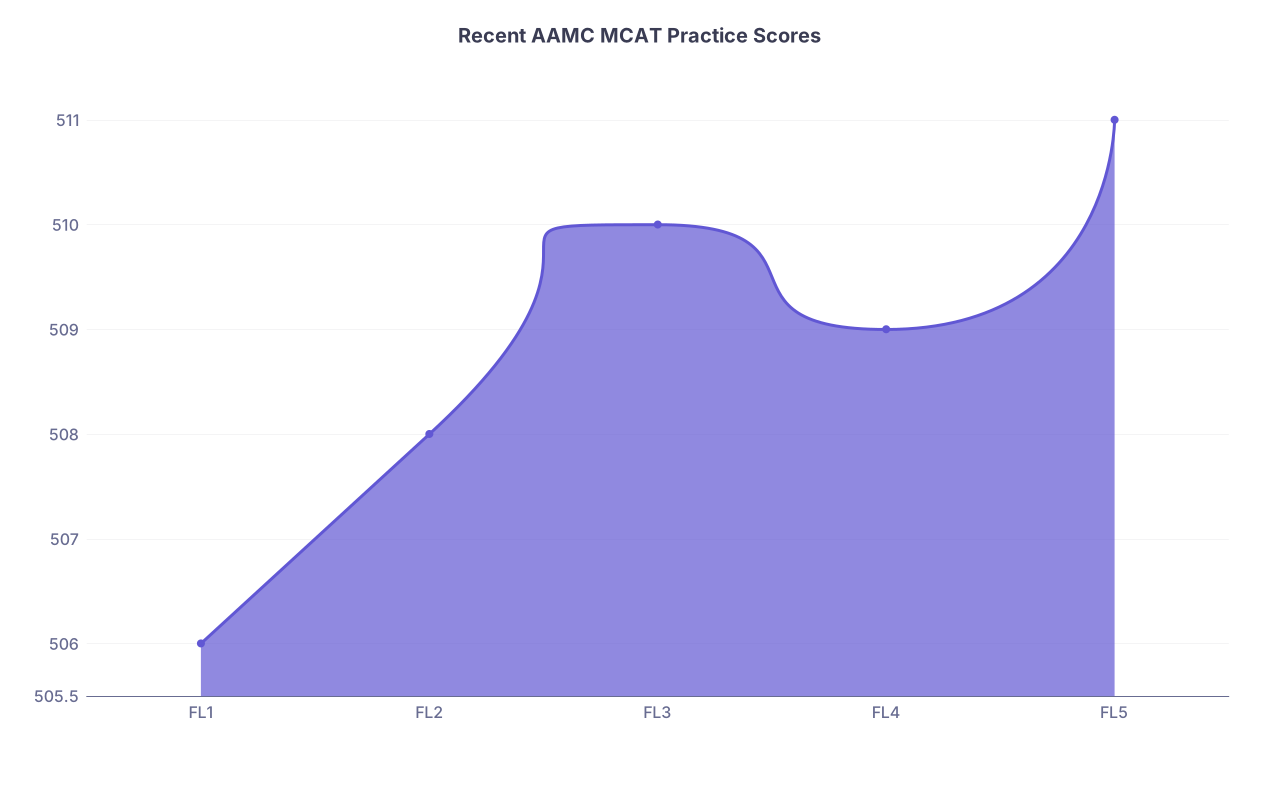
| Category | Value |
|---|---|
| FL1 | 506 |
| FL2 | 508 |
| FL3 | 510 |
| FL4 | 509 |
| FL5 | 511 |
Then ask:
- Is the general direction flat, slightly up, or nosediving?
- Are my worst days still within 3–4 points of my best days?
- Are the most recent tests my best ones, or at least not my worst?
If you see a flatish or slightly rising line, and your last two scores are in the top half of your range, you’re not in “panic postpone” territory. You’re in “dial in routine, fix dumb mistakes, and accept some uncertainty” territory.
What actually deserves your anxiety vs what doesn’t
Some things that do deserve your attention:
- Multiple recent AAMC FLs significantly below your absolute minimum acceptable score
- No improvement after weeks of targeted review (not just doing random questions)
- Clear content gaps in core topics (acid/base, kinematics, amino acids, experimental design)
- Test‑day routine chaos (you’ve never actually simulated your real start time, breaks, food)
Some things that don’t:
- One disastrous test after terrible sleep or high stress at work/school
- Score swings of 2–4 points between exams
- One section occasionally dropping 1–2 points
- Third‑party exams being “off” by 5–7 points compared to AAMC
Don’t give one ugly score more emotional weight than four decent ones. That’s your anxiety talking, not the data.
FAQ (Exactly 5 Questions)
1. My AAMC practice scores are 505, 508, 507, and I need a 510. Do I trust the 508 and go for it?
I’d call your current range about 505–508, with a realistic test‑day expectation around 506–507. If your “need” for a 510 is based on top‑tier school medians, remember those are medians, not cutoffs. If your entire list is full of schools where 510 is basically the floor, I’d strongly consider either tightening up your prep for a few more weeks or adjusting your school list. Sitting now and expecting a 510+ on test day when you’ve never broken 508 on AAMC is more hope than data.
2. I got a 520 on a third‑party FL but only 511–513 on AAMC. Which score is real?
The AAMC range is closer to reality. Third‑party exams sometimes have generous curves or different question styles that accidentally fit your strengths. Schools will never see your 520 practice score, only your official MCAT. Trust the AAMC 511–513 as your real ballpark and plan your expectations and school list around that. If the 520 keeps you motivated, fine—but don’t build your entire strategy on it.
3. My scores went 507 → 510 → 504 on AAMC. Should I postpone?
Maybe. First question: what happened on the 504? If you were exhausted, anxious, short on time, or life was on fire, I’d treat that 504 as a warning that your test‑day routine needs serious work—but not automatic proof you’re a 504‑level tester. If, on the other hand, you were well‑rested, took it seriously, and still dropped with no clear external reason, I’d look very hard at your review process. If you’re within ~2 weeks of test day and can’t identify specific, fixable causes, postponing could be smart.
4. Is it possible my real MCAT will be higher than all my AAMC practice scores?
Yes, but you can’t plan on that. People do sometimes score 1–3 points higher on the real thing when adrenaline, focus, and tight routines all line up. I’ve seen students with AAMC averages around 508 land a 511 on test day. But I’ve also seen the reverse: nerves shave off 2–3 points. The safest mindset: expect your real score to fall around your recent AAMC average, maybe ±2 points. Anything higher is a bonus, not the plan.
5. How many practice scores do I need before I can “trust” my range?
Usually 3–5 AAMC full-lengths done under true testing conditions is enough to get a decent read on your range. If you only have one AAMC FL, that number is fragile. With two, you start to see a pattern. With three or four, especially if they’re within a few points of each other, you’ve got something you can actually believe. Don’t obsess over every single third‑party test you’ve ever taken; center your judgment on those last few official-style exams.
Key takeaways:
- Stop hunting for one magic “true” score; think in terms of a range and a trend, centered on your recent AAMC full-lengths.
- One bad outlier doesn’t erase multiple solid performances—investigate why it happened before you panic‑postpone.
- Use your practice scores to make strategic decisions (test date, school list, last‑minute focus), not to fuel late‑night doom spirals your data doesn’t actually justify.