Last week, someone messaged me at 11:47 p.m.: “My last three FLs were 512–514. I’m terrified I’m going to walk out with a 503. What if my MCAT score just tanks on test day and ruins everything?”
I knew exactly what they meant—because that sick, sinking “what if I choke when it counts?” feeling is practically built into this whole process. You do months of work, grind through exams, sacrifice weekends…for one seven-hour performance. And your brain keeps whispering, "What if that day is the day everything goes wrong?"
Let’s go straight into the worst-case stuff you’re already imagining and pull it apart, piece by piece.
First: Yes, Your Score Could Drop. But Probably Not How You Think.
You know those horror stories on Reddit? “I was getting 520+ on every practice and got a 505 on the real thing.” They stick in your mind because they’re dramatic and terrifying.
But they’re not the norm.
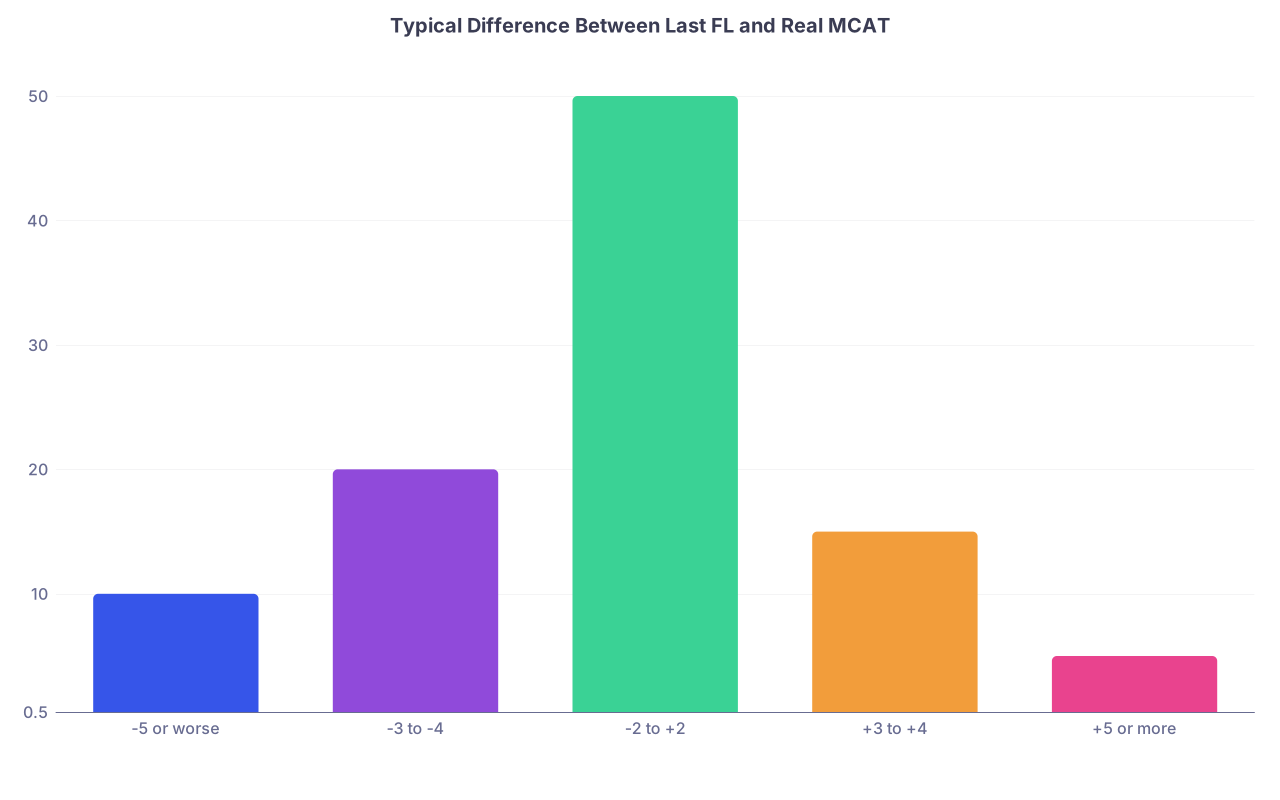
| Category | Value |
|---|---|
| -5 or worse | 10 |
| -3 to -4 | 20 |
| -2 to +2 | 50 |
| +3 to +4 | 15 |
| +5 or more | 5 |
Most people land within a small band of their last few AAMC full-lengths. The “dropped 10 points” stories exist, but they’re outliers, often with context:
- They never took full-lengths under real testing conditions.
- They were sick, panicked, or had a major life thing happen near test day.
- They mismanaged timing horribly or froze on one section.
The scary part is: you can’t 100% control whether something weird happens that day. That’s where the anxiety lives.
But here’s the piece your brain skips: even if your score drops, that doesn’t automatically mean med school is over, your file is ruined, your life plan is dead. The outcome might be bad by your standards and still be usable, fixable, or recoverable.
What “Bad Outcome” Actually Means: Three Levels of Panic
Let me define “bad” the way I usually see it play out, because your brain probably labels everything below your goal as catastrophic.
Level 1: “Worse Than I Wanted, But Still Okay”
Example: You were averaging 515–517 on AAMC practice. You walk out feeling awful. Score comes back: 511–512.
Your brain: “I choked. I’m done. No way I’m getting into a good school.”
Reality: You’re still:
- Above or near the national average for matriculants.
- Competitive at a wide range of MD and DO schools, especially with a solid GPA and decent experiences.
This isn’t a “disaster.” This is a disappointment that still keeps doors open.
Level 2: “This Hurts My MD Chances, But It’s Not Death”
Example: Practice scores were around 508–510. You come out with a 502–504.
Now we’re in that gray zone where:
- Some MD schools become long shots.
- Some state schools might still be in play, especially if your GPA is strong and you’re in-state.
- DO schools remain absolutely possible.
This is the level where people debate retaking. It feels like a failure. It’s not. It just narrows your path and forces some careful decision-making.
Level 3: “This Is Way Below My Range”
Example: You were around 510 on practice and scored a 495–498. Or you were targeting 508+ and got a 490.
Here’s where the real panic hits. You’re thinking:
- “Did I just permanently brand myself as a low scorer?”
- “Are schools going to see this and write me off forever?”
- “Will I look like I’m bad at standardized tests no matter what I do now?”
This level often does need a retake, maybe a gap year, maybe a whole rebuild of your testing approach. But even here, this isn’t the final verdict on “whether you can be a doctor.” It’s data. Ugly data, yes. But still data.
What Med Schools See When Your MCAT Is Lower Than Expected
Let me be uncomfortably honest: schools are not sitting there trying to “understand” your pain. They see numbers, patterns, and risk.
If your MCAT is lower than your practice tests, they don’t know that. They don’t see your UWorld history or your 518 on FL4. They see:
- Your actual MCAT score(s)
- Your GPA trend
- Your course rigor
- Your experiences, essays, LORs, etc.
They’re asking: “If we admit this person, will they pass Step/Level exams and graduate?”
Here’s how different “bad” outcomes are interpreted:
One Lower Score, Then a Higher Retake
Example: 498 → 508
This is not some giant red flag. More often, it reads as:
- First attempt: probably unprepared / mismanaged.
- Second attempt: showed growth, maturity, fixed issues.
Programs care far more about the highest score than premed forums make it sound. The first score isn’t invisible, but it’s also not a permanent scarlet letter.
Multiple Attempts, Small Improvements
Example: 498 → 501 → 503
This is where things get trickier. It can raise questions about ceiling, test-taking skills, or whether you’re maxed out.
Is it dooming? No. But it’s harder to spin. You need to show:
- Strong academics (upward GPA trend, rigorous courses).
- Real reflection and change in study habits—not just “I tried harder.”
- A realistic school list (especially DO and less stat-heavy MD schools).
Good GPA + Lower MCAT
Say you’ve got a 3.8 in a hard major and a 503. Adcoms might think:
- Solid work ethic and consistency.
- Possible test anxiety or standardized testing weakness.
- Still someone who could succeed, especially in less cutthroat schools.
This is way less catastrophic than a low GPA + low MCAT. Schools can live with one weaker pillar if the rest of the file is strong.
The Big Question: If My MCAT Drops, Should I Retake?
This is where the spiral usually hits hardest. “What if I retake and it gets worse? What if I become ‘that person’ with 3 scores on file?”
Let’s break it down sanely.
| Situation | Likely Advice |
|---|---|
| 512+ score | Usually no retake |
| 508–511, strong GPA | Retake only if targeting top-tier |
| 500–507 | Consider retake if aiming broadly MD |
| Below 500 | Strongly consider retake |
Some general truths:
- 512+: You rarely need to retake. Even if practice was 515–518. A 512 that feels “bad” to you might be more than enough for a lot of schools.
- 508–511: Retake if you’re dead set on super competitive MD programs and know you underperformed relative to realistic practice, not fantasy goals.
- 500–507: Retake is reasonable if your goal is MD and your GPA/experiences support that. For DO, this can be workable, depending on the rest of your app.
- Below 500: I’d almost always retake unless your whole plan is changing (postbac, SMP first, etc.).
But here’s the uncomfortable piece: don’t retake just because your ego is bruised. Retake only if:
- You have clear, concrete reasons you underperformed (timing, anxiety, content gaps).
- You know exactly what you’d do differently, not just “more of the same, but harder.”
- You actually have the time and energy to rebuild properly.
A second mediocre attempt isn’t better than one bad one plus a thoughtful delay and real improvement.
Worst-Case Day: You Walk Out Knowing It Went Badly. Now What?
Picture this: you hit submit on the last section. You feel hollow. You’re already replaying guessed questions in your head. You’re thinking: “Do I void? Do I keep it? Did I just nuke my chances?”
This is the nightmare.
Here’s a simple decision path to keep you from making a panic move:

| Step | Description |
|---|---|
| Step 1 | Finished MCAT |
| Step 2 | Keep score |
| Step 3 | Consider voiding |
| Step 4 | Fell far below normal performance? |
| Step 5 | Guess drop >5 points from last AAMC FLs? |
General guidance:
- If your last few AAMC FLs were, say, 513–515, and you’re sure you misbubbled, left entire passages blank, or had a full meltdown? Voiding might be reasonable if you can definitely retake.
- If you “just felt bad,” but finished all sections and didn’t have a total timing collapse? Keep the score. People are terrible at predicting their MCAT outcome based on vibes.
The void button is tempting because it feels like control. It’s also irreversible. Don’t hit it just because you’re scared.
If Your Score Comes Back Lower Than You Wanted: Interpreting It Without Destroying Yourself
You open the score report. It’s lower. Maybe much lower. Your stomach drops. You start mentally rewriting your whole career path.
Pause.
Here’s how to interpret it like an adult, not a panicked premed:
Compare to your AAMC averages, not your “dream number.”
If you averaged 509 and got 506, that’s a mild underperformance, not a disaster. If you averaged 515 and got 503, that gap means something went wrong beyond just luck.Look at section breakdowns.
- One section super low? That’s often fixable with targeted work.
- All four dragged down? Could be fatigue, anxiety, or foundational content issues.
Overlay your GPA and school goals.
- High GPA + slightly low MCAT → still a path.
- Lower GPA + low MCAT → may need more structural change (postbac/SMP, retake, adjusted school list).
Separate your ego from strategy.
You might “feel like” a 515 person. But schools only see 503. Yelling at the number in your head doesn’t change the one on the screen. Work with what’s real.
The Fear Underneath All This: “What If This One Day Ruins Everything?”
This is the part that really keeps you up at night, isn’t it? Not just the number. The idea that:
- One test day could erase years of work.
- One bad performance means you’re not smart enough.
- One score decides your entire career.
I’m going to say something your anxiety won’t believe, but it’s the truth: the MCAT is heavy, but it’s not a singular god-button that decides your fate.
People get in with:
- A rough first MCAT and a solid retake.
- A lower MCAT but stellar GPA, narrative, and school alignment.
- A delayed application after taking time to recover and rebuild.
And yes, some people don’t get in on the first try. Or even the second. Some pivot to DO. Some do SMPs. Some take extra years. But the pattern is always the same: the ones who make it don’t treat one “bad outcome” as a final verdict. They treat it as information.
You’re allowed to be devastated. To cry. To feel like everything sucks and you’re behind your classmates. That’s normal.
You just don’t get to decide, in that moment of panic, that your entire future is over.
How to Protect Yourself Before Test Day (So a Drop Hurts Less)
Since you’re reading this before all hell breaks loose (hopefully), here are things you can do now to cushion against the worst-case scenario:
- Take all AAMC FLs under strict conditions. No pausing, no phones, same start time as the real exam, 10-minute breaks only. That way your practice range is actually meaningful.
- Track performance over time, not just your best score. Your “realistic range” is usually more important than your PR.
- Stress-test yourself. Take one FL on a bad day. Sleep a little less. See how low you actually drop when you’re not feeling 100%.
- Have a Plan B and Plan C in writing. If I get X–Y, I’ll apply this cycle to A/B/C schools. If I get below X, I’ll retake after doing [specific change].
Your anxiety feeds on ambiguity. If you already know what you’ll do in each scenario, even the bad ones, you’ll still be scared—but you won’t be directionless.
Your Next Step (Yes, Right Now)
Don’t just close this and go back to doom-scrolling SDN.
Open a new document and write three headings:
- “If my score is around what I expect”
- “If my score is 3–5 points lower than expected”
- “If my score is way lower than expected”
Under each heading, write:
- What I’ll feel (name it).
- What I’ll do in the first 48 hours (no impulsive voids, no big life decisions).
- What my concrete options are (retake timing, school types, gap year possibilities).
You’re not jinxing yourself. You’re building yourself a lifeline for future-you who might be panicking and ready to declare all hopes dead.
Make that plan now—before test day or before score release—so that if the worst-case happens, you’re not starting from zero while your brain is on fire.