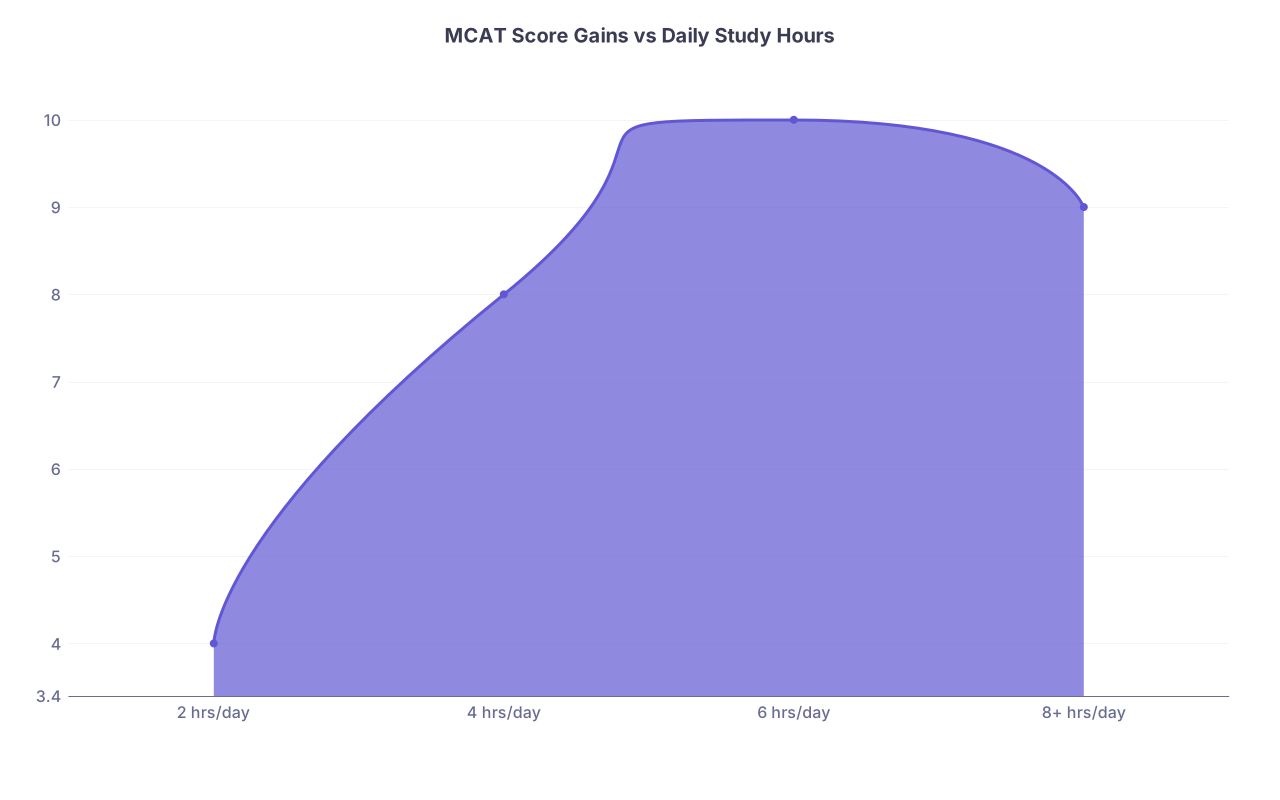
You’re staring at two dates on your screen: your planned MCAT retake… and the application deadline that’s way too close for comfort. Your brain is doing that awful ping‑pong thing:
“If I retake and bomb, I’m done.” “If I don’t retake, my current score might kill my chances.” “If I push it to next year, I’ll be behind everyone.” “What if I submit with this score and schools silently blacklist me?”
You’re not trying to “optimize your profile.” You’re trying to not ruin your future in one dumb decision.
Let’s walk through this like someone who’s had these same spiraling thoughts and has watched other people either salvage it… or light it on fire.
First, be brutally honest about your current score
Before we even talk deadlines and scheduling, you need to answer one question: is your current score actually fatal for your goals, or just not perfect?
Here’s the ugly truth no one likes saying out loud: a lot of people waste a retake because they’re chasing vibes, not numbers.
Ask yourself:
- What’s your current MCAT score and breakdown?
- What type of schools are you realistically targeting? (Not fantasy list. Actual list.)
- How does your score look for those schools, considering your GPA and the rest of your app?
To ground this, here’s a rough snapshot:
| Situation | Retake Pressure Level |
|---|---|
| 502 with 3.4 GPA, applying MD broadly | Very high |
| 508 with 3.9 GPA, strong research | Low–moderate |
| 510 with 3.6 GPA, aiming only top 20 MD | Moderate |
| 505 with 3.8 GPA, applying DO + some MD | Moderate |
| 515 with 3.7 GPA, unbalanced section (123) | Depends on specialty/schools |
Here’s my blunt opinion:
- If you’re below ~504–505 and want MD, a retake is usually not optional unless your story is insanely strong in other ways.
- If you’re around 508–510, it’s gray zone. Retake might help or might just stress you into scoring the same.
- If you’re 512+, a retake right before apps are due is almost always a bad idea unless you truly underperformed relative to consistent FLs.
The key is this: you can’t make a good retake decision until you admit whether your current score aligns with your actual target schools. Not the schools you tell your grandma. The ones you’d actually be okay attending.
The real question: will a retake in this timeline help or hurt?
It’s not just “should I retake the MCAT?” It’s “should I retake the MCAT with apps due soon?”
Those are different questions.
The risk factors stack up when the retake is close to deadlines:
- You might not have enough time to fix whatever tanked you the first time.
- You’ll be splitting your brain between studying and writing secondaries.
- Schools might not see your new score until later in the cycle.
- If you underperform again, now you’re that applicant who looks stuck.
So you have to weigh:
- Likelihood of scoring 3–5+ points higher
- How much a higher score would actually change your school list
- How far along you are in studying vs. just panicking
If your FLs are hovering at basically the same score as your official test, and you’re 4–6 weeks from the retake… that’s a red flag. You’re not magically jumping 7 points just because you’re “more motivated.”
On the other hand, if:
- Your official score was clearly below consistent FLs (like FLs 511–513, official 505), and
- You can point to concrete reasons: anxiety meltdown, sleep issues, logistics disaster,
…then a retake, even close to deadlines, might actually salvage your cycle.
Timeline reality check: when will schools actually see this new score?
This part people love to hand‑wave, but it’s critical.
MCAT scores take about 30–35 days to come back. So if your apps are due, say, early June for primary opening, and you’re thinking of a late June or July retake, your score won’t post until July/August.
So what does that mean?
- You can still submit your primary with your current score.
- Schools will receive your updated score automatically when it posts.
- Some schools will wait to fully review you until the new score arrives.
- Some will pre‑screen with your old score and either hold or toss you.
If your current score is way below their cutoffs, they may never wait for the new one. That’s the risk.
If you’re not sure where you’d fall, this is where you do some homework: each school’s website, SDN threads, calling a few admissions offices. Yes, actually call. People do it. They’ll often say if they’ll hold your file for a pending MCAT.
Three main paths you’re probably choosing between
You’re likely stuck between these options:
- Submit with current score, no retake
- Submit with current score, retake scheduled
- Delay applying a year and retake with a sane timeline
Let me walk through these like I would with a friend, not like an advisor sugar‑coating things.
1. Submit with current score and don’t retake
This is the “I’m rolling the dice this cycle” path.
It makes sense when:
- Your score is not amazing, but within range for at least some MD and/or DO schools on your list.
- Your GPA and activities are strong enough to help buffer it.
- Your practice tests suggest you’ve pretty much topped out for now.
This path is often smarter than people admit, especially if you’re sitting on a 508–510 and you’re not top‑20 obsessed.
Worst‑case downside: you don’t get in this cycle.
But guess what? That’s the same worst‑case downside as botching a rushed retake… except you didn’t risk a lower score permanently living on your record.
2. Submit now, retake soon, hope the new score saves you
This is where a lot of people end up. It can work, but only under the right conditions.
This strategy works best when:
- Your current score is borderline for your target schools.
- Your practice tests are consistently higher than your official (not just one fluke).
- You have a specific, realistic study plan to raise your score by at least 3–5 points.
- You’re prepared to grind secondaries and MCAT at the same time for a month or two.
Here’s the honest fear: “What if schools judge me for having multiple MCAT scores?”
Reality: schools care way more about your highest reasonable score and your trend than the number of attempts. Two attempts? Totally fine. Three? Still workable if you improve. Four+ with little change? That starts to look bad.
Your risk here is not “oh no, I took it twice.” It’s “I took it twice and didn’t meaningfully improve.”
So if you can’t reasonably see yourself scoring higher in FLs before test day, this path is more self‑sabotage than strategy.
3. Delay the whole cycle and retake with a long runway
This is the nightmare scenario in your head: everyone moves on, you’re “behind,” your classmates all get white coats while you explain your gap year for the 15th time.
Here’s the uncomfortable truth: for a solid chunk of people, this is the least damaging long‑term option.
It makes sense if:
- Your current score is too low for MD and even weak for DO (e.g., <500).
- Your GPA isn’t stellar, so you really need that MCAT to carry weight.
- You’d be going into a retake soon with half‑baked prep and maximum stress.
- You genuinely believe, with time and a structured plan, you can jump 7–10+ points.
I have watched people force an application with a 498 → 501 retake and burn an entire cycle when they could have taken a year, hit 508–510, and completely changed their trajectory.
Delaying isn’t a moral failure. It’s usually a maturity flex. But yeah, it stings.
How to decide if a rushed retake is worth it
Let’s be clinical for a second and step away from panic mode. If you can’t answer “yes” to most of these, a rushed retake with apps due soon probably isn’t worth it:
- Are your last 3–4 full‑lengths consistently higher than your current MCAT by at least 3–5 points?
- Do you have enough time per week (realistically) to study without completely tanking secondaries or life?
- Do you know exactly what went wrong the first time? (content? timing? anxiety?)
- Do you have a different plan this time around, not just “do more practice questions and hope”?
- Can you handle the possibility that your new score comes back after many schools have already started interviews?
If you’re answering “no” or “uhhh” to most of those, you’re not in retake‑ready territory. You’re in panic‑action territory.
How schools actually view a late MCAT retake
Here’s the thing: admissions people are not sitting around gossiping about who retook in July. They’re trying to triage thousands of files.
Typical pattern:
- If your first score is close to their range and they see a future test date, they may hold your file till the new score posts.
- If your first score is way below their threshold, some may auto‑screen you out regardless of future dates.
- If your updated score posts in August or early September, you’re late but not dead. Just not early.
You’re scared they’ll think, “Wow, this applicant is indecisive and flaky for retaking.” No. They’re thinking, “Did this person show academic potential somewhere on this score report?”
They care about the number, not the drama in your head.
Minimizing damage if you do retake close to deadlines
If you decide, after all this, “I’m retaking anyway,” then you need to protect yourself from the worst‑case outcomes as much as possible.
Here’s what that means in practice:
- Lock down a realistic test date you can actually be ready for. Don’t pick the absolute latest date possible just to “buy time” if it means scores won’t be back until deep in the cycle.
- Finalize your school list based on your current score, not your fantasy retake score. If you do better—great, expand later.
- Get your personal statement and activities done now, before MCAT chaos peaks.
- Front‑load as much secondary prep as you can (pre‑write common prompts) so you’re not trying to craft 20 essays during your last 2 weeks of studying.
You’re basically trying to not have two giant application fires burning at the exact same time.
If you don’t retake: how to not obsess over “what if”
If you choose to roll with your current score, you’re going to torture yourself with:
“What if I’d just retaken and gotten 3 points higher?”
That’s survivorship bias talking. You’re imagining the version of you who magically improves, not the very real version who might stay flat or drop.
Your job, if you stick with your current score, is to squeeze every ounce of impact from the rest of your app:
- Make your personal statement so specific and human that someone could recognize you from it alone.
- Use your experiences section to show actual growth, not just “I did this and it was great.”
- Apply smart: target schools where your stats aren’t a joke.
You cannot fix your MCAT retroactively. But you absolutely can still tank or elevate your cycle with the rest of your application.
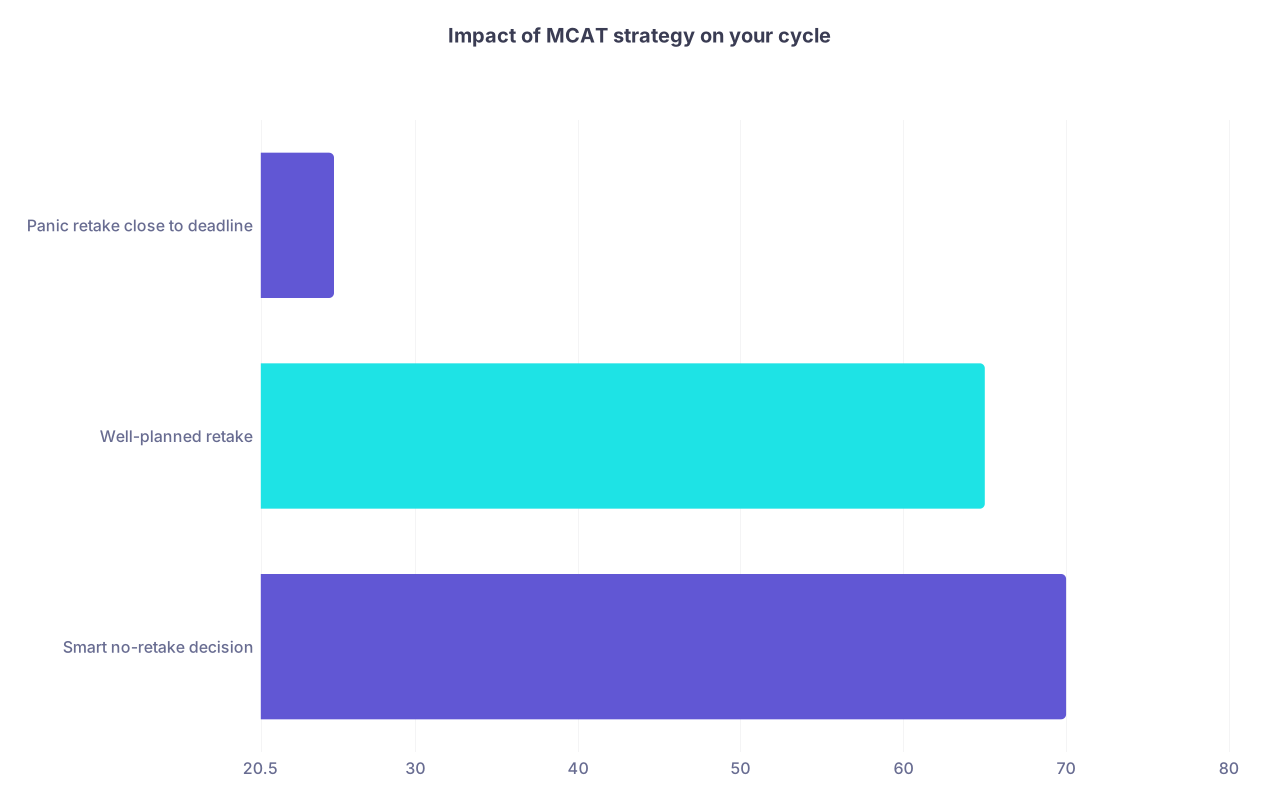
| Category | Value |
|---|---|
| Smart no-retake decision | 70 |
| Well-planned retake | 65 |
| Panic retake close to deadline | 25 |
What I’d personally do in common scenarios
Let me stick my neck out and give actual opinions.
Scenario 1: 503 MCAT, 3.5 GPA, wants MD only, thinking of July retake
I’d retake, but seriously consider delaying the application a year unless your FLs are already 507–509 and trending up. Trying to “fix” this in a few weeks while applying is asking for mediocrity twice.Scenario 2: 509 MCAT, 3.8 GPA, solid research, wants mid‑tier MD, June deadline
I probably wouldn’t retake this late unless your FLs are 514+ and you know exactly why you underperformed. Otherwise you’re risking turning a decent app into a stressful gamble.Scenario 3: 498 MCAT, 3.3 GPA, DO + MD hopeful, thinking June retake with apps now
I would not apply this cycle. I’d take the time, rebuild foundation, aim for 505–508+ with a long prep, and come back with a stronger app overall. Rushing this is how people collect rejections and burnout.
You don’t have to agree with me. But you should be honest enough with yourself to pick which scenario you’re closest to.

| Step | Description |
|---|---|
| Step 1 | Current MCAT Score |
| Step 2 | Strong case to retake, consider delaying apps |
| Step 3 | Rebuild long-term, skip this cycle |
| Step 4 | Consider retake while applying, plan carefully |
| Step 5 | Apply with current score, skip rushed retake |
| Step 6 | Below ~504? |
| Step 7 | Can you improve 7+ points with prep time? |
| Step 8 | Are FLs 3-5+ points higher? |
FAQ: 5 questions you’re probably still obsessing over
1. Will schools see that I’m planning to retake the MCAT?
Yes. When you submit AMCAS/AACOMAS, you can indicate a future MCAT date. Schools will see that and some will hold off making a decision until that score posts. It doesn’t “look bad” to have a future date. What looks bad is multiple low scores with no improvement.
2. Should I wait to submit my primary until after my retake score comes back?
Usually, no. Submit your primary early with your current score, list your future test date, and let the new score update when it’s ready. Waiting to even submit your primary until scores post puts you at a late‑cycle disadvantage, which can matter more than a few points of improvement unless your current score is truly non‑competitive.
3. What if my retake score is the same or lower?
Then you live with it. Schools will generally use your highest score, but they’ll see the pattern. One small non‑improvement isn’t the end of the world; it just means the MCAT is likely reflecting your current ceiling. In that case, it’s usually better to stop retaking and focus on strengthening the rest of your profile rather than chasing a number.
4. How many MCAT attempts is “too many”?
Two is normal. Three can still be okay if there’s a clear upward trend. Once you start hitting four or more attempts without major improvement, some schools will quietly screen you out or question your judgment. That’s why a rushed retake near deadlines is risky—every attempt “counts” in the story you’re telling about your judgment and preparation.
5. Is it better to apply with a weaker score now or delay and apply stronger next year?
If your current score and GPA combo gives you a realistic shot at some schools you’d actually attend, I’d argue it’s reasonable to apply now. If your numbers are so low that most schools on your list are a fantasy, it’s almost always better to wait, retake with a real plan, and come back stronger than to burn time and money on a doomed cycle.
Here’s what you can do today, not in some vague “later” window: open a blank document and write down three numbers—your current MCAT, your average of the last 3 FLs, and the median MCAT of your realistic target schools. Based on those three numbers alone, decide whether you’re truly in retake‑worthy territory or just in perfectionist panic mode. Then commit, in writing, to either a retake plan or an application plan—no more living in the miserable in‑between.