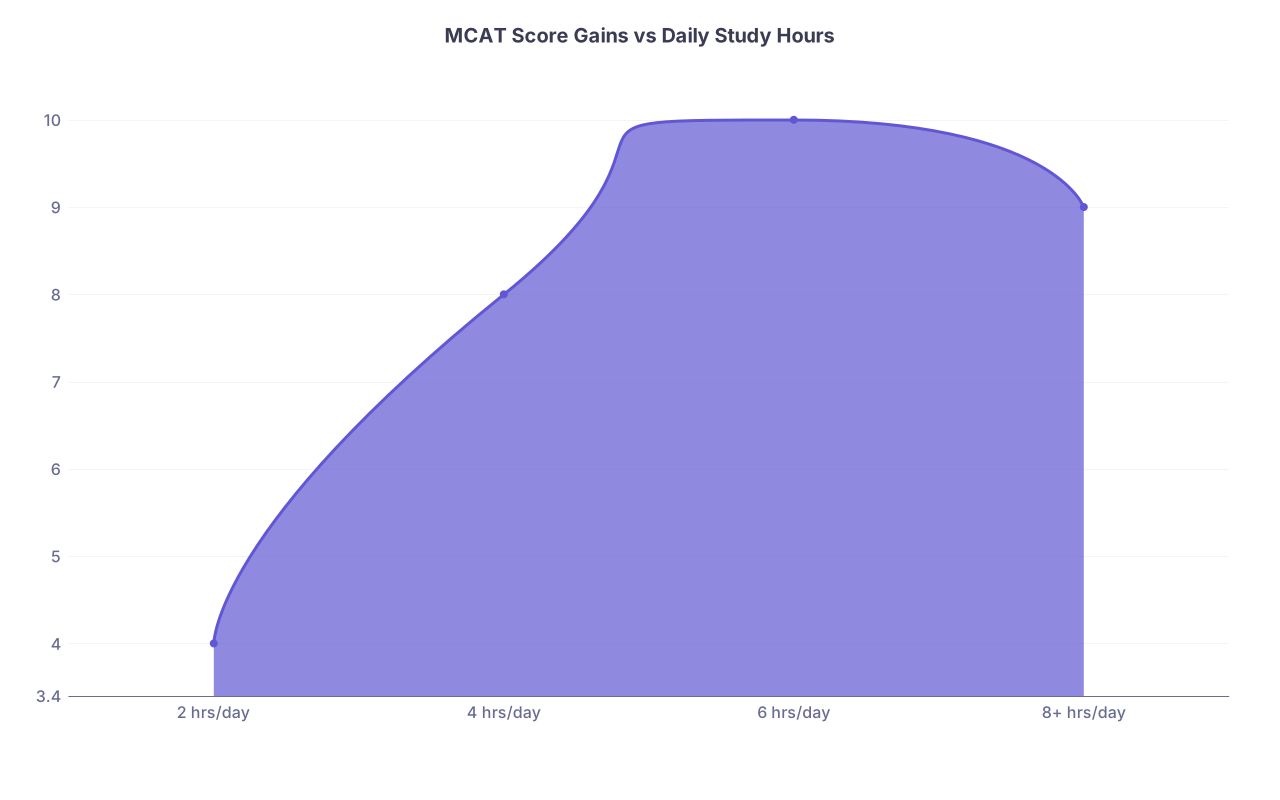
The panic you’re feeling about starting MCAT prep “too late” is doing more damage than your actual start date.
Let me be blunt: people blow perfectly salvageable MCAT chances not because they started in August or with 8 weeks left, but because once they realize they’re behind, they flail. They try to do everything, with every resource, all at once. Then they burn out, score stall, and go, “See? I knew I was too late.”
You’re not out. You just don’t have the luxury of a cute, slow, 6‑month plan anymore. You need triage. As in: what lives, what dies, what gets brutally cut.
Let’s walk through that. Step by step. No fluff, no “just believe in yourself” nonsense.
Step 1: Face the Clock (and Be Honest About Your Target)
First thing: how late are we actually talking?
Are you 12 weeks out? 8? 4? Already rescheduled three times and now you’re stuck?
Your anxiety is probably screaming, “It’s over,” at every scenario. It’s not. But the plan looks very different at 4 weeks versus 12.
Here’s the harsh truth: the MCAT doesn’t care when you started. It only cares what you can do on one specific day. So we work backward from that.
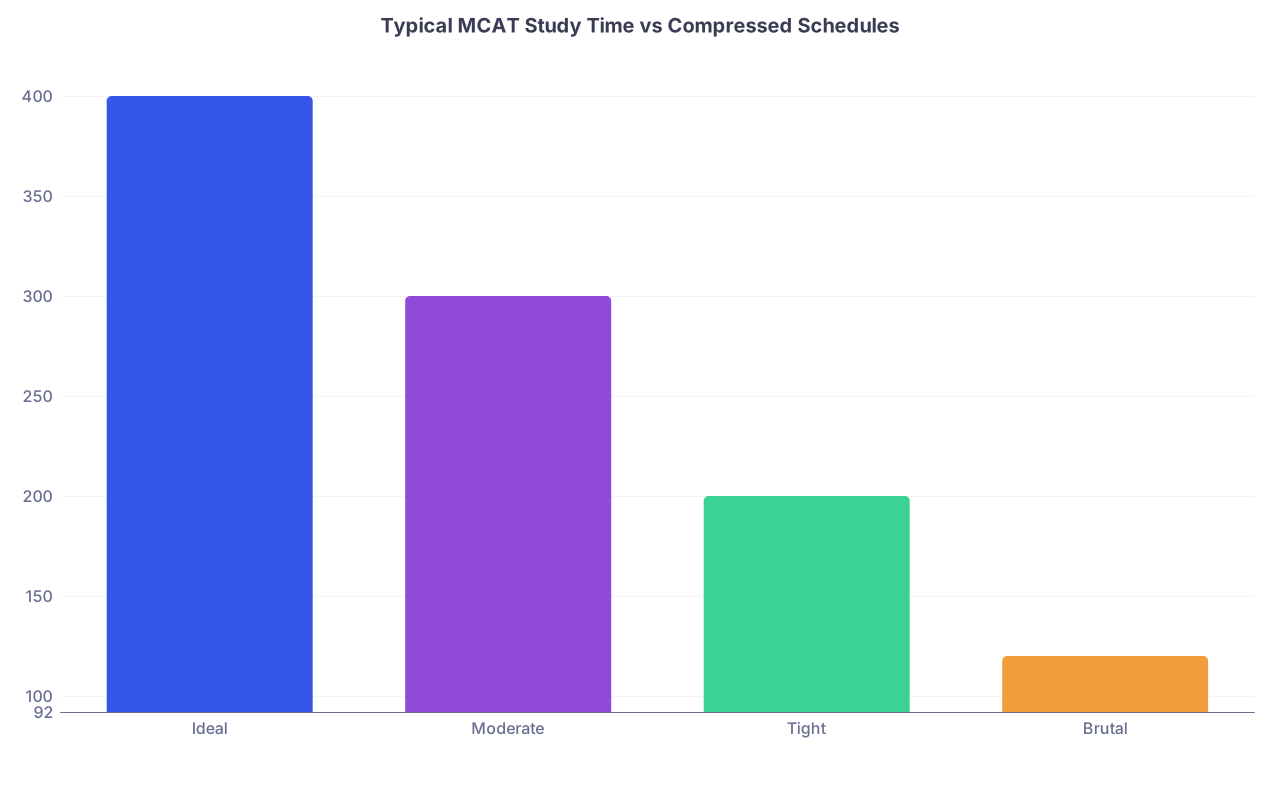
| Category | Value |
|---|---|
| Ideal | 400 |
| Moderate | 300 |
| Tight | 200 |
| Brutal | 120 |
Rough translation:
- 400 hours: Chill 4–6 month plan. You don’t have this.
- 300 hours: Still comfortable.
- 200 hours: Tight but fully doable for a strong background.
- ~120 hours: This is the “I started late and I’m trying to survive” zone.
Now add some reality:
- Are you full-time in school or working 40 hours?
- Are you in the middle of midterms or a heavy semester?
- Any big non-negotiable obligations (family, religious, health)?
You can’t plan 35 hours a week if you can realistically do 15. You can lie to me; you can’t lie to the test.
So ask yourself, brutally:
- How many hours per week can I actually give without imploding?
- How many weeks until test day, non-negotiable?
- What is my realistic target score for this cycle, not my fantasy one?
If you’ve taken a diagnostic, use that. If not, I’d still rather you sketch a rough target now and refine later than float in denial.
Step 2: Take a Diagnostic Now (Even If You Feel Underprepared)
I know you don’t want to. You feel “not ready.” You’re afraid you’ll see a number that ruins your week.
Do it anyway.
Strong opinion: one of the worst things late-start students do is delay their first full-length because “I don’t want to see a low score.” That’s like refusing bloodwork because you don’t want to see bad labs.
You need data. Not vibes. Not your roommate’s opinion of how smart you are.
Here’s the order I’d use:
- If you can, take an AAMC full-length as your baseline. If that feels too precious, you can use a Next Step/Blueprint/Kaplan exam first, but you’ll eventually want an AAMC baseline if time permits.
- Take it under real conditions: timed, no pauses, quiet environment, no phone.
You might bomb it. Fine. I’ve seen people go from 498 diagnostics to 510+ with focused 8–10 week plans. Not common, but not mythical either.
What matters most from that baseline:
- Total score and section breakdown
- Which sections are clearly dragging you down
- Whether it’s content (you didn’t know it) or execution (you knew it, but screwed up timing, second-guessed, panicked)
You’re going to use that diagnostic as your triage map.
Step 3: Triage Your Goal – Keep, Adjust, or Punt?
This is the part nobody wants to talk about.
You might need to adjust your score goal or change your test date. That’s not failure. That’s being strategic instead of delusional.
Here’s a rough, not-perfect-but-useful snapshot:
| Baseline Score | Weeks Left | Aggressive but Realistic Range |
|---|---|---|
| 505+ | 8–10 | 510–520+ possible |
| 500–504 | 8–10 | 507–512 reasonable |
| 495–499 | 8–10 | 503–508 if very disciplined |
| <495 | 8–10 | Improvement likely, but big jumps are risky |
Again, not a prophecy. Just pattern recognition from lots of anxious premeds before you.
If your situation looks like this:
- You’re sitting at 492 with 5 weeks left
- You’re in full-time classes plus a job
- You’re dreaming of a 518 for top-10 schools this cycle
Then yeah, I’m going to tell you straight: don’t throw yourself at that test date just because you’re scared of looking like you “quit.” Rescheduling or pushing to the next cycle may actually be the adult move.
But if you’re more like:
- 500 baseline with 8–9 weeks
- Reasonable time per week (20–25 hours)
- Solid undergrad science base
Then no, you are absolutely not too late. You just can’t waste a week debating flashcard colors.
Step 4: Ruthlessly Prioritize Content (You Can’t Master Everything)
With a late start, you stop trying to be an encyclopedia. You start acting like a test-taker with limited ammo.
This is where people either get smart or crash.
The MCAT is not equally balanced across every niche topic. Some stuff is high-yield. Some stuff is “would be nice” if you had six months. You don’t.
The AAMC content outline and released exams tell you the truth about where the points live:
- Bio/Biochem: heavy on enzymes, metabolism basics, DNA/RNA, gene expression, endocrine, nervous system, proteins.
- Chem/Phys: general chemistry, physics concepts that tie directly to experiments, fluids, circuits, electrochem.
- Psych/Soc: research design, bias, major theories (Erikson, Piaget, Kohlberg, conditioning, social structures).
- CARS: pure skills, no content. Needs constant practice.
If your time is short, you do not need to:
- Memorize every amino acid property’s obscure nuance if you barely know glycolysis.
- Go insane over every physics derivation if you can’t interpret graphs or free-body diagrams.
- Perfect every last detail of every random psych term from a 500-page book when you still miss basic experiment questions.
Content triage mindset:
- Keep: High-yield topics you see constantly in questions.
- Minimize: Low-yield topics you might see once.
- Accept: You’ll guess on a few questions. Everyone does. High scorers too.
Step 5: Switch to a Question-First Strategy (Immediately)
If you started late, you can’t afford 5 weeks of “content review only” where you’re passively reading textbooks and making rainbow notes.
You need to flip it:
Questions → Identify weak areas → Targeted content review → Back to questions.
Not the other way around.
I’m talking:
- Daily practice passages, even if your content feels shaky.
- Review that is painfully deep, not cute and superficial.
- Writing down your thinking errors, not just the right answer.
Here’s a simple flow that actually works:

| Step | Description |
|---|---|
| Step 1 | Do 1-2 passages |
| Step 2 | Mark all unsure questions |
| Step 3 | Review every question in detail |
| Step 4 | Identify pattern: content vs reasoning vs timing |
| Step 5 | Targeted mini-review of weak topic |
| Step 6 | Redo similar questions/passages |
If you’re short on time, you live in this loop. You don’t casually read 50 pages of physics hoping it sinks in.
For a late starter, I’d bias your time something like:
- 60–70%: Practice questions/passages + review
- 30–40%: Targeted content review based on your misses
The review is where the score jumps happen. Not in the 25th re-reading of a Kaplan chapter.
Step 6: Build a Compressed, Realistic Weekly Plan
You probably want me to spit out a magical “8-week to 520” template. Those are mostly fantasy.
But I can give you a rough compressed structure that doesn’t assume you’re a robot.
Let’s say you’ve got 8 weeks and ~20 hours per week. Your rough breakdown could look like:
Week 1–2:
- One full-length if not already done, then 1–2 half-lengths/section exams spread out
- Daily: CARS passages (3–4 per day), plus mixed science passages
- Content: Patch the worst holes from your diagnostic, not everything you ever forgot
Week 3–5:
- One full-length every 7–10 days
- Heavy passage work in your weakest sections
- Quick, focused content blocks (30–60 minutes) only on patterns of weakness
Week 6–7:
- Full-lengths spaced weekly
- Hardcore review (I mean 6–8 hours of total review per full-length over 2–3 days)
- Practice mimicking test-day schedule so your brain knows the grind
Week 8:
- One last full-length 7–10 days before exam
- Then shorter mixed passages, light content brush-ups
- Sleep, meal timing, and anxiety control become as important as last-minute facts
If you’re down to 4–5 weeks, you’d cut the “ramp up” phase almost entirely. You’d be living in a cycle of:
- Full-length → 2 days deep review → 1–2 days targeted practice → repeat.
Step 7: Decide If You Should Postpone (Without Lying to Yourself)
The question running in your head: “Am I too late? Should I just move the exam?”
Here’s the honest way to answer it:
Look at your last two full-lengths (not just one freak-out outlier):
- Are you improving at all? Even a few points?
- Are your mistakes mostly “I didn’t know this at all” or “I knew this but rushed/panicked/misread”?
- Does your projected trend line get you close to your target if you had the remaining time?
If your last two full-lengths look like:
- 496 → 497 → 497 → 496 with 3–4 weeks left
and you’re aiming for a 510 this cycle…
You’re not morally obligated to charge into that exam and “just see what happens.” Schools will actually see that score. It lives on your record.
On the other hand, if you’re:
- 501 → 505 → 507 with 5–6 weeks left
and your target is 510–512…
You’re not too late. You just need to stop studying like someone who has all the time in the world.
Step 8: Managing the Anxiety (So It Doesn’t Wreck the Score You Could Get)
Your inner monologue right now is probably brutal:
“I’m behind. Everyone else started in January. I’m screwed. I always do this. I ruin everything.”
You know what that does on test day? It shows up as:
- Rushing through questions you could’ve gotten right
- Changing correct answers because you “didn’t trust yourself”
- Burning mental energy on catastrophizing instead of reading
You don’t need to be a Zen monk. You just need to not be actively sabotaging yourself.
- Non-negotiable sleep window. Late-start students try to steal time from sleep. It backfires.
- A simple, repeatable pre-study ritual: same time, same place, same drink/snack, no doom-scrolling.
- Boundaries with people who keep asking, “So how’s MCAT studying?” Shut that down.
And honestly? Give yourself permission to be late and still succeed. People retake. People push back cycles. People start late and crush it. Med schools are full of them. You’re not uniquely doomed.
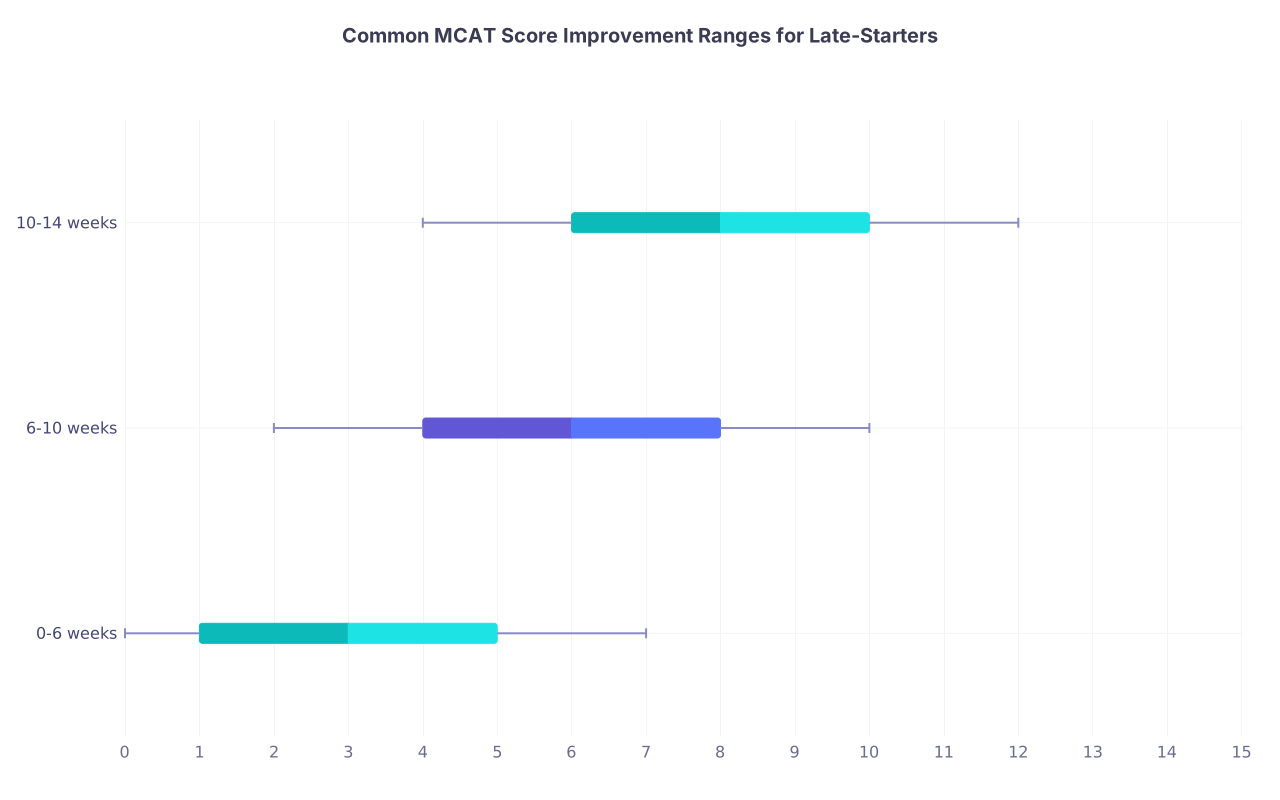
| Category | Min | Q1 | Median | Q3 | Max |
|---|---|---|---|---|---|
| 0-6 weeks | 0 | 1 | 3 | 5 | 7 |
| 6-10 weeks | 2 | 4 | 6 | 8 | 10 |
| 10-14 weeks | 4 | 6 | 8 | 10 | 12 |
Quick Reality Check Before You Spiral
A few things I’ve seen over and over:
- People with “late” 2–3 month starts still hitting 510+ because they stopped making perfect color-coded notes and did ruthless practice + review.
- People with early starts sabotaging themselves with scattered resources and no structure, scoring the same or worse than their diagnostic.
- People who rescheduled, beat themselves up for “failing,” then came back 6 months later and hit scores they never could’ve reached in the panicked timeline.
You’re not the exception where being late = automatic doom. You’re just in the group that has to be more focused and more honest.

FAQs (You’re Not the Only One Asking These)
1. Is 2 months enough time to study for the MCAT if I’m starting from scratch?
From true scratch? No prior science foundation, no bio/chem/physics background? Two months is brutal. You might be able to get to a survivable score with full-time study, but probably not a highly competitive one.
If you’ve already taken the prereqs and just mean “I haven’t reviewed anything yet,” then 2 months can be enough if you:
- Cut the fluff and stick to 1 main resource + AAMC materials
- Do lots of practice early
- Accept that you’re not mastering every obscure detail
But you shouldn’t be planning casual 10–12 hour weeks. Think 20–30 focused hours weekly.
2. I took a diagnostic and scored in the low 490s. Should I cancel my test that’s 6 weeks away?
Not automatically. I’d look at:
- How bad was the timing? Did you leave tons of questions blank?
- Were you totally unfamiliar with sections (e.g., never took physics yet)?
- Can you realistically give 25–30 hours/week?
If your 490 was with zero timing management, lots of blank guesses, and you’ve got strong coursework behind you, I’ve seen people move into the low 500s or even upper 500s with a hyper-focused 6-week sprint.
But if it was a serious effort, content gaps everywhere, and your life only allows 10–15 hours/week… I’d strongly lean toward postponing and building a real plan rather than gambling on a Hail Mary score.
3. Should I even bother with content books this late, or just do questions?
You still need content. You just don’t need all the content.
What I’d do: use books or videos only as a reference, not a starting point. Let your questions tell you what to study. Missed a fluids question because you forgot the equations? That’s when you go to the book and spend 30–45 minutes tightening that topic, then come back to more fluids questions.
If you’re sitting there passively reading for three hours without touching a passage, you’re wasting your limited time.
4. How many full-lengths should I take if I started studying late?
If you’ve got 6–8 weeks, I’d aim for:
- 1 baseline (maybe non-AAMC if you want to “save” theirs)
- Then 4–6 total full-lengths, with at least 3 being AAMC exams
If you’re down to 4 weeks, you might get in:
- 3–4 full-lengths max, but only if you’re actually reviewing them in depth
The mistake is cramming in a ton of exams and barely reviewing. One fully dissected exam is worth more than three you rush through and quickly glance at the score.
5. Am I “ruining” my application if I take the MCAT late in the cycle with a rushed prep?
You’re not ruined, but you might be limiting your options. A weak MCAT taken in a panic can:
- Force you into applying with a score below your actual potential
- Push you into a rushed re-take timeline later
- Make you burn money on a cycle that never had a real shot
Sometimes the bravest, most strategic thing you can do is say, “I’m not going to sit for this exam in a half-prepared state just because I’m scared of feeling behind.” Med school isn’t going anywhere. You’re allowed to set yourself up to succeed instead of just survive.

If you remember nothing else, remember this:
- Starting late doesn’t kill your chances. Studying chaotically does.
- Triage ruthlessly: high-yield topics, question-first learning, brutal review.
- Be honest with your timeline and goal. Adjust the plan or the date, not your entire sense of self-worth.