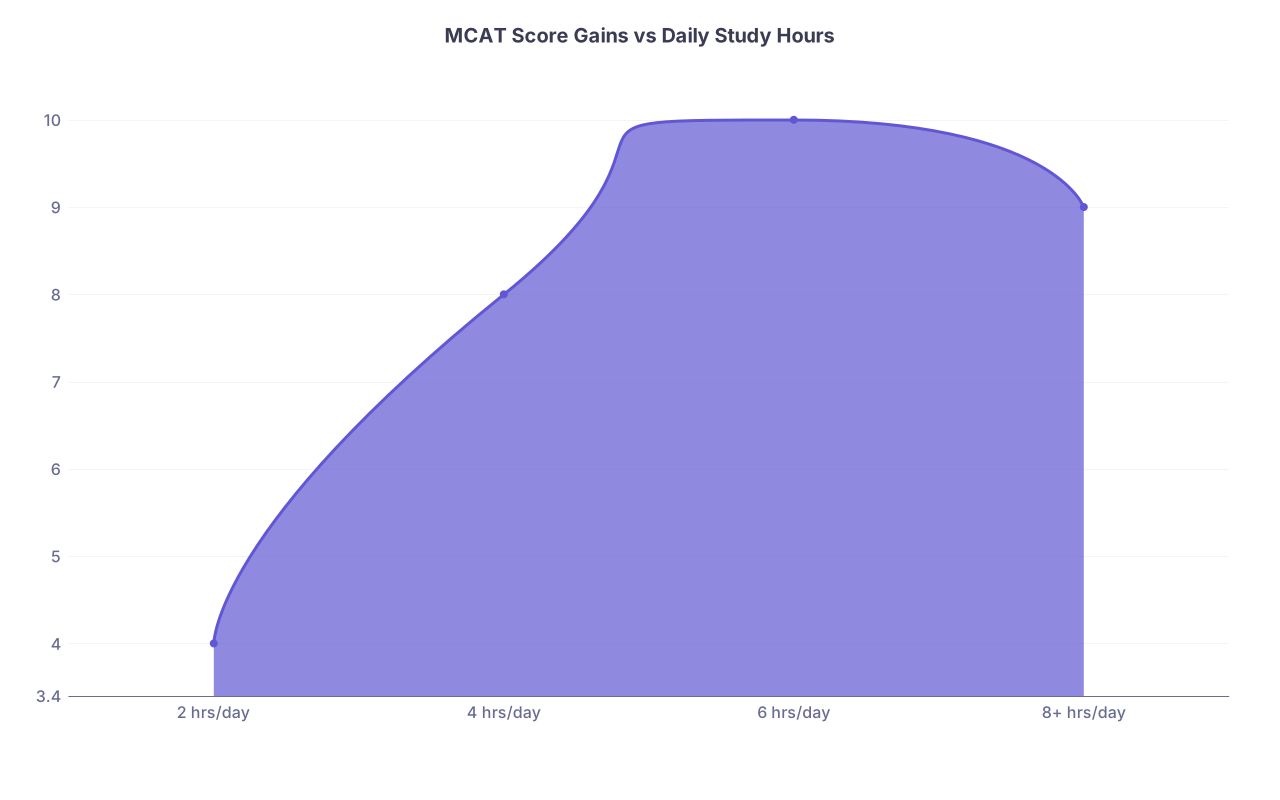
The biggest mistake MCAT students make with mechanics is thinking it is about formulas. It is not. It is about recognizing problem types in under 5 seconds and snapping into the right mental model.
You are not solving “physics” on the MCAT. You are solving 8 recycled mechanics templates with slightly different costumes.
Let me break this down very specifically.
The Only Mechanics Rules That Actually Matter on the MCAT
Before we walk through the 8 core problem types, lay down the ground rules. Every single mechanics question you see is built on the same small set of ideas:
- Kinematics (constant acceleration motion)
- Newton’s Laws (F = ma, normal/weight/tension/friction)
- Work–Energy (W = ΔK, conservation of mechanical energy)
- Momentum & Impulse (p = mv, J = Δp)
- Circular motion (centripetal acceleration and forces)
- Simple harmonic motion (springs, sometimes pendulums)
That is it. If your “strategy” is memorizing 20+ equations without tying them to specific question archetypes, you will keep spinning.
We are going to organize mechanics and kinematics into 8 MCAT problem types. For each, I will give you:
- The “trigger words” and visuals that identify it
- The mental model you must use
- The minimal equations that actually matter
- The traps I watch students fall into constantly
- A quick pattern example
Keep in mind: MCAT physics is conceptual and proportional, not algebra olympics. If you are doing three lines of algebra for a single discrete question, you are doing too much.
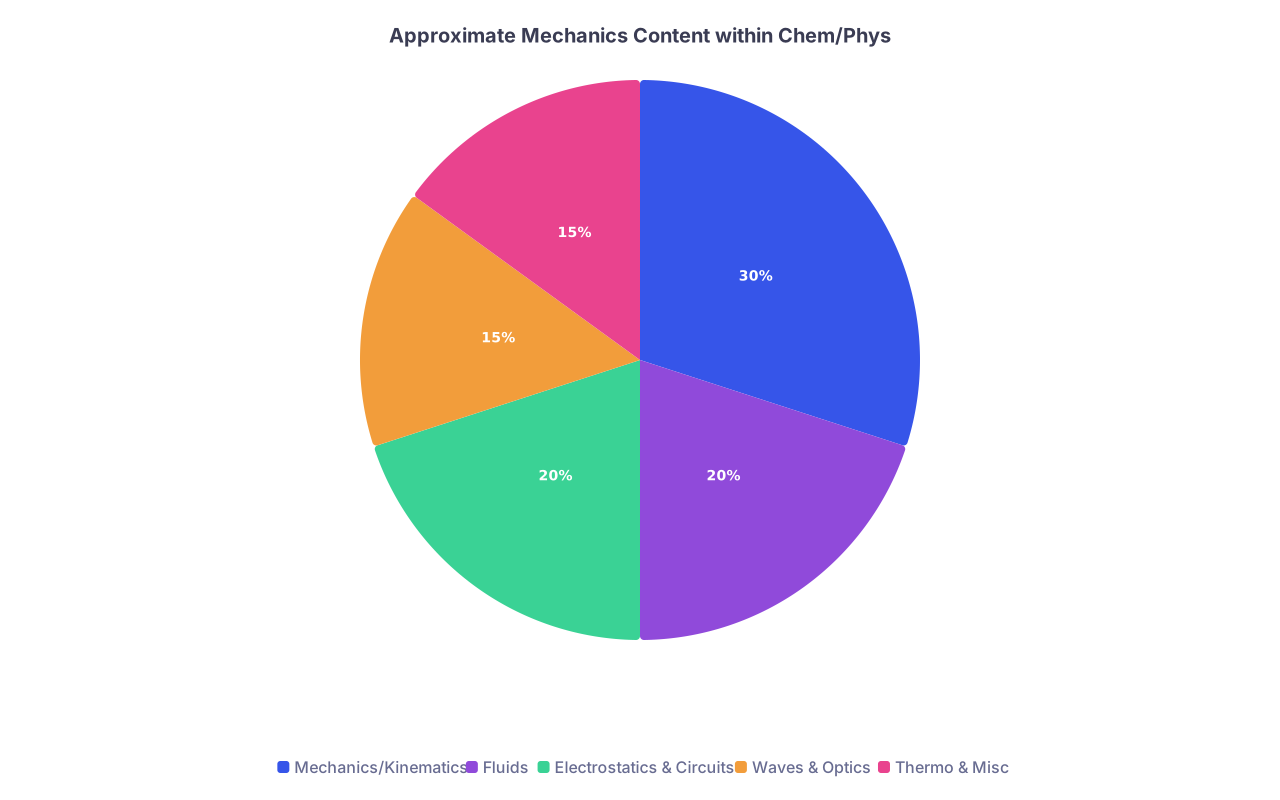
| Category | Value |
|---|---|
| Mechanics/Kinematics | 30 |
| Fluids | 20 |
| Electrostatics & Circuits | 20 |
| Waves & Optics | 15 |
| Thermo & Misc | 15 |
Core Type 1: Straight-line Kinematics (Constant Acceleration)
This is the bread-and-butter MCAT mechanics problem. Constant acceleration, usually gravity. One-dimensional motion. Sometimes two dimensions but separable (projectiles).
How you recognize it
- “An object is dropped / thrown / launched…”
- “A car accelerates from rest…”
- “A ball is thrown upward…”
- Graphs of position vs time, velocity vs time
- “Neglect air resistance”
Mental model
You are in the land of the big three (really four) kinematics equations under constant acceleration:
- ( v = v_0 + at )
- ( x = x_0 + v_0 t + \frac{1}{2} a t^2 )
- ( v^2 = v_0^2 + 2a\Delta x )
- ( \text{average v at constant a: } \bar{v} = \frac{v_0 + v}{2} )
For vertical motion near Earth: ( a = g \approx 10 , \text{m/s}^2 ) downward.
The MCAT does not want exact numbers most of the time. It wants comparisons: “If initial speed doubles, what happens to range / height / time?”
Core proportional relationships
- Time up to peak: ( t_{up} \propto v_0 )
- Max height: ( h_{max} \propto v_0^2 )
- Range (no air, flat landing): ( R \propto v_0^2 \sin(2\theta) )
So if initial speed doubles, height and range go up by a factor of 4, time by a factor of 2.
Common traps
- Mixing up vertical and horizontal components in projectile motion
- Using g = 9.8 when 10 is easier and perfectly acceptable
- Forgetting that at the top of a projectile path, v = 0 but a = g (not zero)
- Misreading graphs: area under v–t graph = displacement, slope of x–t graph = velocity
Pattern example
“A ball is thrown straight upward with speed v. Ignoring air resistance, how does the total time in the air change if the ball is thrown with speed 2v?”
Time up is ( t_{up} = v/g ). Time down is the same. Total time T = 2v/g. Double v → double T. That is the reasoning the MCAT wants.
Core Type 2: Free-Body Diagrams and Newton’s Second Law
This is where most premeds get wrecked. Not because the math is hard, but because they skip the diagram and try to “solve” directly. That never ends well.
How you recognize it
- “Block on a frictionless surface…”
- “Box pulled by a rope at angle θ…”
- “Inclined plane at angle θ…”
- “Block attached to a hanging mass over a pulley…”
- “Elevator accelerating upward/downward…”
Mental model
Step 1: Draw the free-body diagram. Every single time. No exceptions.
- Weight: ( mg ) downward
- Normal force: perpendicular to surface
- Tension: along the rope / string
- Friction: parallel to surface, opposite motion (or intended motion)
- Static: ( f_s \leq \mu_s N )
- Kinetic: ( f_k = \mu_k N )
Step 2: Choose axes aligned with motion or the surface. Components matter.
Step 3: Apply ( \sum F = ma ) in each direction.
Classic subtypes
Inclined plane
For a block on a plane angled θ above horizontal:
- Component of weight parallel to plane: ( mg\sin\theta ) down the plane
- Component normal to plane: ( mg\cos\theta )
- Normal force: ( N = mg\cos\theta )
No friction? Acceleration along plane: ( a = g\sin\theta ).
Tension systems (two-mass, pulley)
Two blocks connected by a light string:
- Write F = ma for each block
- Tension is same throughout ideal string
- Solve system; often you just need direction or relative magnitude
Elevator problems
Apparent weight ( N ) on scale:
- Elevator accelerating up: ( N = m(g + a) )
- Elevator accelerating down: ( N = m(g - a) )
Common traps
- Forgetting to break weight into components on an incline
- Making friction equal to μN automatically (that is max static; actual static can be less)
- Treating all accelerations as g (no, only free fall in vertical direction)
- Getting sign conventions wrong
Pattern example
“A 5 kg block rests on a frictionless 30° incline. What is its acceleration down the plane?”
( a = g\sin30^\circ = 10 \times 0.5 = 5 , \text{m/s}^2 ).
You should do that mentally in under 10 seconds.
Core Type 3: Work, Kinetic Energy, and Power
Most mechanics questions with forces over a distance can be bulldozed with work–energy instead of F = ma + kinematics.
How you recognize it
(See also: Underperforming on Full-Lengths? A Post-Exam Autopsy Template for a step-by-step review process.)
- “What is the speed of the block after being pushed…”
- “How much work did the force do…”
- “What power must the motor provide…”
- Wordings involving energy, work, or power explicitly
Mental model
Kinetic energy: ( K = \frac{1}{2}mv^2 )
Work: ( W = F d \cos\theta )
Net work = change in kinetic energy: ( W_{net} = \Delta K )
Power: ( P = \frac{W}{t} = Fv \cos\theta ) for constant v and F.
The MCAT loves proportional reasoning:
- Double force at same distance → double work
- Double speed → kinetic energy increases by factor of 4
- Climbing stairs faster: same work, more power
Classic moves
Push a block horizontally with friction
Work by applied force – work by friction = ΔK
Friction force: ( f_k = \mu_k N = \mu_k mg ) on horizontal.
Power problems
If a car of mass m moves at constant speed v on level ground with resistive drag F:
- Engine power output ≈ ( P = Fv )
If speed doubles, required power to overcome drag is often > 2x (if F depends on v).
Common traps
- Using W = Fd without cosθ when force is at an angle
- Confusing work done by a force with work done on an object (sign errors)
- Forgetting that work is scalar; energy is scalar; direction lives in forces / velocities
Pattern example
“A box of mass m is pushed with constant horizontal force F across a rough floor a distance d at constant speed. What is the work done by the normal force?”
Normal is perpendicular to displacement (θ = 90°). Cos 90° = 0. Work by normal = 0.
This style shows up constantly.
Core Type 4: Gravitational Potential Energy and Conservation of Mechanical Energy
Now we bring potential energy into the story. MCAT problems love “object slides down a frictionless track” because it lets them test energy conservation without ugly math.
How you recognize it
- “Frictionless track / ramp / roller coaster…”
- “An object is released from rest at height h…”
- “What is the speed at the bottom…”
- Height changes without nonconservative work
Mental model
Gravitational potential energy near Earth: ( U_g = mgh ).
Conservation of mechanical energy (no nonconservative work):
( K_i + U_i = K_f + U_f )
or
( \frac{1}{2}mv_i^2 + mgh_i = \frac{1}{2}mv_f^2 + mgh_f )
Mass cancels a lot. Which is the point.
What the MCAT really wants here
- You to see height difference and convert to speed
- You to realize mass cancels, so all objects slide the same if frictionless
- You to compute speeds from drops without time or acceleration steps
Common traps
- Trying to do F = ma + kinematics when energy is far cleaner
- Treating “higher path length” as changing energy (only vertical height matters)
- Thinking a heavier object gains more speed when dropped from same height (both get same v; heavier one has more energy, not more speed)
Pattern example
“A block slides down a frictionless track from height h and reaches speed v at the bottom. If another block of twice the mass starts from the same height, what is its speed at the bottom?”
Same. v. Because:
( mgh = \frac{1}{2}mv^2 \Rightarrow v = \sqrt{2gh} ) (no mass).
Mass cancels, so speed depends only on height and g.
Core Type 5: Circular Motion and Centripetal Forces
Students overcomplicate this or forget it entirely. It pops up in MCAT passages all the time—cars on curves, roller coasters, planets, satellites.
How you recognize it
- “Car going around a flat/unbanked curve…”
- “Object whirled in a circle on a string…”
- “Roller coaster at top/bottom of a loop…”
- “Minimum speed to keep contact…”
Mental model
Centripetal acceleration:
( a_c = \frac{v^2}{r} ) toward center.
Not a new force. Just the net inward acceleration that existing forces must provide.
Then:
( \sum F_{\text{toward center}} = m \frac{v^2}{r} )
Examples:
Car on flat curve: static friction provides centripetal force.
- ( f_s = \mu_s N = \mu_s mg )
- So ( \mu_s mg = m v^2 / r \Rightarrow v_{max} = \sqrt{\mu_s g r} )
Object on rope in a vertical circle:
- At top: ( T + mg = m v^2 / r )
- At bottom: ( T - mg = m v^2 / r )
Common traps
- Treating centripetal force as a new separate force rather than the net result
- Getting direction wrong: centripetal is radial inward, not up/down/tangent
- Confusing centripetal with centrifugal (which you should ignore here)
- Forgetting that at minimum loop speed, tension at top = 0 (just mg provides centripetal)
Pattern example
“A car of mass m travels around a flat curve of radius r. Coefficient of static friction between tires and road is μ. What is the maximum speed without skidding?”
Friction = centripetal:
( \mu mg = m v^2 / r \Rightarrow v_{max} = \sqrt{\mu g r} )
That formula is worth burning into memory.

| Step | Description |
|---|---|
| Step 1 | Read physics stem |
| Step 2 | Kinematics equations |
| Step 3 | Free-body + F=ma |
| Step 4 | Work-Energy / PE |
| Step 5 | Centripetal motion |
| Step 6 | Momentum/Impulse |
| Step 7 | SHM / Springs |
| Step 8 | Re-read: likely combo |
| Step 9 | Is motion constant a? |
| Step 10 | Forces emphasized? |
| Step 11 | Height/energy words? |
| Step 12 | Circle / loop / curve? |
| Step 13 | Collision/Explosion? |
| Step 14 | Spring/oscillation? |
Core Type 6: Collisions, Impulse, and Momentum
Here the MCAT is testing whether you know when energy is conserved, when only momentum is conserved, and how to reason through collisions without getting lost.
How you recognize it
- “Two carts collide…”
- “A bullet embeds in a block…”
- “Objects stick together / bounce off…”
- “What is the recoil speed…”
- “Impulse delivered by the force…”
Mental model
Momentum: ( \vec{p} = m\vec{v} )
Impulse: ( \vec{J} = \Delta \vec{p} = F_{avg} \Delta t )
If no external net force on the system: total momentum is conserved.
Collisions:
- Perfectly inelastic: objects stick together. Momentum conserved, KE not.
- Elastic: objects bounce and total KE is conserved (MCAT rarely makes you do full algebra here, but conceptual questions appear).
Go-to equations
Momentum conservation in one dimension:
( m_1 v_{1i} + m_2 v_{2i} = m_1 v_{1f} + m_2 v_{2f} )
Perfectly inelastic (stick together):
( m_1 v_{1i} + m_2 v_{2i} = (m_1 + m_2) v_f )
What MCAT really tests
- Recognizing that “sticking” means kinetic energy is lost but momentum conserved
- That a lighter object recoils faster than a heavy one if they share momentum
- That longer collision time → smaller average force for same Δp (airbags, crumple zones)
Common traps
- Forcing KE conservation in an inelastic collision
- Treating external forces (like friction) as negligible when the problem says so, but then trying to include them
- Mixing up direction (signs) on velocities in 1D
Pattern example
“A bullet of mass m traveling at speed v embeds itself in a stationary block of mass 4m. What fraction of the bullet’s initial kinetic energy is lost in the collision?”
Momentum: ( m v = (m + 4m) v_f = 5m v_f \Rightarrow v_f = v/5 )
Initial KE: ( K_i = \frac{1}{2} m v^2 )
Final KE: ( K_f = \frac{1}{2} (5m) (v/5)^2 = \frac{1}{2} (5m)(v^2/25) = \frac{1}{10} m v^2 )
Loss fraction = ( 1 - K_f/K_i = 1 - (\frac{1}{10} m v^2) / (\frac{1}{2} m v^2) = 1 - \frac{1}{5} = \frac{4}{5} ).
80% of KE lost. Very standard.
Core Type 7: Springs and Simple Harmonic Motion (SHM)
Springs show up less than inclined planes, but when they do, almost everyone overcomplicates them. You should handle these in your sleep.
How you recognize it
- “Block attached to a spring with spring constant k…”
- “Mass–spring system oscillates…”
- “Maximum displacement / amplitude A…”
- “Frequency / period of oscillation…”
Mental model
Hooke’s Law: ( F = -kx )
Spring potential energy: ( U_s = \frac{1}{2} k x^2 )
Mass–spring on frictionless surface undergoing SHM:
- Angular frequency: ( \omega = \sqrt{\frac{k}{m}} )
- Period: ( T = 2\pi \sqrt{\frac{m}{k}} )
- Frequency: ( f = \frac{1}{T} = \frac{1}{2\pi} \sqrt{\frac{k}{m}} )
Total mechanical energy in SHM:
( E = \frac{1}{2} k A^2 = \frac{1}{2} m v_{max}^2 )
At maximum displacement: v = 0, all energy is spring PE.
At equilibrium: x = 0, all energy is KE, v = v_max.
What the MCAT cares about
- Proportional relationships: if k doubles → ( \omega ) increases, period decreases
- Where KE and PE are max/min in the cycle
- That energy stays constant (ignoring damping)
Common traps
- Plugging numbers into trig-based SHM equations (x = A cos ωt) — unnecessary
- Forgetting squared relationships: doubling amplitude → quadruple energy
- Confusing frequency with angular frequency
Pattern example
“A mass m on a horizontal spring oscillates with amplitude A and spring constant k. Which change increases the period of oscillation?”
Look at ( T = 2\pi \sqrt{m/k} ).
Increase m → T increases.
Decrease k → T increases.
Amplitude A does not appear: changing A does not change T. Classic test point.
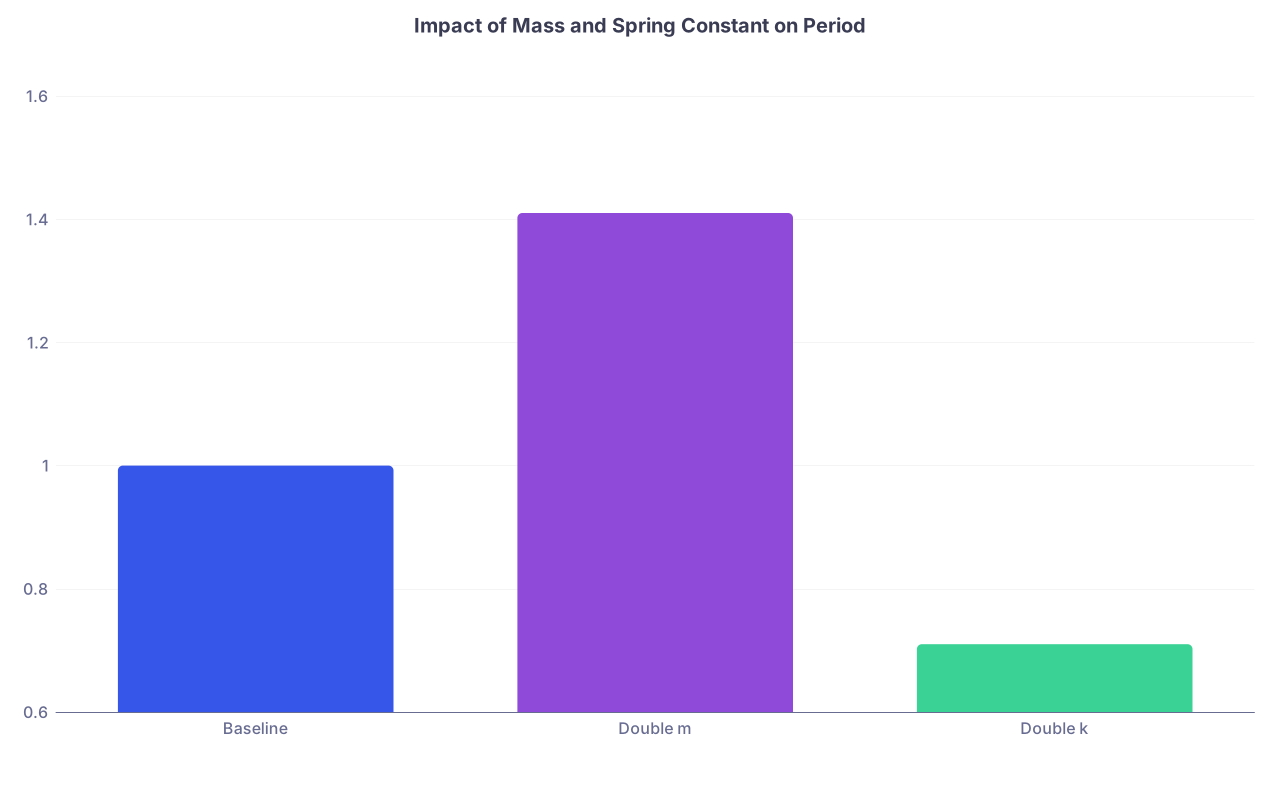
| Category | Value |
|---|---|
| Baseline | 1 |
| Double m | 1.41 |
| Double k | 0.71 |
Core Type 8: Multi-step “Combo” Problems (Your Real MCAT Boss Fights)
The MCAT likes to chain 2 or 3 of the above into one stem. That is where people panic. You see a block on a ramp, attached to a spring, with friction, then something about speed and power. Suddenly everyone forgets everything.
You cannot treat these as new topics. They are just sequences of the same 8 patterns.
How you recognize it
Stems like:
- “A block of mass m is released from height h above a spring (k) on a rough surface. It slides, compresses the spring, then comes momentarily to rest…”
- “A car accelerates down a ramp then enters a circular loop…”
- “A projectile hits a pendulum bob causing it to swing…”
Mental model
You go stepwise:
Identify distinct phases (motion segments).
Identify the right tool for each phase:
- Constant a motion → kinematics
- Force-balance at a single instant → F = ma + FBD
- Change in speed with height / springs / friction → work–energy
- Collisions → momentum
- Circular section → centripetal
Stitch results: output of phase 1 becomes input of phase 2.
Think of it like small sub-problems, each belonging to one of the 8 types. The MCAT rarely needs algebra for all steps. Often it wants a single conceptual conclusion.
Classic combo archetypes
Block slides → compresses spring
- Use energy (mgh or μkmgd) to find speed at start of compression
- Then use KE → spring PE to find max compression
Collision + SHM
- Bullet hits block (momentum conserved) → find combined v
- Then treat block+bullet as mass on spring (SHM or max compression via energy)
Ramp + loop
- Use initial height to get speed at some point along track (energy)
- At loop top, apply centripetal condition: ( N + mg = mv^2/r ) or limiting case N = 0
Common traps
- Trying to handle everything with one equation set instead of chunking
- Forgetting transitions: what exactly is conserved in each phase?
- Accidentally assuming both energy and momentum conserved in the same collision step (in inelastic collisions they are not)
Strategy: Turning These 8 Types Into Reflexes
This is where serious score improvement happens. Not from reading more physics, but from drilling recognition.
Make yourself a “mechanics one-pager”
Organize it around the 8 types, not chapters from a textbook. Something like:
| # | Core Type |
|---|---|
| 1 | Straight-line kinematics |
| 2 | Free-body diagrams & Newton 2 |
| 3 | Work, kinetic energy, power |
| 4 | Gravitational potential & energy |
| 5 | Circular motion & centripetal |
| 6 | Collisions & momentum |
| 7 | Springs & SHM |
| 8 | Multi-step combo problems |
Under each, list:
- 2–3 trigger phrases
- 1–2 core equations
- 1–2 classic pitfalls
Review that sheet before every physics practice block.
How to practice so this actually sticks
- Take 20 random mechanics questions.
- For each, before solving, label it: “Type 3: Work–Energy” etc.
- After solving, check: did your chosen type actually match the simplest approach?
If you mis-classify a question, that is better feedback than getting it wrong numerically. Misclassification means your mental library is off. Fix the category before you worry about the calculation.
FAQs
1. How much mechanics and kinematics actually show up on the MCAT?
On a typical exam, pure mechanics (kinematics, forces, energy, momentum, circular motion, springs) usually accounts for roughly a quarter to a third of the physics-heavy material in Chem/Phys. You will not see 20 questions in a row on inclined planes, but you will see these ideas woven through passages on biomechanics, cars, sports, or devices. Treat it as foundational, not optional.
2. Do I need to memorize every formula from my physics textbook?
No. That is how students drown. For mechanics and kinematics, you need maybe a dozen formulas total, tied to the 8 problem types above. If you cannot place an equation in a specific use-case (“I use this only when…”) it is clutter. Focus on: the 3–4 kinematics equations, F = ma + friction/tension/normal, W = Fd cosθ, K = ½mv², U = mgh and ½kx², p = mv, a_c = v²/r, and T = 2π√(m/k). That is the core.
3. Should I always try to use energy instead of forces and kinematics?
No, but it is often cleaner. Use energy when you care about speeds at different positions and can ignore or easily integrate nonconservative forces (like friction). Use F = ma + kinematics when you care about acceleration, tension, normal force, or when forces change direction in a way that matters. Good rule: if the question literally asks for a force or an acceleration at some instant, start with forces; if it asks for a speed after some motion, start with energy.
4. Why do I keep getting tripped up on free-body diagram problems?
Because you are probably skipping the diagram and solving in your head. MCAT time pressure makes people shortcut the one step they cannot shortcut. Force questions are not about plugging into equations. They are about correctly identifying all forces and their directions, then projecting along sensible axes. If you force yourself to sketch every block/mass with arrows for just one week of practice, your accuracy will jump. It feels slower at first. It is not.
5. How do I know when to use momentum conservation versus energy conservation?
Ask two questions. First: “Is there a collision or explosion?” If yes, think momentum first. Second: “Are there external net forces or clear nonconservative processes (heat, deformation)?” If so, you probably cannot conserve mechanical energy across that interaction, but you can often conserve momentum if the system is isolated. Collisions where objects stick: momentum conserved, KE lost. Smooth slides without friction: energy conserved, momentum not necessarily conserved for a single object. Treat each phase separately instead of trying to apply both everywhere.
Key points you should walk away with:
- MCAT mechanics is built from 8 recurring problem types. Your job is rapid recognition, not formula hoarding.
- Every mechanics stem reduces to one or two of: constant a kinematics, F = ma with a clean free-body diagram, energy, momentum, circular motion, or springs.
- The fastest solvers chunk multi-step questions into these types and use proportional reasoning, not heavy algebra.