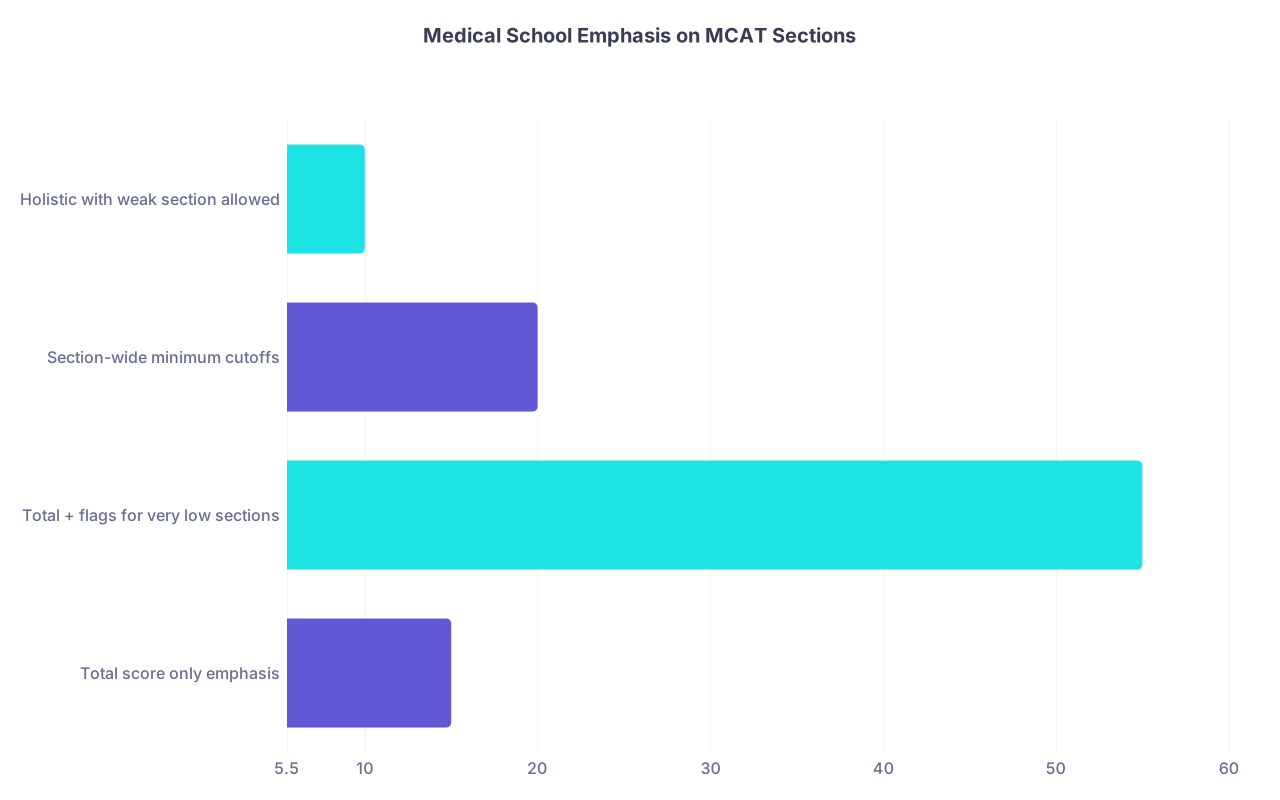
| Category | Value |
|---|---|
| Total score only emphasis | 15 |
| Total + flags for very low sections | 55 |
| Section-wide minimum cutoffs | 20 |
| Holistic with weak section allowed | 10 |
A single low MCAT section is not automatically a dealbreaker. The blanket “you’re done” advice is lazy and often wrong.
You’ve probably heard the script: “One bad section and top schools toss your app.” Or, “A 124 anywhere? Forget MD.”
That’s not how most schools actually work.
Do some programs have hard section cutoffs? Yes.
Do all of them? Not even close.
Can a single weak section be offset? Often, yes—if the rest of your profile makes sense.
Let’s separate rumor from reality and talk about what admissions committees actually do with that one ugly section score.
How schools actually look at MCAT sections (not how Reddit says they do)
Here’s the reality from people who have actually sat in committee rooms:
Most schools start with some version of a computer screen:
- Overall MCAT score
- Section scores
- GPA (overall and science)
- State residency / mission fit flags
Then they do one of three things.

1. “Total score first, everything else later” schools
A good chunk of schools—especially mid-tier and many state schools—care primarily about your total MCAT. They do look at sections, but they do not let one 124–125 automatically kill an otherwise strong file.
What this looks like in practice:
- 515 (129/130/126/130) → taken seriously almost everywhere
- 512 (127/127/127/131) → also taken seriously
- 512 (131/130/126/125) → yes, they notice the 125, but they do not automatically trash it
If you’re above their typical matriculant median (say, 511–513+ for many MD schools), a single dip into mid‑120s in one section isn’t an instant rejection at these places. They’ll want reassurance it’s not a pattern of weakness, but they’ll keep reading.
2. “Section floors” schools
Some schools have explicit or de facto section minimums. You see this mostly at:
- Highly competitive MD programs
- Schools burned by students struggling in a specific domain (often CARS or C/P)
- Institutions where the curriculum is reading-intense or conceptually brutal
You’ll never see “we auto-screen everyone below 125 in any section” on their website. But you see it in their data and in how they talk:
“We typically don’t advance applications with any section below the 25th percentile unless there’s a compelling reason.”
Translated: if you have a 123 or 124 anywhere, you’re behind the starting line at these programs.
3. “Pattern hunters”
There’s a third group: committees that mainly care about patterns.
They’re asking:
- Did you struggle once or is this a theme?
- Does the low section line up with other red flags (weak grades, failed courses, no related experiences)?
- Did you show improvement anywhere (retake, upper‑level coursework, etc.)?
A single 124 in CARS with stellar humanities grades and lots of reading-heavy research? They’ll raise an eyebrow but may chalk it up to test-day variance.
A 124 in C/P with C’s in physics and gen chem? Different story. That looks like real weakness, not a fluke.
What the data actually shows about “dealbreaker” sections
The AAMC does not publish a neat table saying “124 = doomed.” But if you look at their MCAT/GPA grids and actual class profiles, you can reverse-engineer reality.
Broad strokes:
- Matriculants at MD schools cluster in the 507–515 total range.
- Average section scores hover 127–128 for many schools.
- That means plenty of matriculants have one section at 124–126.
If a single low section were truly fatal, you wouldn’t see the range of section scores you do in real classes.
Here’s a simplified way to think about how section scores are treated across types of schools:
| School Type | Typical View on One 124–125 Section |
|---|---|
| Top‑20 MD | Notice, may hurt, not always fatal |
| Mid‑tier private MD | Concerned, but context matters |
| State MD (in‑state) | Often tolerated with strong total/GPA |
| DO programs | Usually fine if total is reasonable |
| Ultra‑competitive MD | More likely to screen out at section level |
This isn’t exact, but it reflects what you actually see when you look at matriculant profiles against self-reported section breakdowns.
The myths that refuse to die (and why they’re wrong)
Let me go straight at the most common nonsense.
Myth 1: “Any section below 125 means no MD”
False. I’ve seen:
- A 511 with 123 CARS → multiple MD interviews at state schools, ended up with 2 MD acceptances.
- A 514 with 124 Psych/Soc → interviewed at a top‑25 MD, waitlisted, matched elsewhere MD.
- A 509 with 124 Chem/Phys → MD at home state school, strong clinical + disadvantaged background.
The pattern in those cases:
- Solid overall score
- Strong GPA, especially in the supposedly weak area
- Some contextual factor (URM, first‑gen, state school fit, unique experiences)
Is a 124 ideal? No. But “no MD for you” is just lazy absolutism.
Myth 2: “Schools only care about total MCAT”
Also wrong. Saying “only total matters” is just the mirror-image of Reddit’s “one section ruins everything.”
Here’s what actually happens:
- A total score gets you past the screen.
- Section scores get used to ask questions.
Examples I’ve watched in committee:
- 519 with a 124 in CARS → “Why is reading so out of line? ESL? Test anxiety? Any evidence in the file this will be a problem in school?”
- 508 with flat 127s → “Not amazing, but consistent. Safe.”
- 512 with 131/130/125/126 → “Great science, weaker verbal and psych. Any evidence they struggle with communication or social science concepts?”
Total opens the door. Sections shape the conversation.
Myth 3: “CARS below 125 is uniquely fatal”
CARS gets mythologized because:
- It’s hard to “study” the way you study for content.
- It correlates somewhat with in‑school performance for heavy-reading curricula.
- People like to pretend one number captures your intelligence.
What I’ve seen:
- Some schools are hypersensitive to low CARS, especially those with P/F preclinical curricula and reading-heavy small groups.
- Others treat CARS like any other section—a data point, not gospel.
You absolutely can get into MD with a 123–124 CARS, especially if:
- You have strong writing-intensive coursework grades
- You’re a non-native English speaker with clear improvement over time
- Your essays and letters are strong and coherent (yes, they notice)
Is a 122 CARS at a place like UCSF or Penn a problem? Realistically, yes. At your in‑state public? Less so, if the rest of your app is strong.
When a low section is a real problem
Let’s stop sugarcoating. There are scenarios where a bad section is a serious obstacle, sometimes a legitimate dealbreaker for certain schools.
1. Very low section (≤123) + borderline total
If you’re sitting on:
- 502 with section breakdown 126/123/126/127
- 499 with one section at 122
You’re fighting statistics. Most MD matriculants aren’t in that band. Some DO schools will be fine with this, especially with strong GPA and story, but many MD schools won’t ever see the nuance because you’re below their auto-screen thresholds.
2. Low section matching a documented weakness
Examples:
- 124 Chem/Phys + repeated C’s in physics and gen chem
- 123 Bio/Biochem + failed or withdrawn intro biology courses
- 122 CARS + consistently poor performance in writing/reading classes
Now the story is: this isn’t an off day. This is a capability concern.
Schools aren’t trying to be cruel here; they’re asking: “Are we setting this person up to fail Step/boards and our curriculum?”
3. Repeated low section with no sign you addressed it
Say:
- First attempt: 503 (126/123/127/127)
- Second attempt: 506 (127/123/128/128)
You improved total slightly, but the exact same 123 in CARS suggests you never really tackled the weakness. That bothers committees more than one bad day.
Compare that to:
- First: 505 (123 C/P, others 127–128)
- Second: 510 (126 C/P, others 128–129)
Not perfect, but they see growth and effort. That reads very differently.
How much does one low section matter at different score bands?
You can’t talk about a single low section without context. A 124 means one thing at a 498 and something very different at a 520.
Here’s the blunt version:
Total 520+ with one 124–125
Top schools will still look. Your research, letters, and background start to matter more than that single dip. They may wonder what happened, but they won’t auto-trash.Total 514–519 with one 124–125
Competitive almost everywhere. At the ultra-elite places, the low section might knock you from “auto-interview” to “debate” pile, but you’re far from out.Total 508–513 with one 124–125
This is where section quirks start to bite at some schools. For others (especially state schools, DO schools), this is pretty workable with a solid GPA.Total 502–507 with one 124–125
MD schools become much more selective. DO schools largely fine with it if GPA is good. You need stronger narrative and mission fit to overcome cold stats.Below 502 total
At that point the total score is usually the primary concern; the single section becomes less of a separate argument. Most MDs won’t seriously consider, DOs become your main path, or you re-take.
Should you retake the MCAT just for one low section?
This is the million‑dollar anxiety question.
I’ve seen people with 514 (124 in one section) panic and retake, only to end up with a 513 flat. That’s not a win.
A retake makes sense when:
- Your total is meaningfully below the typical range of your target schools
- The low section aligns with a real weakness and you’ve actually fixed the underlying problem
- You have a realistic shot (based on practice tests, not wishful thinking) of a 3+ point jump in total score, not just one section
Rough rule of thumb:
- If you’re 510–512+ with otherwise strong stats, one low section is usually better handled by your application narrative and school list than by gambling on a retake.
- If you’re sub‑508 aiming mainly for MD, a thoughtful retake with clear improvement can change the conversation entirely.
- If you’re happy with DO or your in‑state MD has lower medians, a single low section is often survivable without retake.
What adcoms dislike: multiple retakes with minimal change. That signals poor insight or poor preparation strategy more than resilience.
How to blunt the impact of a weak section without magical thinking
You can’t erase a 124. You can bury it in context.
- Use your personal statement and secondary essays (where appropriate) to show skills that contradict the implication of that low score. Weak CARS? Then your writing should be clean, organized, reflective, and mature.
- Let letters of recommendation do some talking. A professor describing you as the best writer in their seminar carries more weight than your 124 in CARS.
- Point to coursework that counters the weakness. A low science section with A’s in upper‑level physiology, biochem, or physics is not the same as low science with weak coursework.
- Pick your school list like an adult, not like an Instagram flex. If you’ve got a 508 with a 123 somewhere, sending 20 applications to top‑25 MD programs is not “ambitious”; it’s self-sabotage.
And if you do have an actual, documented accommodation need or language background that reasonably explains some of the discrepancy? The disadvantaged essay and secondaries are places to calmly explain that, not to make excuses but to give context.
The bottom line: one bad section is a data point, not a verdict
Strip away the drama and you’re left with this:
- A single low MCAT section is almost never an automatic dealbreaker across the board; it’s a flag that schools interpret in the context of your total score, GPA, coursework, and story.
- The lower your total score and the more that weak section matches a real pattern in your record, the more it hurts. High totals and contradictory evidence in your favor blunt the damage.
- Smart applicants don’t chase perfection; they build a school list and narrative that acknowledge reality. Sometimes that means retaking. Often it means accepting that one ugly number isn’t the thing that will make or break you—your overall application strategy will.

| Step | Description |
|---|---|
| Step 1 | Single Low Section |
| Step 2 | Consider Thoughtful Retake |
| Step 3 | Focus on Narrative & School List |
| Step 4 | Strengthen Academics or Retake |
| Step 5 | Total MCAT >= 510? |
| Step 6 | GPA Strong? |