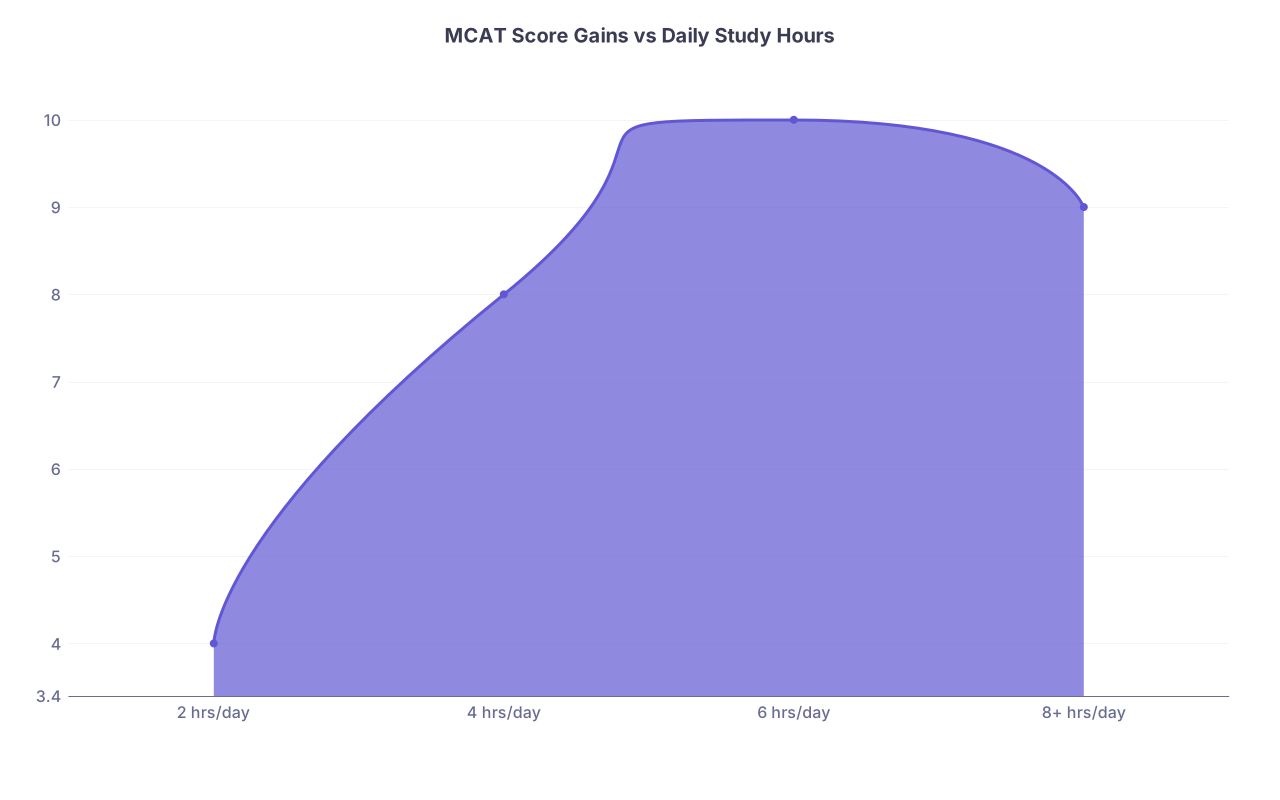
The blunt truth: CARS tutoring is absolutely worth it for some students with one weak section… and a complete waste of money for others. The trick is knowing which one you are.
You’re not asking, “Is CARS tutoring good?” You’re asking, “Is CARS tutoring worth it for me, given that this is my only weak section?” That’s a much better question. Let’s answer that.
The Real Role of CARS in Your MCAT Score
Before you throw money at the problem, get clear on what CARS actually does to your application.
CARS is:
- One out of four sections
- Scored 118–132 (like the others)
- Weirdly important for certain schools and for “holistic” reviewers
- A decent proxy—fair or not—for “can this person think and read like a clinician?”
Many students can get away with a slightly lower CARS, especially if they’re strong in science and have a solid GPA. But there’s a big difference between:
- “My CARS is my lowest section, but still decent,” and
- “My CARS is dragging my entire application down.”
Let’s make that concrete.
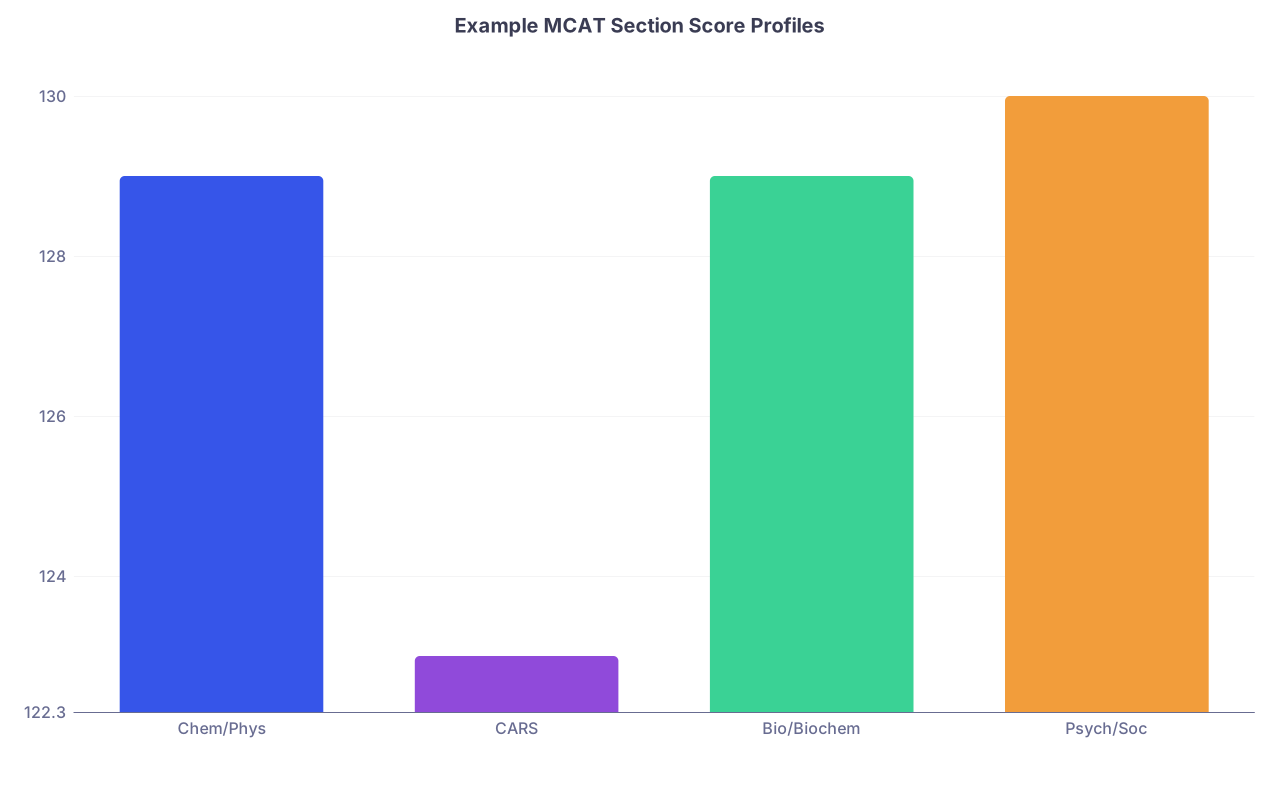
| Category | Value |
|---|---|
| Chem/Phys | 129 |
| CARS | 123 |
| Bio/Biochem | 129 |
| Psych/Soc | 130 |
If you’re in the 129/123/129/130 type situation, you already know the problem. A 123 CARS on an otherwise strong MCAT is like a big red highlighter stroke on your score report.
Now the real question: Do you fix that with tutoring?
A Simple Framework: When CARS Tutoring Is Worth It
Here’s the decision rule I use when students ask me this:
CARS tutoring is worth it if and only if most of the following are true:
Your CARS is 2–4 points below your other sections
Example: 129/125/130/129 or 128/123/129/128
One point off? Probably not worth tutoring. Four or more points off? Very likely a problem.You’ve already done serious solo work… and plateaued
I do not mean:- “I did 5 passages and my score didn’t move.”
I mean: - You’ve used a good chunk of AAMC CARS Qpacks and practice exams
- You’ve reviewed explanations, not just checked answers
- You’ve tried at least one structured method (Jack Westin, Testing Solutions, Anki for CARS mistakes, whatever)
- After 6–8 weeks, your CARS score on AAMC exams is still stuck within 1 point
- “I did 5 passages and my score didn’t move.”
You’re consistently missing the same types of questions
This is where a tutor can actually help. Common patterns tutors can fix:- Always falling for extreme answer choices
- Misreading what the question stem actually asks
- Overvaluing your outside knowledge
- Struggling with “main idea” or author attitude
- Panicking with timing and rushing last 1–2 passages
You can realistically improve your score in the timeline you have
If your exam is in 3–4 months, you have room.
If your exam is in 3 weeks and you’re at a 122–124 CARS, tutoring will not work magic. That’s not cynicism, that’s just data.You’ve already squeezed the easy points out of the other sections
If you’re at:- 130+ in two sections
- 128+ in the third
- 124–126 in CARS
Then a 2–3 point CARS jump can be the difference between “good score” and “competitive almost everywhere.”
If those describe you, yes. CARS tutoring might be a high-yield investment.
If not, keep your money.
When CARS Tutoring Is Usually a Waste of Money
Let me be just as direct on the flip side. CARS tutoring is probably not worth it if:
Your overall MCAT is weak across the board
Example: 124/123/124/125.
The issue here is not “a single weak section.” Your foundation and test-taking across the entire exam need work. A CARS tutor is not your first priority; a full MCAT plan is.You’re hoping for a miracle jump (5–6+ points) in a short time
I’ve watched people pay thousands of dollars expecting to go from 123 to 129 in 6 weeks with a tutor. That’s fantasy.
Reasonable CARS improvement with focused help:- 1–2 points? Very realistic
- 3–4 points? Possible, but requires time + consistency
- 5+ points in under 2 months? No. Not reliably.
You have no time or mental bandwidth to do homework
CARS tutoring isn’t like paying someone to fix your car while you sit in the lobby. It only works if you:- Do timed passages between sessions
- Review mistakes in detail
- Apply strategy changes immediately
If your schedule is clinical work 60 hrs/week + classes + family obligations and you can barely breathe, tutoring sessions alone won’t fix anything.
You haven’t even tried structured self-study yet
If your entire CARS “prep” so far is:- A few random passages from Reddit
- One Kaplan book you skimmed
You’re not ready for tutoring. First, squeeze the free/cheap resources.
Your diagnostic was low, but you haven’t taken any AAMC practice exams
Do not base a tutoring decision on only third-party CARS scores.
AAMC CARS feels different and is the only thing med schools actually care about.
What Good CARS Tutoring Actually Does (and What It Doesn’t)
People over-romanticize tutoring. It’s not magic. It’s pattern correction.
A strong CARS tutor helps you:
Build a reading process you can repeat
Maybe it’s “read for structure and attitude, not details.”
Maybe it’s “summarize each paragraph in 3–5 words.”
It’s not about finding the “one secret method.” It’s about your method that fits your brain.Diagnose your actual problem
Common underlying issues:- You read too slowly because you try to understand every detail
- You read too fast because you panic about time
- You bring in outside knowledge and argue with the passage
- You chase answer choices that “sound smart” instead of ones actually supported
Break your bad habits in real time
A good session often looks like:- You screen-share a timed passage
- Talk through your thoughts
- Tutor stops you mid-sentence and says: “You just made this assumption; that’s why you miss inference questions.”
That’s what you’re paying for: immediate feedback on your thinking, not just the answers.
Give you a structured plan between sessions
Example week:- 3 days: 3 passages/day timed
- 2 days: deep review of those passages (line-by-line, why each wrong answer is wrong)
- 1 day: full CARS section timed
- 1 day: rest or light review
What tutoring won’t do:
- Turn a non-reader into a top CARS scorer without significant effort
- Fix sleep, anxiety, burnout, or general test fatigue
- Overcome a complete lack of content in other MCAT sections
If you’re hiring a tutor expecting them to drag your score up while you stay passive, save your money.
Group Class vs 1:1 Tutoring for a Single Weak Section
If CARS is your only problem, here’s how I’d rank your options:
Targeted 1:1 CARS tutoring (short-term, 4–8 sessions)
Best if:- You already know your patterns (e.g., always misreading tone, or always missing inference questions).
- You want someone to watch you work and correct in real time.
Focused CARS course (e.g., small-group, 4–6 weeks)
Better if:- Budget is tight
- You need basic frameworks and a ton of practice
- You don’t even know where to start with CARS
Full MCAT course primarily for CARS
Usually overkill if your sciences are strong. You’ll sit through a lot of content you don’t need.No tutoring, self-study only
Absolutely fine if:- Your CARS is just 1–2 points behind the others
- You’re a strong reader who just needs more exposure to passage style and timing
Cost vs Score Gain: Is It Actually “Worth It”?
Let’s be annoyingly practical for a second.
Typical CARS tutoring rates (US, 2024):
| Option | Approx. Cost | Duration |
|---|---|---|
| 1:1 CARS tutor (independent) | $70–$120/hr | 4–10 sessions |
| Big company 1:1 tutoring | $150–$300/hr | 10–20 sessions |
| Small-group CARS course | $300–$800 | 4–8 weeks |
| Self-study resources | $0–$200 | Self-paced |
Now match that to potential impact.
If:
- You’re sitting at 509–511 with a weak CARS
- A 2–3 point CARS bump realistically pushes you to 513–515
- You’re targeting mid- to high-tier MD schools
Then spending $600–$1,200 for a few points may be a rational investment. That score band shift can change your interview odds significantly at some schools.
If:
- You’re at 498 total
- Even with a 4-point CARS bump you’ll be at 501–502
- Your GPA is average or weak
Then that same $600–$1,200 is better spent rethinking your entire prep plan, not just CARS.
A 5-Minute Self-Assessment: Do You Need a Tutor or Just a Plan?
Do this honestly. No one is watching.
Look at your last two AAMC full-lengths.
Write down:- CARS score on each
- Number of questions missed per passage (approximate)
- Whether you finished on time
Read the AAMC explanations for 10–15 recent CARS misses.
For each, ask:- Did I misunderstand the passage?
- Did I misread the question stem?
- Did I narrow to 2 and pick the wrong one?
- Did I run out of time and guess?
Identify the dominant pattern.
If there’s one clear reason most of the time (e.g., always misreading tone, always rushing last 2 passages), that’s fixable with structure and self-discipline.If your mistakes feel:
- Random
- Diffuse
- Hard to categorize
That’s where an experienced tutor’s outside perspective can actually be worth it.
Ask yourself: “If someone gave me a perfect CARS strategy today, do I actually have 8–10 hrs/week to apply it?”
If not, tutoring is lipstick on a pig. Your main issue is time, not tactics.
How to Vet a CARS Tutor So You Don’t Get Scammed
If you decide tutoring is worth exploring, do not just click “buy” on the first pretty website.
Ask them:
- What’s your average score improvement with students who start where I am (share your AAMC scores)?
- How many CARS-only students have you worked with?
- Can you walk me through what one session typically looks like?
- What homework do you assign between sessions?
- Do you use AAMC materials in session, or save those for students to do independently?
If they:
- Promise huge guaranteed jumps
- Can’t clearly describe their method
- Avoid talking about AAMC materials or data
Move on.
If You Don’t Get a Tutor: The Minimum Effective CARS Plan
Let’s say you read all this and decide: not worth it for me.
Fine. Then do not just shrug and hope. Use a simple, high-yield solo approach:
- 3–4 passages, 4–5 days per week (timed, AAMC when possible)
- For each passage, review like this:
- Why is the correct answer provably supported by the passage?
- For each wrong answer, find the exact word/phrase that makes it wrong
- Track your errors in a simple spreadsheet by type:
- Main idea
- Detail
- Inference
- Author attitude
- Application
- Every week, pick one weak question type and focus on it:
- Ask: “What do these questions all want me to do?”
- Adjust your reading accordingly.
Is this as tailored as 1:1 tutoring? No.
Can it move you 1–3 points over 6–8 weeks if you actually do it? Yes.
FAQs: CARS Tutoring for a Single Weak Section
1. My practice MCAT is 514 but my CARS is 124. Should I delay the exam and get a tutor?
If your target schools are mid- to top-tier MD and your real AAMC exams consistently show 124 CARS, I’d strongly consider delaying if you have at least 6–8 weeks to work and can afford even a short burst of tutoring (4–6 sessions). A 124 on a 514 is a visible weakness. If you’re aiming mostly at less competitive MD or DO programs and your application is otherwise strong, you might accept that score and move on.
2. Can I jump from 123 to 128+ in CARS with tutoring alone?
Possible? Yes. Predictable? No. If you have:
- Several months
- Strong English reading background
- Serious commitment to 8–10 hours/week of CARS practice
Then 4–5 points is on the table. If your test is in 4–6 weeks, I’d set expectations at 2–3 points with intense work, not 5+.
3. Is CARS tutoring still useful if English is my second language?
Sometimes it’s even more useful, but only if the tutor understands ESL issues. You’ll need work on:
- Vocabulary in context
- Idioms and subtle tone
- Reading speed
I’ve seen ESL students make strong gains with tutors who focus on process and language simultaneously, not just “MCAT tricks.”
4. My CARS is 126 and everything else is 128–129. Should I pay for a tutor?
Probably not. A 2–3 point CARS gap is normal. You might tighten that with self-study. If you have time and money to burn and are gunning for extremely competitive schools (top 10 MD), then maybe. But for most applicants, this isn’t a tutoring situation.
5. What’s better: 10 sessions right before my exam, or 5 sessions spaced out over 2 months?
Take the 5 sessions over 2 months every time. You need time to implement changes, practice, and build new habits. Back-to-back sessions near test day mostly make you feel “busy,” not better.
6. Are the big-name companies’ CARS tutors better than independent tutors?
Not automatically. The big companies sometimes have very good people, sometimes not. Independents can be excellent and cheaper. The key is: ask for data, ask for their process, and see if they actually listen to your specific situation rather than giving canned answers.
7. What’s one thing I should do before spending a dollar on CARS tutoring?
Pull your last two AAMC exams, list every CARS question you missed, and categorize each by error type. If you cannot see any patterns after that exercise, then talk to a tutor. If you do see patterns, build a 2–3 week solo plan around fixing just those — and then reassess.
Open your last AAMC full-length right now, pull up the CARS section, and start categorizing your missed questions. By the time you finish that analysis, you’ll know a lot more clearly whether you need a tutor—or just a better plan and some discipline.