
You’re staring at a $2,000 MCAT course checkout page. Credit card in hand. A mix of panic and hope: “If I just buy this, maybe I’ll be okay.” At the same time, you’ve heard people say they got 520+ with self-study and free resources.
Here’s what you actually need: a clear, no-BS framework to decide whether a commercial MCAT course is worth it for you, not for the loudest person on Reddit.
Let’s build that.
First: What Are You Really Buying With a Commercial MCAT Course?
Strip away the marketing. A commercial MCAT course is basically a bundle of:
- Content: videos, textbooks, question banks, full-length exams
- Structure: pre-made study schedules, checklists, modules
- Accountability: fixed class times, instructors, sometimes progress tracking
- Access: office hours, “ask a tutor” features, maybe score guarantees
You can get solid content for FAR cheaper (or free). What you can’t easily get without paying is external structure + live accountability.
So the right question isn’t “Are courses a scam?”
The right question is:
“Given my starting point, goals, time, and personality, is paying for structure and accountability likely to change my score enough to justify the cost?”
Step 1: Define Your Situation in Cold, Hard Numbers
Before you think about Kaplan vs Blueprint vs self-study, answer these concretely:
- Target score (based on realistic schools you’d apply to)
- Current diagnostic level
- Timeline until test day
- Weekly hours you can actually study (not fantasy numbers)
If you do nothing else, write these 4 numbers down.
A simple score gap rule
Use your score gap as the first filter:
- Score gap = Target score – Diagnostic score
| Score Gap | Course Likely Value | Notes |
|---|---|---|
| 0–5 | Low–Moderate | Probably do not need full course; focus on practice tests and weak areas |
| 6–10 | Moderate | Course might help if you lack structure or discipline |
| 11–15 | Moderate–High | Strong candidate for a structured course or tutor |
| 16+ | High | You need a serious plan; course often justified if time and money allow |
If your score gap is 3 points and you’re already at a 514 trying to hit 517, a $2,000 general course is almost never the best move. You need targeted, high-yield practice and maybe a few tutoring sessions.
If your score gap is 15+ and you don’t know where to start? A well-run course can be the difference between spinning your wheels for 6 months and getting a structured path forward.
Step 2: Brutal Honesty Check – How Do You Actually Study?
This is where most people lie to themselves. Do not.
Look at these three profiles and be honest which one sounds like you.
Self-starter, planner, finisher
You’ve built your own schedules before (for finals, Step-style exams, etc.), followed them reasonably well, and hit your performance targets. You’re fine watching YouTube lectures, pausing, taking notes, and grinding Anki or Q-banks without anyone checking on you.Good intentions, messy execution
You always start strong. Beautiful spreadsheets, color-coded, then week 3 hits and you’re 5 days behind. You study in bursts and then lose momentum. You can work hard, but staying consistent alone is a problem.Needs external pressure
You don’t study until there’s a quiz tomorrow. Group projects, deadlines, check-ins push you to work. If no one knows you’re supposed to be doing something, it does not get done.
Now pair that with your score gap:
- Profile 1 + small gap (≤10): self-study with good materials is usually enough.
- Profile 2 + medium/large gap (10–15+): a course or at least some external structure is very likely worth it.
- Profile 3 + any non-trivial gap (>5): you need accountability. Course or tutor. Or a very disciplined study group.
If you’re thinking “I’m sort of 1, sort of 2,” you’re probably a 2.
Step 3: Time vs Money Math (Re-Take Risk Included)
Courses are expensive. Retaking the MCAT is more expensive.
You’re not just comparing “$2,000 course vs $300 books.” You’re comparing:
- One well-planned attempt vs
- A messy attempt + another 6 months of studying + another $335 registration + more anxiety + possibly a weaker application timeline
Look at this as expected value, not sticker price.
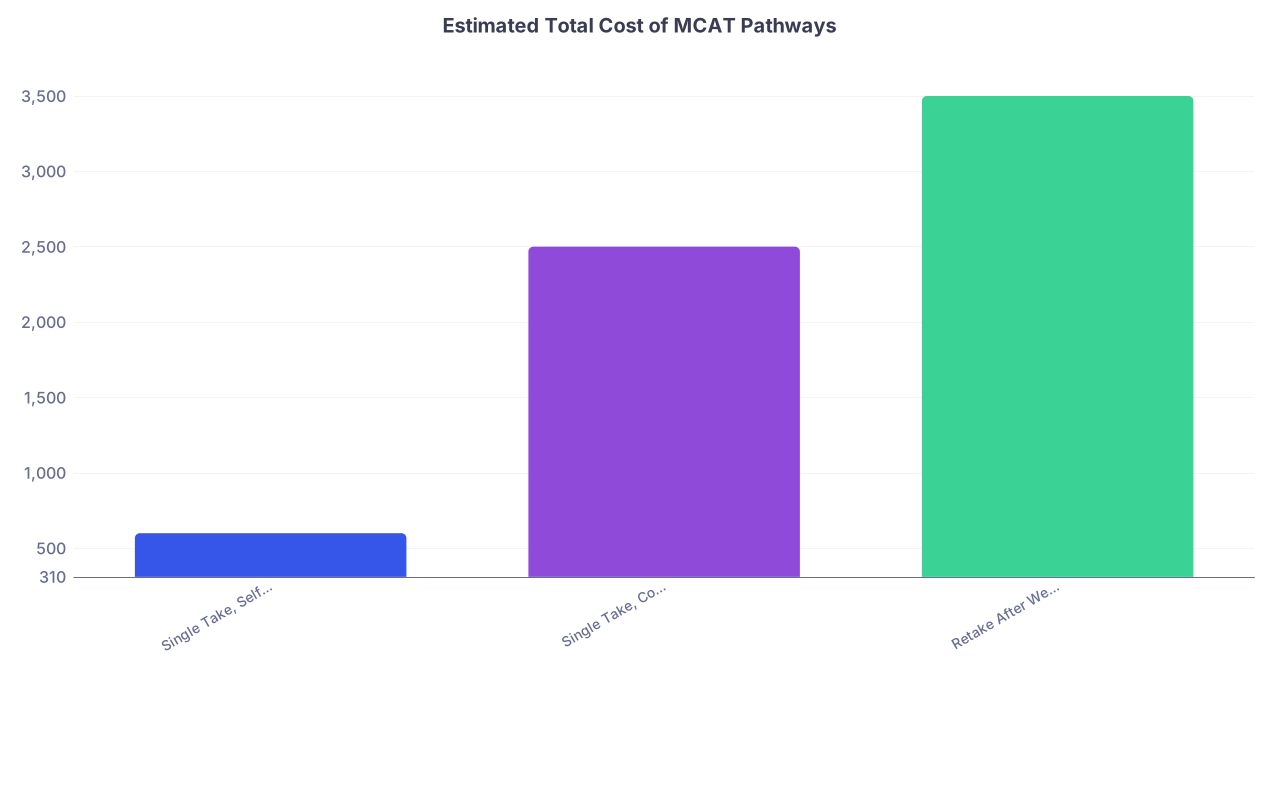
| Category | Value |
|---|---|
| Single Take, Self-Study | 600 |
| Single Take, Course | 2500 |
| Retake After Weak Self-Study | 3500 |
If paying for structure now meaningfully reduces your risk of a retake, the “too expensive” course can actually be cheaper in total effort, time lost, and money.
On the flip side, if you’re already testing near your target range, a full-blown course is often overkill. A few hundred dollars of targeted materials + 2–3 tutoring sessions can be smarter.
Step 4: What Do Commercial Courses Actually Do Well (and Badly)?
Let me be blunt about the strengths and weaknesses.
Where courses are genuinely strong
- They give you a default plan. Don’t underestimate how much cognitive load that removes. You log in, do what’s on the schedule.
- You get repetition across multiple modalities: reading, video, practice questions, office hours.
- Some provide legit good test-taking strategy coaching. Not magical, but helpful, especially in CARS.
- For students who are the “Profile 2/3” I described earlier, they create just enough pressure that you stop procrastinating.
Where courses routinely disappoint
- Content review is often not better than free resources (Khan Academy, free videos) + a good set of books.
- Class time can be bloated, slow, and not personalized to your actual gaps.
- The score guarantees are heavily conditional and not magic. If you’re starting from 490, nobody is “guaranteeing” you a 515.
- Many people treat buying the course as the work. Then they watch passively and barely touch the Q-banks. That’s a waste.
So: a commercial MCAT course is a force multiplier. It can multiply effort that’s already there. It does not create motivation from zero.
Step 5: Compare Specific Options – Course vs DIY Stack
Skip the marketing fluff. Compare what actually matters:
| Feature | Full Commercial Course | DIY Stack (Books + AAMC + Q-bank) |
|---|---|---|
| Cost (approx) | $1,800–$3,000 | $300–$800 |
| Structure | Pre-built schedule, live/recorded | Must build your own |
| Accountability | Class times, instructors | Only what you create for yourself |
| Content Depth | Usually solid | Solid with right books |
| Practice Quality | Varies by company | AAMC = gold standard, add 1–2 good Q-banks |
| Flexibility | Lower (class times, pacing) | Very high |
| Personalization | Limited in groups | Higher if you self-diagnose well |
A strong DIY setup often looks like:
- AAMC bundle (all practice, must-have)
- One good set of content books (Kaplan, Princeton Review, or Examkrackers)
- One additional Q-bank (UWorld, Blueprint, etc.)
- Free/cheap videos for topics you’re weak in (Khan Academy, etc.)
- A schedule you actually follow
If you’re capable of assembling and executing that, you’re not missing anything essential by skipping a full course.
Step 6: Red Flags That You Should NOT Buy a Full Course
Yes, there are times when a commercial course is absolutely not worth the cost.
Do not buy a full course if:
- You’re taking the MCAT in 4–5 weeks. Too late. Do targeted practice instead.
- Your diagnostic is already near 510+ and your target is 510–515. You need refinement, not a full curriculum.
- You know you will not attend live sessions or watch the recordings regularly. “I’ll just use their books and Q-bank” = overpaying.
- You’re going to have to put it entirely on high-interest credit and you’re not in a huge score gap situation. Then the financial stress may hurt you more than the structure helps.
In those cases, a leaner setup makes more sense:
- AAMC materials
- One solid commercial Q-bank
- 1–3 strategic tutoring sessions on your weakest sections
- A 10–12 week schedule you build and stick to
Step 7: When a Commercial Course Is Probably Worth It
I’d seriously consider paying for a course if:
- Your diagnostic is ≤500 and your realistic target is ≥510–512
- You have at least 3–4 months to prep and can commit 15–20 hours/week
- You recognize yourself as needing external structure/accountability
- You have significant content gaps (especially if it’s been years since core sciences)
This is the “I need someone to lay out the path and drag me down it” group. For you, yes, the cost might sting, but the alternative is often wandering, losing a year, and taking the MCAT twice.
Step 8: How to Vet Course Quality (Beyond the Hype)
If you decide a course might be worth it, don’t just pick based on brand recognition.
Ask very specific questions:
- How many full-length exams are included, and whose are they? (AAMC is non-negotiable; the rest are supplemental.)
- Do you get recordings of every session? (Crucial if you’re balancing school/work.)
- How easy is it to get help on specific questions? (Forums? 1:1 office hours? Email?)
- What’s the average starting and ending score range of their students? If they dodge this, not a good sign.
- What’s the withdrawal/refund policy if the fit is bad in week 1–2?
If they brag only about “500 hours of video” and “200+ lessons” but say nothing clear about practice volume, instructor access, or student outcomes, be skeptical.
Step 9: Build a Quick Decision Matrix for Yourself
Let’s boil this down. Rate yourself 1–5 on each:
- Score gap (1 = small, 5 = huge)
- Self-discipline (1 = strong, 5 = weak)
- Time until exam (1 = long time, 5 = very short)
- Financial flexibility (1 = very tight, 5 = comfortable)
Now interpret:
- If score gap ≥4 AND self-discipline ≥3 AND time until exam is 2–3 → course is likely worth strong consideration.
- If score gap ≤2 AND self-discipline 1–2 → skip the full course, do focused self-study.
- If financial flexibility is 1 and everything else is borderline → look for cheaper structure: study groups, free calendars, targeted tutoring hours instead of a full course.
It’s not perfect, but it forces you to confront the trade-offs with actual numbers instead of feelings.
Step 10: If You Skip the Course – How to Replace What It Would’ve Given You
Let’s say you decide: “No, the commercial MCAT course isn’t worth it for me.” Then you must replace the 3 things courses give you:
Structure
- Print or build a 10–16 week study schedule. Assign:
- Specific chapters/videos per day
- Specific number of questions per day
- Weekly full-lengths in the final month
- Print or build a 10–16 week study schedule. Assign:
Accountability
- Find 1–2 study partners with the same test date and similar target. Weekly check-ins with actual numbers: hours studied, questions done, scores.
- Or, use a tutor for monthly accountability sessions even if you’re self-studying most of the time.
Feedback
- After every full-length exam, spend as much time reviewing as you spent taking it. Diagnose patterns: timing, careless errors, specific content gaps.
- Keep a running “error log” spreadsheet. Real courses often force this on you. You can do it yourself.

| Step | Description |
|---|---|
| Step 1 | Diagnostic Test |
| Step 2 | Set Target Score |
| Step 3 | Choose Test Date |
| Step 4 | Build Weekly Study Plan |
| Step 5 | Daily Content + Practice |
| Step 6 | Full-Length Exams |
| Step 7 | Review & Adjust Plan |
Do those three things well and you’ve recreated 80% of what a commercial course offers—without the price tag.
Final Verdict: Is a Commercial MCAT Course Worth It?
Sometimes yes. Sometimes absolutely not.
Worth it when:
- You have a large score gap
- You struggle with self-discipline
- You have months, not weeks
- You can afford it without destroying your life
Not worth it when:
- Your gap is small and you already test well
- You’re short on time or will skip half the sessions
- You have the track record and discipline to self-study effectively
- The money situation is dire and you have other viable prep options
The course itself isn’t magic. The real question is whether spending that money will substantially change your behavior and consistency. If yes, it might be the best investment you make. If no, it’s just an expensive security blanket.
One Concrete Action To Take Today
Before you touch your credit card, do this:
Take a full-length diagnostic MCAT (AAMC if possible, or a free one from a major company) in the next 48 hours. Then:
- Write down your score
- Write down your realistic target
- Calculate your score gap
- Re-read this article with those numbers in front of you
That one data point will make your decision about a commercial MCAT course 10x clearer than any marketing email ever will.
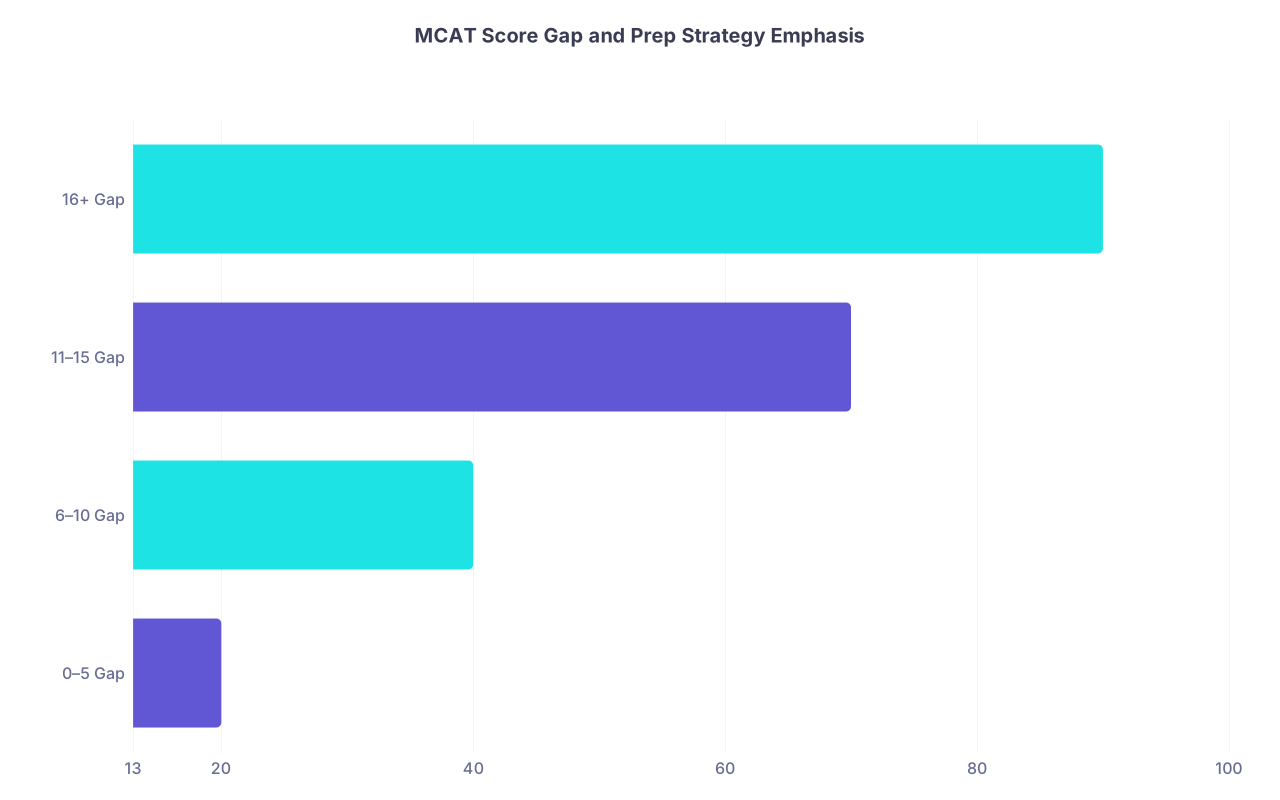
| Category | Value |
|---|---|
| 0–5 Gap | 20 |
| 6–10 Gap | 40 |
| 11–15 Gap | 70 |
| 16+ Gap | 90 |
And if you already know your diagnostic score right now? Grab a piece of paper, write:
“Diagnostic: ___, Target: ___, Gap: ___”
Then decide: do you need content, structure, accountability—or all three—and choose the cheapest setup that actually gives you those.