What if your entire application strategy hinges on a single decision: keep your current MCAT… or gamble on a retake that might not go the way you hope?
Here’s the answer you’re looking for: there is a structured, logical way to decide. Not vibes. Not Reddit panic. A step-by-step framework that tells you, “Yes, retake,” or “No, apply now.”
Let’s walk through it.
Step 1: Know What Your Score Actually Means
Forget feelings for a second. Start with where your score sits in the real world.
Use this as a simple reference point:
| Total Score | General Category | Typical Competitiveness* |
|---|---|---|
| 472–499 | Very Low | Unlikely MD, possible SMP/post-bacc |
| 500–506 | Below Average | Some MD (in-state), many DO |
| 507–511 | Solid / Competitive | Many MD (especially mid-tier/state) |
| 512–515 | Strong | Broad MD including some top-25 |
| 516–528 | Excellent | Competitive anywhere (holistic still) |
*These are rough generalizations, not guarantees.
Then compare your score to schools you care about.
Pull up the MSAR (for MD) and Choose DO Explorer (for DO). You’re trying to answer one question:
Where does my score fall relative to the 10th–90th percentile for the schools I want?
If your score is:
- Below the 10th percentile for most of your realistic schools → that’s a red flag.
- Around the 25th–50th percentile → workable, especially if other parts of your app are strong.
- At or above the median for most target schools → you probably don’t have an MCAT problem.
To visualize this gap:
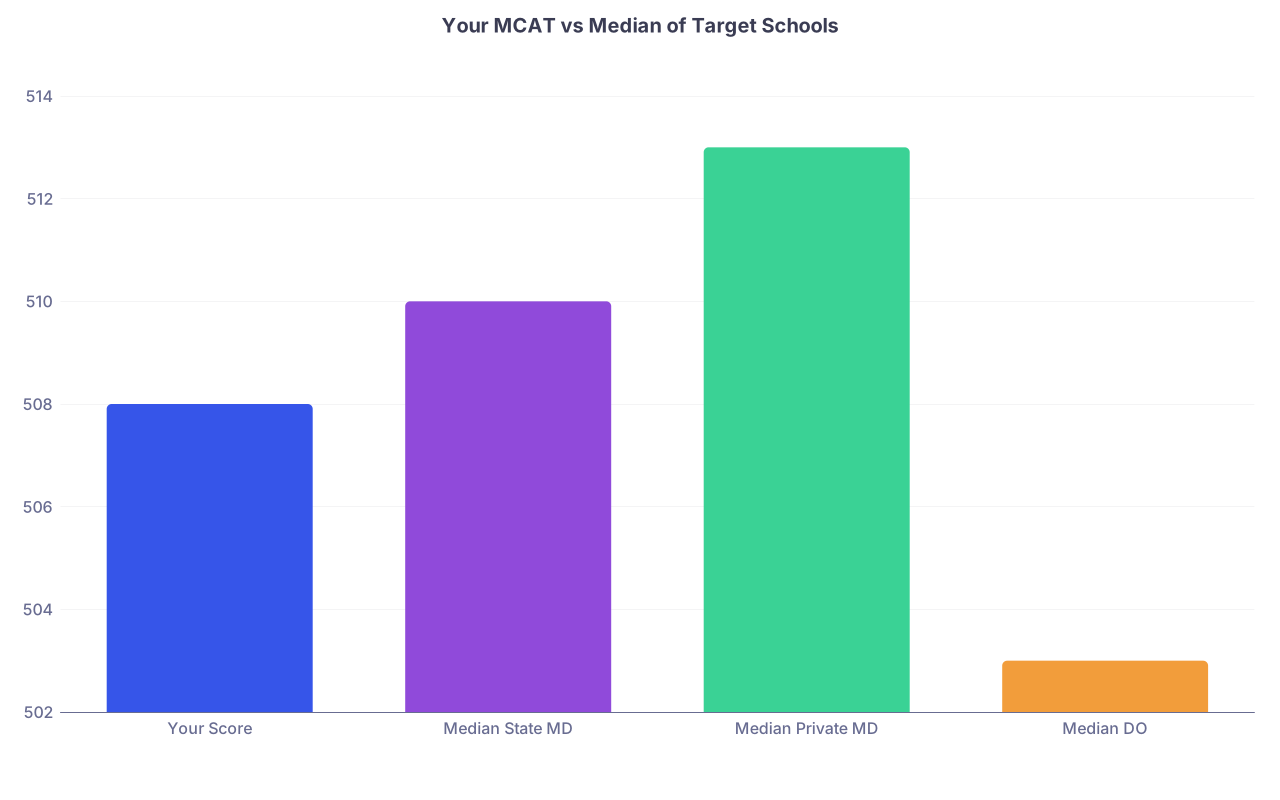
| Category | Value |
|---|---|
| Your Score | 508 |
| Median State MD | 510 |
| Median Private MD | 513 |
| Median DO | 503 |
If your “Your Score” bar is much lower than every other bar for the schools you want, that’s when retaking enters the conversation seriously.
Step 2: Check If Your Score is a True Weakness in Your Context
Do not look at your MCAT in isolation. Admissions committees don’t.
Here’s what I’ve seen matter most in real files:
- MCAT vs GPA
- MCAT + GPA vs School Tier
- MCAT vs Your Demographic / Background Context
Ask yourself:
Do you have a high GPA (3.7+) with a lower MCAT?
That often screams “test-taking issue” but strong academic consistency. Committees may be more forgiving, especially if everything else is A+.Do you have a lower GPA (≤3.4) and a modest MCAT?
Then the MCAT has more weight as proof of academic readiness. A weak MCAT and weak-ish GPA is a problem. That’s where a retake is more likely indicated.Are you applying:
- To very competitive schools (top-20, heavy research focus)?
- Or mainly to state MD / regional MD / DO schools?
Be honest: if your dream list is, say, Harvard / Stanford / UCSF and your score is 509, the real issue isn’t whether to retake. It’s that your school list is fantasy unless your application is god-tier and your story is exceptional.
Step 3: Run This Simple “Retake Decision” Checklist
Now the core question:
“Given who I am, my history, and my timeline, is a higher score likely enough to justify the risk, cost, and delay?”
Use this decision framework:

| Step | Description |
|---|---|
| Step 1 | Current MCAT Score |
| Step 2 | Serious Retake Consideration |
| Step 3 | Apply With Current Score or Adjust School List |
| Step 4 | Apply With Current Score |
| Step 5 | Case-by-case: Lean toward modest school list shifts or 1-cycle delay |
| Step 6 | Below 10th percentile for target schools? |
| Step 7 | Strong evidence you can improve 3+ points? |
| Step 8 | At or above 50th percentile for many realistic schools? |
| Step 9 | Other factors: GPA, trends, timing |
Let’s translate that into concrete questions.
You should lean toward a retake if most of these are true:
- Your score is below ~505 (for MD-heavy applicants) or below ~500 (for DO-heavy applicants).
- Your score is below the 10th percentile for almost all your reasonable target schools.
- Your GPA isn’t terrible, so a better MCAT could plausibly “rescue” you a bit.
- Your practice tests were consistently 3–6 points higher than your actual test.
- You had specific, fixable issues on test day (illness, anxiety meltdown, timing disaster, major life event).
- You have enough time to retake and apply reasonably early next cycle.
- You’re mentally able to re-engage in serious study, not just “hope it goes better.”
You should lean toward using your current score if most of these are true:
- Your score is 508+ and within or near the middle 50% for many target schools.
- Your practice scores were similar to your real score. No strong evidence you “underperformed.”
- You are burned out and not in a place to significantly change your prep.
- Your GPA is strong, and the rest of your app is compelling (clinical, research, leadership).
- A retake would significantly delay your application timing (late apps hurt more than a 1–2 point improvement helps).
- You’d be content with a broader or more realistic school list instead of “fixing” your profile with a retake.
Step 4: Look Hard at Your Practice Test History
This is the part people romanticize. “I was scoring 520 on all my FLs and got a 510.” Usually not true.
Open your practice test log (or reconstruct it). Focus on:
- Only AAMC full lengths.
- The last 3–4 exams before test day.
Now ask:
“What is the average of my last three AAMC practice tests, and how far is that from my real score?”
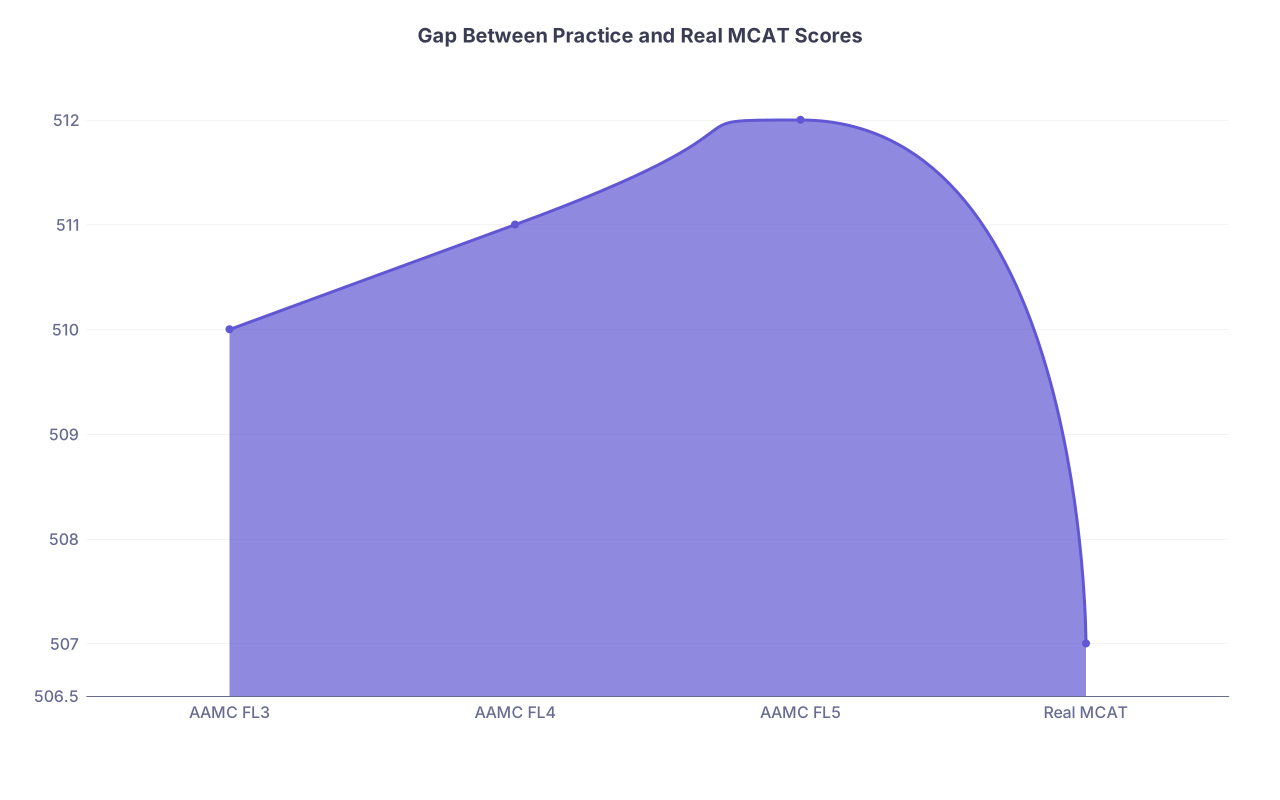
| Category | Value |
|---|---|
| AAMC FL3 | 510 |
| AAMC FL4 | 511 |
| AAMC FL5 | 512 |
| Real MCAT | 507 |
Use this rough rule:
- If your actual score is within 2 points of that average → you probably performed as expected. A retake may not fix much unless you change how you study.
- If your actual score is 3–5 points lower → retake is worth real consideration, if you can identify clear reasons and fixable weaknesses.
- If your practice tests were all over the place → you don’t have a stable baseline yet. Retaking without building one is gambling.
Be ruthlessly honest. I’ve seen too many people say, “I was scoring 515+,” and when we check, it was one random third-party exam, one UWorld self-assessment, and one AAMC at 510.
Step 5: Timing Reality Check – Will a Retake Help or Hurt Your Cycle?
Retakes aren’t free because time matters.
You have three things to consider:
- When you’d retake
- When scores release
- When you’d actually submit primaries and secondaries
Rough truth:
Submitting primaries in June/early July with one MCAT is often better than submitting in September with a slightly better MCAT.
Here’s a typical timing impact:
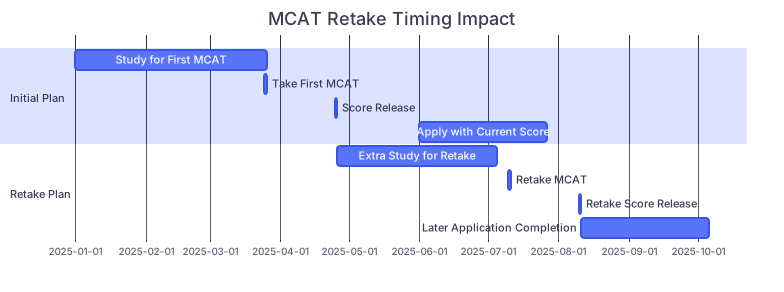
| Task | Details |
|---|---|
| Initial Plan: Study for First MCAT | a1, 2025-01-01, 12w |
| Initial Plan: Take First MCAT | a2, 2025-03-25, 1d |
| Initial Plan: Score Release | a3, 2025-04-25, 1d |
| Initial Plan: Apply with Current Score | a4, 2025-06-01, 8w |
| Retake Plan: Extra Study for Retake | b1, 2025-04-26, 10w |
| Retake Plan: Retake MCAT | b2, 2025-07-10, 1d |
| Retake Plan: Retake Score Release | b3, 2025-08-10, 1d |
| Retake Plan: Later Application Completion | b4, 2025-08-11, 8w |
If a retake:
- Pushes your complete date (when schools actually have everything) to August or later,
- And you’re only hoping for a 2–3 point bump…
…it usually isn’t worth it for that cycle. In that situation, a gap year with a stronger, well-prepped retake is often smarter than “late + small bump.”
Step 6: Check How Multiple MCAT Scores Will Look
Schools don’t just see your highest score. They see all of them.
General patterns:
- One low score → one higher score: often okay, especially if the second is clearly better.
- Multiple attempts with flat or decreasing scores: that starts to look like a ceiling.
- Huge jumps (e.g., 498 → 511) are rare and raise questions but are net positive if explained by major changes in prep and circumstances.
So ask:
- “If I retake and score the same or 1 point lower, can I live with two similar scores on my record?”
- “What specific score would make the retake clearly worth it for me? 3 points higher? 5?”
If you can’t define a target score + school-list impact, you’re not really making a strategic choice. You’re just retaking because you’re anxious.
Step 7: Decide Using This Simple Matrix
Let’s make it brutally clear. Identify which row you’re closest to.
| Situation | Likely Best Move |
|---|---|
| ≤503, GPA 3.5+, strong improvement plan | Strongly consider retake |
| 504–507, GPA 3.6+, out-of-state MD heavy | Retake or refocus on realistic schools |
| 508–510, solid GPA, broad MD/DO list | Usually apply with current score |
| 511–513, average+ GPA, realistic school list | Apply with current score |
| Strong AAMC practice >> real score (≥4 pts) | Retake if clear fixable problems |
If you don’t see your exact situation there, interpolate logically. The point is: combine score, GPA, school type, and practice-test history.
Step 8: If You Retake, Change Your Strategy — Don’t Just Repeat
Retaking with the same approach is how you end up with the same score.
If you’re committing to a retake, you need to answer:
Content gaps: Which sections and subskills killed you?
- C/P: equations, experimental setups, units?
- CARS: timing, confidence, or specific question types?
- B/B: pathways, memorization vs understanding?
- P/S: pure content vs application?
Practice quality: Did you:
- Do all AAMC materials properly (timed, reviewed in depth)?
- Review explanations or just “look at answers”?
- Track patterns in wrong answers?
Test-day readiness:
- Sleep, anxiety plan, nutrition, breaks, warmup?
- Did you simulate test day at least twice with full-length + early wake-up?
If your answer to most of that is “no,” then yes, a retake with a real system can move the needle.
Step 9: If You Apply With Current Score, Optimize the Rest of Your App
If you decide not to retake, then stop obsessing over the MCAT. Squeezing more anxiety out of a fixed number won’t change your odds. Making the rest of your file stronger will.
Focus on:
- School list:
- Include a healthy chunk of realistic MD programs (especially in-state).
- Add DO schools if your metrics are marginal for MD.
- Personal statement:
- Clear story, not generic “I want to help people.”
- Show progression, insight, responsibility.
- Activities:
- Depth over random scatter.
- Show leadership, impact, continuity.
- Letters of rec:
- At least one or two from people who know you well and can speak to your work ethic and intellect, not just “A in my class.”
Your MCAT is one lever. You have others.
The Bottom Line
You should retake if:
- Your score is clearly below what your realistic target schools typically accept,
- You have hard evidence you can score significantly higher (practice tests, clear mistakes, fixable issues),
- You have the time and mental bandwidth to prepare differently, not just “more.”
You should apply with your current MCAT if:
- Your score is within range for many schools on a sane list,
- Your practice tests were similar to your real score,
- A retake would make you apply late or destroy your ability to work on other parts of the app.
Do not retake just because you “don’t like the number.” Retake because it actually changes your options.
FAQ: Retake or Apply With Current MCAT?
1. Is a 508 MCAT good enough for MD?
Yes, for many applicants and many schools. With a 508, a solid GPA, and a well-built school list (especially including in-state and mid-tier MD programs), you’re competitive. Is it enough for top-20 research powerhouses? Usually not. But “not top-20” is not the same as “no MD options.”
2. How many times is too many MCAT retakes?
Two total attempts is common and fine. Three attempts is still salvageable if there’s an upward trend. Once you hit four or more attempts, some schools start to wonder if you’ve hit a ceiling or lack insight into your readiness. If you’re on attempt #3 and haven’t broken through, something fundamental in your prep or schedule needs to change — not just another test date.
3. Should I apply DO instead of retaking a low MCAT?
If your stats are marginal for MD (say 500–505) but in range for many DO schools, and you’re okay with osteopathic training and career paths, applying DO instead of gambling on a retake can be very smart. If your goal is strictly certain MD-only programs or highly competitive specialties, a carefully planned retake plus a stronger overall profile might be justified. But many students severely underestimate DO as a valid path.
4. Will a later, higher MCAT override a lower earlier score?
Most schools say they consider your highest score, but they still see the trend. A later score that’s 3–5 points higher absolutely helps. If your second score is only 1 point higher, the “improvement” isn’t very persuasive and you’ve burned time. The stronger the upward trend (and the fewer total attempts), the more that later score can overshadow earlier ones.
5. What should I do today to move this decision forward?
Do this right now: open your last three AAMC full-length scores and your top 15 schools’ MCAT medians from MSAR.
Highlight:
- Your average AAMC FL score
- How many of those 15 schools you’re within 2 points of the median for
If your real MCAT is within 2 points of your FL average and you’re within range for at least half of those schools, you probably don’t have an MCAT emergency. If you’re far below both, it’s time to seriously map out a retake plan — not theoretical — with dates, resources, and a different study strategy.