
You’re sitting there with your transcript and your MCAT practice scores side by side.
Cumulative GPA: 3.1.
Science GPA: 2.9.
MCAT practice: hovering around 516–520.
And the real question in your head isn’t “how do I raise my score?” It’s this:
Can a strong MCAT actually save me from a low GPA — or am I just rearranging deck chairs?
Let me give you the blunt version first, then we’ll unpack it.
A strong MCAT can absolutely keep you in the game with a low GPA. It cannot erase a weak academic record, but it can change your category from automatic-screen-out to “worth a closer look,” especially at DO schools and some MD programs. How far that gets you depends on how low the GPA is, how strong the MCAT is, and what else you’ve fixed or proven since.
Let’s go step by step.
How Schools Actually Weigh GPA vs MCAT
Med schools don’t treat GPA and MCAT as two independent boxes. They look at them together. Almost every admissions dean I’ve heard talk about it uses some version of this line:
“We want to know: can you handle our curriculum, and will you do the work?”
GPA and MCAT answer those in different ways:
- GPA = long-term behavior and consistency
- MCAT = standardized, apples-to-apples comparison
Both matter. But they play different roles at different stages.
Stage 1: The Screen
This is the brutal part no one likes to talk about.
Most schools run applications through some kind of initial filter. That might be:
- Hard cutoffs (e.g., cGPA 3.0, sGPA 3.0, MCAT 500)
- Tiered review (e.g., 3.4+/510+ = fast-track; 3.0–3.3 with 513+ = secondary review)
- Holistic-ish but still heavily numeric
Here’s the key thing: a strong MCAT can keep you from being auto-rejected at this stage.
If you’ve got:
- 3.0 GPA with a 505 → many MD schools won’t even see your file
- 3.0 GPA with a 517 → way more schools will at least read the application
They won’t automatically love you. But they’ll look.
To visualize it:

| Category | Value |
|---|---|
| 3.0 GPA & 502 MCAT | 10 |
| 3.0 GPA & 510 MCAT | 35 |
| 3.0 GPA & 517 MCAT | 70 |
Those percentages aren’t real numbers; they’re just representing the general trend I see: once your MCAT climbs, the chance someone actually reviews your file jumps.
Stage 2: The Deeper Review
Once you’re past the screen, the MCAT stops being a magic shield. Committees start asking:
- Why is the GPA low?
- Is there an upward trend?
- Are there recent, rigorous courses with strong grades?
- Does the MCAT align with your science performance or contradict it?
At this point, a high MCAT with a low GPA forces a question:
Is this person actually capable, but unfocused/immature early on — or are they just a good test-taker who can’t grind through a curriculum?
Your job is to make that question easy for them to answer in your favor.
What “Offset” Really Means (And What It Doesn’t)
People use “offset” like it’s some formula: 520 MCAT = +0.3 GPA. That’s not how schools think.
Here’s the honest breakdown:
A high MCAT can:
- Get you past screening thresholds
- Demonstrate raw academic potential
- Make your file competitive if there’s an explanation + clear upward trend
- Sometimes override a modest GPA (3.2–3.4) at schools that like reinvention stories
A high MCAT cannot:
- Make a 2.5 look fine for MD without major postbac/SMP repair
- Excuse ongoing Cs in upper-level sciences
- Fix a complete lack of recent coursework
- Turn you into a top-20 MD candidate with a chronically weak academic record
So the answer to your question, “Can a strong MCAT offset a low GPA?” is:
- Mildly low GPA (3.3–3.4) → Yes, often. Especially with 512+ and an upward trend.
- Moderately low GPA (3.0–3.2) → Sometimes. Needs 510–515+ and academic repair.
- Seriously low GPA (<3.0) → Not for MD without formal repair. For DO, a very high MCAT + strong recent grades may keep you alive.
MD vs DO: Where a High MCAT Helps More
If you’re playing this “high MCAT vs low GPA” game, you absolutely need to think MD vs DO strategically.
| School Type | Avg GPA Range | Avg MCAT Range | Flexibility with Low GPA |
|---|---|---|---|
| Mid-tier MD | 3.6–3.8 | 511–515 | Moderate if strong trend & story |
| Lower-tier MD | 3.4–3.6 | 508–512 | Some flexibility with high MCAT |
| DO Schools | 3.3–3.6 | 503–508 | Most flexible with reinvention |
These are rough bands, not exact numbers, but they reflect what I’ve seen repeatedly.
MD Programs
MD schools, especially mid- and upper-tier, are GPA-sensitive. A few patterns:
3.2 GPA with 520 MCAT
- Some MD schools will take a serious look, especially state schools or those that like academic redemption stories.
- Many will still hesitate if there’s no recent, strong science performance.
3.0 GPA with 508 MCAT
- You’re in long-shot territory for most MD without real academic repair.
3.4 GPA with 512 MCAT
- This is absolutely workable at a broad range of MD schools if the trend is decent and the rest of the app is strong.
DO Programs
DO schools are usually more forgiving of earlier mistakes if you’ve clearly turned the corner.
- 3.0 GPA with 510–512 MCAT + recent A’s in upper-level science → You’re legitimately competitive at many DO schools.
- 2.8 GPA with 515 MCAT + 15–30 credits of recent 3.8+ science → You’re in the conversation at some DO programs.
I’ve literally watched applicants with GPAs under 3.0 and MCAT 510–512 walk into multiple DO acceptances after a strong postbac + coherent story. No MD love. But solid DO options.
How Low Is “Too Low” for GPA — Even with a Strong MCAT?
Let’s talk realistic ranges.
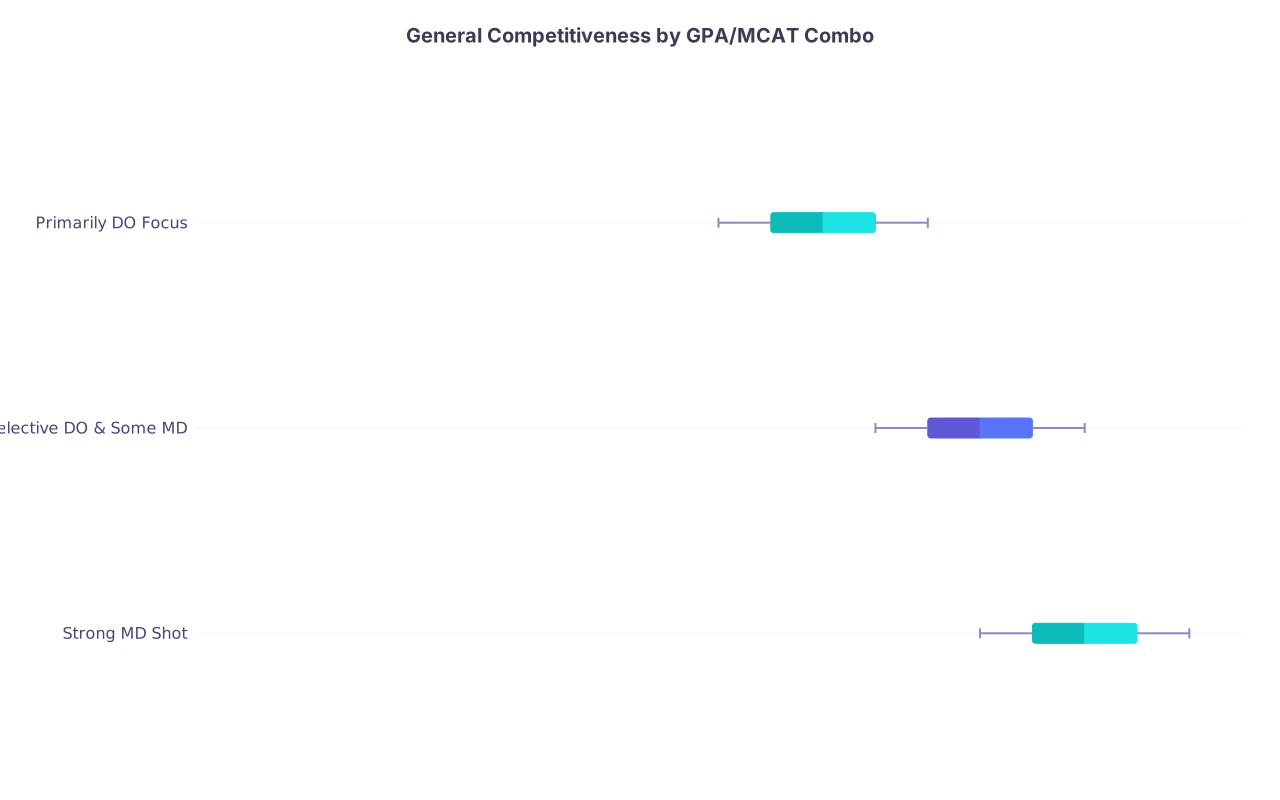
| Category | Min | Q1 | Median | Q3 | Max |
|---|---|---|---|---|---|
| Strong MD Shot | 3.5 | 3.6 | 3.7 | 3.8 | 3.9 |
| Selective DO & Some MD | 3.3 | 3.4 | 3.5 | 3.6 | 3.7 |
| Primarily DO Focus | 3 | 3.1 | 3.2 | 3.3 | 3.4 |
Now layer MCAT on top of that. Here’s a simple mental framework:
GPA ≥ 3.5, MCAT ≥ 510
- You’re fine. A higher MCAT helps you climb in school tier, but you’re not in “offset” territory. You’re in “how high can I reach?” territory.
GPA 3.3–3.49, MCAT 512+
- Many schools will see this as “strong but slightly uneven.” If there’s an upward trend and solid science performance in later years, you’re competitive at a wide range of MD and DO programs.
GPA 3.0–3.29, MCAT 515+
- This is where the MCAT starts doing heavy lifting.
- You’re not a slam dunk anywhere, but you’re no longer auto-out.
- MD: target state schools, mission-fit schools, and those with a track record of taking academic redemptions.
- DO: you can be very competitive if the low GPA is older and you’ve repaired.
GPA 2.8–2.99, MCAT 515+
- For MD: you’re basically in “postbac/SMP first” territory unless there’s already strong upward-trend coursework in the last 30–40 credits.
- For DO: with significant recent A-level science work, you can absolutely get looks.
GPA < 2.8, any MCAT
- No, a 522 is not enough by itself. At this point, schools see a massive risk: sustained poor academic performance over years.
- You need academic reinvention: formal postbac or SMP with excellent performance.
When a Strong MCAT Does Change Your Trajectory
Let me show you what “MCAT as a game-changer” actually looks like in practice.
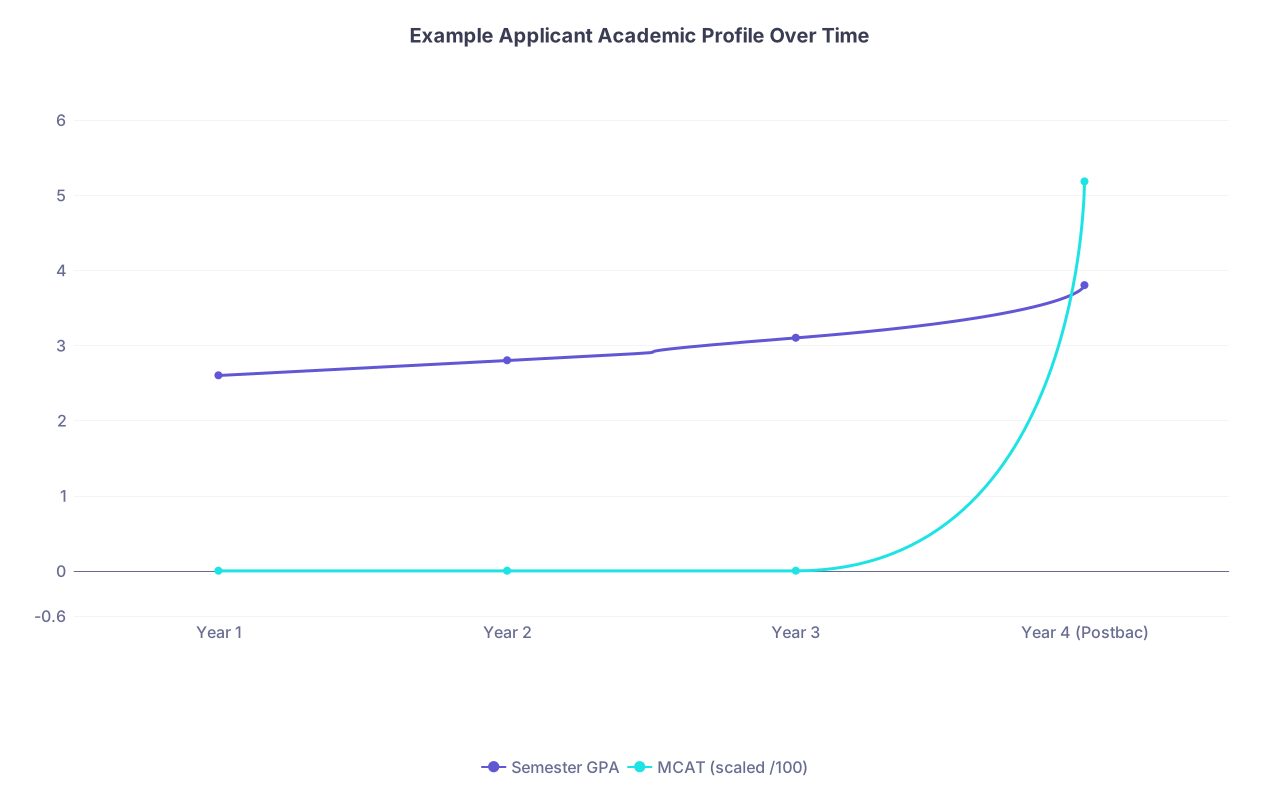
| Category | Semester GPA | MCAT (scaled /100) |
|---|---|---|
| Year 1 | 2.6 | 0 |
| Year 2 | 2.8 | 0 |
| Year 3 | 3.1 | 0 |
| Year 4 (Postbac) | 3.8 | 5.18 |
(That 5.18 corresponds to 518 just scaled for the chart.)
Story like this:
- First two years: immature, distracted, maybe working too many hours
- Science GPA wrecked early with C/C+ in gen chem, orgo, calc
- Realization hits junior year, upward trend starts
- Postbac: 24–32 credits of A/A- in upper-level bio / physiology / biochem
- MCAT: 516–520
Here, the MCAT:
- Confirms that the recent A-level work isn’t a fluke
- Reassures adcoms you can handle heavy standardized exams
- Puts you in the category of “late bloomer who fixed it” rather than “chronic underperformer”
That combo — documented academic turnaround + strong MCAT — is where the test score actually offsets early damage.
Without repair? High MCAT just looks confusing and risky.
If Your GPA Is Low, How High Should You Aim on the MCAT?
You don’t get style points for a 525 vs 518 if you already have a 3.8. But with a weak GPA, that extra 2–3 points can move you from “probably screened” to “we need to discuss this applicant.”
Here’s a rough target chart if you’re asking “what MCAT should I realistically aim for to stay competitive?”:
| GPA Band | MD-Focused Target | DO-Focused Target |
|---|---|---|
| 3.6+ | 510–515+ | 502–505+ |
| 3.3–3.59 | 512–516+ | 504–508+ |
| 3.0–3.29 | 514–518+ | 506–510+ |
| 2.7–2.99 | 515–520+ (after repair) | 508–512+ (with repair) |
This isn’t “you need exactly this or you’re doomed.” It’s “if you’re trying to compensate, this is the range where the MCAT starts to really shift how committees see you.”
What You Should Do If You’re In This Situation
Here’s the practical roadmap if you’re banking on a high MCAT to offset a low GPA:
1. Diagnose the GPA Problem Honestly
Break your transcript down:
- Early vs late semesters
- Science vs non-science
- Lower vs upper division
You want to answer: was I bad at school, bad at time management, or dealing with real life chaos? Schools will ask the same question.
2. Decide: Repair First, Or MCAT First?
If your science GPA is under ~3.0 with no upward trend, studying for the MCAT before academic repair is usually backward. You’ll waste the score if you apply with a still-ugly transcript.
General rule I stand by:
If you haven’t proven you can get As in upper-level sciences recently →
Fix that first with a postbac or structured DIY postbac.If you already have 20–30 credits of 3.7–4.0 recent hard science →
Now a high MCAT becomes a powerful complement.
3. Build a Coherent Story
“Yeah I partied too much” is not a coherent story.
A real, useful explanation does three things:
- Names the problem (family issues, work hours, mental health, immaturity — clearly and succinctly)
- Shows the turning point (specific semester or event where you changed course)
- Proves the fix (upward trend, strong recent grades, MCAT, better habits)
A high MCAT is part of point #3 — proof that your “new you” is academically solid.
Quick FAQ: Common Variants of Your Question
FAQ 1: I have a 3.0 GPA and a 520 MCAT. Do I have a shot at MD?
Yes, but it’s an uphill battle and context matters a lot.
You’re in consideration range at:
- Some state schools (especially your in-state)
- Mission-driven or non-trad-friendly schools
- A few MD programs that like comeback stories
Your chances skyrocket if:
- The 3.0 hides a strong upward trend (last 40–60 credits at 3.7+)
- Science GPA in the last 2 years is high
- You explain the earlier performance rationally and briefly
If your transcript is 3.0 flat with no trend and no postbac? The 520 will not magically fix that. You’d likely need academic repair first to really capitalize on that MCAT.
FAQ 2: Which matters more: GPA or MCAT?
For most applicants, GPA is slightly more important over the long run because it shows consistency. For screening, both matter, but low GPA is often harder to “explain away” than a single slightly low MCAT.
If you’re weak in one, you must be strong in the other. But GPA + upward trend + recent performance is king for long-term academic trust.
FAQ 3: Is it ever smart to retake the MCAT just to offset a low GPA more?
Only if:
- Your current MCAT is clearly below your target band for your GPA
- You have realistic evidence (practice tests) that you can score significantly higher (3+ points)
- You won’t be neglecting necessary academic repair to chase a slightly higher number
A 512 → 515 might slightly help. But 505 → 514 can change your cycle. Aim for moves that change your category, not cosmetic bumps.
FAQ 4: I have a 3.2 GPA, 509 MCAT. Should I apply or fix things first?
Borderline.
If you’re:
- ORM (overrepresented in medicine – e.g., white/Asian in many regions)
- Average extracurriculars
- Flat GPA trend
Then I’d seriously consider: do 1–2 years of academic enhancement (postbac or upper-level sciences), then retake the MCAT and push into the 513–515+ range.
If you’re:
- Strong upward trend
- Solid science GPA in later years
- Great state residency and mission fit at certain schools
You could apply, but I’d build a list heavy on DO and GPA-friendly MD programs, and be realistic.
FAQ 5: What if I have the opposite problem — high GPA, low MCAT?
This is a different headache. Adcoms will worry your coursework wasn’t rigorous or that you’re not great under standardized pressure.
But it’s easier to fix: the MCAT is retake-able; your GPA isn’t. In that scenario, I’d push harder on MCAT prep rather than adding more coursework, unless your science base is actually weak.
Key takeaways, stripped of fluff:
- A strong MCAT cannot erase a low GPA, but it can absolutely keep you in the running and change how schools categorize you — especially if you’ve already shown recent academic improvement.
- The lower your GPA, the more you must pair that strong MCAT with real academic repair (postbac, SMP, or clear upward trend), not just a good story.
- If you’re in “low GPA, aiming high MCAT” territory, you should be planning MD and DO strategically, not betting your entire future on one pathway that’s numerically stacked against you.