
The fantasy that you can “make up for” a mediocre MCAT at a Top 20 MD program is mostly wrong.
You want Top 20? You need a high MCAT. Full stop.
Let me give you real numbers, not vague “aim high” nonsense.
The MCAT Targets That Actually Get Attention
For Top 20 MD programs (think Harvard, Columbia, UCSF, Penn, WashU, Vanderbilt, etc.), here’s the reality:
- A 520+ puts you solidly in the competitive range.
- 518–519 is workable but not “wow” for many Top 20s.
- 515–517 is borderline and needs a strong story, GPA, and experiences.
- Below 515, you’re fighting uphill at most Top 20s unless you bring something exceptional.
I’ve seen too many students with a 512 thinking “but that’s 88th percentile, that’s great!” It is great. Just not “Top 20 MD likely” great, especially for unhooked applicants (no major institutional connection, no Division I sports, no truly extraordinary achievement).
Let’s ground this with typical MSAR-type data.
| School Tier / Example | Median MCAT | Competitive Range |
|---|---|---|
| Ultra-elite (Harvard, Columbia, NYU) | 521–523 | 519–525 |
| High Top 20 (UCSF, Penn, WashU) | 520–522 | 518–524 |
| Lower Top 20 (Mayo, Vanderbilt, Northwestern) | 518–521 | 516–523 |
| Strong non–Top 20 state flagships | 513–516 | 510–519 |
Are there people getting in with 515 to these schools? Yes.
Are they the rule? No.
The quick answer to the title question
If you’re gunning broadly for Top 20 MD programs:
- Target score: 520+
- Absolute floor for a realistic shot as a standard applicant: 517–518
- Score where most people start asking “is Top 20 realistic?”: 514–516
If you don’t like those numbers, your problem isn’t with me—it’s with the applicant pool.
Why Top 20 MCAT Cutoffs Are So Brutal
Top 20 programs are drowning in 520+ applicants. They can afford to be picky.
A few dynamics you need to understand:
Score compression at the top
At mid-tier schools, you see a wide spread of scores. At Top 20s, the bell curve is shifted right. It’s not unusual for a large chunk of the interviewed pool to be 518–525.MCAT is a fast screen
When schools have 10,000–14,000 applicants, the MCAT is the easiest first-pass filter. No one is “holistically reviewing” every 506 for Top 20. They aren’t.Boards pressure
Schools care (a lot) about USMLE Step performance and match lists. High MCAT correlates with strong test performance. So they like high scores. Shocking.
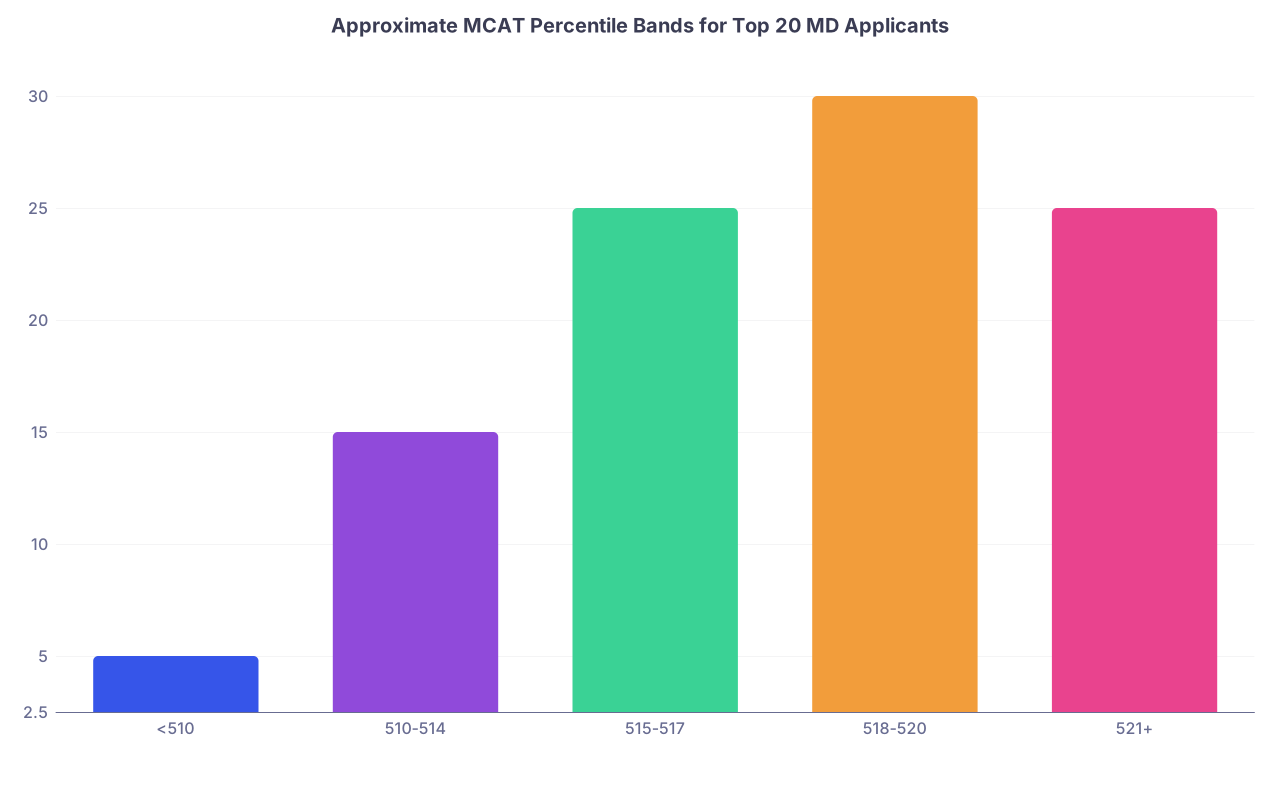
| Category | Value |
|---|---|
| <510 | 5 |
| 510-514 | 15 |
| 515-517 | 25 |
| 518-520 | 30 |
| 521+ | 25 |
Does that mean you’re dead without a 520? No. But you need to be brutally honest about where you stand and how the rest of your app looks.
How MCAT Interacts With GPA for Top 20
You can’t look at MCAT in a vacuum. Top 20s care about the combo.
Here’s the rule of thumb I use with students:
3.9+ GPA
- MCAT 520+: You’re in the academic “green zone.” Now everything is about experiences and fit.
- MCAT 517–519: Still viable at many Top 20s if your story and experiences are strong.
- MCAT 514–516: You’re more of a reach but not impossible at lower Top 20s.
3.7–3.89 GPA
- MCAT 520+: Strong Top 20 competitiveness.
- MCAT 517–519: Good for lower Top 20, strong for top 30–40.
- MCAT 514–516: You’re realistically mid to upper-mid tier, with maybe a couple of Top 20 lottery tickets.
Below 3.7 GPA (especially sGPA)
- You really want 520+ if you’re going to seriously chase Top 20.
- A 515 with a 3.5 is not “balanced.” It’s a tough sell at that level.
The combo matters more than a single number. But MCAT is the easiest thing for them to sort by.
What If You’re Below 515?
Here’s the part people don’t like hearing:
If your dream is “Top 20 MD or bust” and your practice tests are topping out at 510–512, you probably have two choices:
- Recalibrate your school list.
- Recalibrate your expectations and re-take plan.
If you’re in this bucket, think this way:
- 510–512:
- Great score for many state MD schools and DO programs.
- Very weak for Top 20, unless you have truly unusual circumstances or hooks.
- 513–514:
- Reasonable for a strong state MD and some mid-tier privates, especially with a strong GPA and good narrative.
- At most Top 20s you’re a “they liked your story so much they ignored your stats” exception if you get in.
I’ve watched too many applicants waste cycles chasing prestige that doesn’t match their numbers, then end up reapplying with the same stats a year older and more bitter.
Be ambitious. Not delusional.
Should You Retake the MCAT for a Top 20 Shot?
This is the part people overthink.
You should seriously consider a retake for Top 20 targeting if:
- You scored ≤517 and you have strong evidence (practice AAMCs, test-day issues, clear content gaps) that you can reach 520+ with another 2–3 months of work.
- Your GPA is on the low side for Top 20 (≤3.7) and you need the MCAT to compensate.
- You underperformed your AAMC full-length averages by 3+ points.
You probably should NOT retake if:
- You have a 518–520 and your full-lengths were in that range. You’re in the competitive band. You won’t magically turn into a 526.
- You already took it twice and didn’t materially improve.
- Your app is weak in other ways (no clinical, limited research, mediocre letters) that won’t be fixed by a 3-point bump.
Top 20 schools do see multiple MCAT scores. They don’t love serial testers with marginal improvement.
Aim for one strong score, maybe two attempts max.
How to Decide if Top 20 Is Realistic for You
Forget generic advice. Let’s walk through an honest decision flow.

| Step | Description |
|---|---|
| Step 1 | Your MCAT Score |
| Step 2 | Top 20 Broadly Reasonable |
| Step 3 | Top 20 Possible, Need Strong Story |
| Step 4 | Top 20 is Reach, Focus Top 30-50 |
| Step 5 | Selective Top 20 Reasonable |
| Step 6 | Primarily Aim Top 30-50 |
| Step 7 | MCAT >= 520? |
| Step 8 | GPA >= 3.7? |
| Step 9 | MCAT 517-519? |
| Step 10 | GPA >= 3.8? |
You should think in “bands,” not fantasy scenarios.
Band 1: 521+
You’re in the upper tier of MCAT applicants. Now the main questions are:
- Do you have sustained, meaningful clinical experience?
- Any research with real depth?
- Evidence of leadership/impact, not just laundry-list volunteering?
With a 521+, a strong GPA, and solid experiences, you absolutely should throw a broad net across Top 20 and strong non–Top 20.
Band 2: 518–520
This is “quietly strong” territory.
Top 20 isn’t guaranteed, but you’re in the game. The better your GPA and experiences, the more schools in that range you can target confidently.
I usually tell students in this band:
Apply to Top 20s that match your strengths (research-heavy if you’ve got research, primary care–heavy if you’ve got community work, etc.), plus a strong base of schools in the 20–50 range.
Band 3: 515–517
You’re not out, but you’re not a stat-based darling for Top 20.
Your Top 20 odds depend heavily on one of these being true:
- 3.9+ GPA and excellent story
- Very strong research (posters, publications, real lab responsibility)
- Unique life context or adversity with strong narrative
- Underserved background plus consistent mission-aligned work
If none of that applies, don’t build your whole list around Top 20s. Toss in a couple as “reach” and put most of your energy into realistic fits.
Strategic School List Building With Your MCAT
Here’s how I’d roughly balance a school list based on MCAT alone (assuming average to strong GPA and experiences):
| MCAT Band | Top 20 Slots | Rank 20–50 Slots | State / Safety MD | DO (if open) |
|---|---|---|---|---|
| 521+ | 10–15 | 10–12 | 3–5 | 0–2 |
| 518–520 | 6–10 | 10–15 | 4–6 | 0–3 |
| 515–517 | 3–6 | 10–15 | 6–8 | 2–5 |
| 511–514 | 0–3 | 8–12 | 6–10 | 4–8 |
This isn’t exact science. It’s pattern recognition from watching hundreds of cycles play out.
What I don’t want you to do is:
Score a 514, apply to 18 Top 20s and 2 “safeties,” then act shocked when you only get 1 interview.
How to Study If You Need a 520+
If you’re reading this early enough and you haven’t taken the MCAT yet—and your honest target is 520+—you need to treat this like a full-time job for a chunk of time.
Non-negotiables to reach the 520+ tier:
Brutal content mastery
If you’re missing basic amino acid properties or Newton’s laws on practice questions, you’re not close yet. You need to know this stuff cold, not “I’ve seen it before.”5–7 AAMC full-lengths under test-like conditions
No pausing. No long breaks. No “I’ll finish CARS tonight.” The people scoring 520+ almost always have multiple official exams under strict conditions.Obsessive review of wrong answers
Don’t just mark “got it wrong: oops.” You need a log of patterns: careless mistakes, content gaps, misreading, timing errors. Then you fix actual causes, not symptoms.Timing discipline
If your CARS is constantly choking at passage 8 with 4 unanswered, you’re capped. High scorers don’t just know content; they manage time ruthlessly.
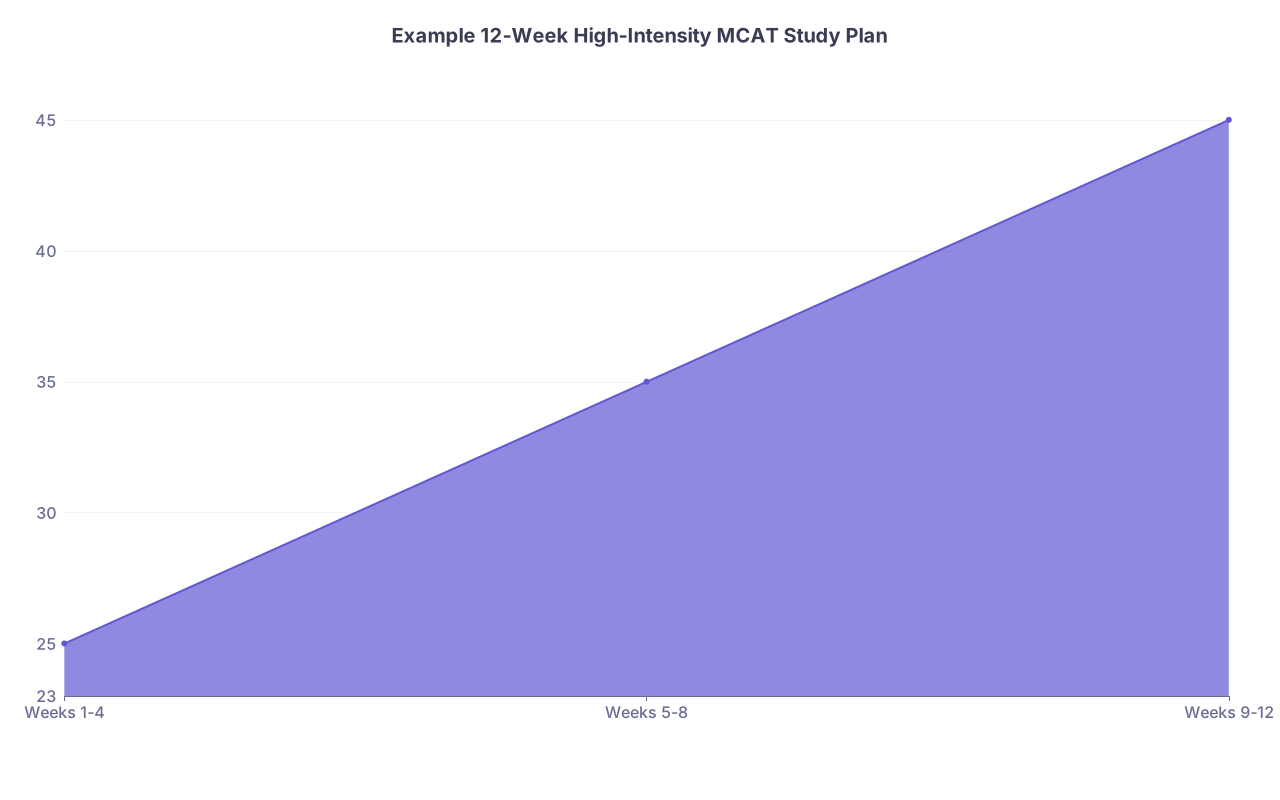
Here’s a rough “serious” 3-month prep example.
| Category | Value |
|---|---|
| Weeks 1-4 | 25 |
| Weeks 5-8 | 35 |
| Weeks 9-12 | 45 |
Those numbers are hours per week. Yes, 35–45 hours. This is what it often takes if you’re trying to leap into 520+ while still shoring up weak content.
Final Reality Check
There’s nothing magical about “Top 20.”
You’re not a better doctor because you trained there. You are, however, likely to have easier access to research, high-powered letters, and certain competitive specialties.
But don’t twist your entire life, risk your sanity, or delay your career multiple years just to chase a number that keeps you out of 10 schools and maybe into 5 slightly shinier ones.
If your MCAT ends up a bit below “Top 20 ideal,” here’s the truth:
Match lists from good non–Top 20 MD schools are full of residents at MGH, UCSF, Stanford, etc. People get where they want to go from all sorts of places.
Make your MCAT plan based on data, not ego.
FAQs
1. Is a 518 good enough for Top 20 MD programs?
Yes, it’s competitive, but not a guaranteed “shoe-in” number. With a 518, strong GPA (ideally 3.8+), and solid clinical, research, and extracurriculars, you should absolutely apply to a decent spread of Top 20s. But you should also load up on Top 30–50 programs. If the rest of your app is average, a 518 alone won’t carry you at ultra-elite schools.
2. Can I get into a Top 20 MD with a 514 MCAT?
Possible, but you’re in outlier territory. You’d need some combination of: exceptional GPA, unique life story, heavyweight research (publications, real responsibilities), or a background/mission fit that the school especially values. For a standard applicant profile, 514 makes Top 20 a steep uphill climb and should not be the core of your school list.
3. Does a 520 MCAT guarantee admission to a Top 20 program?
No. Not even close. A 520+ clears the academic bar, but you can still get shut out if your clinical exposure is thin, your personal statement is bland, your activities look shallow, or your letters are weak. High MCATs get rejected from Top 20s every year. The score opens the door; it doesn’t walk you through it.
4. Which matters more for Top 20: MCAT or GPA?
They’re both important, but if I had to pick one lever to move for most applicants, it’s MCAT. GPA trends are harder to fix late in the game. That said, a 3.5 with a 522 isn’t “fixed.” It’s still a concern. Schools love to see both: high GPA (especially science) and high MCAT. Outliers work occasionally, but don’t bank on it.
5. Should I delay my application a year to improve from 514 to 520?
Maybe. If you’re confident—based on AAMC practice tests—that you left a lot of points on the table and can realistically reach 520+ with focused prep, then waiting can make sense if Top 20 is a priority. But if your practice scores cluster around 514–516 and you’re hoping for a miracle jump “next time,” you might just be trading time for marginal gains. Do the math on your actual trajectory, not your fantasy.
6. How many times can I take the MCAT before Top 20 schools care?
Once is ideal. Twice is common and usually fine, especially with a clear jump (e.g., 510 → 519). Three starts to raise eyebrows unless there’s a very clear story of improvement and a strong final score. More than three? You’re giving admissions committees a lot of chances to question your test-taking ability or planning.
7. If I don’t hit 520+, should I give up on competitive specialties?
Not at all. Residency competitiveness depends far more on med school performance, Step/Level scores, letters, research, and clinical evaluations than where you went to med school or what you got on the MCAT. A solid MCAT gets you into a good school. From there, what you do over the next four years matters more than the number you’re obsessing over now.
Key points to walk away with:
- For Top 20 MD programs, 520+ is the realistic target, 517–519 is workable, and below that you’re fighting uphill.
- MCAT doesn’t work alone; your GPA and experiences either reinforce or undercut your score.
- Don’t build your entire future around a prestige label—use your score to build a smart school list, not a fantasy one.