
It’s 3:25 PM. You just clicked through the last MCAT question, your brain feels like oatmeal, and now the screen hits you with the worst possible timing:
“Do you wish to VOID your exam?”
Clock’s ticking. Your heart rate spikes. Every hard passage you guessed on is suddenly replaying in your head. And now you have to make a decision that actually matters.
Here’s the answer you’re looking for: you need a clear, pre-made checklist so you’re not making a panic decision in the worst mental state of your life.
Let’s build that checklist.
First: What Voiding Actually Does (And Doesn’t Do)
If you don’t understand the consequences, your decision is already shaky.
When you void your MCAT:
- No score is calculated.
- No schools ever see that test date.
- It does count as one of your lifetime MCAT attempts (you get 3 per year / 4 in 2 years / 7 lifetime).
- You do not get a refund.
- You won’t see any score, ever—not even a “low” number. Just nothing.
When you submit your MCAT:
- A scaled score is generated (472–528).
- Schools will see it if you choose that test date in AMCAS/AACOMAS/TMDSAS.
- You can choose to retake later, but this score will stay on your record.
So voiding is not a free “do-over.” It’s burning one of your attempts in exchange for erasing this day from score reports.
Core Question: Are You Reacting to Feelings or Facts?
Almost everyone walks out of the MCAT feeling terrible.
I’ve seen 516+ scorers swear they “definitely failed.” I’ve seen 490 scorers walk out thinking they “might’ve done okay.” Your feelings are a horrible predictor.
So the real decision rule is this:
Only void for clear, objective reasons. Not vibes. Not anxiety. Not perfectionism.
Let’s break that into concrete checks you can run through in those 5 brutal minutes.
The Test-Day Decision Checklist
Use this in order. If you hit a “Yes” on certain items, you’re basically done.
1. Did something major and external wreck your exam?
Examples of legit void-leaning events:
- You were actively sick: vomiting, fever, migraine-level pain, repeated bathroom trips.
- Technical failure that disrupted multiple sections (e.g., repeated computer restarts, you lost 10+ minutes in more than one section).
- Serious acute mental health event (panic attack that wiped out a whole section).
- Major personal emergency (family crisis text mid-exam that completely shattered your focus).
- You mis-managed time so badly that an entire passage or more was left blank in multiple sections.
If one of these happened, ask:
Did this likely drop my performance an entire tier below what my practice scores showed?
Example: You were scoring 510–513 in practice, but had to randomly guess on the last 15 questions in two sections because of a panic spiral. That’s not “I felt bad.” That’s concrete, measurable damage.
If your honest answer is yes, this single event blew up my exam, voiding is very reasonable.
If your test just felt hard? That’s the design. Hard ≠ special disaster.
2. How did this compare to your recent practice tests?
Think back to your last 3–5 official-style practice exams (AAMC FLs, not random third-party only).
Make a quick mental table:
| Test | Practice Exam Type | Score |
|---|---|---|
| 1 | AAMC FL 1 | 504 |
| 2 | AAMC FL 2 | 507 |
| 3 | AAMC FL 3 | 509 |
| 4 | AAMC FL 4 | 510 |
Now categorize yourself:
You were consistently at or above your goal range.
Example: Goal 510, last 3 AAMC exams: 511, 512, 514.
Today felt hard, timing was tight, but no full meltdown.
→ Do not void. You’re almost certainly underestimating your performance.You were consistently below your goal but improving.
Example: Goal 515, last 3: 505, 507, 509.
Today felt similar, maybe slightly worse.
→ Don’t void just because you didn’t “feel” like a 515. You weren’t there yet anyway. Submit, see the score, then decide on retake.You were nowhere near ready, and you knew it.
Example: You were getting 495–500 on AAMC practice, but still sat because the date was “already scheduled” or parents pressured you.
→ If this wasn’t a true attempt (more like a forced trial run), voiding is reasonable. You already knew you weren’t ready; don’t create a permanent low score if you plan to apply competitively.
Rule of thumb:
If your practice scores were within ~3–4 points of your realistic target, and nothing catastrophic happened, keep it.
3. Did you leave big chunks completely blank?
MCAT scoring is scaled, but it’s not magic.
Ask yourself honestly:
- Did I accidentally mis-bubble or skip an entire passage?
- Did I run out of time so badly I left >10 questions blank in a section?
- Did that happen in more than one section?
If you left:
- A few questions blank per section? That’s normal. Happens to a lot of 510+ scorers.
- 5–7 questions blank in one section but did okay otherwise? Still very salvageable.
- 10–15+ blank in multiple sections, with almost pure guessing on others?
Now you’re in territory where your score may be much lower than your actual knowledge and potential.
If your exam day performance doesn’t at all reflect your real prep because of severe timing disasters across the board, I’d lean toward void.
But if you “had to guess on the last passage” in CARS like everyone else on earth? That’s not a void reason.
4. Where are you in your application timeline?
This part people don’t think through, and it bites them later.
Ask:
Are you applying this cycle or next?
- If you’re taking this MCAT early (e.g., January for a June application next year), you have plenty of runway to retake. Less pressure to accept a truly blown attempt.
- If you’re taking it late (e.g., July/August while you’re already in the cycle), the cost of voiding is higher: delayed apps, maybe missing this cycle entirely.
Do you have enough attempts left?
- If this is your first or second attempt, voiding is safer—you’ve got attempts left.
- If this is your third, fourth, or beyond, every void is serious. Schools may not see voids, but you’re limiting your own tools.
Do you have the capacity to properly retake?
- Another solid 2–3 months of prep available?
- Or are you starting classes, working full-time, dealing with big life stuff?
If voiding means:
- You’ll miss your planned application year,
- Or you realistically won’t be able to prepare properly for a retake,
then I’d be more cautious. A usable-but-not-perfect score in hand can sometimes be better than an endless cycle of “I’ll do better next time” that never happens.
5. Are your expectations just too high?
Nobody wants to hear this, but it matters.
If:
- You’ve been scoring 505–508 in practice,
- Your GPA is ~3.6,
- Your target schools are mostly mid-tier MD and DO,
and you’re thinking about voiding because, “I don’t think I got a 520,” that’s just unrealistic.
Void is not for:
- “I don’t feel like I hit my dream 99th percentile target.”
Void is for: - “This performance was significantly worse than what I’ve repeatedly demonstrated in prep, because of something abnormal.”
You don’t need a 520 to be a great doctor. You need a score that matches your prep and opens the doors you’re reasonably aiming for.
6. The Mental Health / Burnout Check
Last piece: your brain and your future sanity.
If you void, can you:
- Honestly tolerate starting over?
- Spend another 8–12 weeks with 8-hour practice tests and content review?
- Keep your motivation high without spiraling into self-hate or burnout?
I’ve seen people void in a panic, then three weeks later realize:
“I absolutely cannot go through that whole process again,”
and now they’re stuck. No score. No plan. Just dread.
If this exam was a legitimate attempt, and a retake would wreck you mentally or logistically, that weighs in favor of submitting unless there was a real, objective disaster.
Simple Decision Flow: Void or Keep?
Here’s the brutally simple framework you can run in your head:
Did a major, external, clear problem trash my performance (illness, tech issues, meltdown, emergency)?
- Yes → Lean VOID, especially if this was supposed to be your “real” attempt.
- No → Go to 2.
Were my recent AAMC practice scores within 3–5 points of my actual realistic target?
- Yes → Lean KEEP unless something extreme happened.
- No → Ask: was today similar to those practice tests?
- Yes → KEEP, then decide about retake later with real data.
- No, today was much worse → Maybe VOID.
Did I leave huge chunks blank in multiple sections or mis-bubble a whole passage?
- Yes → VOID is reasonable.
- No → KEEP.
Would voiding seriously wreck my timeline or rely on a fantasy retake I probably won’t prep for?
- Yes → Lean KEEP.
- No → Your call, weighted by steps 1–3.
A Reality Check On “I Just Don’t Know How I Did”
That’s how everyone feels.
You don’t know how passages were scaled. You don’t know how your guessing performed. You don’t know which questions everyone else bombed.
The MCAT is intentionally designed to feel rough. If you walk out thinking, “That was fine, pretty easy,” that’s actually more concerning; it often means you missed nuance.
So unless you’re sitting there with clear, objective reasons to believe your score will be far below both:
- Your practice range
- And your minimum acceptable score for your goals
you’re usually better off keeping it and dealing with the real number later.
Because that’s the key: voiding removes data.
You can’t analyze it. You can’t learn from it. You just burned an attempt.
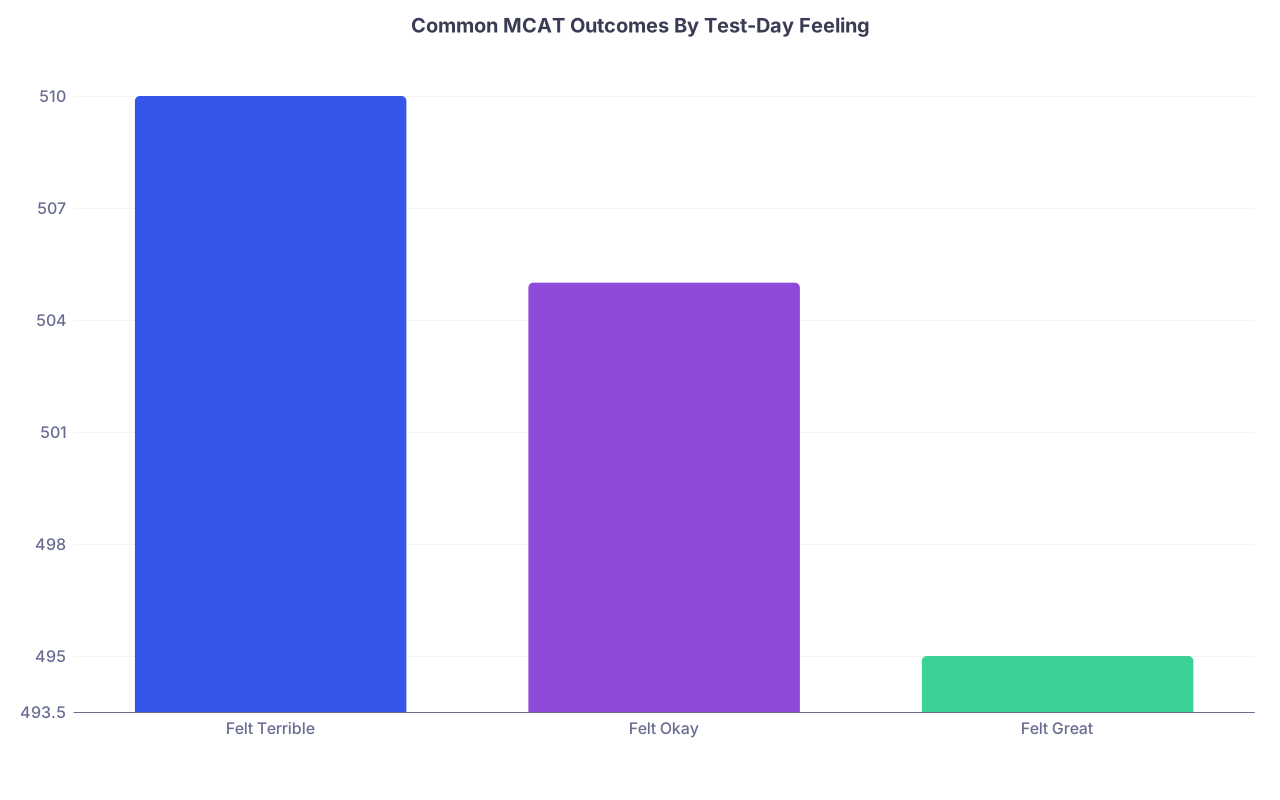
| Category | Value |
|---|---|
| Felt Terrible | 510 |
| Felt Okay | 505 |
| Felt Great | 495 |
This kind of pattern (based on what students report after scores release) is why I’m so blunt: feelings are trash data. Don’t void based on them alone.

| Step | Description |
|---|---|
| Step 1 | Finished MCAT |
| Step 2 | Practice scores good? |
| Step 3 | Consider VOID |
| Step 4 | KEEP score |
| Step 5 | Consider VOID |
| Step 6 | Major disaster? |
| Step 7 | Similar to practice? |
| Step 8 | Retake feasible? |
FAQs: Voiding Your MCAT Score
1. Do medical schools know if I voided my MCAT?
No. Schools do not see voided exams on your score report. They only see actual scores (472–528) for dates you’ve released. However, AMCAS limits total attempts, so you can’t void endlessly and pretend it never happened—for you, it still counts against the 7-lifetime cap.
2. Is it better to void or have a low score on record?
If you’re talking extremely low compared to your goals (e.g., you want MD and you’re about to post a likely 490 when your practice was 510+ but you had a meltdown), I’d lean void. But if your “low” is just “not what I dreamed of” (e.g., you wanted 518 and probably got around 508), I’d keep it, see the number, and then decide on a retake. You can work with a mid-500s. You can’t work with nothing.
3. Can I void after I see my MCAT score?
No. The void option is only at the end of test day, before your exam is submitted. Once you click submit, that’s it. You can’t retroactively void after score release. If you hate your score later, your only option is to retake.
4. What if this was just a “practice” MCAT I signed up for early?
If you truly weren’t prepared—no full content review, no AAMC FLs, treating it like a diagnostic—and you don’t want a likely weak score on your record, voiding is fine. But if you were “kind of prepared,” did months of work, and this was supposed to be real, don’t pretend it’s a practice run afterward just because it felt hard.
5. How many times can I take the MCAT if I void once?
A voided exam counts as an attempt, so it uses up one of your allowed tries. AAMC policy (as of now):
- Max 3 times in a single testing year
- Max 4 times in a 2-year period
- Max 7 times in your lifetime
So if you void once, you’ve got 6 lifetime attempts left. Plenty—but don’t burn them carelessly.
6. I panicked and already voided. Did I ruin my chances?
No. Annoying? Yes. Fatal? No. Schools won’t know. Your job now is to treat your next MCAT as your real exam: fix the issues that hurt you (timing, stamina, anxiety), use the AAMC materials heavily, and don’t sign up again until your practice tests are where you want to be. One void in your history is a non-issue. A pattern of repeated low scores is worse.
Key Takeaways:
- Only void for clear, objective disasters, not vague bad feelings.
- Compare test day honestly to your AAMC practice trend and your real application timeline.
- When in doubt—and nothing catastrophic happened—keep the score, see the data, then make your retake decision with reality, not fear.