
The usual advice about full-length MCATs is vague and wrong. “As many as you can” is not a plan.
You don’t need 15 full-lengths. You probably don’t even need 10. But you do need the right ones, at the right time, for the right reasons.
Here’s the real answer.
The Short Answer: How Many Full-Length MCATs You Actually Need
If you want a number, here it is:
- Absolute minimum for a serious attempt: 4–5 full-length exams
- Typical solid prep for most students: 6–8 full-length exams
- Upper limit for almost everyone: 9–10 full-length exams (beyond this is usually low-yield)
Break it down more specifically:
- All 6 AAMC exams are non‑negotiable for a competitive score (unless your timeline is catastrophically short).
- 1–3 third‑party exams (Kaplan/Blueprint/Altius/Princeton/etc.) early in prep are helpful for stamina and diagnostics, but they’re not the main event.
If you’re aiming for a competitive score (510+), your target should be:
| Target Score | AAMC FLs | Third-Party FLs | Total FLs |
|---|---|---|---|
| 500–505 | 4–5 | 0–2 | 4–7 |
| 505–510 | 5–6 | 1–2 | 6–8 |
| 510–515 | 6 | 2–3 | 7–9 |
| 515+ | 6 | 3–4 | 8–10 |
If you’re nowhere near these numbers and your test is 2–3 weeks away, you’re under-tested.
Why Full-Lengths Matter (And Why People Overdo Them)
Full-lengths aren’t just “more practice questions.” They train four things you won’t get from random passages:
- Stamina – 7.5 hours of focused attention, maintaining accuracy when you’re mentally fried.
- Pacing – knowing exactly what 90 seconds per question feels like and when you need to move.
- Strategy under pressure – when to flag, when to guess, when to cut your losses and move on.
- Score calibration – especially with AAMC exams, you’re learning what a 505 vs. 515 actually looks like for you.
Where people screw this up:
- Doing too few FLs and discovering stamina/pacing issues on test day.
- Doing too many low-quality third‑party FLs, burning time and morale without score benefit.
- Taking FLs back-to-back without deep review, which is like sparring daily without ever watching the fight tape.
The number of exams isn’t what moves your score. It’s:
- The quality of the exams
- The timing
- The depth of your review
Your goal isn’t to collect test numbers. It’s to extract every point from each one.
The Non‑Negotiable Core: AAMC Full-Length Exams
These are your gold standard:
- AAMC Sample (unscaled, but still useful)
- AAMC FL 1
- AAMC FL 2
- AAMC FL 3
- AAMC FL 4
- AAMC FL 5
You should aim to take at least 4, ideally all 6 before your real MCAT.
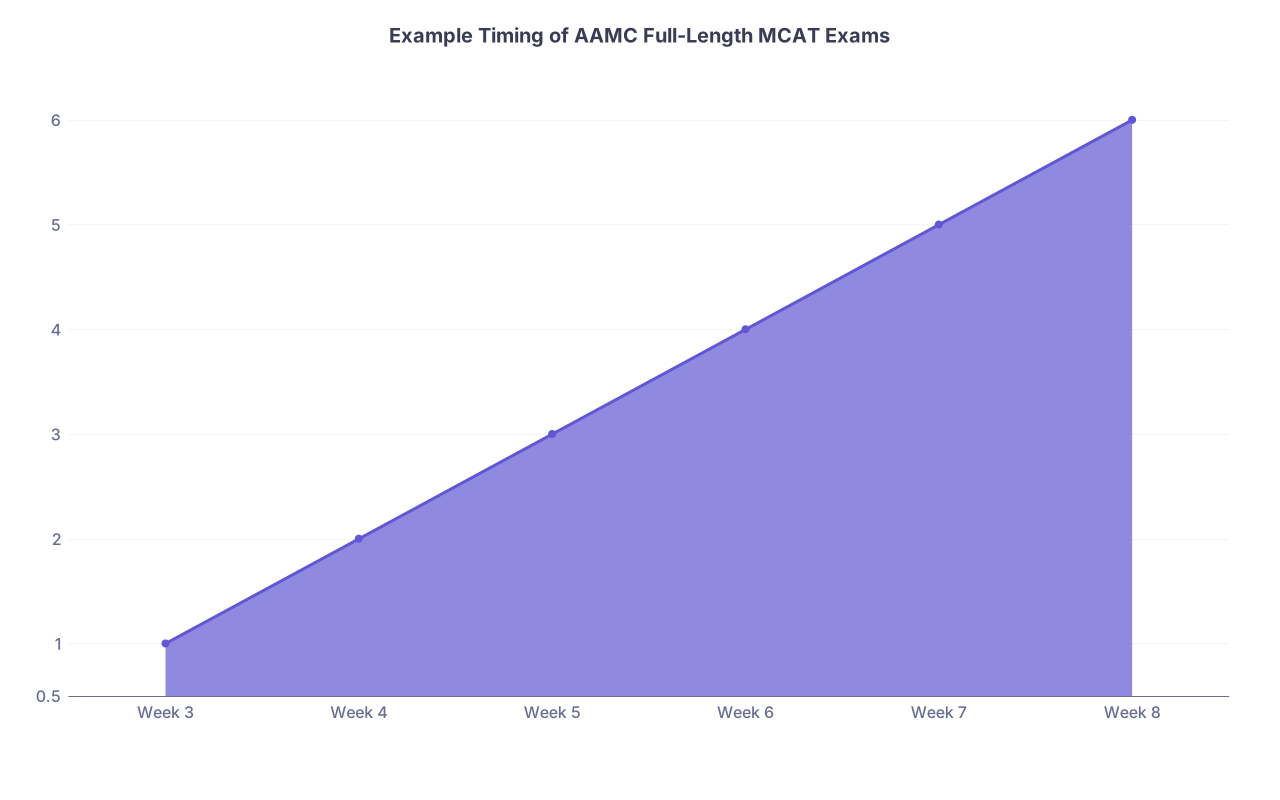
Here’s a sane usage pattern if you have ~8–10 weeks of focused prep:
| Category | Value |
|---|---|
| Week 3 | 1 |
| Week 4 | 2 |
| Week 5 | 3 |
| Week 6 | 4 |
| Week 7 | 5 |
| Week 8 | 6 |
One simple sequence:
- Early/mid content: AAMC Sample as a low-stakes diagnostic of test structure and stamina
- Then: FL 1 → FL 2 → FL 3 → FL 4 → FL 5 spaced about 5–7 days apart in the last 5–6 weeks, each followed by 1–2 days of deep review
If you can’t realistically finish all of them before test day, your bare minimum:
- AAMC Sample OR FL 1 early
- At least 3 scored AAMC FLs in the last month
If your schedule has you doing zero AAMC exams before test day, postpone. That’s not overcautious—that’s just common sense.
Where Third-Party Full-Lengths Actually Fit
Third‑party exams are like weighted bats in baseball. Good for training, but you don’t bring them to the real game.
What they’re good for:
- Early diagnostic before you touch any AAMC material
- Stamina and routine building when you’re still shaky on content
- Extra reps if you finish AAMC materials and still have several weeks and gas in the tank
What they’re not good for:
- Predicting your final score with precision
- Mirroring AAMC CARS style exactly (no one really nails it)
- Setting your emotional state if the scores are wildly off
Strategic use if you’re doing, say, 8 full-lengths:
- Weeks 1–3 of real prep: 2–3 third‑party FLs
- Final 5–6 weeks: switch almost entirely to AAMC FLs and question packs
Rule of thumb: don’t waste AAMC FLs early when your content is weak. Use third‑party to get your act together, then bring in AAMC when you’re ready to learn from the “real” exam style.
How to Decide Your Number: A Simple Framework
Let’s cut the theory and build a decision rule. Answer these:
How far out is your test date?
- 4 weeks or less: you can probably fit 3–5 FLs total without burning out
- 5–8 weeks: 5–8 FLs is realistic
- 9+ weeks: you could do 8–10 FLs, but still no need to go beyond ~10
How solid is your content base?
- Very weak (haven’t finished content review): lean more third‑party early, delay AAMC
- Moderate (reviewed most topics but rusty): start mixing AAMC in sooner
- Strong (retaker, strong prereqs): move quickly into AAMC FLs, fewer total may still work
How are you scoring now vs. your goal?
10 points below target: you’ll benefit from more FLs if you do deep review
- 5–10 points below: aim for 6–8 total
- Within 3–4 points: sometimes 4–6 high‑quality, well‑reviewed FLs is enough
Think of it as a matrix:
| Time to Test | Score Gap to Goal | Recommended FL Count |
|---|---|---|
| 4 weeks | >10 points | 4–5 |
| 4–6 weeks | 5–10 points | 5–7 |
| 6–10 weeks | >10 points | 7–9 |
| 6–10 weeks | 5–10 points | 6–8 |
| 8+ weeks | ≤5 points | 5–7 |
This is not perfect science. But it keeps you out of the two main ditches: “I only did 2 exams” and “I did 14 and learned nothing.”
How Often Should You Take Full-Lengths?
General guideline for most students:
During heavy content review (early‑mid):
One FL every 1–2 weeks, mostly third‑partyDuring dedicated test phase (last 4–6 weeks):
One FL every 5–7 days, mostly AAMC
Why not more often?
Because the review is where you gain points. If you’re taking FLs every other day, you’re not reviewing deeply. You’re just getting repeated evidence that your weaknesses still exist.
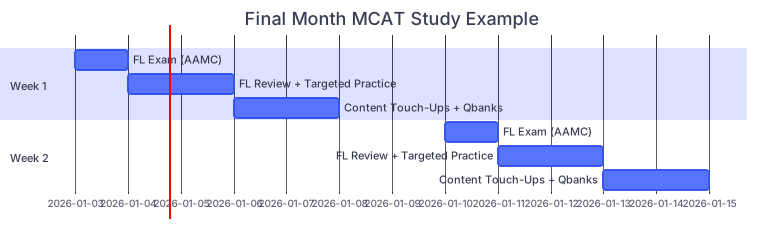
Here’s a simple weekly pattern during your final month:
| Task | Details |
|---|---|
| Week 1: FL Exam (AAMC) | a1, 2026-01-03, 1d |
| Week 1: FL Review + Targeted Practice | a2, 2026-01-04, 2d |
| Week 1: Content Touch-Ups + Qbanks | a3, 2026-01-06, 2d |
| Week 2: FL Exam (AAMC) | b1, 2026-01-10, 1d |
| Week 2: FL Review + Targeted Practice | b2, 2026-01-11, 2d |
| Week 2: Content Touch-Ups + Qbanks | b3, 2026-01-13, 2d |
Same pattern for weeks 3–4: exam → deep review → focused repair work → lighter content/passages.
Rest days are underrated. Nobody gets bonus points for taking a full-length when they’re half-dead.
What a “Good” Full-Length Review Actually Looks Like
If your “review” is just checking which questions you missed, you’re throwing away points.
A high-yield review session should include:
For every question (right or wrong):
- Why did you pick your answer? Was it content, logic, or a guess?
- Why is each wrong option actually wrong?
- Was the issue content, timing, reading, or panic?
For each section, write down:
- 2–3 patterns that hurt you (e.g., “misreading graph axes,” “rushing last 10 questions”)
- 2–3 concrete fixes for next time (e.g., “force myself to re-read stems on calculation Qs,” “hard cap of 80 seconds before I flag and move on”)
For content gaps, build a list and actually schedule when you’ll fix them:
- Example: “Weak on endocrine hormones → review Anki deck + 50 endocrine questions on Wednesday”
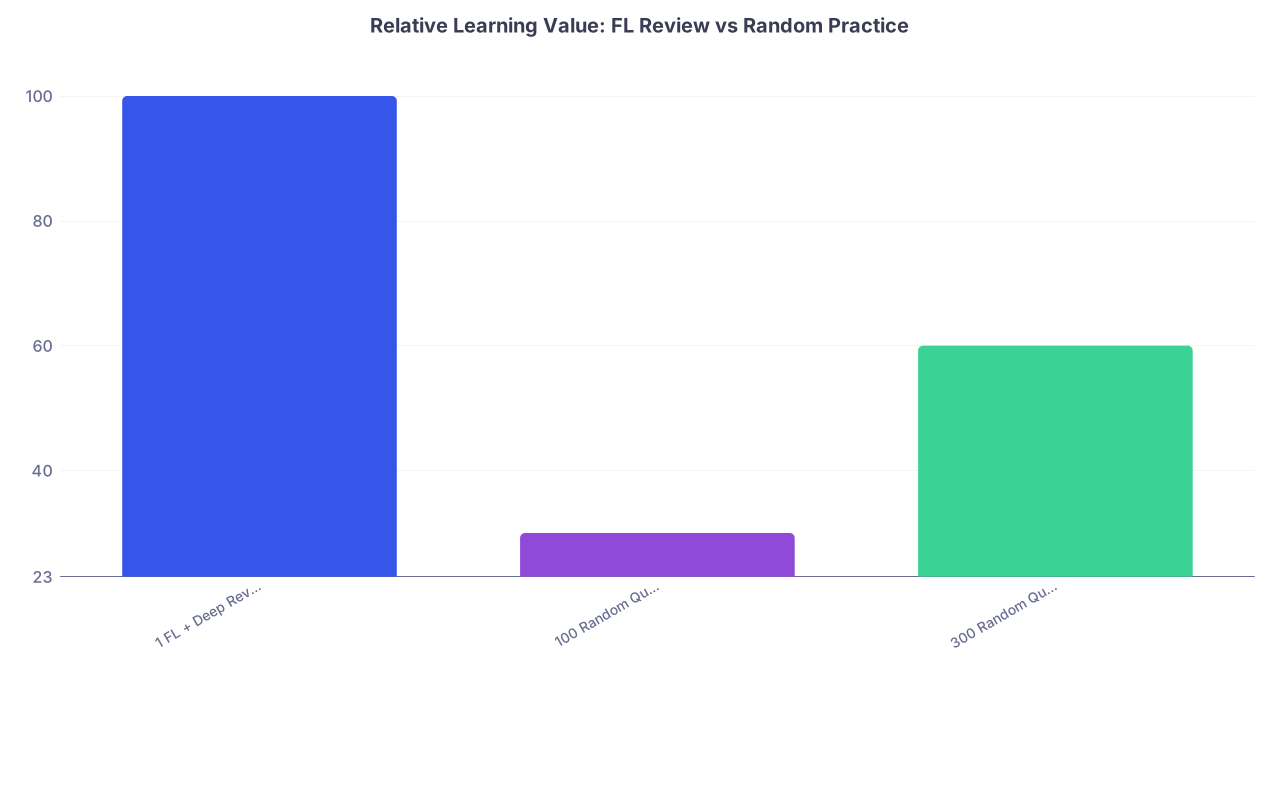
One full-length, well reviewed, is easily worth 1000+ random practice questions. That’s not an exaggeration.
| Category | Value |
|---|---|
| 1 FL + Deep Review | 100 |
| 100 Random Questions | 30 |
| 300 Random Questions | 60 |
(Think of the “values” here as a rough learning value index, not a real unit.)
When You’re Doing Too Many (Or Too Few)
You’re probably doing too few full-lengths if:
- You’ve taken only 1–2 FLs and your exam is within 3 weeks
- You haven’t done any official AAMC full-length
- You still feel “surprised” by the length or pacing every time
You’re probably doing too many if:
- You’re taking >10 total with no clear score improvement
- You’re cramming FLs back-to-back without at least a full day of review
- Your brain is fried, you’re dreading them, and your scores are dropping from fatigue, not ability
Remember: full-lengths are stressful. There’s a real cost. Use that stress wisely.
Special Cases: Retakers, High-Scorers, and Compressed Timelines
Retakers
If you’ve sat for the MCAT before, you don’t necessarily need more full-lengths. You need smarter ones.
- 1–2 third‑party FLs to restart stamina
- Then all remaining AAMC FLs you haven’t used (or haven’t seen in a year+ so you barely remember them)
- Total usually around 6–8 FLs
Focus on post‑exam autopsies: what actually happened last time, and how will you make this sitting tangibly different?
Aiming 520+
If you’re going for something in the 518–522+ range, you might think “I need 15+ FLs.”
No. What you need is near‑perfect accuracy and insane consistency.
For many high scorers:
- 8–10 excellent, brutally reviewed full-lengths
- Very heavy review of AAMC sections and Qpacks
- ruthless attention to small, repeated errors
More exams past 10 is diminishing returns unless you truly have endless time and are still seeing new issues.
Very Limited Time (≤4 Weeks)
You’re not in an ideal spot, but here’s the honest priority:
- At least 3–4 AAMC FLs, no matter what
- Deep review of each
- Fill the in‑between days with targeted content/practice based on those FLs
If your baseline is way below your target and you can’t realistically fit 3–4 AAMC full-lengths, strongly consider pushing the date. Hoping to “figure it out on test day” is how people end up with panic‑retakes.
FAQ: Full-Length MCATs
1. Can I skip third-party full-lengths and only do AAMC?
Yes, if you’ve got limited time and a decent content foundation, you can do only AAMC and be fine. I’d still like to see you at 5–6 total exams though. If you’re very early in prep (3+ months out), 1–2 third‑party FLs can help you learn pacing and stamina before you burn through the official ones.
2. How close to my test date should I take my last full-length?
For most students, 4–5 days before the real exam is ideal. You want enough time to review it and do targeted tune‑ups, but not so late that you exhaust yourself. The final 2–3 days should be light review, not massive full-lengths.
3. My third-party scores are all over the place. Which ones do I trust?
Trust AAMC for score prediction. Third‑party is mostly for practice and identifying weaknesses. If your AAMC scores (especially FL 2–5) consistently average around, say, 511–513, that’s a much better predictor than one random 505 from a harsh third‑party exam.
4. What if my full-length scores aren’t improving?
Stop blindly adding more exams. Pause. Take your last two FLs and do an obsessively detailed review. Look for patterns: timing, content domains, reading issues. Often the bottleneck is one or two fixable habits (like rushing the last 5 CARS questions) rather than “I need more exams.”
5. Is 2–3 full-lengths enough if I’m strong in my classes?
No. Strong coursework doesn’t substitute for 7.5 hours of test-day stamina and MCAT‑specific style. Even with a 4.0 and strong science background, you should still be doing at least 4–5 full-lengths, including multiple AAMC exams, if you care about hitting a competitive score.
Key takeaways:
You don’t need 15 full-lengths. You do need 4–8 well-chosen, deeply reviewed exams, with AAMC as the core. The score jump comes from what you learn after each test, not the sheer number you cram in.