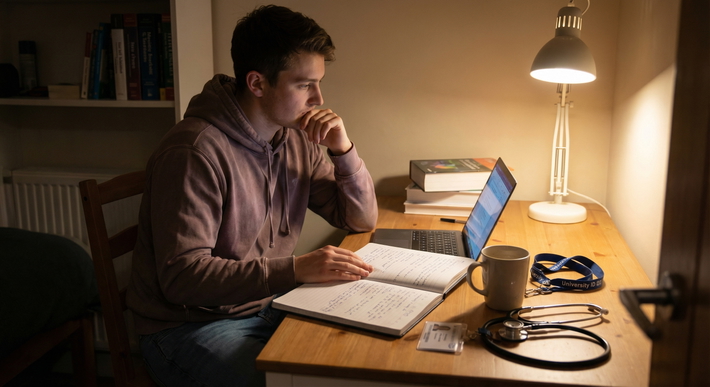
You missed clerkship days. Now your brain is doing the usual thing: panic, shame, avoidance, maybe a little fantasy that if you stay quiet long enough the schedule gods will fix it for you.
They won't.
This is one of those medical school problems that gets worse fast when you disappear. I've seen students turn two missed days into a professionalism mess simply because they froze, sent scattered half-explanations, or waited until Friday at 4:47 p.m. to "clarify the situation." Bad move.
The good news: a missed-day problem is often salvageable. Even when it's messy. Even when the absence wasn't handled perfectly at the start. What matters now is whether you act like a professional from this point forward.
The First 24 Hours: Stop the Spiral and Triage What Happened
First, get specific. "I missed some clerkship" is useless. You need three facts immediately:
- Why did you miss?
- How many days or partial days did you miss?
- Was it excused, partially excused, or currently unexcused?
That distinction matters. A fever with a same-day message to the coordinator is different from oversleeping and hoping nobody notices. A family emergency with documentation is different from missing orientation because your flight got delayed and you never emailed anyone. Don't blur those together. Your school definitely won't.
Before you send a single message, pull up the clerkship syllabus and attendance policy. Read the actual words. Not what your class group chat thinks it says. Look for:
- absence reporting rules
- deadlines for notification
- who must be contacted
- make-up requirements
- consequences for unexcused absences
- whether partial-day absences count as full days
You need to know what's truly at stake. Pass/fail issue? Honor eligibility? Mandatory remediation? Administrative note only? Guessing is how students make dumb, avoidable mistakes.
Then do immediate damage control. Notify the right person promptly. Keep it factual, brief, and respectful. No dramatic essay. No three-paragraph emotional confession. No weird oversharing. You are not writing for sympathy; you are creating a clean record.
A workable message sounds like this: you missed X date(s), the reason was Y, you have or will provide documentation if needed, and you want to know the next steps to make up the time.
Use this quick triage:
- Illness: contact the clerkship coordinator and follow student health/absence rules
- Family emergency: notify the coordinator or director, ask what documentation is needed
- Mental health crisis: contact the clerkship office and student affairs; if this is bigger than one absence, stop trying to white-knuckle it
- Travel disruption: report it immediately and save receipts, delay notices, and timestamps
- Administrative mix-up: document exactly what schedule you received and when
Your first 24 hours are about stopping silence. Silence is what turns a fixable absence into a professionalism problem.
Step 1: Reconstruct the Facts and Document Everything
Start a simple timeline. Not fancy. One page is enough.
Include:
- date(s) missed
- full day or partial day
- reason for each absence
- who you notified
- when you notified them
- how they responded
- what documentation exists
If this feels overly meticulous, good. That's the point. Clerkship directors, coordinators, deans, and student affairs staff don't live inside your personal chaos. They need a paper trail. If your story changes every time you tell it, you lose credibility fast.
Save everything that supports your absence:
- doctor's note or visit summary
- urgent care discharge paperwork
- screenshots of messages or emails
- flight delay or cancellation notices
- police report or towing receipt if transportation really did implode
- funeral information or family emergency documentation if applicable
And yes, documentation matters even when the reason feels obvious to you. "I was really sick" may be true. But if the school requires a note after two missed days, your conviction doesn't replace the policy.
What not to do:
- don't embellish
- don't fabricate
- don't send frantic late-night novels
- don't make the story more dramatic to sound more deserving
- don't contradict your own timestamps
I strongly recommend keeping a one-page summary ready for any meeting. When you're stressed, you ramble. Everybody does. A clean summary keeps you from sounding evasive or inconsistent.
Step 2: Contact the Right People in the Right Order
Most of these situations go sideways because the student tells the wrong person and assumes the right person somehow got the memo. That's not how clerkships work.
Usually, the communication chain looks like this:
- Clerkship coordinator
- Preceptor or attending at the site
- Site administrator if relevant
- Clerkship director
- Student affairs or dean's office if the issue is bigger or unresolved
Follow your school's policy if it lists a different order. But don't just text a resident and call it handled. Residents are not attendance infrastructure.
Your outreach should do four things:
- acknowledge the missed time
- state the reason plainly
- express that you want to make it right
- ask for next steps
Try something like:
Dear [Name], I missed clerkship on [date(s)] due to [brief reason]. I notified [person] on [date/time] and can provide documentation if needed. I want to make sure I handle this correctly and complete any required make-up work. Please let me know the next steps. Thank you, [Your Name]
That's enough. Clean. Adult. Useful.
If you missed multiple days, do not send six disconnected messages to six different people with slightly different explanations. Send one organized summary and ask for a meeting if needed. Scattered communication makes you look chaotic, and chaos kills trust.
If no one responds, escalate politely. Quickly. Especially if grade deadlines, evaluations, shelf exam timing, or rotation-end paperwork are approaching. A reasonable follow-up after 24 to 48 hours is not annoying. It's responsible.

Step 3: Ask for a Make-Up Plan You Can Actually Complete
Now you need a plan that fixes the actual deficit. Not a fake fix. Not a symbolic gesture. A real plan.
Common make-up options include:
- extra clinical days
- weekend shifts
- evening call
- simulation sessions
- written assignments or reflections
- additional patient notes
- repeating part of the rotation
- formal remediation block
Pick the option that actually restores what was missed. If you missed patient contact and team exposure, a weak little reflection assignment may not solve the problem. If your school offers choices, don't reflexively choose the easiest one if it leaves obvious holes in your performance record. Short-term convenience can cost you later.
When you negotiate, be practical. Offer real availability. Say when you can stay late, come in on weekends, or add an extra day. Show flexibility. Ask directly what is required for full credit.
If the missed time was unexcused, expect a tougher remediation plan. That's fair. Don't waste energy arguing that the consequence feels harsh. Your job is to complete it cleanly.
Most important: confirm the plan in writing.
You want an email that spells out:
- what you must complete
- by what date
- who signs off
- whether the work restores attendance/credit
- whether anything else affects your grade or evaluation
Verbal plans are how students end up hearing, weeks later, "That didn't count."
Step 4: Rebuild Reliability on the Rotation
Making up hours is only half the job. The rest is rebuilding trust.
From this point on, be boringly reliable.
That means:
- arrive early
- answer emails the same day
- confirm site assignments
- double-check schedules
- carry the right contact numbers
- notify people early if another issue comes up
You do not need to become a frantic, overcompensating robot. In fact, that usually looks worse. I've seen students try to "redeem themselves" by buzzing around, inserting themselves into everything, apologizing repeatedly, and creating even more chaos. Don't do that.
Be useful. Be organized. Be calm.
Also, ask for feedback. Quietly and professionally. A simple "Is there anything I can do better this week?" goes a long way with residents and attendings. It shows maturity, and it gives people fresh material to remember besides the missed days.
And yes, professionalism counts here. No complaining. No public drama. No defensive speeches about how misunderstood you were. If someone mentions the absence, own it once and move on.
Step 5: Protect Your Grade, Evaluation, and Record
Missed days don't just affect attendance. They can hit:
- narrative evaluations
- professionalism comments
- final grade calculations
- honors eligibility
- shelf exam timing
- end-of-rotation sign-off requirements
You need to know exactly what changed. Ask directly. Don't assume that making up the hours automatically wipes out every downstream consequence.
Questions worth asking:
- Does this affect my eligibility for honors?
- Do I still meet the clinical day requirement?
- Is any additional evaluation needed?
- Will this generate a professionalism notation?
- Does student affairs or the dean's office need to be informed?
That last one matters more than students realize. Some schools require formal notification for repeated absences, mental health concerns affecting attendance, or any remediation plan. If you ignore that step, the issue can resurface later during another rotation or academic review.
Keep one folder. Digital, obviously. Put in:
- attendance policy
- clerkship syllabus
- all emails
- screenshots
- documentation
- make-up plan
- proof of completion
- any final clearance message
This is not paranoia. This is survival. Unresolved absences have a nasty habit of reappearing at the worst possible time, like when grades are finalized or MSPE questions start surfacing.
Step 6: Handle Special Scenarios Without Making Them Worse
Some missed-day situations are not one-off problems. They're signs of a bigger issue. Treat them that way.
If you're dealing with:
- repeated illness
- worsening depression or anxiety
- panic attacks
- caregiving duties at home
- unstable transportation
- visa or travel interruption
- serious personal crisis
stop trying to duct-tape the problem with one more apology email.
This is when you involve the right support office:
- student health for illness patterns or return-to-work documentation
- counseling or mental health services if functioning is slipping
- student affairs/dean's office if attendance problems are expanding
- disability services if you may need accommodations
- leave-of-absence support if the situation is bigger than a short remediation plan
Some situations need formal accommodations, not improvised heroics. Trying to self-manage a collapsing situation usually creates two problems instead of one: the underlying issue and a professionalism trail.
If you already had a rough reputation on the rotation, be honest with yourself. You do not fix that by arguing about fairness or relitigating every negative interaction. You fix it by changing the behavior now, communicating clearly, and following through exactly.
And here's the truth students need to hear: an imperfect but honest story is far more salvageable than a suspiciously polished one. People in medical education have seen every version of the "my phone died, Wi-Fi failed, email didn't send, alarm broke, car vanished" script. If your explanation sounds manufactured, they'll know.
Step 7: Close the Loop and Prevent the Same Problem Next Time
Don't assume you're done just because you completed the extra shift.
Close the loop.
Send the follow-up email. Confirm the make-up work is complete. Ask whether any additional action is required. Make sure the clerkship record reflects that the issue has been resolved. If you need written clearance, get it.
Then do a short after-action review with yourself. Not a guilt spiral. A real review.
Ask:
- What actually caused the missed days?
- What system failed?
- What warning signs did I ignore?
- What would prevent this next time?
Your prevention plan should be concrete:
- backup transportation option
- saved contact list for coordinator/site/preceptor
- earlier communication if you're getting sick
- alarms that aren't one fragile phone setting
- calendar reminders for site changes
- emergency plan for family or caregiving disruptions
One disrupted clerkship is not the end of your training. I've seen students recover from worse. But they recovered because they stopped hiding, handled the paperwork, took the hit if they earned it, and rebuilt trust fast.
Do that now. Today. Document everything, contact the right person, and get a make-up plan in writing before this turns into a formal academic problem.