
You just got torn apart on rounds. Now what?
You’re standing in the hallway outside a patient’s room, pretending to look at the EMR on the workstation. Your stomach’s still in your throat.
On rounds, your attending just:
- Asked you a question you did not know
- Pushed, then mocked your answer in front of the team
- Maybe said something like, “Did you go to medical school?” or “This is basic. Even interns know this.”
- The residents went silent. The nurse side-eyed. You wanted the ground to swallow you.
Now rounds are over. You’re replaying every second. You’re thinking:
- “Everyone thinks I’m an idiot.”
- “I should not be in medicine.”
- “I will never match if this attending writes my eval.”
You’re also supposed to go back into that same room, talk to that same patient, with that same red face.
I’m going to walk you through what to do in the next 24–72 hours. Not in theory. In practice. What to do today, what to do with that attending, how to protect your evaluation, and how to not let this become the story you tell yourself about who you are.
We’ll do this in stages: immediate triage, short-term reset, strategic follow‑up, and longer-term mental health damage control.
Step 1: The immediate aftermath (the next 1–4 hours)
1. Get physically away from the team for 5–10 minutes
Do not just swallow it and keep walking like nothing happened. You are not a robot, and if you try to be, it will leak out sideways later.
Find a spot: bathroom, stairwell, empty call room, your car, the chapel—whatever your hospital has.
Once you’re alone:
- Put your phone on do not disturb.
- Set a timer for 5 minutes.
- Do one grounding thing that isn’t scrolling or texting.
Here’s a simple, non‑woo breathing drill that actually works under adrenaline:
- Inhale through nose for 4 seconds
- Hold for 2 seconds
- Long exhale through mouth for 6–8 seconds
- Repeat 6–8 times
You’re not “meditating.” You’re dropping your sympathetic system by force so you can function like a human again.
2. Label what actually happened (not the story in your head)
You need to separate event from story before your brain cements them together.
On your notes app or a scrap of paper, literally write:
Event (factual):
“On rounds, Dr. X asked me about managing acute decompensated heart failure. I didn’t know the exact dosing. They said, ‘This is basic, I expect a third-year to know this,’ in front of everyone. I felt frozen. The room went quiet.”Story (mind’s spin):
“I’m stupid. Everyone thinks I’m incompetent. I don’t belong in medicine. My evaluation is ruined. I’ll never be a good doctor.”
Seeing those separated in black and white stops your mind from merging them into one “truth.”
The event is true.
Your story is… a story. Very understandable. But not automatically true.
3. Decide how you’ll carry yourself for the rest of the day
You still have work to do. Patients to see. Tasks to complete.
You need an interim script for yourself. Something like:
“Today’s goal is not to impress anyone. Today’s goal is to be safe, polite, and prepared on the basics. I will not disappear. I will not overcompensate. I will just execute.”
Three behavioral rules for the rest of the day:
- Do not ghost. Don’t disappear from the team’s orbit to lick your wounds for hours. That looks worse than whatever just happened.
- Do not overshare. Your vulnerability is not for every random intern. Save the processing for later with safe people.
- Do not retaliate (even subtly). No snark, no visible eye-rolling behind the attending’s back. There are always more eyes on you than you think.

Step 2: The same day, after rounds – how to reset your footing
1. Do a targeted knowledge patch, not a 6‑hour shame study session
The instinct is to go crazy: read three chapters, watch four videos, vow never to be wrong again.
That’s how people burn out and learn nothing.
Instead, do a 30–60 minute focused repair on the exact topic you were grilled on.
Example:
The question was on heart failure management?
Pull up UpToDate or a short review, write down:- Key meds + first‑line dosing
- What you’d do in mild vs severe
- One or two supporting studies or guideline lines (max)
The question was on diabetic ketoacidosis?
Write out: diagnostic criteria, first lab orders, fluid strategy, insulin strategy, what ICU vs floor would look like.
Goal: by tomorrow, if that topic comes up again, you have a clean, clear 2–3 minute presentation ready in your head.
Not to “redeem yourself.”
To remind your own brain: “I can learn. I just didn’t know yet.”
2. Do a non‑dramatic competence move before you go home
Before you sign out or leave:
- Double‑check one note or order set you’re responsible for and polish it.
- Ask a resident: “Anything else I can help with before I head out? I want to make sure everything’s done for my patients.”
You’re sending a quiet signal: “I’m still here. I still care. I’m not spiraling into uselessness.”
You’re also anchoring the day in one small thing you did well, not just the humiliation.
3. Decide, tonight, if this needs a conversation with the attending
Not every ugly interaction needs a direct “we should talk” follow‑up.
But some do.
Ask yourself these questions, and be brutally honest:
| Question | If your answer is "Yes"… |
|---|---|
| Did they insult *you* rather than your knowledge? ("Are you stupid?" vs "This is basic material.") | Conversation is more warranted |
| Did they mock you repeatedly, not just once? | Pattern = more reason to address |
| Did you freeze to the point you could not function afterward? | Might be useful to clear the air |
| Are they your evaluator / clerkship director? | Strategic to repair relationship |
| Do you feel unsafe / targeted? | Might need help *beyond* just a personal convo |
If you’re answering “yes” to 2+ of those, lean toward some form of follow‑up. Not necessarily a confrontation. A professional reset.
But don’t email them tonight. You’re still raw. Sleep first.
Step 3: The next 24–72 hours – how to handle that attending and protect your eval
1. Day after: show up like a professional, not a wounded animal
Walk in tomorrow acting like:
- You remember what happened
- You’re not pretending it never occurred
- You’re also not walking on eggshells
You don’t need some big speech in the workroom. What you do need:
- Be on time.
- Be prepared on that topic plus one related topic.
- Greet the team normally.
- Don’t avoid eye contact with the attending. You don’t have to stare them down, just don’t shrink.
If they never mention yesterday again and the behavior doesn’t repeat, sometimes the smartest move is to let it fade while you quietly outperform their expectations.
If the tension is obvious or the comment was personal and cutting, consider a brief 1‑on‑1.
2. How to have a short, low‑drama reset conversation
You’re not going in to accuse. You’re going in to reset the working relationship and signal that you take feedback seriously, not abuse.
When to do it: sometime between cases / after rounds / at a natural lull. Not in front of the whole team.
Script you can adapt:
“Dr. X, do you have a minute?
Yesterday on rounds, when we were talking about heart failure management, I really felt like I dropped the ball on that question. I went home and reviewed the topic, and I understand the approach much better now.
I also wanted to mention—I felt pretty embarrassed the way it came across in front of the team. I absolutely want to be pushed and I value tough teaching, but I learn best when it’s framed as ‘here’s what you need to know’ rather than ‘this is basic, you should already know this.’
I’m committed to improving during this rotation and I really want to make sure we’re on the same page.”
Key points here:
- You own your knowledge gap.
- You show you did the work.
- You name what happened without using loaded language (“unprofessional,” “abusive”) right off the bat.
- You tell them how you learn best, which is a non‑threatening way of saying: “Don’t humiliate me again.”
Possible responses:
- Best case: “I’m sorry, I was too harsh yesterday. I appreciate you bringing it up.”
- Middling: “That’s just my style. This is how we teach here.”
- Worst case: They blow you off or double down.
Whatever their response, you’ve:
- Shown maturity
- Left a paper‑trail in their head: you’re reflective, not fragile
- Given yourself a psychological anchor—you advocated for yourself
If this is your clerkship director or a big eval‑writer, that matters.

| Step | Description |
|---|---|
| Step 1 | Public embarrassment on rounds |
| Step 2 | Immediate 5-10 min reset |
| Step 3 | Targeted knowledge review |
| Step 4 | Decide if attending convo needed |
| Step 5 | Brief 1-on-1 reset talk |
| Step 6 | Quietly improve performance |
| Step 7 | Monitor for pattern/retaliation |
| Step 8 | If pattern or unsafe, escalate to support |
3. Document the incident if the behavior was over the line
If what happened wasn’t just sharp teaching but demeaning, personal, or repeatedly humiliating, write it down while your memory is fresh.
Privately. Not in the EMR. Not in your group chat screenshots folder.
Include:
- Date, time, location
- Who was present
- Exact words or close paraphrase
- How it affected your functioning (e.g., “I froze and couldn’t present for the rest of the patient list”)
Why? Because if:
- This becomes a pattern
- You decide to talk to the clerkship director, student affairs, or GME
- Or someone asks you later “what exactly happened?”
You’re not relying on a foggy, emotional memory.
Step 4: When this is not a one‑off – patterns and escalation
Some attendings are just blunt. Some are actually toxic.
You can tell the difference over 1–2 weeks.
Signs this is a pattern, not a one-time blow‑up
- They consistently single you out for the harshest questioning.
- Comments are about you (“you’re hopeless,” “you’re lazy”), not your work.
- They humiliate students in front of patients, not just the team.
- Residents quietly warn you: “Yeah, Dr. X is like this with students every year.”
- Multiple students share similar stories.
At that point, this is bigger than your ego. It’s a learning environment issue.
Who you can talk to (and when)
You’re not required to fight this alone. There are levels.
Trusted resident / senior:
“Hey, can I ask you something about how rounds went yesterday? I felt pretty called out and I’m not sure if that’s just Dr. X’s style or if I should be doing something differently.”You’re not asking them to fix it. You’re gathering intel. Sometimes they’ll say, “Yeah, they do that to everyone. Don’t take it personally.” Sometimes they’ll say, “You’re not the first to bring this up. You can talk to [clerkship director].”
Clerkship coordinator / clerkship director:
This is for patterns or truly egregious behavior.Email like this (short and factual):
“Dear Dr. Y,
I wanted to request a brief meeting regarding a concern about the learning environment on my current rotation. I had an interaction with an attending that felt demeaning, and I’m not sure how best to address it while still learning effectively on the service.
I’d appreciate your guidance.
Best,
[Name], MS3”You’re not accusing. You’re asking for guidance. In person, you can describe what happened using your documented notes.
Student affairs / counseling / ombudsperson:
If it’s affecting your sleep, anxiety, or making you dread coming in, loop them in. They see this pattern across rotations; you’re not the first.
Important: retaliation for raising concerns about mistreatment is usually explicitly prohibited in institutional policy. Does it still happen sometimes informally? Yes. That’s why you go through formal channels, stay factual, and don’t go in guns blazing without thinking.

Step 5: Protecting your mental health so this doesn’t own you
The bigger danger here isn’t the attending. It’s the story you build around what they did.
1. Separate “feedback about knowledge” from “judgment of you as a person”
Harshness muddies the message. Strip out the emotional tone and ask:
- What actual content was underneath the humiliation?
- What specific gap were they (badly) trying to highlight?
Turn that into a concrete learning goal:
“By the end of this week, I will be able to present an initial management plan for acute heart failure in under 2 minutes, including medications and doses.”
One student I worked with started rating each painful interaction like this:
- 0/10 = pure abuse, no useful content
- 10/10 = harsh but high-yield teaching, content salvageable
If it’s above 4–5, mine it for learning. If it’s 0–3, chalk it up under “data point: don’t emulate this style when I’m an attending.”
2. Use your people—strategically
Who you talk to about this matters.
Good options:
- One friend in your class who “gets it” and doesn’t escalate your anxiety
- A resident you trust
- Therapist or counselor (school-based or outside)
Bad options:
- Blasting the story in your 40‑person class GroupMe
- Posting about “toxic attendings” on Twitter or Reddit the same day it happened
- Vague‑booking on Instagram
You’re trying to regulate, not recruit an army.
When you tell the story, notice your language:
- “They destroyed me.” → “They spoke to me in a way that felt humiliating.”
- “I embarrassed myself.” → “I didn’t know the answer and they reacted harshly.”
Words matter. They’re the script you’ll rehearse in your head at 2 a.m.
3. Watch for red‑flag symptoms that mean you need more help
If, in the next days/weeks, you’re noticing:
- Dreading coming to the hospital to the point of nausea
- Replaying the event nonstop, like a mental loop you cannot turn off
- Sleep wrecked—either can’t fall asleep or waking up at 3–4 a.m. panicked
- Drop in appetite, joy, or interest in anything non‑medical
- Thoughts like, “They’d all be better off if I weren’t here”
That’s not just “being sensitive.” That’s your brain showing strain.
At that point:
- Get an appointment with student mental health or an outside therapist.
- If you have even a flicker of self‑harm thought, tell someone the same day—a friend, a mentor, your school’s on‑call line.
You’re not weak for getting help. You’re doing what you’d beg your own patient to do.
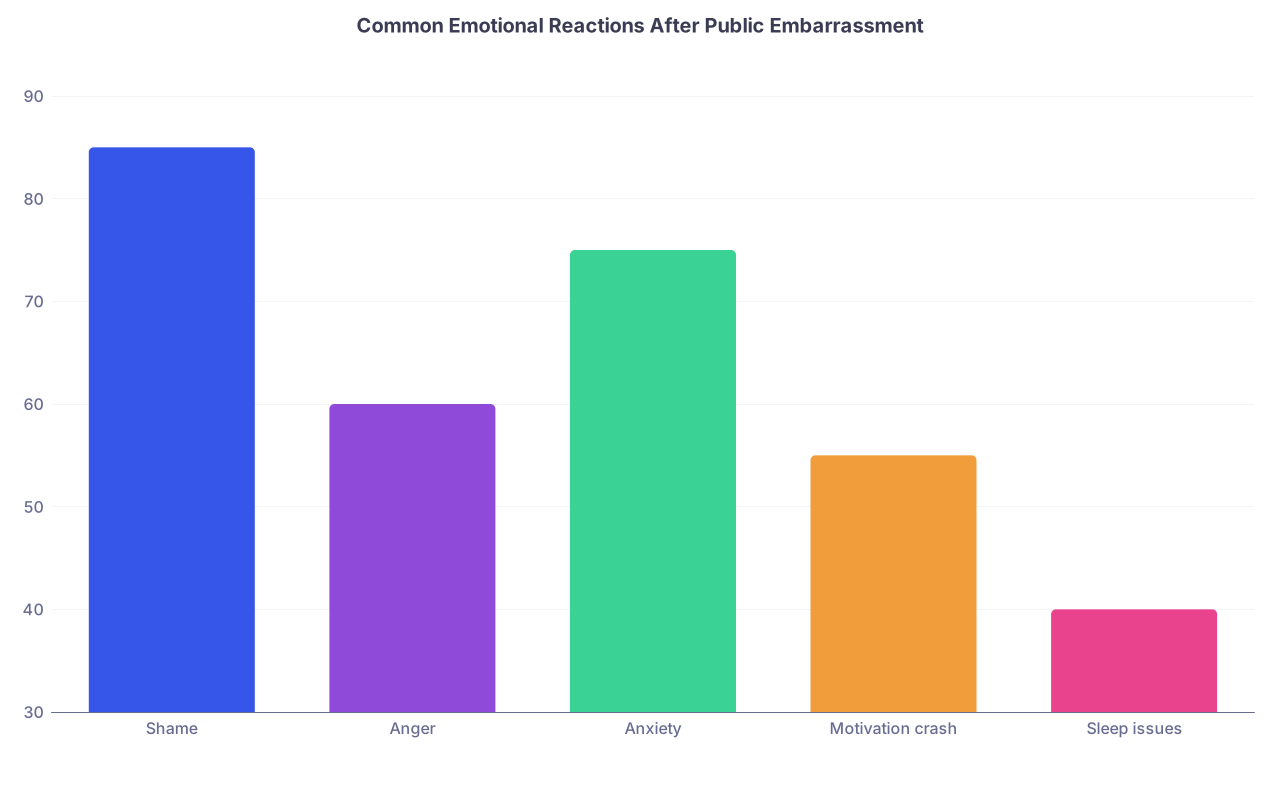
| Category | Value |
|---|---|
| Shame | 85 |
| Anger | 60 |
| Anxiety | 75 |
| Motivation crash | 55 |
| Sleep issues | 40 |
Step 6: Turning this into a net gain (yes, really)
You don’t have to pretend what happened was “good.” It sucked.
But you can decide what you’re going to extract from it.
1. Build a micro‑system to prevent repeat ambushes
Patterns I’ve seen:
- Attendings who always grill on guideline basics → You prep one guideline summary per night.
- Attendings obsessed with differential diagnosis → You practice building and verbalizing 3‑item differentials with prioritization.
- Attendings who hate when people say “I don’t know” → You train yourself to say:
“I’m not sure of the exact answer, but here’s how I’m thinking about it…”
Pick the attending’s style apart like an exam blueprint. Target the pattern, not their personality.
2. Bank this for your future leadership style
You are collecting examples of:
- “I never want to talk to a learner this way.”
- “I do want to push people, but I’ll do it like this instead.”
Literally write them down somewhere.
Years from now, you’ll have a med student of your own. You’ll remember exactly how this felt. And you’ll decide not to recreate it.
3. Put this in perspective of your whole trajectory
You will remember this week longer than they do.
I have watched:
- A student who got called “unprepared” on surgery rounds go on to be chief resident
- A student who blanked on a simple CHF question match cards fellowship
- A student told “you’re not cut out for this” by one attending get honors on three other rotations and match their dream specialty
One attending on one bad day doesn’t get to be the narrator of your entire career.

What the next weeks can look like
In a week, here’s what “healthy recovery” looks like:
- You remember what happened but it doesn’t hijack your entire day.
- You’ve patched the specific knowledge gap.
- You’ve had (or decided against) a short reset conversation with the attending.
- You’re still showing up on time, doing your work, asking reasonable questions.
- You’re starting to see small wins again—a good note, a grateful patient, a resident compliment.
And yes, this might still pop into your head during exams, OSCEs, even years later. That’s fine. It becomes part of the background noise.
What you’re really doing right now is building two muscles:
- The clinical competence to handle being questioned in front of other people
- The psychological resilience to not let someone else’s bad moment define your worth
You’ll need both for the rest of your training. This is one ugly rep.
Handle today. Patch the knowledge. Decide if a conversation is needed. Document if it was over the line. Pull in support if it’s haunting you.
Once you’ve done that, your attention can shift back where it actually belongs: learning medicine and taking care of patients.
With those foundations in place, you’ll be in a very different headspace the next time someone cold‑calls you on rounds. And eventually, you’ll be the one setting the tone for how the team treats its most vulnerable member—the terrified student in your old shoes. But that’s a story for another day.