
The way most medical students “rest” on weekends is broken. Collapsing on the couch, doom-scrolling TikTok, half-studying with 10 open tabs, and then wondering on Sunday night why you still feel like garbage. That is not rest. That is slow-motion burnout.
You do not need another vague “prioritize self-care” lecture. You need a protocol. A repeatable weekend reset system that takes you from fried and scattered on Friday to functional and focused by Sunday night.
Let’s build that.
The Core Problem: You Are Not Actually Resting
Here is what I see over and over in med students:
- You are chronically sleep-deprived.
- Your “days off” are actually:
- Catch-up study days
- Chore days
- Social obligation days
Wrapped in guilt because you “should” be doing more Anki or UWorld.
Result:
You never hit true recovery. Your baseline keeps dropping. What used to be a normal week now wipes you out.
Chronic exhaustion in med school is not just “too many hours.” It is:
- Fragmented attention
- Constant anxiety about the next exam
- Zero protected time for your nervous system to downshift
A real weekend reset has one job:
Shift your brain and body out of survival mode and back into a stable, sustainable baseline, without nuking your academic progress.
So here is the structure I recommend: a 48-hour Weekend Reset Protocol you can repeat every week, with some flexibility.
The Overall Weekend Reset Framework
Think of your weekend in four blocks:
| Block | Primary Goal | Approx Time |
|---|---|---|
| Friday Evening | Decompression & Triage | 2–4 hours |
| Saturday Morning | Deep Recovery | 3–4 hours |
| Saturday Afternoon | Light Structure & Life Admin | 3–5 hours |
| Sunday | Academic Calibration & Gentle Prep | 6–8 hours |
You will adjust exact times based on your schedule (call, exam weeks, family stuff), but the structure holds:
- Downshift
- Recover
- Rebuild life structure
- Re-engage academically (without panic)
Let us go block by block.
Block 1: Friday Evening – Hard Stop & Decompression
The first mistake most students make: letting Friday “just happen.” You stagger home, open your phone, and fall into the algorithm. Then suddenly it is 1:30 am, you are wired and ashamed, and the weekend is already compromised.
You need a Friday shutdown ritual. Non-negotiable.
Step 1: Declare a hard stop
Pick a time:
- Pre-clinical: 7–8 pm
- Clinical: whenever you are home + shower + food (often 7–9 pm)
At that time, you:
- Close your laptop.
- Close your Anki/UWorld/apps.
- Physically put your backpack away in a closet or corner.
Say, out loud if you need to:
“Workday is over. I am off duty.”
Sounds corny. Works anyway.
Step 2: 20-minute brain dump
You cannot rest with 47 half-formed worries circling your brain.
Do this:
- Grab a notebook / iPad / scrap paper.
- Set a 10–20 minute timer.
- Dump everything out of your head:
- Upcoming exams, OSCEs, quizzes
- Emails you owe
- Patient you are worried about
- Chores, errands, bills
- Random “I should really…” tasks
Then do a quick triage:
- Mark with a star: must be done this weekend.
- Mark with a circle: can wait until next week.
- Put a line through: unrealistic / optional / not happening.
Do not plan times yet. Just separate urgent from noise.
This gives your brain permission to relax, because you are not trusting memory anymore—things are captured.
Step 3: Physical decompression (30–60 minutes)
Your nervous system has been in fight-or-flight all week. You have to physically tell it: we are safe now.
Pick one of these (not all):
- 30–40 minute easy walk outside (no lectures, no question banks)
- Hot shower, then 10 minutes stretching or foam rolling
- Light yoga video (15–30 mins, not power yoga that feels like punishment)
- Slow bike ride, no metrics, no Strava ego
Rule:
No academic content. No “productivity” podcasts. This is not sneaky multitasking time.
Step 4: Deliberate pleasure – not mindless numbing (1–3 hours)
Here is where most students sabotage themselves. They go straight from high stress to high-stimulation numbing (endless social media, video games until 3 am, binge anything).
That does not restore you. It keeps your nervous system revved.
Instead, you pick deliberate, time-bounded enjoyment:
- One movie with a set end time
- Two episodes of a series (set a number before you start)
- Dinner with friends
- Cooking a real meal
- Board games, hobby, music
Set a sleep boundary:
- Aim for bed by 11–12 latest.
- If you are routinely up until 2–3 am every Friday, that is one of the main reasons you feel destroyed by Sunday.
You are not in college anymore. You are a professional-in-training with a brain that needs actual maintenance.
Block 2: Saturday Morning – Deep Recovery Mode
Saturday morning is not for catching up on lectures. It is for reversing the damage of the week.
If you treat Saturday morning as your “bonus study time,” you will keep burning down your reserves.
Step 1: Sleep until naturally awake (with a cap)
Let yourself sleep in within reason:
- If your weekday wakeup is 6 am, let yourself wake up naturally, up to 8:30–9 am.
- More than a 2–3 hour shift from weekday wake time and you start wrecking your circadian rhythm.
If you are so exhausted that you are sleeping 12–14 hours every weekend, that is data. Your weekly schedule is not sustainable, and you need to adjust midweek load, not just “use weekends to survive.”
Step 2: Rehydrate, refuel, sunlight (30–60 minutes)
Basic, yes. But most med students are chronically:
- Slightly dehydrated
- Under-sunned
- Running on coffee and sugar
Protocol:
- Big glass of water before caffeine.
- Protein-heavy breakfast (eggs, Greek yogurt, leftover chicken + rice, not just toast or cereal).
- 10–20 minutes of actual sunlight:
- Balcony, sidewalk, stoop, short walk
- No sunglasses if you can tolerate it (regulates circadian rhythm better).
This alone will do more for your fatigue than another cup of coffee.
Step 3: 60–90 minutes of “parasympathetic” activity
You need time where your body is not bracing for the next task.
Choose 1–2:
- Yoga, Pilates, or tai chi
- Walking while listening to music you like (again, not lectures)
- Gentle swim
- Sitting with coffee and a physical book that has nothing to do with medicine
- Prayer, meditation, journaling if that fits your framework
The metric is simple:
You should feel your breathing slow down. Your thoughts get less chaotic.
If you are checking your phone every 2 minutes, you are not actually resting. Put it in another room for this block.
Step 4: Screens with rules (if you want them)
If you want to scroll or watch something on Saturday morning, fine. But:
- Do it after you have:
- Slept in,
- Eaten,
- Gotten light,
- Done one recovery activity.
- Set a timer (20–30 mins) and stop when it goes off.
You are learning to send your brain a different message:
“My rest is intentional, not accidental.”
Block 3: Saturday Afternoon – Life Admin & Light Structure
By midday Saturday, you should feel at least 20–30% more human. This is where you rebuild basic life infrastructure so the coming week does not crush you.
This is not “massive productivity.” It is targeted.
Step 1: 15-minute weekend planning sprint
Remember your Friday brain dump? Now you turn it into a weekend plan.
Take 15 minutes and:
- List:
- Top 3 life tasks you must do (laundry, groceries, bill, cleaning).
- Top 2–3 academic tasks you must do (e.g., 40 UWorlds, 1 lecture, finish notes).
- Drop them into rough slots:
- Late Saturday afternoon
- Sunday morning
- Sunday afternoon/evening
Be ruthless:
- If your list has 18 tasks, you are lying to yourself.
- Chronic exhaustion often comes from thinking you can do 12 hours of work in a 4-hour window. That constant “I am behind” feeling is exhausting by itself.
Step 2: Life admin power block (1.5–3 hours)
Set a timer for 90–180 minutes. Get through as much as you can from:
- Laundry, dishes, trash
- Groceries / meal ingredients
- Room/apartment reset (make the bed, clear desk, pick stuff off floor)
- Pay rent/bills
- Refill meds
- Prep simple food for the week (more on that in a second)
Keep it focused:
- Phone in another room.
- Music or podcast allowed, but nothing med-school related.
You are building a physical environment that does not actively drain you next week.

Step 3: Minimum viable meal prep (60–90 minutes)
You are not becoming a fitness influencer. You are trying to prevent future exhaustion.
Your goal is simple:
Create 3–6 “crash-safe” meals or components you can grab on insane days.
Examples:
- Big tray of roasted vegetables + chicken thighs
- Pot of chili or lentil soup
- Pre-cooked rice or quinoa in containers
- Overnight oats in 3–4 jars
- Washed, chopped salad base (spinach, tomatoes, cucumbers, chickpeas)
You do not need perfect macros. You need food you can eat at 10 pm when you are too tired to cook and Uber Eats is bleeding your bank account and energy.
Step 4: Optional low-stakes social time
Saturday late afternoon or evening is a good time for:
- Coffee with one friend
- One casual hangout
- Phone call with family
Key word: low-stakes.
If every social event drains you more (large group, alcohol-heavy, late nights), you are not resetting; you are trading exhaustion types.
On weeks when you are deeply depleted, it is perfectly valid to say “no” to big gatherings and opt for one-on-one or nothing.
Block 4: Sunday – Academic Calibration Without Panic
Sunday is not “cram day.” It is calibration day:
- Get your academic bearings.
- Do focused, limited work.
- Protect your evening so you do not start Monday already anxious.
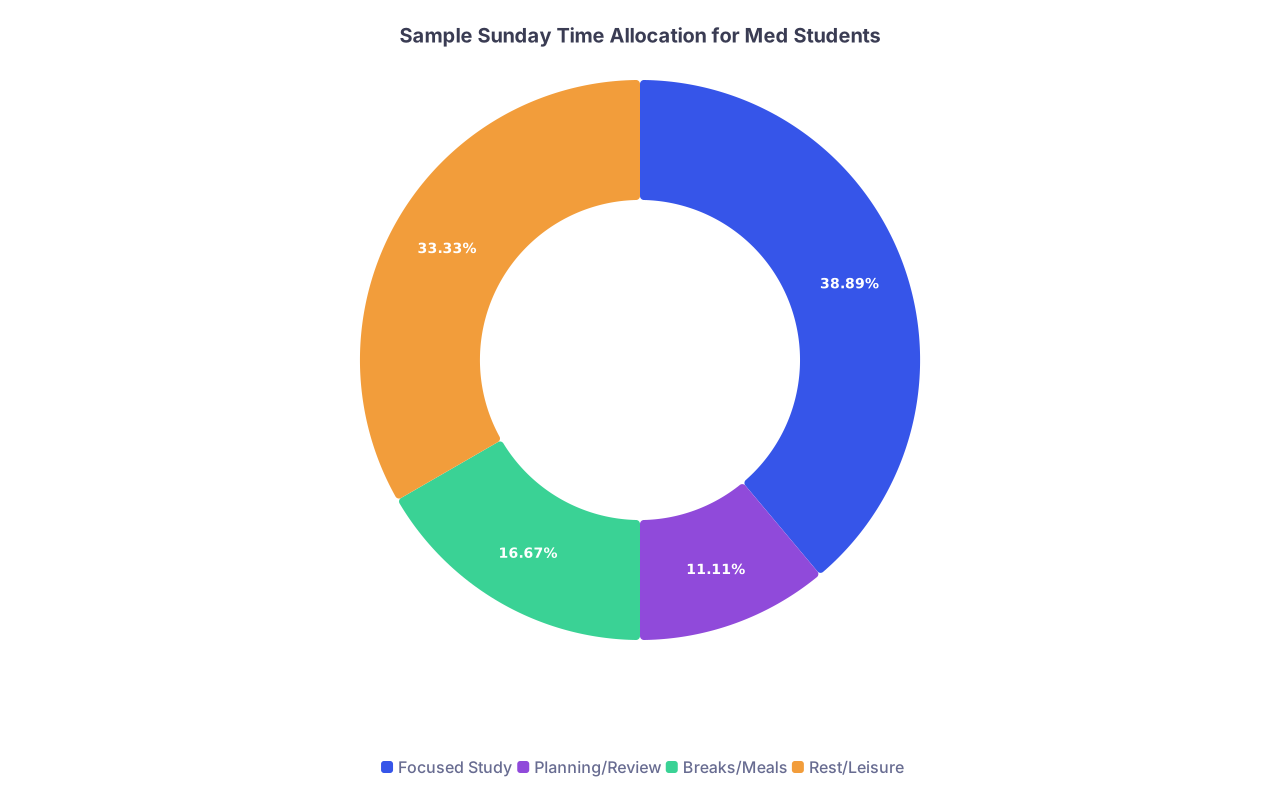
| Category | Value |
|---|---|
| Focused Study | 210 |
| Planning/Review | 60 |
| Breaks/Meals | 90 |
| Rest/Leisure | 180 |
(Values above in minutes: ~3.5h focused study, 1h planning, 1.5h breaks/meals, 3h rest/leisure.)
Step 1: Morning – single deep-focus block (2–3 hours)
You are most clear-minded earlier in the day. Use that.
Pick one main task:
- 40–60 UWorld or question bank with full review
- 1–2 tough lectures you actually watch and outline
- Rewriting high-yield notes for an upcoming block exam
- Practice cases / CCS / oral cases if clinical
Rules:
- 25–50 minute focus intervals (Pomodoro-style), then 5–10 minute breaks.
- No multitasking. No tabs open you do not need.
- Phone on Do Not Disturb, in another room.
You are not trying to conquer your entire backlog. You are reinforcing the identity of: “I can focus when I choose to.”
Step 2: Midday – movement + decent food (60–90 minutes)
Non-negotiable: get out of your chair.
- Walk, run, gym, or something that gets your heart rate up slightly.
- Then eat a non-trash meal. Not just leftover cold pizza.
Your brain is an organ sitting in a biological system that you are abusing. Stop expecting it to perform on fumes.
Step 3: Afternoon – light academic + planning (2–3 hours)
This is where you set up your week rather than react to it.
Quick review of calendar and deadlines:
- Exams, quizzes, OSCEs
- Clinic or OR days
- Early rounds, calls
- Mandatory sessions
For each day of the coming week, assign:
- 1–2 primary academic goals (e.g., “Block 3 lectures 1–3” or “60 questions + review”)
- 1–2 life tasks (e.g., groceries top-up, call landlord, 20-min clean)
Build a realistic study plan:
- If you are on surgery rotation with 5 am wakeups, you are not doing 5 hours of Anki at night. Stop pretending.
- If you are pre-clinical with more flexible time, build in protected rest or you will just fill every gap with more low-yield studying.
You want to close Sunday with clarity, not vague dread.
Step 4: Sunday evening – shut it down on purpose
This is huge. Most students “study until they crash.” That trains your brain to associate nights with anxiety and failure.
Pick a shutdown time:
- 8–9:30 pm range works for most
- Possibly earlier if you wake up super early
At shutdown:
- Close all study materials.
- Write tomorrow’s top three tasks on a sticky note or in your planner.
- Physically tidy your desk (30–60 seconds).
- Perform the same 3–4 “pre-bed” actions every night:
- Make tea
- Shower
- Stretch 5 minutes
- Read 5–10 pages of a non-medical book
You are training a pattern:
“When I do these things, the day is over. I’m safe to rest.”

| Step | Description |
|---|---|
| Step 1 | Friday Hard Stop |
| Step 2 | Brain Dump |
| Step 3 | Decompression |
| Step 4 | Sleep In with Cap |
| Step 5 | Deep Recovery Activities |
| Step 6 | Life Admin & Meal Prep |
| Step 7 | Sunday Deep Work Block |
| Step 8 | Week Planning |
| Step 9 | Sunday Shutdown Routine |
Adjustments for Different Phases and Chaos Levels
Your life is not a clean template. Exams, call, Step, shelf weeks will blow up any perfect plan. So here is how you adjust without losing the whole reset.
When you have a major exam Monday or Tuesday
You cannot take all of Saturday morning off, but you still need recovery.
Condensed version:
- Friday night: still do the brain dump, decompression, and sleep by a sane time.
- Saturday morning:
- 60–90 mins of deep recovery (sleep in, light movement, real breakfast).
- Then 3–4 hours of intense studying.
- Saturday afternoon:
- Short break + 1–2 hours life admin minimum (laundry, food).
- More studying if needed.
- Sunday:
- Two serious study blocks (3–4 hours each) separated by movement and a full meal.
- Mandatory Sunday shutdown by 9–10 pm. No all-nighter. Your recall tanks if you blow your sleep the night before.
When you are on a brutal rotation (surgery, ICU, night float)
Your bandwidth is smaller. So you shrink the protocol, not delete it.
Minimum viable reset:
- Friday (or first off-night):
- 10-minute brain dump.
- 20–30 min walk or shower + stretching.
- Decent food and early sleep.
- First free morning:
- Sleep in with a cap.
- 20 minutes of sunlight + protein.
- 30–45 minutes of movement.
- One 2–3 hour block for:
- Life admin (30–60 mins).
- Bare-minimum studying (60–90 mins).
- Sunday evening-style shutdown before your next shift.
Tiny but consistent resets beat occasional “crash for 16 hours then panic.”
Fixing the Hidden Drivers of Exhaustion
If you only change your weekend but keep sabotaging yourself all week, you will not move the needle much. Two things especially matter.
1. Stop the “study every spare second” mentality
The belief that you should be studying 100% of the time you are awake is poison.
It:
- Keeps your brain in constant guilt mode.
- Makes rest feel like failure instead of maintenance.
- Paradoxically reduces how much high-quality studying you actually do.
Instead:
- Create 2–4 defined blocks of studying on weekdays (even if only 45–60 mins each).
- Give yourself permission that outside those blocks, you are not expected to be studying constantly.
You will feel the guilt monster rear up. Ignore it. Watch your actual output improve.
2. Declare tech boundaries
Your phone and laptop are probably frying your attention more than you realize.
On weekends, especially:
- Keep your phone in another room for your:
- Friday decompression walk
- Saturday morning recovery
- Sunday deep work block
- Use app limits or grayscale screen on social media.
- Do one weekly social media fast block (e.g., Saturday 9 am–2 pm no social apps).
You are not weak for being distracted. These apps are engineered to beat your brain. You respond by controlling the environment, not relying on pure discipline.
Warning Signs You Need More Than a Weekend Reset
I am going to be blunt: a protocol will not fix everything. You may need more help if:
- You wake up exhausted even after 9–10 hours of sleep consistently.
- You are crying multiple times per week and feel numb or hopeless.
- You are thinking “If I get hit by a car and do not have to go to clinic, that would be a relief.”
- You are using alcohol, stimulants, or sedatives just to function at baseline.
- You cannot concentrate enough to read a single page or finish a simple task.
That is not “normal med school stress.” That is burnout or depression territory, and you need:
- A real conversation with Student Health or a mental health professional.
- Possibly time off, accommodations, or a reduced load.
You are not weak. You are a human in a system that often chews people up. Use the resources.
Putting It All Together: A Concrete Example Weekend
Let me give you a version you can literally copy into your planner and tweak.
Friday
- 7:30 pm – Hard stop, close laptop, backpack away.
- 7:40–8:00 – Brain dump + quick triage.
- 8:00–8:30 – Hot shower + 10-min stretching.
- 8:30–10:30 – Dinner + 1 movie with roommate.
- 11:00 – Bed.
Saturday
- 8:30 – Wake, water, breakfast.
- 9:00–9:20 – Walk outside, no phone.
- 9:30–10:15 – Yoga video + shower.
- 10:30–11:00 – Chill with coffee + non-medical book.
- 11:00–11:15 – Plan weekend: top 3 life, top 3 academic tasks.
- 11:15–1:00 – Life admin (laundry, clean room, dishes).
- 1:00–2:00 – Meal prep (chicken, rice, roasted veggies).
- 2:00–4:00 – Free time (social, hobby, reading).
- 4:00–6:00 – Optional light study (Anki review, 20 practice questions).
- Evening – Low-key hangout or alone time.
- 11:30 – Bed.
Sunday
- 8:00 – Wake, breakfast, light walk.
- 9:00–11:30 – Deep work block (40–60 questions + detailed review).
- 11:30–12:30 – Gym or longer walk.
- 12:30–1:30 – Lunch.
- 1:30–2:00 – Week planning (calendars, goals).
- 2:00–4:00 – Second study block (lectures or notes).
- 4:00–6:00 – Free time, call family, hobby.
- 7:00–8:00 – Light review only if needed (skim notes, not heavy new learning).
- 8:30 – Sunday shutdown: set Monday tasks, tidy desk, shower, read.
- 10:00 – Bed.
Is that idealized? Of course. Life will hit it. But even hitting 60–70% of that structure weekly will drastically change how “fried” you feel by Wednesday.
Your Next Step (Do This Today)
Do not just nod and move on. This only works if you make it concrete.
Right now:
- Open your calendar or planner.
- Block off:
- A Friday shutdown time
- A Saturday morning recovery block
- A Sunday deep work block + Sunday shutdown time
- In the margin, write three non-negotiables for this coming weekend:
- One recovery activity (walk, yoga, reading, etc.)
- One life admin block (laundry/clean/groceries).
- One focused academic block (questions or lectures).
You do not need a perfect weekend. You need a repeatable protocol that slowly pulls you out of chronic exhaustion.
Start by protecting just those three blocks this weekend. Build from there.