
It’s 11:47 PM in your shared apartment. You told yourself you’d be asleep by 11.
Your roommate just casually mentioned they finished UWorld for the second time and “might start Anking biochem again just to tighten up weak spots.”
You still have 600 questions left.
You were feeling okay before that sentence. Now your chest is tight, your brain’s spiraling, and your bedroom suddenly feels like a pressure cooker with IKEA furniture.
You live together. You’re on similar timelines. Exams, OSCEs, research, maybe even the same specialty in mind. And whether anyone admits it or not, there’s this low-level (or not-so-low-level) competition running under everything—who scores higher, who gets more interviews, who faculty like more.
You are not crazy for feeling this. But if you do not get a handle on it, it will absolutely poison both:
Let’s get specific about what to do when the competition with your med student roommate is starting to wreck you.
Step 1: Get Clear on What Is Actually Hurting You
You cannot fix “vibes.” You can fix patterns.
Sit down, no phone, 10 minutes. Write down the situations that spike your anxiety or resentment around your roommate.
Common patterns I’ve seen:
- Score comparisons:
“What’d you get on NBME 20?” → You answer → They flex or “oh wow, that’s… not bad” - Study-hour comparisons:
They brag about 12-hour days while you hit a hard physical/mental wall at 8. - Constant productivity talk:
Every meal becomes an update about who did how many questions, Anki reviews, research emails. - Specialty one-upmanship:
You say “I’m thinking about derm” → They respond with “Yeah but you know it’s super competitive, right? My advisor thinks I’m a strong candidate.” - Passive-aggressive comments:
“I could never sleep 8 hours during dedicated, I’d be way too behind.” - Social media comparison inside your own home:
Shared group chats with classmates where everyone posts their achievements, and then you sit in the same living room silently judging yourself against your roommate’s performance in that same chat.
Name 3–5 specific triggers. That’s your starting list.
Now sort them:
- Things they say or do
- Things that are more about your internal insecurity
Both matter. But they require different solutions.
Step 2: Decide What This Relationship Actually Is
You need to be brutally honest about the type of relationship you have with this person.
Are they:
- A friend you live with
- A tolerable housemate
- Low-key rival
- Emotionally unsafe / toxic
Do not label them “best friend” just because you split utilities and anatomy flashbacks.
Why this matters:
You will set different boundaries with a friend than with a purely transactional roommate.
If you barely like each other, stop expecting emotional support and deep understanding. Focus on:
- Clear, respectful boundaries
- Minimal friction
- Protecting your own headspace
If you actually do care about each other, then you owe each other one real conversation instead of passive internal rage for two years.
Step 3: Hard Boundaries Around Study Talk
If competition is killing you, your apartment cannot be a 24/7 study comparison arena. Period.
You don’t have to live like that. You’re allowed to say no.
Here’s a very simple rule that saves people:
- No routine score comparison
- No “how many questions did you do today?”
- No live commentary on who is “ahead” or “behind”
You can literally say this to them:
“Hey, I’ve realized that comparing study stuff at home is making me really anxious and it’s messing with my sleep. I want home to be more of a neutral space. Can we avoid talking about scores, how many questions we did, and who’s ahead? I’m not mad at you—this is just me trying to keep my brain from melting.”
That’s honest, non-accusatory, and clear. You don’t need a TED talk. Two or three sentences are enough.
If they respond well, good sign.
If they get defensive or mocking—also useful data about who you’re living with.

If they keep breaking that boundary:
- Shut it down as soon as it starts.
“I’m not doing score talk at home, remember?” - Change the subject.
- Leave the room if they push.
You don’t argue about the rule. You just enforce it.
Step 4: Create Separate Study Ecosystems
Competition ramps up when your entire workflow is visible to each other. Every Anki session, every Pomodoro timer, every mid-day nap.
If possible, physically separate your study routines.
Ideas that actually work:
- Different primary study locations
You take the med school library. They can have the apartment. Or vice versa. - Different time blocks
You’re a morning person, they’re a night owl? Lean into that. Avoid overlapping heavy study windows. - Different tools / platforms
Stop using their exact method as a yardstick for your worth. If their 10k-card Anki deck is choking you, find a method that suits your brain, not your ego.
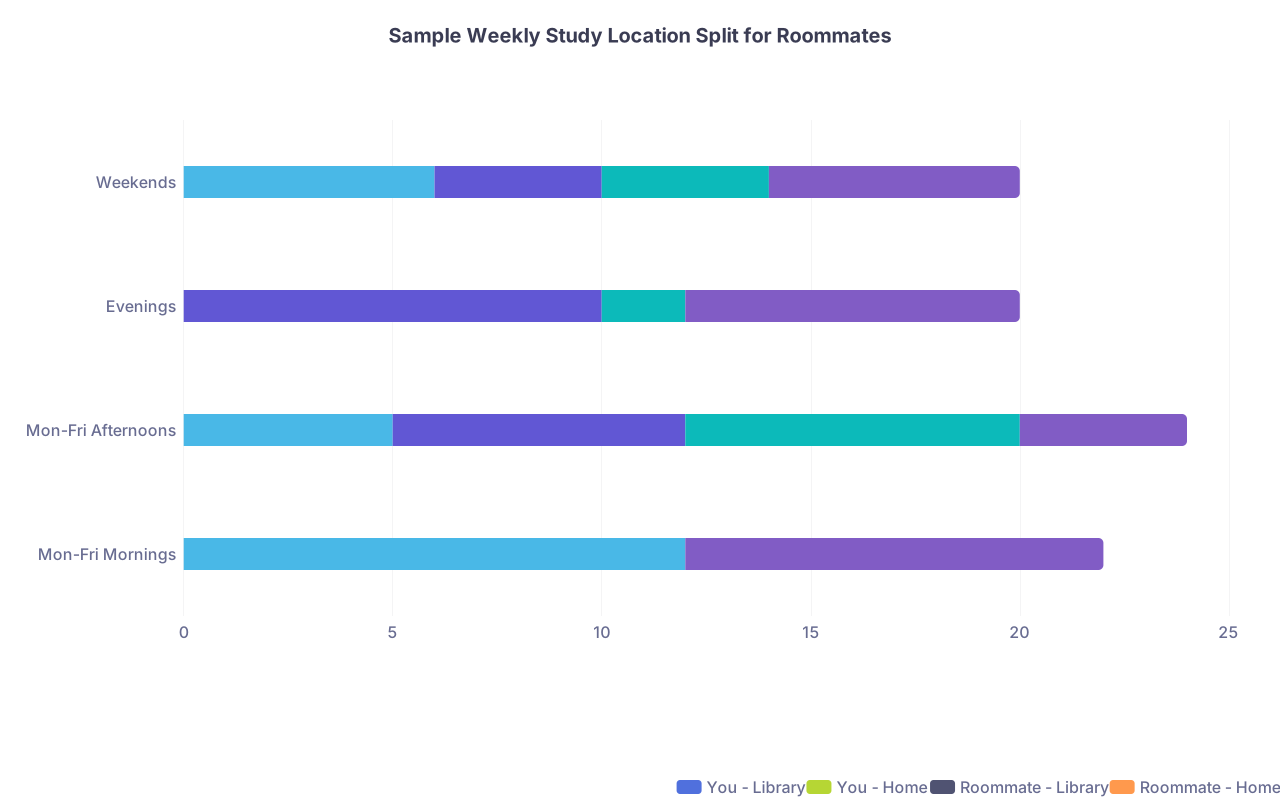
| Category | You - Library | You - Home | Roommate - Library | Roommate - Home |
|---|---|---|---|---|
| Mon-Fri Mornings | 12 | 0 | 0 | 10 |
| Mon-Fri Afternoons | 5 | 7 | 8 | 4 |
| Evenings | 0 | 10 | 2 | 8 |
| Weekends | 6 | 4 | 4 | 6 |
The point: you should not have a live scoreboard of “who is sitting with First Aid open more” in your living room. You need some opacity.
And do not underestimate this:
Just not seeing their grind 24/7 will reduce your anxiety more than another 50 UWorld questions ever will.
Step 5: Stop Doing the One Thing That Always Makes It Worse
You know exactly what I’m about to say: stop asking about their scores.
You might phrase it like:
- “How’d it go?”
- “Did you feel good about it?”
- “Did you pass?”
You’re not fooling anyone. Your brain is begging for a number to compare against.
Here’s the problem:
If they did better than you → you feel like garbage.
If they did worse than you → there’s temporary relief… then guilt or pressure to “maintain the lead.”
No one wins that game.
So adopt a new script:
They: “I got my score back.”
You: “Nice. I’m not checking mine for a bit, trying not to obsess. Want to celebrate with takeout later if you’re happy with it?”
You’re allowed to opt out. It’s not rude. It’s self-protection.
Same rule for practice exams, OSCE evaluations, clerkship grades. You don’t need to know. Their number doesn’t change what you have to do next anyway.
Step 6: Build a Support System That Isn’t Your Roommate
Big mistake: using your med student roommate as your default emotional dumping ground about school.
Why?
Because if competition is already baked in, the support feels tainted. You’re half-venting, half-performing.
You need at least one of each:
- Someone inside medicine who’s not competing directly with you
A classmate you’re not living with, someone in another year, or a friend at a different school. - Someone outside medicine
Sibling, partner, old college friend. People who do not care what your UWorld percentage is.
And if your anxiety, sleep, or functioning is clearly dropping:
Get a therapist. Yes, a real one, not “I listened to a podcast.” Preferably someone who has worked with med students or high-performance anxiety.
You cannot expect your roommate to be your:
- Friend
- Study buddy
- Therapist
- Rival
All at once. That’s a structural problem, not a willpower issue.
Step 7: Redefine What “Competition” Actually Is For You
Here’s the nasty thought that’s probably sitting at the bottom of this:
“If they do better, it means I’m worse.”
That’s not pressure. That’s a zero-sum worldview. It’s also wrong.
Reality:
- Both of you can match.
- Both of you can do well.
- Both of you can get good letters, strong evals, solid scores.
Residency is not choosing between “you or them.” Programs do not get a dossier that says: “Pick exactly one of these two roommates.”
So you have a choice:
- Use them as a constant comparison mirror
- Use them as a loose benchmark and then refocus on your lane
What that looks like in practice:
- You know roughly what score range your school/tutors recommend for your specialty. That’s your target. Not your roommate’s last NBME.
- You know your own weak areas. That’s what determines your study plan. Not what they’re reviewing today.
- You track your own progress trend: NBME 1 → 2 → 3. Are you improving? Yes or no? That’s the only productive competition.
If you absolutely can’t stop comparing, do it in a contained way:
- Once a month, check in with yourself only:
“Compared to last month, where am I?” - Limit “other people data” to what’s actually useful (e.g., a general idea of score ranges people matching into your specialty have), not your roommate’s daily stats.
Step 8: Have the Hard Conversation if Resentment Is Building
If every time they walk in the door you feel your jaw tighten, you have a problem that will not stay invisible. It will come out sideways.
When to talk:
- You’re replaying their comments in your head at night
- You’re avoiding common areas completely
- You’re venting about them to everyone except them
How to structure that conversation so it doesn’t turn into a blame war:
- Lead with your own experience, not their character.
- Be specific.
- Ask for concrete changes.
Example:
“I want to bring something up before it turns into bigger resentment. When we’re constantly talking about who did how many questions or who’s ahead, I end up feeling really anxious and behind. I know you’re not trying to make me feel bad, but I need home to feel less like an exam scoreboard. Can we agree to cut back on that kind of talk and keep most of the med school comparison stuff out of the apartment?”
If they respond maturely, good. You can then negotiate:
- Maybe you both agree no med school talk after 8 PM.
- Or no direct “what was your score?” questions.
If they say things like:
- “You’re just being sensitive”
- “It’s not that deep”
- “This is med school, get used to it”
Then you have your answer: this is not a safe emotional space. Treat it like a functional roommate situation, not a friend or ally. Protect your peace accordingly.
Step 9: Build a Home Identity That Isn’t Just “Two Med Students”
If the only thing you do together is study, talk about exams, and complain about attendings, of course competition will dominate. You’ve given it nothing else to be.
You need at least 1–2 shared non-medical things that are “roommate stuff,” not “classmate stuff.”
Think small and low-key:
- Weekly cheap takeout + trash TV
- Morning coffee walk on Sundays where exam talk is banned
- 20-minute shared workout a couple times a week
- Cooking one meal together on a specific day
Nothing elaborate. Just something that reminds your brain: “This person isn’t only my competitor; they’re also my co-human living in this box with me.”

| Step | Description |
|---|---|
| Step 1 | Med School Day |
| Step 2 | Study in Separate Spaces |
| Step 3 | Return Home |
| Step 4 | No Med Talk Rule |
| Step 5 | Brief Logistics Chat |
| Step 6 | Shared Activity - Meal, TV, Walk |
| Step 7 | Sleep Without Comparison Spiral |
| Step 8 | After 8 PM? |
This doesn’t make competition vanish. But it stops it from being the only defining feature of your relationship.
Step 10: Have an Exit Strategy (Especially Before Dedicated or Match Season)
Sometimes the healthiest move is to admit: living with this person at this stage of training is not good for you.
You don’t need them to be evil or abusive for that to be true. They can be a perfectly decent human who just happens to trigger every insecurity you have.
When to seriously consider moving out:
- Your sleep is consistently wrecked by comparison spirals
- You’re hiding your own successes to avoid triggering weirdness
- Their comments are increasingly cutting, competitive, or dismissive
- You’ve tried a boundaries talk and nothing changed
If dedicated Step/Level studying is coming up, that’s a natural “break point” to restructure living arrangements.
Have a clean conversation:
“Hey, I’ve been thinking about next year and what I need to protect my sanity for dedicated and rotations. I’m going to look for a different living situation. It’s not personal drama; I just need my home to feel less tied to school. Wanted to tell you early so you have time to plan too.”
You do not need to convince them. You inform them. Then you act.
Yes, moving is annoying and expensive. But so is burnout, failed exams, or a destroyed friendship.

Step 11: Take Back Your Headspace, On Purpose
You can’t change your roommate’s brain. You can change what you feed your own.
Start doing these, consistently:
- Single-player metrics only
Track your own: daily question count, accuracy, sleep hours, mood. Compare you vs. last week, not you vs. roommate. - Protected non-med time daily
30–60 minutes where you are not allowed to touch Anki, talk about school, or scroll med Twitter/Reddit. - Explicit self-reminders when your brain starts the comparison spiral:
- “Their pace is not my pace.”
- “Residency doesn’t make me choose between us.”
- “My job is to do my work for today. That’s it.”
And if you find yourself constantly thinking, “I’ll be okay once I out-perform them,” you’ve just discovered why you’re miserable. You’re outsourcing your self-worth to somebody else’s life.
Pull it back.
Quick Recap: What Actually Helps
Cut through everything above and you’re left with three main moves:
Protect your space.
Limit med school comparison talk at home. Use separate study ecosystems. Home is not a live scoreboard.Have the real conversation.
Name what’s happening. Ask for concrete changes. If they can’t or won’t meet you halfway, downgrade the relationship to “functional roommate” in your own mind.Choose your lane and stay in it.
Track your own progress, your own needs, your own pace. Their success or failure is not your grading rubric.
If competition with your roommate is killing you, it doesn’t mean you’re weak. It means you’re human, in a pressure cooker, sharing a very small world with someone running the same race.
You don’t have to move out tomorrow. But you do need to stop letting their trajectory dictate your worth.