
The most dangerous mental health mistake med students make isn’t not asking for help. It’s asking for help badly.
You finally hit the wall. Sleep is wrecked, you’re crying between practice questions, your brain feels like it’s packed in cement. You do the “right” thing: you reach out. And then…
You pick the wrong person. Or say the wrong thing. Or understate what’s actually happening.
And you walk away with nothing. Maybe even worse off.
This is the mess I want you to avoid.
You’re not only fighting your own brain; you’re fighting a system that often responds poorly to vulnerability. If you don’t understand the common mistakes med students make after they take the huge step of asking for help, you can get burned. Sometimes badly.
Let’s walk through the traps so you don’t step in them.
1. Waiting Until You’re In Freefall Before Speaking Up
Let me be blunt: asking for help only when you’re at rock bottom is a terrible strategy.
Most students do this. You tell yourself:
- “Let me just get through this block.”
- “It’s just stress; everyone is struggling.”
- “I’ll talk to someone if I fail this exam. I’ll be fine if I pass.”
By the time you finally reach out:
- You’re not sleeping more than 3–4 hours.
- You’ve stopped eating or you’re bingeing garbage.
- You haven’t done laundry in three weeks and your room looks like a storage unit.
- You’re dissociating in lecture and can’t remember what was just said.
At that point, you’re not asking for support. You’re asking for rescue.
Here’s what goes wrong when you wait too long:
- You can’t explain your symptoms clearly. Everything feels like “I’m just overwhelmed.”
- You’re more likely to minimize or crack jokes because the real thing is terrifying.
- The fix is no longer small adjustments. You might need time off, meds, formal treatment.
The system will often respond more dramatically too:
- Administration may talk about leaves of absence.
- You’re more likely to get flagged as “concerning.”
- Your functioning is so impaired that quick wins aren’t realistic.
Better approach:
Treat mental health like any other medical condition you’d manage in a patient.
You would never say, “Let’s wait until your A1c is 12 and you can’t feel your feet, then we’ll talk.”
Don’t do that to yourself.
Ask for help when:
- You’ve had >2–3 weeks of worsening sleep, anxiety, or mood.
- Your studying drops off and you can’t get it back on track.
- You start having thoughts like, “If I got hit by a bus tomorrow, it wouldn’t be so bad.”
The earlier you speak up, the more options you keep.
2. Going to the Wrong Person First (and Getting Burned)
Another common mistake: telling the wrong person first, then deciding “help doesn’t help.”
I’ve watched students unload serious distress to:
- The most malignant attending in the department
- A clerkship director who comments on “resilience” like it’s a moral issue
- A class group chat (yes, really)
- Their evaluator on a rotation
And then be shocked when it goes sideways.
You need to separate:
- Emotional support people (friends, family, partner, safe faculty)
- Institutional support people (student wellness, dean of students, disability services)
- People who are rating you (attendings, preceptors, grading faculty, some deans)
Those last ones? Do not lead with your worst vulnerabilities. Not until you know they’re safe and not in direct control of your eval or future.
Typical bad outcomes of telling the wrong person:
- You get dismissed: “This is just how med school is; you’ll be fine.”
- You get pathologized: “Maybe you’re not cut out for this.”
- You get exposed: they share more than you realized they would.
- You get labeled: suddenly you’re the “unstable one.”
Better approach:
Start with relatively lower-risk options:
- Confidential therapist (campus counseling if they’re separate from eval, or off-campus)
- A trusted upperclassman who has actually used mental health resources
- A faculty mentor explicitly known as “safe” (ask quietly; students know who)
And when it is the right time to loop in administration, you do it strategically, not impulsively after a bad test or meltdown.
3. Minimizing or Vague-Talking When You Finally Get in the Room
Here’s a painful one: you finally get in front of a therapist, counselor, dean, whoever.
They ask, “So what’s going on?”
You answer:
- “I’m just kind of stressed.”
- “I’ve just been a bit off.”
- “Exams have been rough, that’s all.”
This is the equivalent of a patient coming into the ED with crushing chest pain and saying, “It’s like, a little discomfort, I guess.”
What happens then?
- The clinician underestimates the severity.
- You don’t get the accommodations, meds, or follow-up you actually need.
- You walk away thinking, “See? I’m just weak. Nothing is wrong enough.”
You do not need to dramatize. You do need to be specific.
Instead of “I’m overwhelmed,” say things like:
- “I’ve had passive thoughts that I don’t care if I wake up, 3–4 times a week.”
- “I used to study 6–8 hours most days; now I stare at Anki for 2 hours and get nothing done.”
- “I’ve lost 10 lbs in a month without trying because I forget to eat.”
- “I’m sleeping at 3–4 a.m. daily even though I’m exhausted.”
If suicidal thoughts are present, say them clearly:
- “I’ve thought about not wanting to live.”
- “I’ve thought about methods, but I don’t have a plan or intent.”
- “I’ve had a plan and sometimes I feel close to acting on it.”
No clinician worth anything will punish that honesty. They need that data. Do not self-edit into invisibility.
4. Treating One Conversation as a Magic Fix
Another self-sabotage pattern: treating the act of asking for help as if it’s the treatment itself.
You tell yourself:
- “I finally told someone. I should feel better now.”
- “I had my intake at counseling; guess that’s handled.”
- “The dean knows what’s going on, so things will probably improve.”
Then nothing changes because:
- You don’t actually follow through on therapy homework.
- You never schedule the psych referral.
- You continue the same self-destruction study schedule.
- You ignore every recommendation that feels “too much” (like time off or reduced load).
Then you decide:
“See? Help doesn’t work. I just need to tough it out.”
No. You treated the intake like the intervention.
Mental health support is a process, not a one-off catharsis session.
You need to:
- Show up repeatedly, not just that first time.
- Be willing to try things for more than two days.
- Reassess what’s working and what’s not.
- Adjust expectations. You don’t fix 9 months of collapse in 2 therapy sessions.
Think of it like rehab after an ACL tear. Showing up once to the PT evaluation doesn’t fix anything. But a ton of med students stop right after that first conversation and then blame the system.
5. Confusing “Help” With “Academic Rescue”
This one is vicious because med school bakes it into the culture.
You go ask for help and your real goal (that you don’t say out loud) is:
- “I need to pass this exam.”
- “I need to not repeat this year.”
- “I need to not mess up my match chances.”
So you present mental health distress as a subordinate problem: “I’m stressed because I’m not doing well academically.”
Sometimes that’s true. But frequently, it’s the other way around: “I’m not doing well academically because my mental health is tanked.”
If you go in focused on “fix my grades,” you’ll get:
- Study tips
- Time management advice
- Suggestions to meet with a learning specialist
- Pep talks about “resilience” and “growth mindset”
Sounds good. Totally misses the point if you’re actually depressed, anxious, burned out, or traumatized.
You need to be clear about primary vs secondary issues:
- “Yes, my grades are slipping. But the core problem is I’m not sleeping, I’m crying daily, and I feel hopeless.”
- “I’d like academic help and mental health support. If I fix only the studying but not my mood, this will just repeat.”
Do not let your mental health be reduced to a study skills issue. That’s a fast road to delayed treatment.
6. Ignoring Confidentiality and Documentation Landmines
A huge, and very real, fear: “If I tell them the truth, this will go in my record and ruin my career.”
This fear makes students:
- Lie or half-tell to mental health providers affiliated with the school
- Avoid documentation of accommodations they actually need
- Refuse to discuss suicidal thoughts, even when they’re daily
The irony? Sometimes this avoidance creates worse outcomes.
Here’s what students often get wrong:
Common misunderstandings
“Everything I say to anyone at the school is in my permanent record.”
Wrong. Therapy records and educational records are not automatically the same. But you must clarify where counseling is housed and who has access.“If I ever see a psychiatrist, I’ll have to report it for licensing.”
In most jurisdictions, the question is about current impairment, not historic treatment. Getting treated often makes you a lower risk in the eyes of licensing boards than untreated, concealed illness.“If I ask for accommodations, programs will see that and blacklist me.”
Properly handled, programs usually see the accommodation in action, not the diagnostic backstory.
The actual mistake is this:
Not asking explicitly and early about confidentiality and documentation.
Before you pour your heart out, say:
- “I need to understand how this visit is documented.”
- “Who has access to this record—just you, or anyone in the dean’s office?”
- “If I request accommodations, what exactly is shared with faculty? Diagnosis? Just functional limitations?”
You’re not being difficult. You’re being smart.
Once you know the lanes:
- Use confidential services for clinical care.
- Use the dean’s office/disability services to translate clinical needs into accommodations — not as therapy.
7. Taking the First Dismissive Response as the Final Verdict
I’ve seen this so many times it makes me angry.
Student opens up.
Admin or faculty says something like:
- “Everyone feels like that during Step prep.”
- “This is just part of the process.”
- “You’re stronger than you think. You’ll get through it.”
- “We all went through this and turned out fine.”
Student hears: “You’re being dramatic. This isn’t real.”
Then they shut down and don’t ask again for two years.
Let me be very clear: a dismissive response does not mean your problem isn’t real.
It means you picked the wrong audience.
Do not let one bad or lazy response be the final word on your mental health.
If you get brushed off:
- Treat that interaction as data about that person, not data about your worth or severity.
- Say (if you can), “I understand others struggle too, but I’m concerned about [X concrete symptom]. Who would be the best person to talk to about that?”
- After the meeting, write down what happened. Then go to someone else better suited: therapist, another dean, student wellness, outside provider.
You’d get a second opinion for a weird MRI finding. Get a second opinion on your mental health, too.
8. Asking for Help… and Then Hiding Everything From Your Support System
Another quiet mistake: you go to a professional for help, but you don’t tell anyone in your life what’s actually going on.
So:
- Your partner thinks you’re just “busy.”
- Your friends think you’re just “hardcore about Step.”
- Your family thinks “this is just med school stress.”
You’re trying to “fix it privately” so no one worries, while you are:
- Starting SSRIs alone without anyone around who knows your baseline.
- Having dark suicidal thoughts at 2 a.m. with no one aware.
- Missing classes and exams while pretending to everyone else that things are normal.
That’s how students end up in quiet crises that shock everyone later.
You don’t need to broadcast everything. But you should have:
- At least one person in your daily life who knows the truth.
- Someone who knows your warning signs and what to do if things escalate.
- Someone who can sanity-check your decisions when you’re not thinking clearly.
Tell them in simple language:
- “I’m seeing a therapist and maybe starting meds. I’m safe right now, but if I start saying [X, Y, Z], that means I’m not okay and I need help.”
- “If I start disappearing from texts, skipping everything, and not answering the phone, that’s a red flag.”
Isolation kills momentum. And sometimes people.
9. Refusing “Big” Interventions Out of Fear of Falling Behind
This one is brutal and extremely common:
You’re offered a leave of absence, reduced course load, or deferral of an exam. And you refuse, not because you’re well enough, but because you’re terrified of:
- Being “the one who couldn’t handle it”
- Graduating a year later than your friends
- “Ruining” your match chances
- Having an ugly gap in your CV
So you push on. Half-functioning. Barely hanging on.
And then:
- You fail more exams.
- Your evals start showing “professionalism” concerns from things like being late, snappy, or dissociated.
- Your Step score tanks because you studied in a fog.
You didn’t “save” time. You compounded damage.
Look at it in cold numbers:
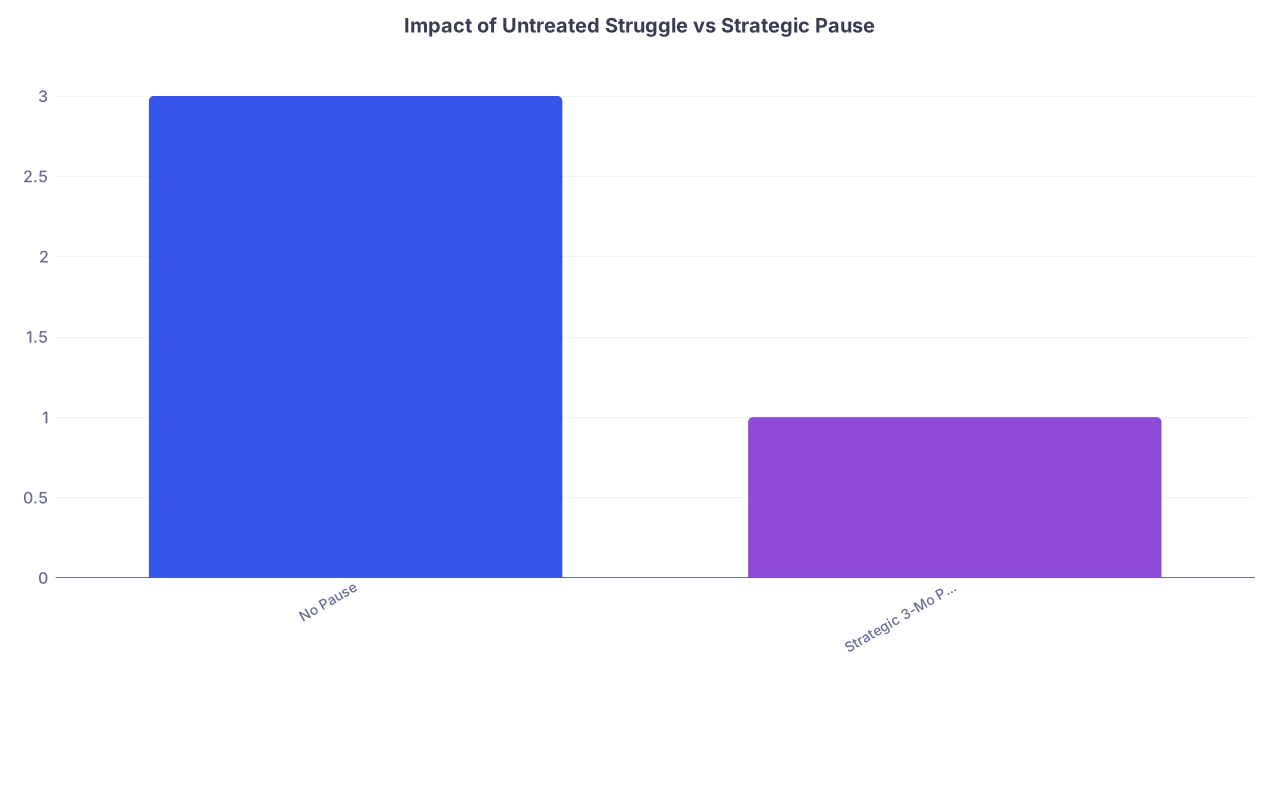
| Category | Value |
|---|---|
| No Pause | 3 |
| Strategic 3-Mo Pause | 1 |
Interpretation:
- “No Pause” → multiple failed exams, remediation, possible repeat year (3+ long-term consequences)
- “Strategic 3-Mo Pause” → one controlled delay with support (1 major consequence, often well-managed)
A clean, intentional break with documentation and support looks better than a chaotic string of failures. Program directors know the difference between:
- “Took a documented LOA for health, came back strong”
vs - “Consistent poor performance and red flags with no clear explanation.”
Do not reject strong interventions solely out of fear of optics. At least have the honest conversation:
“What happens if I don’t do this? What’s the realistic trajectory?”
10. Over-Correcting: Turning Help-Seeking Into Learned Helplessness
Last trap: once some students finally ask for help and get support, they swing too far.
They start offloading every decision:
- “What do you think I should do?”
- “Just tell me whether to defer this exam or not.”
- “You decide what rotations I should take.”
You’re exhausted, so it feels easier to hand over the steering wheel. But then:
- You feel more and more like a passive object in your own life.
- Your sense of competence erodes.
- Every new stressor feels impossible without external approval.
The goal of getting help is not to outsource your life. It’s to get your feet back under you so you can make your own decisions sustainably.
What that looks like in practice:
- Ask providers for options and pros/cons, not commands.
- Say, “Given [X, Y, Z], here’s what I’m leaning toward. Does that seem reasonable?”
- Use support to amplify your agency, not erase it.
There’s a big difference between:
- “Fix me.”
and - “Work with me so I can fix my life.”
Aim for the second.

Quick Comparison: Smart vs Self-Sabotaging Help-Seeking
| Situation | Risky Response | Better Response |
|---|---|---|
| Early insomnia & anxiety | “Push through, talk later if I fail.” | Schedule counseling within 1–2 weeks |
| First bad conversation with admin | “Guess I’m just weak.” | Seek second opinion from therapist/mentor |
| Offered short leave of absence | Refuse to avoid ‘falling behind’ | Consider structured LOA with clear plan |
| Suicidal thoughts emerge | Hide them from everyone | Tell therapist + one trusted person clearly |
| Confused about records/privacy | Assume worst, avoid all help | Ask specific questions about confidentiality |

| Step | Description |
|---|---|
| Step 1 | Notice Persistent Struggle |
| Step 2 | Document Symptoms & Duration |
| Step 3 | Choose Safe First Contact |
| Step 4 | See Therapist/Psych |
| Step 5 | Learning Specialist + Check Mental Health |
| Step 6 | Clarify Confidentiality |
| Step 7 | Follow Up Regularly |
| Step 8 | Discuss Accommodations/LOA with Dean |
| Step 9 | Maintain Supports & Monitoring |
| Step 10 | Clinical vs Academic Issue? |
| Step 11 | Function Still Impaired? |

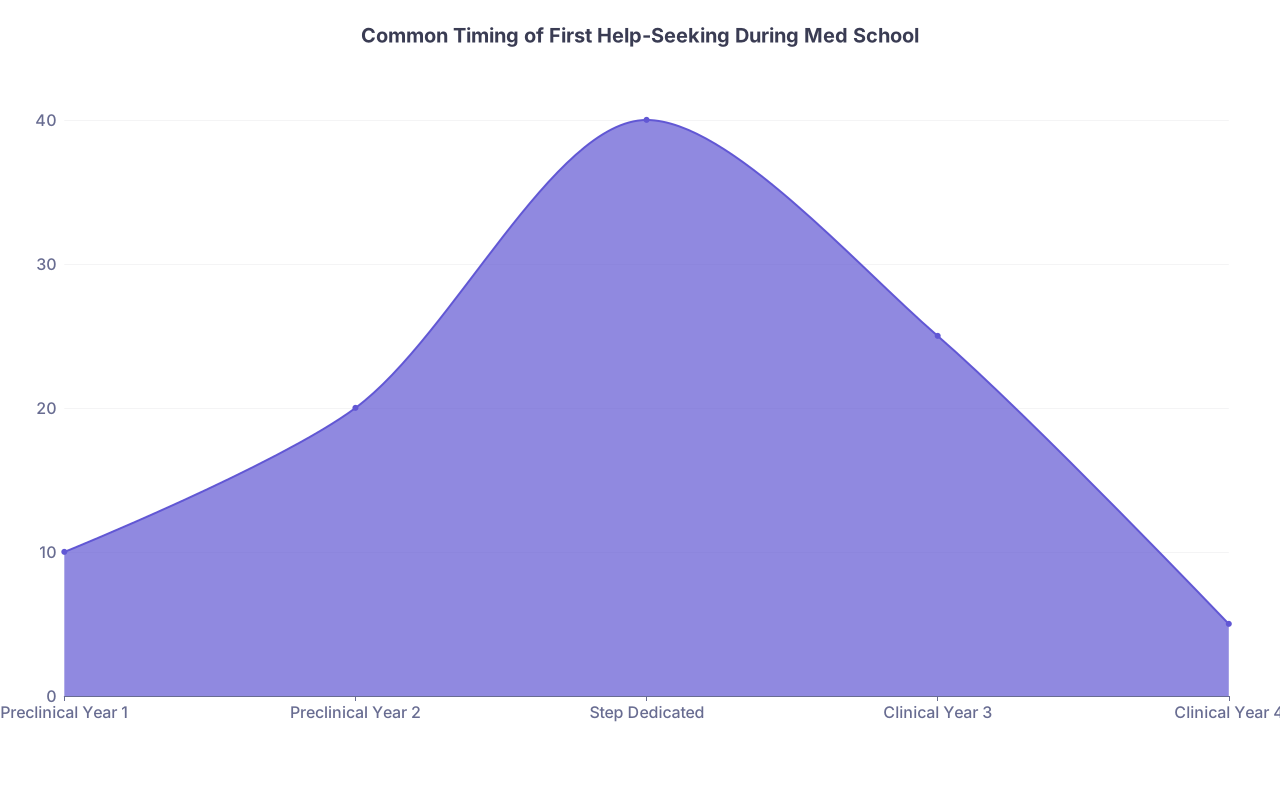
| Category | Value |
|---|---|
| Preclinical Year 1 | 10 |
| Preclinical Year 2 | 20 |
| Step Dedicated | 40 |
| Clinical Year 3 | 25 |
| Clinical Year 4 | 5 |
(Interpretation: Most students wait until things are very high-stakes—Step or third year—before asking for help. That’s late.)

FAQs (Exactly 3)
1. Will getting mental health treatment in med school ruin my chances for residency or licensing?
No, not by default. What worries residency programs and licensing boards is untreated, impairing illness, not responsible treatment. Most licensing forms now focus on current impairment and ability to practice safely, not “have you ever seen a therapist.” If you’re unsure, talk to a physician who’s involved in licensing or a trusted psychiatrist; they know how this is handled in your state and specialty. Hiding serious symptoms is usually the bigger long-term risk.
2. How do I know if what I’m feeling is “bad enough” to ask for help?
If you’re asking that question, you’re already close. Concrete red flags:
- Symptoms (sleep, mood, anxiety, concentration) worsening for >2 weeks
- Daily or near-daily crying, panic, or feeling numb
- Thoughts like “I don’t care if I wake up” or “They’d be better off without me”
- You can’t study at anything close to your previous baseline That’s enough. You don’t need to wait until you’re failing or actively suicidal. Ask early; best case, they tell you it’s mild and give you tools. That’s not a waste—that’s prevention.
3. What if I ask for help and the first person isn’t helpful or makes me feel worse?
Then they’ve told you something about them, not about you. Don’t stop there. Treat it like getting a bad fit with a doctor—you find another one. Try a different counselor, another dean, an outside therapist, or a faculty mentor students trust. You’re allowed to say, “That wasn’t helpful; I’m going to try someone else.” One dismissive or clueless response should never be the final verdict on your mental health.
If you remember nothing else:
- Don’t wait for rock bottom before you ask for help. Early is safer, easier, and less career-disruptive.
- Be specific and honest with the right people, and don’t let one bad response shut you down.
- Use help to regain agency, not surrender it—your goal is to get back in control of your life, not hand it over.