
Most program directors are not automatically scared of a mental health leave. They’re scared of what you try to hide.
Let me tell you how this really works behind closed doors, in the rooms where rank lists get made and files get quietly pushed into the “no” pile.
What PDs See Before They Ever Hear Your Story
First reality: most PDs barely have time to eat lunch, let alone psychoanalyze every line of your application. They skim. Fast. And there are certain things that flag an application for closer inspection.
A leave of absence is one of those flags.
Not because it’s “bad,” but because it raises unspoken questions:
- Did they fall apart under stress?
- Did they come back and function?
- Is this going to repeat during intern year when the stakes are real?
- Are they a professionalism risk?
- Are they hiding something bigger?
Nobody says it exactly like that in the committee notes, but that is the internal monologue.
Here’s what PDs actually see on their end:
| Element | What PD Sees at First Pass |
|---|---|
| Medical school transcript | Term(s) marked LOA or "Leave" |
| MSPE (Dean’s Letter) | One or two sentences about a leave |
| ERAS application timeline | Extended graduation year |
| Your personal statement | May or may not mention the leave |
| Interview conversation | How you explain it in real time |
If your transcript shows “Leave of Absence – 8 months” and your MSPE says, “The student took a personal leave during second year and returned in good academic standing,” that’s neutral. Not good, not bad. Just a question mark.
What PDs do next depends entirely on how you handle that question mark.
The Truth About Mental Health Stigma Among PDs
There’s a split reality here that nobody tells students clearly.
Official line from institutions:
“We fully support students seeking help for mental health. No stigma.”
Unofficial line from a portion of PDs and senior faculty:
“We support mental health… but please don’t give me a resident who’s going to fall apart in October and leave me with uncovered calls.”
Both exist. At the same time.
The younger PDs and APDs who’ve trained in the last 10–15 years? Many of them are openly sympathetic. They remember friends going on SSRIs during Step 1, they themselves have seen therapists. They’ve watched too many residents die by suicide to dismiss mental health as “weakness.”
The older school, especially in some surgical and procedural specialties? Some still quietly equate “mental health leave” with “unstable,” even if they don’t say it out loud. They’re slowly being outnumbered, but they exist.
Here’s the part students underestimate: PDs care less about what diagnosis you had and more about what your behavior looked like and what your performance looks like after the leave.
- If your leave was voluntary, documented, you got treatment, and your performance afterward is steady or stronger → many PDs see that as a positive indicator of insight and resilience.
- If your leave followed major professionalism issues, absences, failed courses, or someone being forced to pull you out → that’s different. Now they’re thinking “pattern,” not “episode.”
I’ve sat in rooms where PDs have said things like:
- “I don’t mind that they took a leave. I mind that nobody can explain what changed when they came back.”
- “I’m not worried about depression; I’m worried about unreliability.”
That’s what you’re up against.
How Timing and Context Change the Whole Story
Not all leaves are interpreted the same. Timing matters. Context matters more.
Let’s break down how a PD often reads different scenarios, even though they won’t say this publicly.
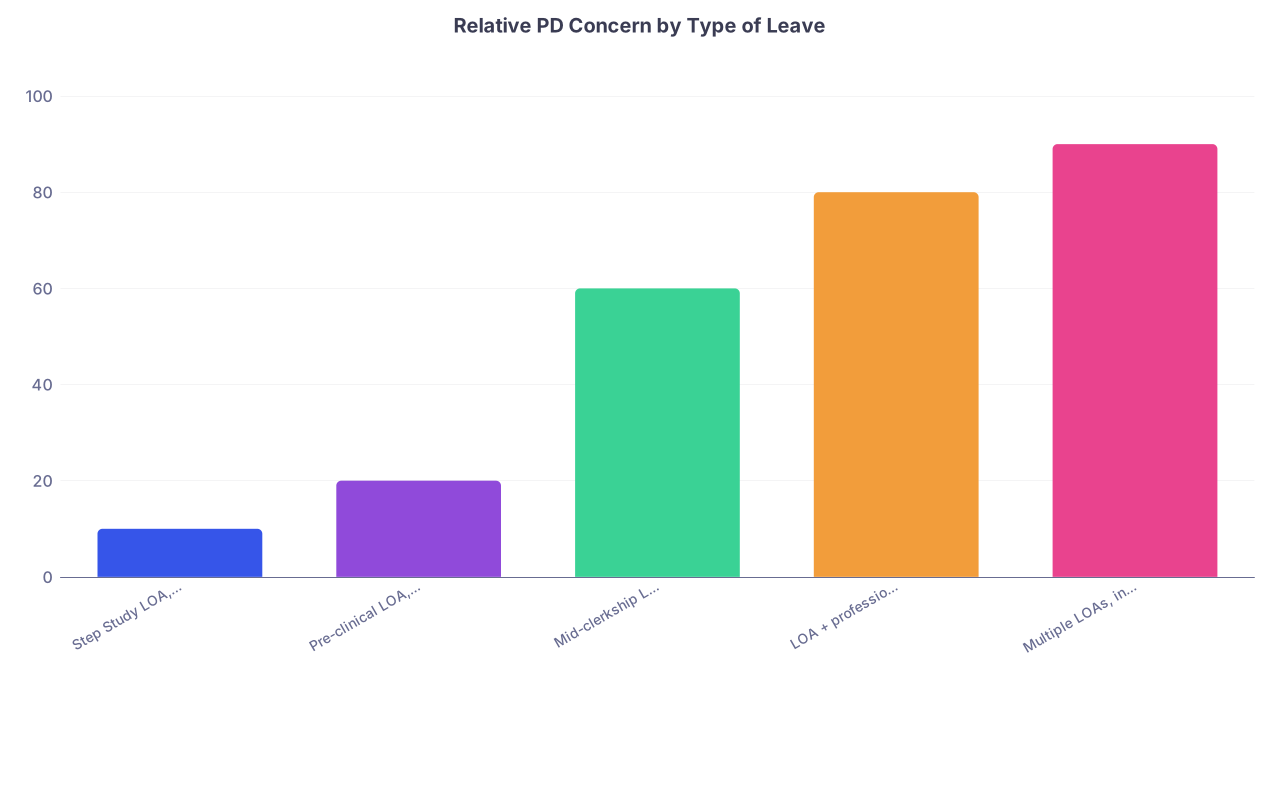
| Category | Value |
|---|---|
| Step Study LOA, smooth return | 10 |
| Pre-clinical LOA, now honors in clerkships | 20 |
| Mid-clerkship LOA with failures | 60 |
| LOA + professionalism issues | 80 |
| Multiple LOAs, inconsistent story | 90 |
Low numbers = low concern. High = major red flag.
Scenario 1: Pre-clinical Leave, Clean Return
Example:
You took a 6–12 month leave in M2 for depression or anxiety, got treatment, repeated or resumed coursework, and your clerkship performance is rock solid: mostly high passes/honors, no narratives complaining about reliability or attitude.
How PDs read this:
- “They hit a wall, got help, came back fine.”
- “No evidence of chronic chaos.”
- “If this were going to implode, I’d see it in their clinical evals. I don’t.”
For many programs, this becomes a non-issue as long as you frame it well and your story hangs together.
Scenario 2: LOA Around Step or Exams, No Other Problems
You stepped away to deal with panic/anxiety around exams or overwhelming burnout, took an LOA, then passed Step 1 or 2 on the next attempt with a solid score and your clerkships are fine.
Behind the scenes, PDs are asking:
- “Did they need a full leave or could this have been handled with accommodations?”
- “Do their scores now show they can pass high-stakes exams without drama?”
- “Did they learn how to manage performance anxiety?”
If the answer to that last one feels like “yes” based on your trajectory and narrative, most PDs move on. In competitive specialties, it might still ding you slightly relative to an equally strong applicant with a totally clean record—but it rarely kills your application by itself.
Scenario 3: Mid-Clerkship Leave, Messy Performance Before and After
This is where PDs start to worry.
Examples I’ve actually seen:
- Student has multiple narratives for being late, missing pages, “needs close supervision,” then takes a leave for “health reasons,” returns, and evaluations are only marginally improved.
- Student fails a core clerkship, disappears on leave, comes back and barely passes retake, with quiet comments about “emotional instability” or “difficulty receiving feedback.”
Most PDs will not say “absolutely not” based only on this, but they will start using words like:
- “Liability”
- “Question mark”
- “High maintenance”
That’s when your leave becomes a genuine obstacle.
The key distinction: is your leave part of a single contained story with a clean recovery arc, or is it one of many data points suggesting chronic instability?
What Programs Look For to Feel Reassured
You want to know what actually calms PDs down about a mental health leave? I’ll spell it out.
They look for three things:
- A coherent timeline
- Obvious improvement
- Third-party validation (not just your words)
1. Coherent Timeline
Inconsistent or vague is deadly. If your ERAS dates, MSPE description, and your own explanation don’t all match, PDs start sniffing for what’s missing.
Bad impression:
- ERAS: LOA during M3.
- MSPE: “The student took a personal leave for 9 months.”
- Personal statement: “I took time away to support a family member” (and you never mention your own mental health or how you changed).
- Interview answer: “I was dealing with some stress, but it wasn’t really a big deal.”
That comes across as evasive and half-true. PDs will assume the hidden part is worse than it probably is.
Better impression:
- ERAS and transcript: Clear dates of leave.
- MSPE: “Student took a leave for treatment of a health condition and returned in good standing; no further interruptions.”
- Your answer: “During my second year I developed significant depression and stepped away for structured treatment. I returned the following year, completed the curriculum without further interruption, and since then I’ve maintained care and healthy routines that have kept me stable.”
Clean. Honest enough. Shows closure.
2. Obvious Improvement
PDs believe what they see more than what you say.
If your record shows:
- Before LOA: marginal passes, professionalism notes, incomplete work
- After LOA: strong clerkship comments, honors, leadership roles, no new issues
The silent committee conclusion is: “They stabilized. Good.”
On the other hand, if performance is flat or worse after the leave, no one’s going to buy the “I learned so much and I’m stronger now” speech.
3. Third-Party Validation
This matters more than you think.
A strong letter from a core clinical faculty saying something like:
“I worked with this student for several months after they returned from a leave. They were consistently reliable, receptive to feedback, and matured significantly during this time. I would not hesitate to trust them with the responsibilities of residency.”
That kind of line neutralizes a lot of background worry. PDs trust the judgment of people who have actually supervised you more than any HR-smoothed MSPE blurb.
How Much Detail Should You Share About the Mental Health Leave?
This is where students really get anxious. They swing between two bad extremes:
- Over-disclosure: trauma-dump level detail about every symptom and crisis
- Under-disclosure: “I took time away for personal reasons” and nothing else
Both make PDs uneasy.
Here’s the internal calculus PDs run about disclosure:

| Step | Description |
|---|---|
| Step 1 | Sees LOA on transcript |
| Step 2 | Concern: Evasive / Hiding |
| Step 3 | Neutral to mildly positive |
| Step 4 | High risk / Do not rank highly |
| Step 5 | Is it explained clearly? |
| Step 6 | Pattern of instability? |
Notice what’s missing. PDs aren’t asking, “What exact DSM-5 code did this student have?” They mostly do not care. They care about pattern and risk.
A solid middle ground for mental-health-specific leaves looks roughly like this:
- Name it in broad terms: “depression,” “anxiety,” “burnout,” “mental health.”
- Anchor it with action: “I sought treatment, including therapy/medication.”
- Emphasize change and current functioning: “Since then, I’ve developed sustainable routines, ongoing care, and have had no further interruptions.”
You don’t need to say “I was suicidal.” You don’t have to volunteer diagnoses like bipolar or PTSD unless you want to. That’s your health information. But if the leave was clearly related to your functioning (missing class, poor performance, etc.), pretending it was just “personal time off” reads as dishonest.
The moment a PD thinks, “They’re still hiding,” they mentally downgrade your reliability.
Specialty Differences: Who Cares More, Who Cares Less
Let’s not pretend all specialties react the same. They don’t.
Here’s how it roughly shakes out in practice, based on PD conversations and committee behavior I’ve watched over the years:
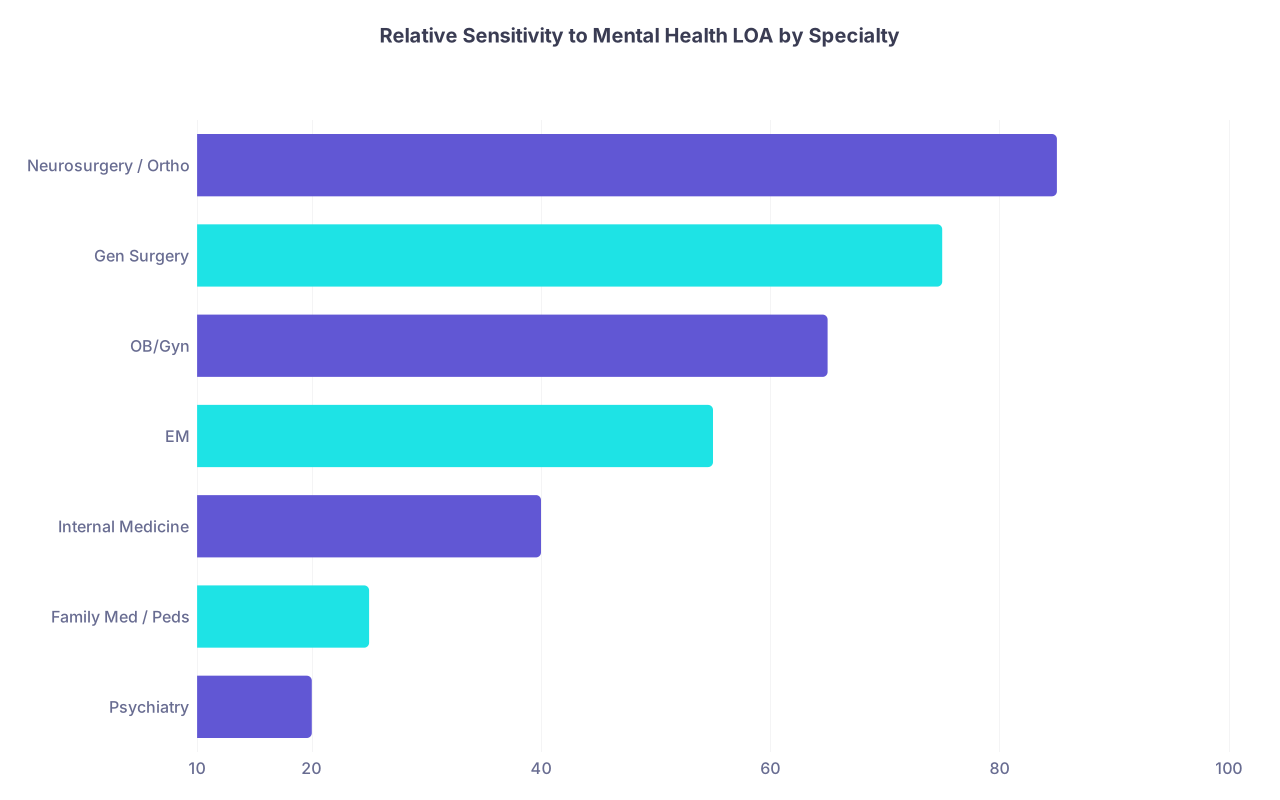
| Category | Value |
|---|---|
| Psychiatry | 20 |
| Family Med / Peds | 25 |
| Internal Medicine | 40 |
| EM | 55 |
| OB/Gyn | 65 |
| Gen Surgery | 75 |
| Neurosurgery / Ortho | 85 |
Higher = more likely to scrutinize the leave harshly.
- Psychiatry: Ironically more compassionate than most. They understand treatment and recovery. They’ll still worry if there’s clear ongoing instability or multiple leaves, but a single well-explained mental health LOA is usually not fatal.
- Family med / Peds: Generally quite open and supportive, as long as your post-leave performance is solid and you’re not erratic.
- Internal medicine: Middle of the road. They care. They do not panic. They’ll set it beside your entire application and make a judgment.
- EM / OB/Gyn: Worried about reliability and night float stress. They’ll look more closely at how you functioned in clinical rotations and any hints of ongoing issues.
- Surgery, particularly super-competitive fields: Still the most conservative. They already feel under siege with duty hours, burnout, and limited manpower. They’re wary of any sign you’ll need time off during a small program’s crunch periods.
But even in surgery, the pendulum is swinging. I’ve watched a trauma surgeon PD say flat out in a committee meeting:
“I would rather take someone who had depression, got treatment, and came back strong than someone who never admits weakness and then implodes in January.”
So no, a mental health LOA doesn’t automatically bar you from any field. But the bar to convince them you’re rock solid afterward is higher in some specialties than others.
How This Plays Out in Interviews
The interview is where PDs and faculty either resolve their concerns or confirm their fears.
Pay attention here: your energy and coherence matter as much as your words.
Here’s what makes committees nervous when you talk about your leave:
- Vague language like “personal reasons” with obvious emotional tension under the surface.
- Overly rehearsed, robotic answers that sound like a lawyer wrote them.
- Visible unraveling—crying, becoming flustered, defensive, or shutting down instantly.
- Blaming language: “The school wasn’t supportive,” “my dean didn’t understand,” “they forced me out.”
Here’s what reassures them:
- Calm, concise, matter-of-fact explanation: “I experienced significant depression, I stepped away with my dean’s support, I got structured care, and I returned and completed med school without further interruptions.”
- Evidence-based story: “My clerkship evaluations after returning reflect better organization and communication, which I attribute partly to finally addressing my mental health.”
- Clear present-state awareness: “I’m still in therapy / I maintain follow-up care. It’s been stable for X years now, including during demanding rotations.”
No theatrics. No drama. Just a clear arc: problem → help → growth → stable function.
If you can discuss the leave without losing emotional control, that’s one of the strongest signals a PD gets that you’re actually in a healthier place.
What You Should Do Now If You’re Considering or Returning From a Leave
Let me be blunt. Your priority is not “optimizing your residency chances.” Your priority is not dying in this system.
If you need a leave for mental health, you take it. Full stop.
But if you’re either:
- Considering a leave now, or
- Already took one and are worried about residency
then there are some strategic moves you can make.
Document reality cleanly with your school.
Don’t let your leave be coded as “academic” if it was primarily health-related. Push (politely but firmly) for accurate language in your MSPE: “health-related leave,” “treatment for a health condition,” etc. You don’t need them to write “major depressive disorder,” but you also don’t want a vague line that sounds like you vanished.Engineer a strong “post-leave” narrative.
The real battle isn’t about the leave; it’s about what comes after. Seek out meaningful clinical experiences, sub-I’s, or electives where faculty can see you functioning well and then write about it in letters.Decide your disclosure level early and keep it consistent.
You can lean into the mental health angle openly or keep it minimal but honest. What you cannot do is give three different versions of the story in your PS, secondary essays, and interviews.Accept that some doors may narrow but most are still open.
A mental health LOA might bump you from “effortless top-tier candidate” to “have to be more strategic.” Fine. You adapt. Mid-tier IM, peds, FM, psych, many EM and OB/Gyn programs? They’re full of residents who’ve had their own mental health struggles.
People do match with LOAs. Every single year. Often into competitive specialties.
The ones who struggle are usually not the ones who took time off. They’re the ones whose time off sits on top of chronic unaddressed problems, scant insight, and poor performance.
FAQ: Leaves of Absence for Mental Health in Med School
1. Should I explicitly label my leave as “mental health” in my application, or keep it as “personal/medical”?
If the leave was clearly for mental health, the safest middle ground is to frame it as “medical/health-related leave to address a mental health condition.” That’s transparent enough to avoid suspicion without forcing you into gory detail. Hiding the mental health aspect entirely and calling it “personal reasons” when everyone can see your grades cratered beforehand makes PDs uneasy—they assume there’s more you’re not saying. Clear, limited honesty beats vague evasiveness.
2. Is a mental health LOA worse than failing a course or Step exam?
One clean, well-managed mental health leave with a strong return is usually less damaging than a record full of repeated failures and no explanation. A failure plus an LOA is more complicated, but still survivable if there’s clear improvement later. PDs fear unpredictability more than “they once struggled and then stabilized.” A string of academic failures without any clear intervention often looks worse than a contained leave done for treatment.
3. Can I still match into a competitive specialty after a mental health leave?
Yes, but you’re going to need three things: impeccable performance after your return, powerful letters that explicitly vouch for your reliability, and a clean, confident explanation of your leave. In hyper-competitive fields like neurosurgery or ortho, some programs will quietly screen you out. Others will not, especially if your post-leave trajectory is excellent. You may need to cast a wider net and be realistic about aiming for programs that value your growth story instead of obsessing over a perfectly “clean” record.
With a clear story, strong recovery, and the right support, a mental health leave in med school becomes part of your narrative—not your obituary. The next step is learning how to package that story in your personal statement and interviews without sounding rehearsed or fragile. But that’s a conversation for another day.