
Clerkship evaluators notice your exhaustion long before you think they do.
They may not say it. They rarely document it honestly. But they see it, they talk about it in workrooms and preceptor offices, and—when it’s persistent—it absolutely colors how they interpret your performance, professionalism, and “fit” for their specialty.
Let me walk you through how this really works behind the curtain.
What Attendings Actually See When You’re Exhausted
Students think they’re hiding it.
They are not.
On a typical inpatient service, by day 3–4 of your week, your attending and senior resident have already categorized you mentally. Not just as “strong” or “weak,” but as “energized,” “stable,” “fragile,” or “on edge.”
They don’t use those exact words on paper. But those are the buckets.
Emotional exhaustion and fatigue show up in patterns:
- You stop volunteering for cases or admissions.
- Your notes get shorter and sloppier.
- You smile less and nod more.
- You start asking, “Do I need to be there?” instead of “Can I scrub in?”
Faculty notice the change in your trajectory more than the single day you look wrecked. Everybody gets one “I’m destroyed” day. What gets flagged is a week-long trend.
Here’s the part nobody tells you: many attendings expect you to be tired. What they’re really evaluating is how your fatigue interacts with reliability, attitude, and patient safety.
Not “Are you tired?” but “Are you tired and becoming unreliable?”
Huge difference.
The Unspoken Framework: How They Mentally Score Your Fatigue
No rubric officially says “emotional exhaustion: exceeds / meets / below expectations.” But informal mental scoring is very real. I’ve heard this exact framework in evaluation meetings again and again.
Think of it like this unofficial scale your evaluators are using:
| Level | What They See | Typical Translation |
|---|---|---|
| 0 | Always upbeat, steady | “Resilient, high ceiling” |
| 1 | Normal fatigue, jokes about being tired | “Standard med student tired” |
| 2 | Noticeably worn down but coping | “Good but close to limit” |
| 3 | Emotional edge, small mistakes | “Struggling, may burn out” |
| 4 | Tearful, shutdown, unsafe | “Not ready / needs support” |
Nobody writes “Level 3” in your eval. But they do write things like:
- “Became overwhelmed when workload increased.”
- “At times seemed disengaged or withdrawn.”
- “Needed additional support to complete tasks.”
Those are fatigue codes. They’re talking about emotional exhaustion without using the word.
Now let me go layer by layer, because each level gets interpreted differently by different attendings.
Level 1–2: “Normal” Tired vs “Borderline” Tired
There’s a kind of fatigue that’s treated as the price of admission. Yawning on rounds. Grabbing coffee between cases. Rubbing your eyes in the call room at 3 a.m.
Most attendings file that under: “Yep, that’s third year.”
Where it starts to matter is the threshold between normal tired and borderline exhausted.
Borderline looks like this:
- You stop asking patients one more question and just accept the intern’s story.
- Pre-rounds get abbreviated. You rely on vitals in the chart rather than walking into the room first.
- Your presentations lose nuance. Less synthesis, more reading the EMR aloud.
I’ve sat in end-of-rotation meetings where a resident said, “They were fine at the beginning, but halfway through they just looked done. Presentations got lazier.”
That single word—lazy—is where emotional exhaustion turns into a professionalism issue in evaluators’ minds. Fair? Not always. But that’s the leap they make if they don’t have a better story to explain your change in performance.
If you’re clearly tired but still:
- Showing up on time,
- Double-checking meds,
- Asking thoughtful questions,
you’re usually interpreted as “hard-working but appropriately stretched.” That does not hurt you. Sometimes it helps, because people recognize you’re getting a realistic taste of the job.
The danger zone is when your fatigue starts to look like you don’t care.
Level 3: When Fatigue Becomes a Narrative Problem
Once exhaustion affects interpersonal interactions, evaluators start writing stories in their heads about you.
They usually won’t say, “This student is burned out.” They’ll say:
- “Not sure they really want to be here.”
- “Seems disinterested in this specialty.”
- “Struggles with resilience during busy days.”
I’ve heard this dozens of times on Surgery and Medicine clerkships, especially around week 4–5. You hit the wall. They interpret the wall.
Here’s what triggers that narrative.
1. Micro-withdrawals
You stop entering the room first. You let the intern or resident lead every encounter. You hang slightly behind. The attending catches that.
They tell themselves, “This student is hiding,” not “This student is exhausted and overwhelmed and afraid to screw up.”
2. Emotional edge
You’re not sobbing in the bathroom. But your affect is thin:
- You get defensive when corrected.
- Your tone goes flat when given new tasks late in the day.
- You visibly deflate when plans change and you have to stay longer.
One of the bluntest comments I heard from a surgical attending about a student: “She’s going to be dangerous when she’s tired. You can see her patience evaporate.” That student wasn’t malicious. She was fried. But the attending didn’t label it as burnout. He labeled it as temperament.
3. Mistakes under pressure
This is the critical one.
If you’re exhausted and you:
- Miss a critical lab,
- Forget to follow up an imaging result,
- Misreport a piece of the story on rounds,
then the link in evaluators’ heads becomes: “Under stress, this student’s quality drops.” That’s where grades start slipping from Honors to High Pass, or High Pass to Pass.
Not because of the mistake alone, but because of the pattern they’ve built around your exhaustion.
Level 4: When They Start Using the Word “Concern”
Most programs are very conservative about documenting mental health or “emotional instability” in narrative comments. They know the implications. So they use coded language.
Phrases you never want to see in an evaluation:
- “At times appeared overwhelmed.”
- “Will benefit from continued development of coping strategies.”
- “Might struggle with the demands of residency without additional support.”
- “Was occasionally unreceptive to feedback during busy times.”
This is the written version of: “We’re not sure this person is safe or sustainable when stressed.”
Behind closed doors, in promotions or dean’s meetings, those phrases get translated bluntly:
“She’s burning out.”
“He doesn’t handle fatigue well.”
“I’d be nervous having them on call.”
And yes—those conversations affect letters. Especially departmental letters. The same attending who writes a slightly softened narrative for the official eval will be much more direct in a confidential letter to a PD.
How Different Specialties Read Your Exhaustion
Here’s the twist: not every specialty interprets visible fatigue the same way. Some almost normalize it. Others see it as a red flag.
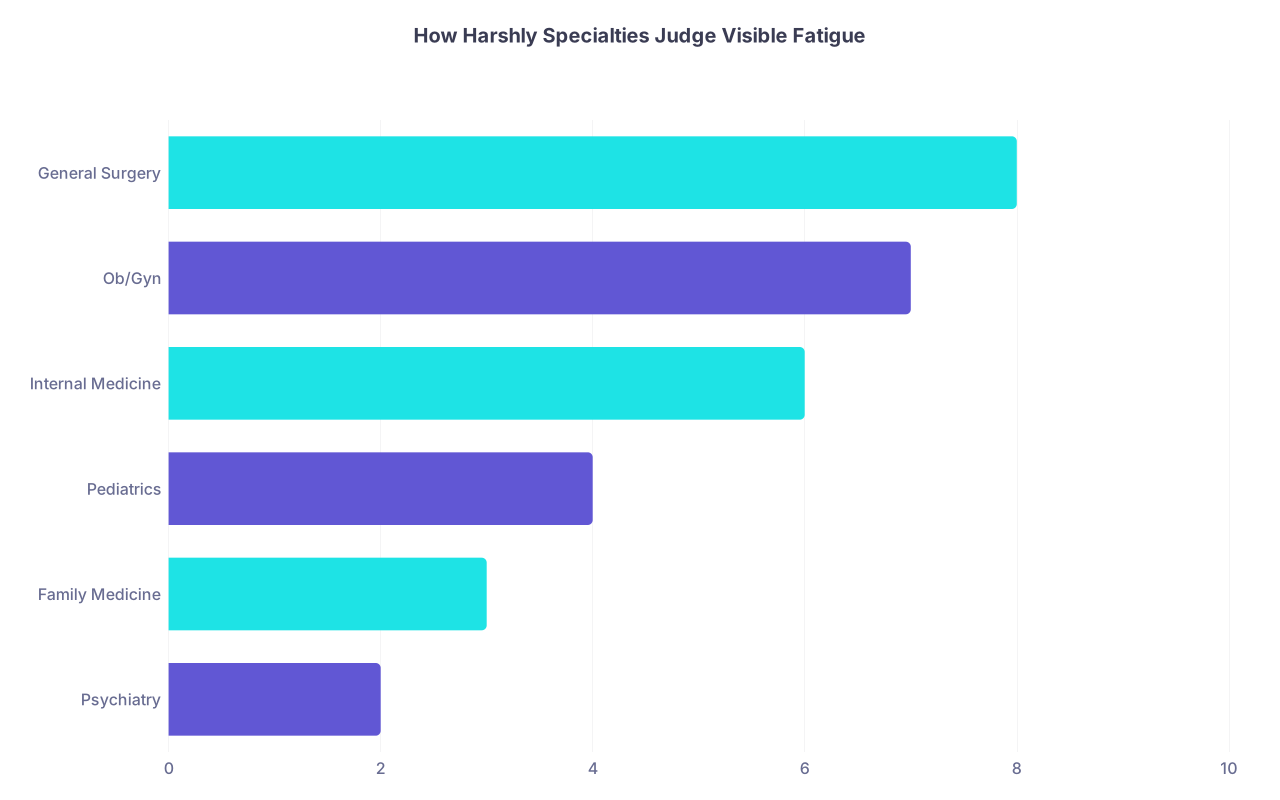
| Category | Value |
|---|---|
| Psychiatry | 2 |
| Family Medicine | 3 |
| Pediatrics | 4 |
| Internal Medicine | 6 |
| Ob/Gyn | 7 |
| General Surgery | 8 |
(10 = extremely harsh, 1 = very forgiving.)
Let me unpack that a bit.
Surgery and Ob/Gyn
These fields have a macho fatigue culture baked in. Everyone is tired. Everyone is post-call. Everyone is pushing through.
On those services, the appearance of resilience is heavily weighted. I’ve heard attendings say, without irony, “If they look this wiped as a student, how are they going to handle 28-hour calls as an intern?”
If you show emotional exhaustion here, they’re more likely to interpret it as “wrong fit for the field” than “normal human reaction to stress.”
However—here’s the nuance—if you’re tired and you keep showing up for cases, keep asking to scrub, keep reading, they’ll actually respect you a lot. You look like someone who can be miserable and still be all-in. Distorted, but real.
Internal Medicine and Pediatrics
These folks notice emotional tone more. They watch how you talk to patients at 4 p.m. compared to 8 a.m.
Fatigue that leads to:
- Shorter visits,
- Fewer explanations,
- Impatience with “difficult” families,
gets interpreted as a professionalism and empathy issue. The concern isn’t just “can you hack the hours?” but “do you become less kind when exhausted?”
IM and Peds attendings will often comment quietly to each other: “He’s very good intellectually, but his bedside manner falls apart when he’s tired.” That exact comment ends up in your composite picture.
Psych, FM, “Lifestyle” Fields
They’re not blind. They just have a slightly more human framework.
In these fields, I’ve seen attendings actually name burnout with students in a supportive way: “You look close to your limit; what’s your schedule like?” They’re more likely to factor system-level abuse into the equation.
However, if your emotional exhaustion shows up as irritability or cynicism toward patients, that’s taken very seriously. These are communication-heavy fields. Empathic depletion is a real concern to them.
What Evaluators Actually Respect When You’re Exhausted
Here’s the part nobody tells students: you don’t have to pretend you’re fine to protect your evaluations.
What evaluators respect is how honestly and proactively you manage your limits without creating work or risk for the team.
Let me translate that into real behavior I’ve seen praised.
1. Naming cognitive limits clearly
A student on night float once said to the senior at 3 a.m.: “I’m really hitting a wall. I can still help, but I would double-check any orders I put in right now.”
The senior later told me, “She was exhausted but self-aware. That’s exactly what I want in a resident.”
She got Honors.
Contrast that with the student who quietly kept going, put in wrong orders, and then blamed the system. That student got a very “mixed” evaluation.
2. Asking for task prioritization
Instead of just slowing down and dropping balls, a smart tired student will say: “I’m a bit behind—if I can only get two things done before sign-out, what should they be?”
That signals three things to your evaluator:
- You understand priorities.
- You know your bandwidth is limited.
- You want to be safe.
That’s professionalism. Not weakness.
3. Staying kind even when your tank is empty
Attendings and residents will forgive a lot of cognitive sloppiness if you are consistently kind to nurses, patients, and staff—even when you’re obviously drained.
I’ve seen brutal surgical attendings say, almost grudgingly, “He looks like hell but the nurses love him and patients like him. He’ll be fine.”
Your affect with staff is often the tie-breaker between “High Pass” and “Honors” in borderline cases when you’ve visibly struggled with fatigue.
How Emotional Exhaustion Shows Up in Narrative Comments
You want to know what your exhaustion really looks like on paper? Let me decode some actual-style phrases.

Here’s the translation guide:
“Calm under pressure”
→ They saw you tired, busy, maybe stressed, but you didn’t snap or shut down.“Reliable and consistent even on busy days”
→ You handled fatigue without errors or disappearances.“At times appeared overwhelmed when service was heavy”
→ Your emotional exhaustion was noticeable and affected your performance or interactions.“Would benefit from ongoing development of resilience skills”
→ They’re hinting at concern about how you handle fatigue and stress. This can spook PDs.“Took feedback well despite a challenging rotation schedule”
→ You were tired, possibly struggling, but didn’t get defensive or bitter.
When you read your MSPE later, pay attention to phrases around “busy,” “stress,” “overwhelmed,” “resilience,” “coping,” “professional under pressure.” That’s the coded conversation about your emotional exhaustion.
What You Should Do During the Rotation When You’re Slipping
Let me be blunt: if you’re so emotionally exhausted that you’re unsafe, your grade is not the priority. Step back. Use student health. Go to the dean’s office. There are ways to remediate a clerkship; there is no way to un-harm a patient.
But most of you are dealing with something slightly earlier: not dangerous, just deteriorating.
Here is how smart students course-correct mid-rotation without tanking their evals.
1. Have a quiet, specific conversation with a trusted resident
You do not need—and usually should not—to make a dramatic emotional disclosure to the attending on day 12. Start with a senior who likes you.
Say something like:
“I’m finding myself more tired and scattered this week than usual. I want to make sure I’m not missing key things. Is there anything you’ve noticed I should tighten up?”
That does two things:
- Gives them permission to give you feedback they were already gossiping about.
- Signals insight and maturity, which can blunt the impact of your slip.
2. Adjust one behavior they can visibly see
Don’t promise a total personality transformation. Pick something concrete:
- “I’m going to start writing down task lists so I don’t drop follow-ups late in the day.”
- “I’m going to pre-round earlier so I’m less rushed.”
Then actually do it. When evaluators see you implement changes while tired, they update their narrative: “Teachable, responsive, coachable.”
3. Protect your sleep on at least half the nights
This sounds obvious, but I’ve seen too many students sacrifice sleep for reading to “look eager” and then implode on the wards.
Faculty would rather you:
- Sleep 6 hours,
- Show up functional,
- Admit you didn’t read much last night,
than sleep 3 hours, read 40 pages, and perform like a zombie.
They will not say that to you explicitly. I just did.
The Ugly Truth: When Programs Weaponize “Resilience”
There’s one more piece of the hidden curriculum nobody wants to write down in an official handbook.
Some clerkship leaders and attendings use the language of “resilience” and “coping” as a shield to avoid confronting bad systems.
Rotations that are chronically understaffed, disorganized, or abusive will often produce a wave of emotionally exhausted students. How do the evaluators interpret it?
The honest ones say:
- “Our structure is unsustainable.”
- “We’re burning through students.”
The others say:
- “Recent students have been less resilient.”
- “This class doesn’t seem as motivated.”
So yes—your emotional exhaustion is sometimes a symptom of a toxic system, not a personal deficiency. But the system will still document you, not itself.
You can’t fix that during the block. What you can do is:
- Protect your own boundaries enough to stay safe.
- Seek allies—there’s usually at least one attending who gets it.
- Document major issues with your dean’s office after grades are locked, so you don’t get tagged as the “problem student.”
I’ve seen students get quietly blacklisted for filing complaints mid-rotation. I’ve also seen them protected when they approached it strategically through the right faculty advocates. Choose carefully.
Quick Reality Check: PDs Are Not Stupid
Program directors reading your MSPE and clerkship comments have seen burned-out students, fragile students, and perfectly normal-but-tired students for years.
They can usually tell the difference between:
- A student who had a brutal but formative rotation and grew from it.
- A student who chronically falls apart whenever life isn’t perfectly controlled.
A single comment about being “overwhelmed on busy days” will not destroy your residency chances. Persistent patterns across multiple clerkships—“struggles when tired” + “overwhelmed during heavy services” + “difficulty with feedback under stress”—do create a narrative.
Your goal isn’t to perform superhuman resilience. Your goal is to make sure that, across the year, the dominant story is:
“Tired sometimes? Of course. Human. But reliable, coachable, and fundamentally safe under pressure.”
That’s what they’re really looking for.

| Step | Description |
|---|---|
| Step 1 | Long Hours & Stress |
| Step 2 | Emotional Exhaustion |
| Step 3 | Seen as Normal Tired |
| Step 4 | Neutral or Positive Comments |
| Step 5 | Withdrawn, Irritable, Errors |
| Step 6 | Framed as Growth & Resilience |
| Step 7 | Mixed but Acceptable Comments |
| Step 8 | Framed as Poor Fit or Fragility |
| Step 9 | Concerning Narrative in MSPE |
| Step 10 | Behavior Change? |
| Step 11 | Insight & Adjustment? |