
Faculty know you’re struggling long before you admit it to yourself.
They may not say it. They may not document it. But behind closed doors, in meetings you never see and email threads you’ll never read, your name can end up in three very different piles: “fine,” “watch,” and “we need to intervene.”
Let me walk you through how that actually happens. Not the sanitized version you hear at orientation. The real version that plays out in clerkship offices, promotions committees, and hallway conversations.
The Quiet Surveillance Network You Didn’t Know You Were In
There’s an unspoken rule among faculty: patterns matter more than any single event.
So yes, you can bomb one quiz or blank on one pimp question and nobody cares. But three small things in a row? That’s when someone mentions your name in the tutor office, or between cases, or in a preceptor meeting.
Most schools have some flavor of this structure, even if they call it something different:
| Layer | What Actually Happens |
|---|---|
| Course/Block Directors | Track exam scores, quiz trends, professionalism flags |
| Small Group/Case Facilitators | Email course directors about behavior/engagement |
| Office of Student Affairs | Maintains “students of concern” lists |
| Promotions/Competency Committees | Review multi-course patterns and narratives |
| Clerkship Directors | Watch for early red flags in clinical years |
Nobody announces, “You are now being monitored.” But once you hit certain trip wires, you’re no longer just “a student in the class.” You are “that student we need to watch.”
Those trip wires are not what you think.
It Starts Earlier Than You Think: Preclinical Red Flags
Students always assume the watch starts in clerkships. Wrong. They start tagging patterns in the preclinical years.
The academic tells that raise eyebrows
The first layer is obvious: numbers. But it’s not just failing.
Here’s what course directors actually notice:
- The 69% that comes out of nowhere when you’ve been at 85% all term.
- The student living in the 1–2 SD below the mean zone, block after block. Barely passing, repeatedly.
- The person who passed everything but bombed the NBME-style comprehensive final.
I’ve sat in meetings where someone said:
“She passed everything, but every time the questions got closer to Step-level application, she cratered. She’s going to struggle later.”
The real concern isn’t the failure. It’s the trajectory. Faculty look for the student slowly sliding downward while pretending it’s fine.
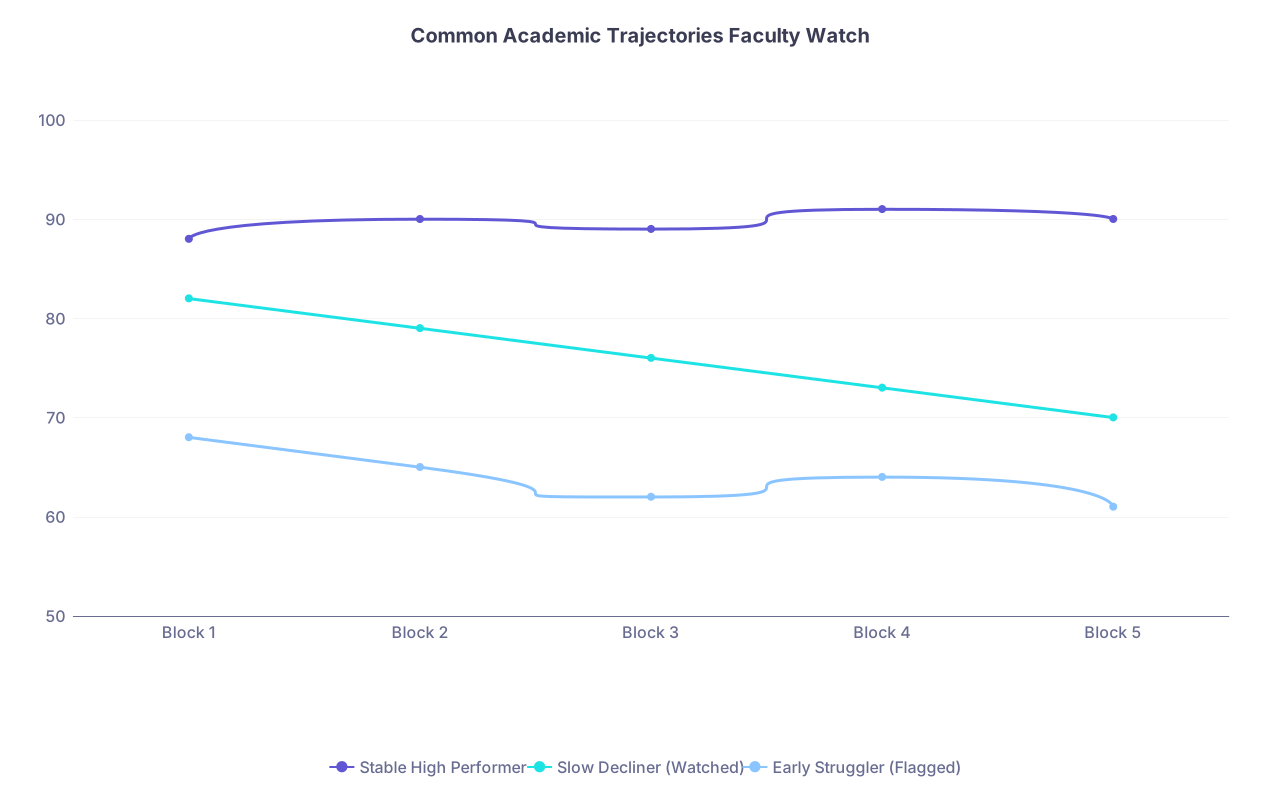
| Category | Stable High Performer | Slow Decliner (Watched) | Early Struggler (Flagged) |
|---|---|---|---|
| Block 1 | 88 | 82 | 68 |
| Block 2 | 90 | 79 | 65 |
| Block 3 | 89 | 76 | 62 |
| Block 4 | 91 | 73 | 64 |
| Block 5 | 90 | 70 | 61 |
The second tell is inconsistency. Strong anatomy, terrible physiology. Great written exams, catastrophic practicals. They start asking: Is this knowledge, anxiety, attention, or something else?
That “something else” is often mental health, even if nobody says the words yet.
The behavior in small group that nobody forgets
The biggest early detector is not exam scores. It’s small group.
Faculty spot struggling students by how they show up in places where you can’t hide in the back row.
The types that trigger concern:
- The ghost: always present, rarely speaks, eyes dead-tired, gets skipped in discussion and does not protest. One facilitator emails, “I’m worried about Sam – very quiet, seems disengaged.” That email is enough to put you on a watch list.
- The overcompensator: dominates every conversation, overcorrects others aggressively, brings in tangential board facts to mask insecurity. Faculty know when it’s true confidence versus panic dressed as arrogance.
- The one who’s always “just getting over something”: migraines, GI issues, “rough week,” repeatedly stepping out, camera off if sessions are virtual. Every week there’s a new reason.
Here’s what you don’t see: multiple facilitators across different courses start sending similar comments. That pattern moves from “maybe just shy” to “student of concern.”
Clinical Years: Where Struggle Becomes Impossible to Hide
You can hide suffering in preclinical years with caffeine, brute force, and isolation. Once you hit the wards, the mask cracks.
Clerkship directors talk to each other. Religiously. They trade names.
“I had concerns about them on IM.”
“We had the same on Surgery.”
“I’m not reassured.”
That’s a problem.
The clinical patterns faculty use to spot trouble
Most attendings don’t care about your raw knowledge early on. They care about three things: reliability, trajectory, and how you respond to feedback.
There are several recognizable patterns.
The vanishing act.
Shows up late “because traffic,” disappears after rounds, perpetually “looking for the resident” when something is hard. Paging them becomes an Olympic sport. Behind closed doors, faculty say, “We can’t trust them when things get busy.”The patient-avoidant student.
Spends way too much time “reading,” “updating the note,” or “finishing orders” instead of sitting with patients. When a student seems more comfortable with UpToDate than with human beings, we start suspecting anxiety, depression, or burnout. Especially if their baseline personality (from preclinical) was different.The emotionally flat student.
You tell them a patient died. Nothing. No visible reaction. Not curiosity, not sadness, just a kind of numb nod. That flatness might be trauma response, sleep deprivation, depression, or all three. Attendings notice it. Senior residents really notice it.The student who crumbles with gentle feedback.
Not the angry one. The one who looks like they’ve been slapped when you say, “You might want to tighten your assessment.” Eyes water. Voice shakes. They apologize ten times. That level of fragility sets off alarms about coping capacity.The chronic under-preparer.
Not dumb. Just always a little behind. H&P half-finished. Assessment shallow. Plan copy-pasted from UpToDate at 7:30 AM. Exam performance is often “pass,” but day-to-day competence feels… off. Faculty start to ask: are they overwhelmed? ADHD? Depressed? Burning out? Or just checked out?
You’ll see some attendings brush it off as “millennial softness.” The more thoughtful ones will quietly email the clerkship director.
The Invisible Meetings Where Your Name Comes Up
Let me tell you what really happens in those “academic progress” or “promotions” meetings.
There’s a spreadsheet. There are narrative comments. And then there are the off-the-record remarks.
Someone pulls up your record. They see borderline scores. Or a failed block. Or a barely passing OSCE. Then someone says:
“I’m more worried than the numbers suggest.”
or
“I know their score looks fine, but…”
Those sentences are death and salvation at the same time. Death because you’re now officially on the radar. Salvation because that’s usually when people start pushing for support instead of waiting for you to crash.

| Step | Description |
|---|---|
| Step 1 | Concerning event |
| Step 2 | Faculty emails course/clerkship director |
| Step 3 | Pattern seen across rotations/courses |
| Step 4 | Name raised at student affairs/promotion meeting |
| Step 5 | Quiet monitoring, optional outreach |
| Step 6 | Required meeting with dean/advisor |
| Step 7 | Formal remediation, LOA discussion |
| Step 8 | Severity |
What counts as a “concerning event”?
- Multiple missed quizzes or required activities “due to illness”
- Abrupt score drops across blocks
- More than one professionalism concern (late notes, missed pages, conflict with nurses)
- Disturbing OSCE behavior: inappropriate affect, missing obvious safety steps, emotional meltdown in the debrief
You might only experience this as a mildly worded email: “Hey, can we meet to check in on how things are going?” That email is rarely casual. It is almost always triggered by a back-room conversation.
Mental Health vs. “Professionalism”: How They Really Talk About It
Faculty like to pretend they separate mental health from professionalism. In real meetings, the line is blurry.
Here’s the uncomfortable truth: a lot of what gets labeled “professionalism issues” are actually unaddressed mental health problems.
Chronically late? Might be depression.
Emotionally volatile with nurses? Could be anxiety and sleep deprivation.
Blunt, irritable on rounds? Sometimes just overwhelmed and burned out.
But institutions are built around documentation, not nuance. So it gets labeled however the policy dictates. Usually professionalism.
Closed-door reality sounds like this:
“She’s clearly depressed but refuses counseling. What do we do with that?”
“He’s on the verge of a panic attack every time he presents. He’s dangerous to himself at this rate.”
“I’m worried about liability if something happens on call.”
The better schools are getting more honest about this. They’ll loop in student wellness, counseling, and disability services early. Not to kick you out, but to protect you and themselves.
The worse schools pretend it’s all about “standards” while quietly letting suffering students flame out.
The Subtle Signs Faculty Pick Up That You Don’t Realize You’re Broadcasting
You think you’re hiding it. You’re not.
Faculty pick up on very small signals:
Your face at 7:30 AM.
The unwashed hair three days in a row. Coffee as meal replacement. The thousand-yard stare. You might still be doing fine on paper, but the emotional wear is visible.The way you respond to normal stress.
Some students get sharper and more focused. Others get scattered and panicky over small tasks. When you melt down over getting an extra patient, attendings notice the disproportion.The “everything is fine” script.
“Yeah, it’s busy, but I’m fine.” Said too quickly, without eye contact, with dark circles and shaky hands. The mismatch between words and body is an enormous red flag.Documentation tone.
I’ve seen notes that suddenly become terse, error-prone, or overly verbose and rambling compared to earlier in the rotation. That shift often mirrors a mental shift.Pimping behavior changes.
Student who used to offer guesses now just shrugs, looks down, and says, “I don’t know,” over and over, even when it’s basic, and even when the attending is gentle. Not laziness. That’s someone whose cognitive bandwidth is shot.
One surgery attending told me once, about a student:
“She knows enough. But psychologically she’s underwater. I don’t care about her score. I care that she’s going to implode if we don’t slow her down.”
That’s much more common than you think.
What Happens When Someone Decides You’re Struggling
There are roughly three paths once the consensus becomes, “Yes, this student is struggling.”
Path 1: Quiet watchful waiting
You’re borderline, but not in crisis. What happens?
- Faculty give you a slightly longer leash.
- They write more narrative detail on your evals.
- Student affairs may send you a “just checking in” message.
In practice, this means you’re under soft surveillance. If you recover, you’ll never know how close you were to being formally flagged. If you don’t, the paper trail is already building.
Path 2: Gentle but mandatory contact
This is the “We think you’re in trouble but we want to help” phase.
You’ll see things like:
- Required meetings with the assistant dean or advisor
- Strong encouragement to seek counseling or academic supports
- Referrals to disability services for possible ADHD/learning differences
- Maybe some exam accommodations or schedule changes
To you, it may feel like you’re being called to the principal’s office. Behind the scenes, this is actually the protective stage. They’re trying to prevent you from becoming a failure statistic or a risk to patient safety.
Path 3: Formal remediation or leave of absence discussion
This is where the institution stops pretending everything is fine.
Triggers include:
- Failing more than one major course or clerkship
- Major professionalism violation tied to emotional reactivity
- Concerns about suicidality, substance use, or clear decompensation
- Repeated borderline performance despite prior interventions
At this point, committee discussions become blunt:
“Can they safely move on?”
“Are we setting them up to fail Step/CK?”
“Will they be safe in intern year?”
You’ll get language like “remediation plan,” “conditions for progression,” and “consideration of medical leave.” The smart students at this stage stop fighting the idea that they’re struggling and start strategically engaging with support.
How to Read the Signs That Faculty Are Worried About You
You will almost never hear, “We think your mental health is affecting your performance,” even when that’s exactly what they believe.
But there are tells.
If you see two or more of these, you’re no longer just another student in the system:
- Different faculty, in different settings, ask you the same “How are you holding up, really?” question with unusual seriousness
- You get invited (not just emailed once, but followed up) to meet with student affairs or the dean
- Feedback shifts from “study more” to “you look really tired” or “you don’t seem like yourself”
- Narrative evals emphasize “resilience,” “coping,” “emotional response to stress” much more than your peers’
That’s your smoke alarm. Ignore it and the next step is fire.
What You Can Do Before Things Go Fully Off the Rails
Here’s the part no one likes to admit: faculty respect students who name their struggle early more than the ones who pretend to be invincible until they crash.
If you’re reading this and seeing yourself in these patterns, here’s what actually plays well behind closed doors:
Be the one to bring it up first.
“I’ve noticed my performance slipping and I’m worried about burnout/depression/anxiety.” That line, said to a course director or advisor, changes how your story is written in meetings. It reframes you from “problem” to “insightful but struggling adult.”Ask for targeted help, not vague sympathy.
“I’d like to talk to someone in counseling.”
“Can we explore a lighter schedule/block rearrangement?”
“Can I meet with learning specialists to adjust my study approach?”
This signals agency, not passivity.Document your steps.
If you see a counselor, talk to disability services, adjust meds – you don’t need to share every detail, but letting student affairs know you’re actively addressing things goes a long way when committees are deciding whether to trust you with the next phase.Stop trying to hide obvious distress.
You’re not fooling anyone. The faculty who matter already suspect. Letting one of them in voluntarily almost always goes better than being “found out” through failure or meltdown.
The Part They’ll Never Put in the Handbook
Faculty are not sitting around trying to fail you. That’s the student myth.
What they’re actually afraid of is this: the student whose struggle everyone saw but nobody addressed in time. The one who:
- Attempts suicide mid-clerkship
- Has a panic attack in the OR
- Walks away from medicine entirely three months after graduation
- Makes a dangerous patient error under stress
In meetings, that’s what people remember. Those stories drive policies more than you can imagine.
So yes, they’re watching you. Quietly. Holistically. With more concern than malice, most of the time.
Your job is not to be perfect. Your job is to be honest early enough that “struggling” doesn’t turn into “irreversible.”
Years from now, you won’t remember the exact score you got on that brutal exam. You’ll remember the moment you finally admitted you weren’t okay—and what you chose to do next.