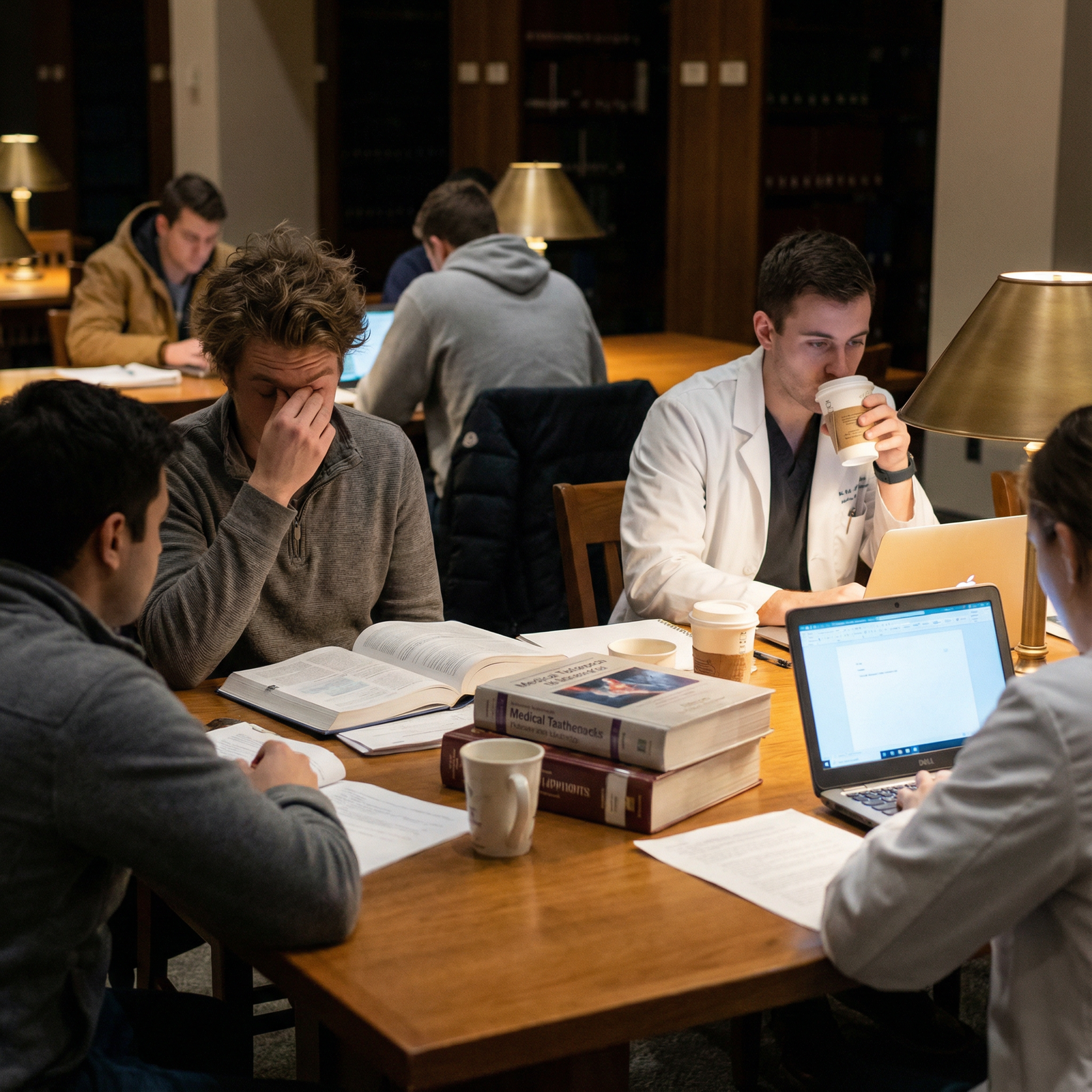
You’re three weeks out from a block exam. It’s 1:47 a.m. Your group chat is pinging with “just started another 40-question set” and “grind never stops.” Someone posted a picture of their iPad covered in Pathoma screenshots with the caption: “If you’re sleeping 8 hours, you don’t want it bad enough.”
You close your eyes for a second and feel that familiar panic: Maybe I really am not doing enough.
This is exactly how hustle culture eats medical students alive. Not in one dramatic moment, but through hundreds of little lies that sound productive, ambitious, even admirable.
Let me be blunt: a lot of what passes for “grind” in medical school is self-harm dressed up as discipline.
You’re here because you’re trying to do this right—work hard without wrecking your brain, your body, or your career longevity. So let’s walk through the dangerous hustle myths med students swallow too easily, and how to avoid getting sucked into them.
Myth #1: “Real med students grind 16 hours a day”
This is the flagship hustle culture myth. The one that makes people brag about “14 hours in the library” like it’s a badge of honor.
It’s not. It’s usually a red flag.
The mistake: believing time in chair = success
Reality: effective, focused hours = success.
Here’s what actually happens when you believe you should be studying every waking moment:
- You start measuring your worth by how long you “studied,” not what you learned.
- You fill time with low-yield nonsense (rewriting notes, color-coding, watching passive videos at 1x speed).
- You feel guilty any time you’re not studying—eating, showering, walking to class.
- Your brain taps out, but you force it to keep going until you’re reading the same sentence 6 times and none of it sticks.
I’ve watched students who “study 14 hours a day” score significantly lower than classmates who did 6–8 focused hours with real breaks and sleep.
Typical pattern of the 16‑hour grinder:
- 9–10 hours of semi-distracted, multitask “studying”
- 2–3 hours of doom scrolling in the library under the illusion of “breaks”
- 3–4 hours of rewatching the same lectures because nothing went in the first time
That is not grinding. That is cognitive self-sabotage.
The better (and actually hard) path:
- 4–6 hours of deep, focused work on practice questions and active recall
- 1–3 hours of lighter review / consolidation
- Real breaks, real meals, and non-negotiable sleep
The students who quietly do this are the ones who end up with consistently strong exam scores while looking… suspiciously non-miserable.
Myth #2: “Sleep is optional if you ‘want it bad enough’”
This one is everywhere. The “sleep is for the weak” memes. The “I only slept 3 hours and still did UWorld” brag. The “you can sleep when you’re an attending” joke that’s not actually funny.
Let me say this clearly:
You’re literally training to be a physician. If you normalize chronic sleep deprivation as a student, you’re rehearsing for burnout, depression, and medical errors later.
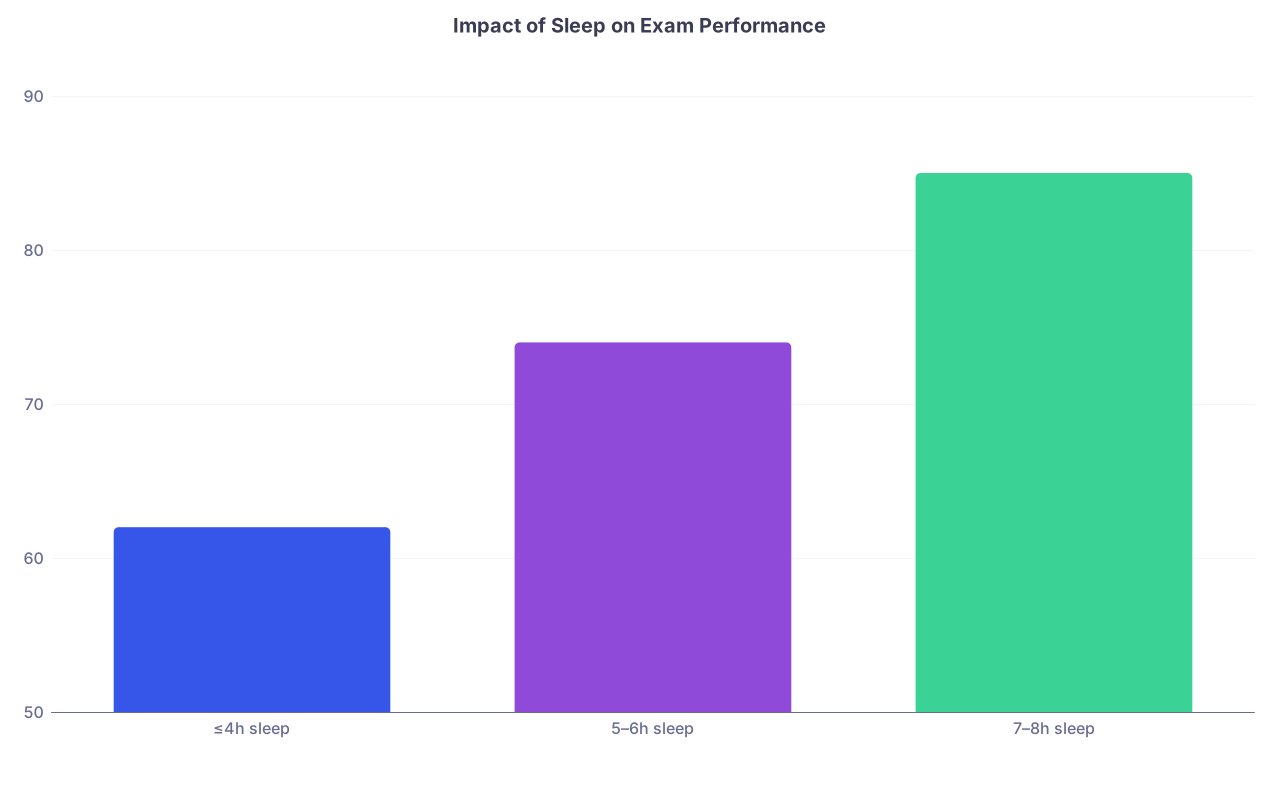
| Category | Value |
|---|---|
| ≤4h sleep | 62 |
| 5–6h sleep | 74 |
| 7–8h sleep | 85 |
(Representative pattern I’ve seen across cohorts: as sleep improves, scores rise. Shockingly.)
The common mistakes:
- Cramming until 2–3 a.m. the week before every exam
- Using caffeine to patch over 4–5 hours of fragmented sleep
- Telling yourself, “I’ll catch up after the test” (you don’t; you just start the next block already depleted)
What this actually does:
- Wrecks memory consolidation (you’re literally blocking your brain from storing what you just “studied”)
- Lowers your mood and resilience, making normal stress feel unbearable
- Increases anxiety and imposter syndrome, which makes you study worse, not better
Red flags you’re entering sleep-deprivation hustle mode:
- You can’t read one Anki card without rereading it repeatedly
- You “wake up tired” daily even on days you don’t set an alarm
- You start crying over minor things (lateness, one bad quiz, a slightly annoyed attending)
- Your caffeine use creeps up and you feel shaky, wired, then exhausted
Do not make the mistake of sacrificing sleep for “just one more hour.” That hour looks productive. It is usually negative yield.
Bare minimum non-negotiable:
- 7 hours in bed most nights, 6 as an emergency exception, not a lifestyle
- Protect the 2–3 nights before big exams like your life depends on it—because your long-term brain health does
Myth #3: “If you’re not suffering, you’re slacking”
There’s this quiet belief in med school circles that you should be miserable. That if you’re not constantly exhausted, behind, and stressed, you must be missing something.
So students do something insane: when studying starts to feel manageable, they add more until they’re drowning again. Because drowning feels more “appropriate” for med school.
The hustle culture lie underneath:
Struggle = virtue. Ease = laziness.
This is how people walk right into:
- Anxiety disorders that get written off as “just how med school is”
- Depression that everyone normalizes until you’re barely functioning
- Emotional numbness and detachment from friends, family… and patients
I hear versions of this all the time:
- “If I can take Sunday off, I must not be pushing hard enough.”
- “If I don’t feel guilty watching a movie, I probably didn’t study enough.”
- “If this block doesn’t break me, I’m not doing it right.”
No. If this block doesn’t break you, it probably means your system is working.
Signs you’re confusing suffering with productivity:
- You feel weirdly uncomfortable on days things go smoothly
- You sabotage yourself by overcommitting, procrastinating, or last-minute cramming to re-create chaos
- You distrust your own success and assume a crash is coming
The smarter mindset:
- Discomfort is sometimes necessary, misery is not
- Growth happens at the edge of your comfort zone, not miles past it
- Stability and sustainability are performance enhancers, not luxury items
If you think you “should” be more miserable, that’s not ambition. That’s internalized toxicity.
Myth #4: “Mental health can wait until after Step / boards / residency”
This myth is the quiet killer.
Students say:
- “Once Step 1 is over, I’ll deal with this.”
- “I just need to push through this month; therapy can wait.”
- “Everybody feels like this; it’s just a phase.”
I’ve seen this exact pattern:
- Stress ramps up.
- Sleep, appetite, and mood start slipping.
- Student minimizes it as “normal for med school.”
- Performance on exams and rotations begins to decline.
- Shame and anxiety ramp up: “I’m clearly not cut out for this.”
- They isolate, double down on hustle mentality… and get worse.
By the time they hit real crisis—panic attacks, suicidal thoughts, can’t study at all—they’ve usually believed this myth for months, sometimes years.

| Step | Description |
|---|---|
| Step 1 | High Stress Block |
| Step 2 | Sleep & Mood Decline |
| Step 3 | Assume Its Normal |
| Step 4 | Study More, Rest Less |
| Step 5 | Performance Drops |
| Step 6 | Shame & Isolation |
| Step 7 | Major Burnout/Depression |
Here’s what hustle culture whispers:
“If you were stronger, you could handle this. Other people are grinding through it. Don’t be soft.”
Here’s reality:
- You’re not weak for needing support
- Ignoring mental health is not toughness; it’s reckless
- Your brain is your only non-replaceable exam resource
The most dangerous beliefs:
- “I’m not bad enough for therapy.”
Translation: “I will wait until I’m in freefall to get help.” - “I don’t have time for counseling.”
Translation: “I’m willing to sacrifice months of productivity to avoid 1 hour/week.” - “If I tell someone, it’ll go on my record.”
At most schools, student mental health services are confidential and separate from academic files. Ask—not assume.
If your daily baseline looks like:
- Persistent dread getting out of bed most days
- Zero interest in anything you used to enjoy
- Thoughts that your classmates / school / family would be better off if you weren’t here
Stop. That’s not “normal med school stress.” That’s a warning signal. Ignoring it is the mistake. Reaching out is not.
Myth #5: “Everyone else is doing more than you”
Hustle culture thrives on comparison. Especially in med school, where everyone is high achieving and scared of being the one who falls behind.
So people:
- Exaggerate how much they’re studying
- Downplay how much they’re struggling
- Curate their schedules on social media to look “relentlessly productive”
You see:
- “Just finished 300 questions!” (No mention that 200 were old repeats done half-asleep over 6 hours.)
- “At the library for 12 hours today!” (But 4 hours were YouTube + snacks + gossip.)
- “5 a.m. grind time!” (Then they nap 3 hours midday and skip lecture.)
And then you compare your messy, real day to their polished highlight reel and think:
“I’m lazy. I’m not doing enough. I’m behind.”
Here’s what you do not see:
- Their panic attacks before quizzes
- Their failed practice NBME they don’t post
- Their third coffee at 8 p.m. because they’re too anxious to sleep
- Their quiet consults with student health for anxiety meds
I’ve seen some of the “hardest grinders” privately admit they’re barely hanging on.
The mistake:
Basing your schedule, goals, and self-worth on:
- What your friend group claims they do
- What super-anxious gunners say you “have to” do
- What random people on Reddit claim worked for them
Better strategy:
- Track your data: number of questions, retention, practice scores, how you feel
- Aim to improve your own metrics, not copy someone else’s
- Treat public “grind” flexing as mostly noise
If you wouldn’t trade lives with someone (their stress, sleep, relationships, mental state), don’t copy their study lifestyle.
Myth #6: “Saying no = weak / uncommitted”
This one is sneakier.
You start school with:
- Classes
- Maybe a research project
- Basic extracurriculars
Then hustle culture piles it on:
- Join 5 specialty interest groups “or you’ll close doors”
- Sign up for leadership positions “for your CV”
- Take on extra research because “you’ll need 10 pubs for residency”
- Tutor, volunteer, shadow, go to every conference
Suddenly:
- You’re booked every evening
- You’re behind on basic coursework
- You’re constantly canceling on friends or showing up mentally absent
And you still feel like you’re not doing enough.
Here’s the trap:
You think saying yes proves you’re ambitious.
Actually, saying yes to everything usually proves you’re afraid.
Afraid of:
- Missing out
- Falling behind
- Looking lazy
- Closing doors
But here’s the ugly outcome: chronic overcommitment makes you mediocre at everything:
- Half-prepared for exams
- Half-engaged in research
- Half-present with patients
- Half-there for yourself
| Pattern | Smart Commitments | Hustle Overload |
|---|---|---|
| Activities | 2–3 meaningful | 6–10 scattered |
| Exam readiness | Usually solid | Constantly “catching up” |
| Mental bandwidth | Manageable | Fragmented and chaotic |
| Long-term impression | Reliable & focused | Flaky & chronically exhausted |
Residency programs do not want the burned-out, overextended zombie with 15 half-baked activities. They want the person who:
- Showed up consistently
- Did solid work
- Has a track record of not imploding under pressure
Saying “no” is not weakness. It is risk management.
Myth #7: “You can treat your body like trash now and fix it later”
Hustle culture treats your body like a disposable vehicle for your brain. As if:
- Skipping meals
- Living on coffee and vending machine junk
- Sitting 12 hours a day
- Ignoring headaches, palpitations, GI issues
…are just part of the sacrifice.
I’ve seen:
- Students pass out in anatomy lab because they haven’t eaten in 16 hours
- People land in the ED with chest pain from a mix of anxiety, sleep deprivation, and over-caffeination
- Chronic back and neck pain by M3 from zero movement and terrible posture
This is not harmless. It’s also not separate from your performance.
Your physical state is your mental state:
- Blood sugar swings → brain fog → poor retention
- Dehydration → headaches → reduced focus
- Zero movement → worse mood, worse sleep, higher anxiety
This is not about turning into a fitness influencer. It’s about not self-sabotaging the very system you need to think clearly.
Bare-minimum non-hustle-basics:
- Eat actual meals at semi-regular times; “snacks only” is not a personality
- Move your body 2–3x/week in any way: walk, stretch, yoga, 20-minute YouTube workout
- Monitor caffeine creep; if you need more than 400 mg/day to function, something else is wrong
- If a physical symptom (heart racing, stomach pain, headaches) is frequent or escalating, do not just push through it forever
You cannot “make up” for treating your body like trash in residency or as an attending. Damage accumulates.
Myth #8: “If you’re struggling, you just need to grind harder”
This one is deadly because it sounds responsible.
You bomb a practice exam → “I just need to work more.”
You’re too anxious to sit still → “I’ll just push through it.”
You can’t focus for more than 10 minutes → “Guess I’ll double my hours.”
No. Sometimes the answer is not “more,” it’s “different.”
When performance drops, the naive hustle reaction is:
- Add more hours
- Sacrifice more sleep
- Cut more joy
All of which further crush:
- Focus
- Memory
- Motivation
The smarter reaction:
- Stop digging. Pause.
- Diagnose the problem:
- Is it content understanding?
- Question strategy?
- Time management?
- Anxiety / mood / sleep?
- Adjust the method, not just the volume.
For example:
- If you’re missing basic physiology concepts → go back to a targeted resource, not random question binging.
- If you understand content but miss questions → slow down, review explanations in depth, write out thought processes.
- If anxiety is so high your mind blanks on tests → no amount of extra studying fixes that; you need to address the anxiety directly.
Grinding harder at a broken system is not grit. It’s stubbornness.
How to Opt Out of Hustle Culture Without Falling Behind
You do not have to choose between:
- Hustle culture misery
and - Being “the lazy one who can’t hack it”
There is a third option: high performance with intentional limits.
Quick framework to avoid the most common mistakes:
Set maximum hours, not just minimums
- Example: “8 hours of real work is my cap. If I hit that, I stop.”
- This forces you to protect focus, not just time spent.
Anchor non-negotiables first
- Sleep window
- Basic meals
- 2–3 blocks/week of some movement
- One small non-med thing that keeps you human (friend call, hobby, religious practice, etc.)
Use data, not vibes
- Track practice scores and retention, not just how exhausted you feel
- If adding hours is not improving outcomes → stop assuming more is the answer
Have a mental health “tripwire” Decide ahead of time:
- “If X happens, I will talk to someone.”
Examples: - Thoughts of self-harm or “everyone would be better off without me”
- More than 2 weeks of daily crying, numbness, or severe anxiety
- Can’t study at all despite wanting to
- “If X happens, I will talk to someone.”
Choose your influences carefully
- Spend less time with doom-spiral group chats that only flex grind and panic
- Spend more time with upperclassmen who look stable, not just “impressive”
FAQs
1. How do I know if I’m working hard enough without hustle culture as a reference?
Look at outcomes and sustainability, not vibes:
- Are your practice exam scores trending up or stable in a safe range?
- Can you maintain your current pace for months without collapsing?
- Do you have at least some capacity for life outside school?
If yes, you’re likely working hard enough. When in doubt, adjust quality before adding more hours.
2. Is it normal to feel overwhelmed even if I’m doing things “right”?
Yes. Med school is objectively demanding. Feeling overwhelmed at times is normal. What’s not normal is:
- Constant dread every day with no relief
- Total hopelessness
- Inability to function in basic tasks
Overwhelmed in waves is part of the game. Overwhelmed as a constant state is a sign something needs to change.
3. What if my classmates really are studying way more than me?
Some might be. Some are exaggerating. Some are studying more because their approach is inefficient or their anxiety is out of control.
If your performance is okay and your system is sustainable, you do not need to match their hours. If your scores are low, focus on smarter methods first, then consider modestly increasing time—not jumping to 14‑hour days.
4. How do I bring up mental health concerns without sounding “weak” to faculty?
You don’t need to. Start with student mental health services or a confidential counselor—people whose job is precisely to support you. If you eventually involve faculty, frame it as: “I’m taking my training seriously enough to address issues early so I can perform at my best,” which is exactly what responsible physicians do.
5. What’s one practical change I can make this week to step out of hustle culture?
Pick one:
- Set a hard bedtime and protect it for 5 nights
- Cap total study time at a realistic number and force yourself to stop when you hit it
- Take one half-day off completely (no “just a few Anki cards”) and watch how your brain rebounds
Then pay attention: if your retention, focus, or mood improves at all, that’s your proof that hustle culture has been lying to you.
Key points to walk away with:
- Hustle culture sells you suffering as proof of dedication; in reality it wrecks performance, mental health, and longevity.
- More hours, less sleep, and constant self-criticism are not marks of a serious med student; they’re markers of unsustainable training.
- Your job is not to prove you can suffer more than your classmates—your job is to build a system you can survive, and actually thrive in, for an entire career.