
It’s 1:37 a.m. Your exam is in two days.
You’ve already promised yourself you’ll “go to bed after this next Anki set” three times. Your phone is face down, but buzzing. Your eyes burn. Your chest feels tight. And in the back of your mind is the quiet, horrifying thought:
“I can’t keep doing this for years.”
You’re not lazy. You’re not weak.
You’re on a study schedule that is basically designed to break you.
I’ve watched med students grind themselves into the ground on “high-yield,” “grindset,” “no-days-off” study plans that look impressive on paper and absolutely destroy them in real life. The tragedy is that most of them think the problem is them, not the schedule.
Let’s fix that.
You’re going to learn what a burnout-breeding study schedule looks like, how to spot the red flags quickly, and what to change before your brain and body tap out for you.
1. The 16-Hour Hero Schedule
This is the one people brag about in group chats and Reddit threads.
The “4 a.m. club.” The “I study while I walk between lectures” crowd.
It sounds like this:
- Wake up: 4–5 a.m.
- Pre-lecture review: 2–3 hours
- Lectures: 8 a.m.–12 p.m.
- Afternoon: 4–6 hours of Anki + Qbank
- Evening: “Just finishing up” until midnight or later
- Sleep: 4–5 hours “for now, just until boards”
You’ll hear phrases like:
- “I’ll catch up on sleep after this block.”
- “I don’t really need 8 hours.”
- “This is what it takes to be competitive.”
This schedule is a slow-motion car crash.
Why this almost guarantees burnout:
Chronic sleep debt
You might “function” on 4–5 hours for a week or two. Past that, you’re not studying; you’re just existing with open eyes. Your recall tanks. Your mood crashes. Your impulse control drops.Your brain is doing this:
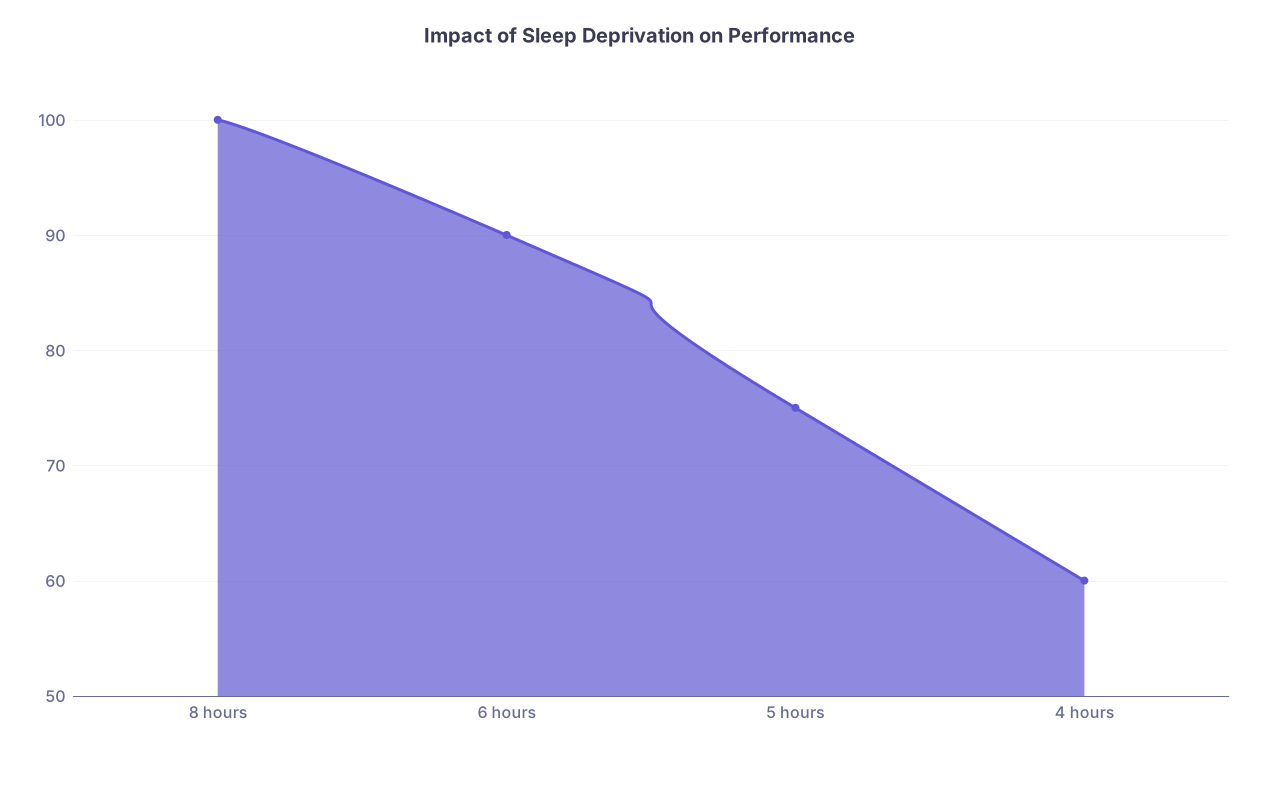
Impact of Sleep Deprivation on Performance Category Value 8 hours 100 6 hours 90 5 hours 75 4 hours 60 That “extra” study time is mostly low-yield suffering.
No buffer for bad days
This kind of schedule assumes you’re a machine. No headaches. No family crises. No off days.
The first time life happens, everything collapses. You’re suddenly “behind,” so you cut more sleep and more breaks. That’s how people end up crying in bathroom stalls between lectures.Identity tied to grinding
Once you start being “the hard worker,” it gets harder to admit the schedule is killing you. You don’t want to be seen as “soft,” so you double down on something that’s obviously not sustainable.
Red flags to watch for:
- You’re proud of how little you sleep
- You feel guilty taking a full day off
- You need caffeine just to feel baseline functional
- You reread the same paragraph and retain nothing
Safer shift:
- Hard cap your daily true study time at 8–9 focused hours
- Non-negotiable 7–8 hours of sleep
- Default one real day off every 1–2 weeks
- Protect one chunk of brain-dead time daily (walk, trash TV, whatever)
If your schedule requires sleep deprivation to fit, it’s not a schedule. It’s slow self-harm dressed up as “dedication.”
2. The “Perfect Plan” That Collapses in Week Two
You’ve seen this one.
Spreadsheet color-coded by topic.
Daily plan broken down in 30-minute blocks from 6 a.m. to 11 p.m.
Anki, Qbank, lecture review, Pathoma, UWorld, Boards and Beyond, sketchy, and somehow gym and meal prep.
On paper, it looks incredible.
In real life, it dies the moment you hit the first unplanned hiccup.

How this schedule burns you out:
Zero tolerance for reality
A “perfect” day schedule assumes you’re at 100% every single day. No fatigue. No slow mornings. No resting after a rough small group.When you slip once, your whole plan is “off,” and you start telling yourself you’re behind, weak, or not disciplined enough.
You spend more energy managing the plan than learning
I’ve watched students spend an hour “adjusting” a Notion board every night just to extend a fantasy. That time should be sleep, exercise, or actual studying.
If your planning system is a second part-time job, it’s a problem.You build daily quotas, not sustainable rhythms
“200 Anki, 60 UWorld, 3 lectures, 1 review video, 1 hour of notes…”
On a good day, maybe you barely make it.
On a bad day, you crash and then push even harder the next day to “catch up,” which just digs the hole deeper.
Red flags:
- You feel constant background anxiety that you’re “off schedule”
- You rewrite your schedule every few days
- You regularly push tasks to “tomorrow” until they’re a huge unreadable backlog
- You feel worse about yourself the more detailed your schedule becomes
Safer alternative:
Use ranges and priority tiers, not rigid minute-by-minute plans.
Something like:
- Core non-negotiables (most days):
- 2–3 hours: Qbank and review
- 1–2 hours: Anki
- Optional add-ons if you have bandwidth:
- 1 hour: lectures
- 1 hour: videos or deep review
- Hard-stops:
- No new study after 10 p.m.
- Bed window: 10–11:30 p.m.
Set weekly targets (e.g., 250–300 UWorld questions/week), then flex the days. Real life needs slack.
3. The “Every Resource, Every Day” Frankenstein Schedule
This one is born from fear.
You hear 5 different upperclassmen swear by 5 different resources.
So you combine all of them. Every day.
Your typical plan looks like:
- 3–4 new lectures
- 200+ Anki reviews
- 40–80 Qbank questions
- 1–2 hours of board videos
- 30–60 minutes of pathology/pathophys book
- Plus “catching up” on old stuff
It’s the academic equivalent of mixing every medicine in the Pyxis “just to be safe.”
| Category | Planned Daily Amount |
|---|---|
| Lectures | 3–4 hours |
| Anki | 200–300 cards |
| Qbank | 40–80 questions |
| Videos | 1–2 hours |
| Reading | 30–60 minutes |
Why this leads straight to burnout:
No depth, just frantic sampling
You touch 10 things shallowly, understand none of them deeply, and then blame your “memory” or “intelligence” when facts don’t stick. It’s not you. It’s the chaos.Constant cognitive switching cost
Lecture → Anki → Qbank → Video → Note tidy-up.
Your brain spends half its energy just changing gears. By mid-afternoon, you feel weirdly fried despite never truly focusing.You never feel “done”
When your daily list is 20 items long, you will always end the day behind. That chronic “I didn’t do enough” guilt is a direct highway to burnout and depression.
Red flags:
- You’re scared to drop any resource because “what if it’s what I need to honor/pass Step/match derm?”
- You’re always mid-way through 3–4 different video series
- You’re months into a course and can’t say which 1–2 tools are actually working best for you
Safer correction: ruthless subtraction
Pick:
- 1 main content source (lectures OR a video series; not all of them)
- 1 main active recall tool (Anki or another flashcard system)
- 1 main application tool (Qbank)
Everything else is optional seasoning, not daily staples.
Ask yourself bluntly:
“If I had to drop half my study tasks tomorrow, what would I keep?”
That’s your actual study strategy. The rest is fear and FOMO.
4. The Procrastination-Then-Panic Exam Crunch
Here’s the classic pattern:
Weeks 1–3 of the block:
“I’ll really start next week.” “I just need to settle in.”
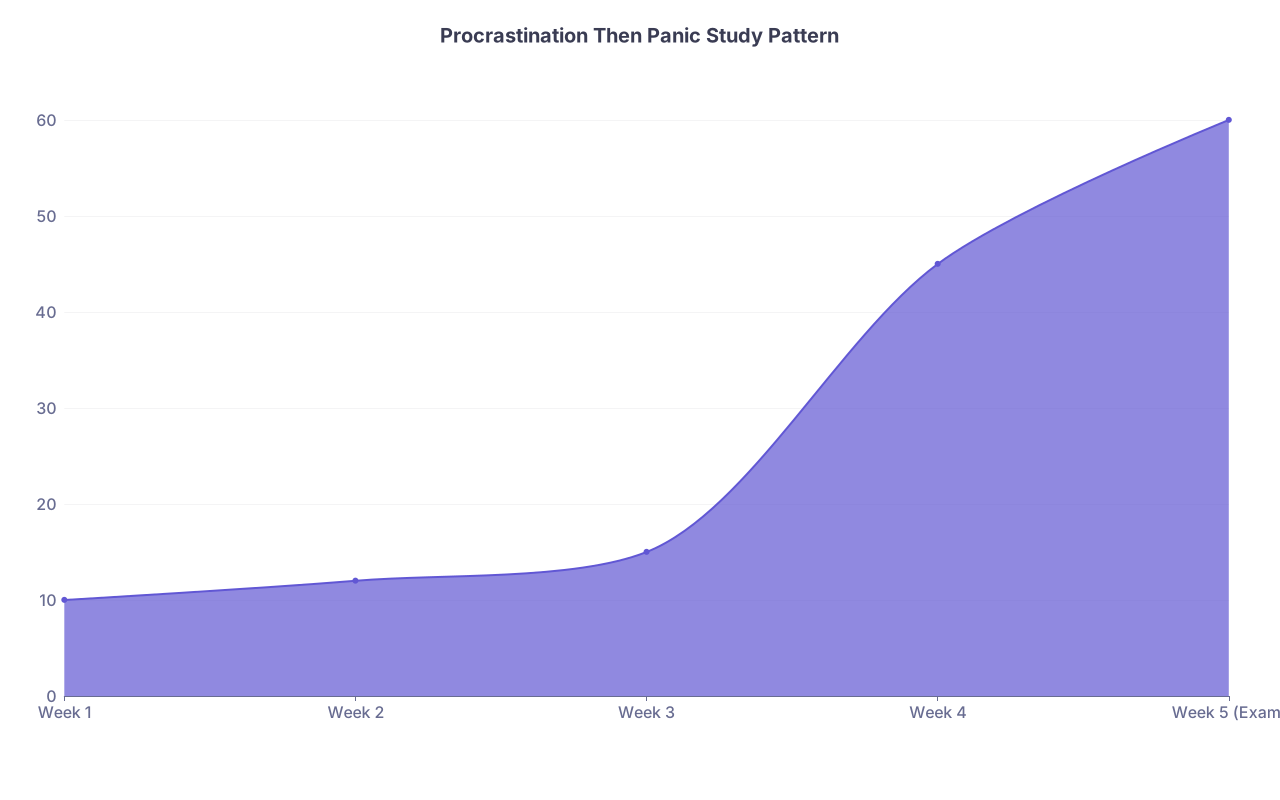
You half-watch some lectures on 1.75x, do Anki for 2–3 days in a row, then ghost it.
Two weeks before the exam:
You “realize” how much there is. Panic mode.
Suddenly it’s 8–10+ hours a day, every day, full throttle, because “this is what I should have been doing all along.”
| Category | Value |
|---|---|
| Week 1 | 10 |
| Week 2 | 12 |
| Week 3 | 15 |
| Week 4 | 45 |
| Week 5 (Exam) | 60 |
The problem isn’t just the panic phase. It’s the whiplash between doing almost nothing and doing absolutely everything.
How this schedule fries you:
Guilt-based motivation
You’re not studying to learn. You’re studying to outrun the shame of starting late. That’s not sustainable. Shame is a short-term fuel that leaves you emotionally scorched.All-or-nothing identity
You start telling yourself, “I’m just someone who works better under pressure.”
No. You’re someone whose nervous system is in a constant fight-or-flight loop before every exam. That comes with a cost: sleep, appetite, mood, relationships.Repeated trauma cycle
Every block becomes:- Denial
- Avoidance
- Panic grind
- Survive exam
- Swear you’ll never do it again
- Repeat
That on-off stress hits your brain and body harder than consistent moderate effort.
Red flags:
- You can’t start “until the pressure is real”
- You only feel focused when you’re terrified of failing
- Each block ends with you mentally wrecked for 3–5 days after the exam
Safer pattern: low, boring consistency
You don’t need to become a productivity robot. You do need a minimum standard even in your “lazy” phases.
For example:
- Absolute baseline:
- 30–60 min Anki most days
- 10–20 Qbank questions, review same day
- When the exam gets closer:
- Scale up from that base, not from zero
The goal isn’t “no procrastination ever.” The goal is “my worst weeks are still enough to prevent panic mode.”
5. The 7-Days-A-Week, No-Real-Day-Off Grind
This one fools a lot of “good students.”
You think you’re being responsible. Disciplined. Mature.
Your schedule:
- Study every single day
- “Light” days are still 3–4 hours minimum
- Any day under 2–3 hours = “wasted” day
- You feel tense or guilty on vacation or family days

Why this predictably burns you out:
No recovery cycles
Muscles need rest after lifting. So does your brain.
When there’s never a true “off” day, your baseline keeps drifting downward. You don’t notice right away. Then one day you realize you’re constantly irritable, joyless, and exhausted.Pleasure becomes suspicious
I’ve heard versions of:
“I can’t watch a movie without feeling like I’m slacking.”
That’s not discipline. That’s your nervous system stuck in survival mode.You train yourself out of motivation
If every day, including weekends, feels exactly the same, with the same pressure, your brain stops responding. Nothing feels urgent. Nothing feels rewarding. That’s a straight shot toward burnout or depression.
Red flags:
- You can’t answer “What do you do for fun?” without referencing medicine
- A day without study makes you anxious, not rested
- You fantasize about getting sick or injured just to justify stopping
Safer alternative: real, planned rest
At minimum, protect:
- 1 half-day off per week where you don’t open a single study app
- 1 full evening each week for real life (friends, family, hobbies)
Those are not “if I’m caught up” rewards. They’re requirements.
Ironically, the students who schedule predictable, guilt-free time off usually outlast and outperform the non-stop grinders. Because they actually still like being alive.
6. The Comparison-Driven “Whoever Studies More Wins” Schedule
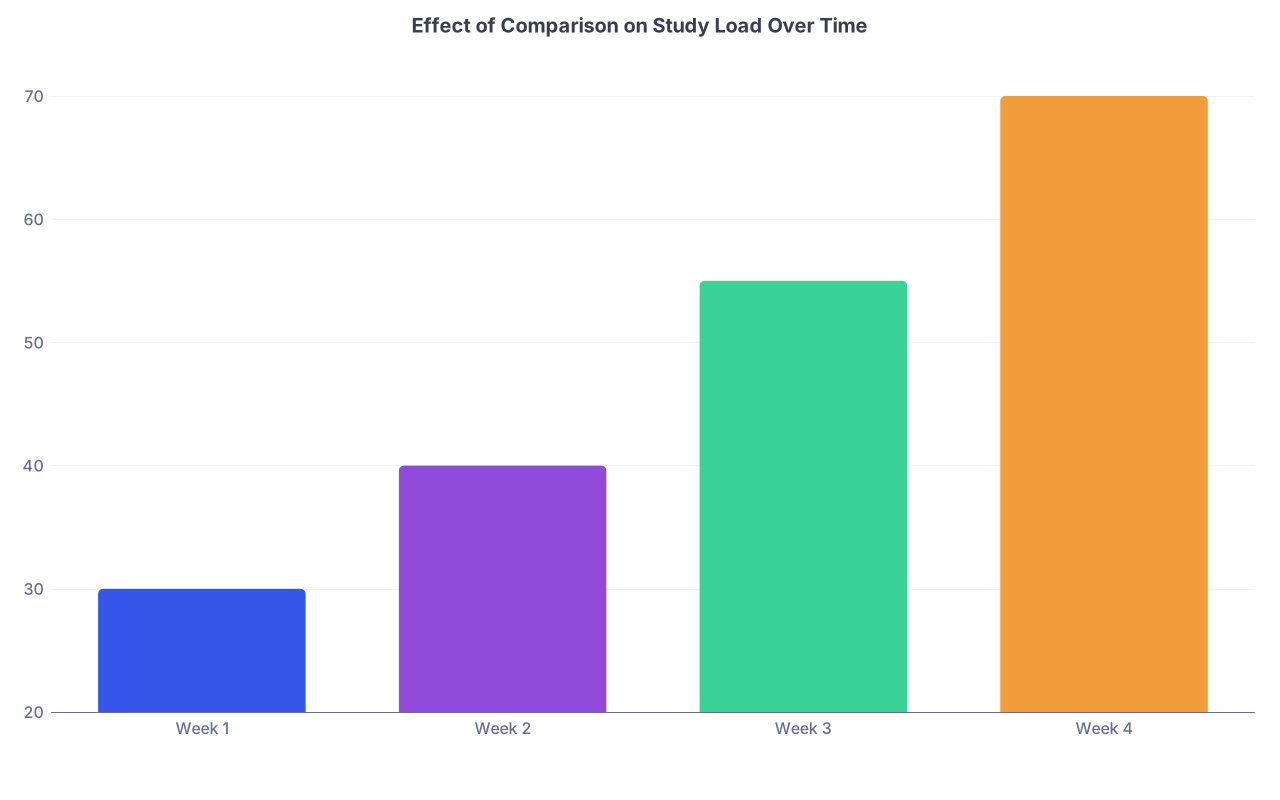
This schedule shifts every week because it’s not based on your needs. It’s based on whoever you’re currently comparing yourself to.
You see:
- A classmate post on GroupMe: “Anyone want to do 120 questions/day for the next month?”
- A Reddit post: “I raised my score 40 points, here was my 12-hour schedule.”
- A YouTube video: “My 4 a.m.–10 p.m. Step 1 grind (I scored 265).”
So you adjust. Again. And again.
| Category | Value |
|---|---|
| Week 1 | 30 |
| Week 2 | 40 |
| Week 3 | 55 |
| Week 4 | 70 |
How this wrecks you:
Your schedule never stabilizes
You keep chasing someone else’s “secret” instead of committing to a process long enough to see if it actually works for you.Every day becomes a referendum on your worth
If a friend does 80 questions and you “only” did 40, you feel like a failure, even if your 40 were deeply reviewed and theirs were rushed.You ignore your own warning signs
Anxiety, headaches, irritability, brain fog—those are your dashboard lights. But comparison mode convinces you to floor the gas anyway because “everyone else is hustling.”
Red flags:
- Your schedule changes every time you hear what a “gunner” is doing
- You always feel like you’re behind, even when objectively you’re doing fine
- You use other people’s reported hours or question counts to decide if you’re allowed to rest
Safer mindset shift:
Define success in process metrics you control, not in comparison:
- “I do focused Qbank with full review 5 days/week.”
- “I sleep 7 hours and do Anki at least 5 days/week.”
Unfollow or mute accounts and group chats that only post flexy productivity stuff. Yes, really.
7. The “Fix My Life in One Month” Step/Board-Study Schedule
Last one, and it’s brutal.
You coast through preclinical with minimal consistent studying. You pass exams. You’re “not a gunner.” Maybe your school is P/F and you assume you’ll ramp it up for Step.
Then 6–8 weeks before your dedicated period, you realize your baseline is weak. So you design a monstrous dedicated schedule:
- 80–120 Qbank questions daily
- 300–400 Anki reviews
- 4–6 hours of videos
- 1–2 passes of First Aid over the period
- Little to no rest days

| Step | Description |
|---|---|
| Step 1 | Weak Baseline Knowledge |
| Step 2 | Panic About Step |
| Step 3 | Create Extreme Schedule |
| Step 4 | Overload Daily Tasks |
| Step 5 | Exhaustion and Incomplete Tasks |
| Step 6 | Increase Guilt and Panic |
| Step 7 | Lower Retention and Confidence |
| Step 8 | Burnout Before Exam |
You’re trying to brute-force years of foundation into a few weeks. Dedicated becomes a daily beatdown instead of a refinement phase.
Why this backfires hard:
You can’t compress long-term memory on command
Spaced repetition works over time. No way around that.
When you cram, you build fragile, shallow connections that evaporate under stress. Especially test-day stress.You burn out before you peak
Peak performance for big exams usually comes when your studying has been intense but sustainable for a while. Not when you’ve been sprinting at redline for 3–4 weeks straight.You nuke your confidence
You design a schedule that no human can complete, then each day you “fail” to do it. By week 3, it’s not just “this is hard,” it’s “I’m not cut out for this.” Completely unnecessary self-damage.
Red flags:
- Your daily plan for dedicated takes >12–14 hours on paper
- You require zero bad days, zero headaches, zero oversleeping for your plan to work
- You feel like this is your “last chance” to prove you belong in medicine
Safer approach:
Before dedicated, gradually ramp:
- Build a real Anki habit months before
- Use at least 1 Qbank during your courses, not just in dedicated
During dedicated:
- Aim for 60–80 well-reviewed questions/day as a normal human target
- 1–2 major resources, not 5 or 6
- Plan at least 1 lighter day per week
You cannot out-study chronic burnout. It always wins.
How to Audit Your Current Schedule (Without Lying to Yourself)
Time for the uncomfortable part.
Take a typical week. Not your fantasy week. Last week.
Ask yourself:
Sleep audit
- Average sleep per night?
- How many nights under 6 hours?
- Do you wake up rested at least 2–3 days a week?
Emotional audit
- How often do you feel dread when you open your laptop?
- Do you remember the last time you enjoyed something unrelated to medicine?
- Are you more irritable, numb, or tearful than you were 6 months ago?
Schedule rigidity
- Does one bad day blow up your whole plan?
- Do you ever intentionally take a day or evening off without guilt?
- Can you skip one study block and not spiral mentally?
Body signals
- Headaches, gut issues, palpitations, jaw clenching, insomnia?
- Using caffeine, Adderall, or other stimulants just to reach “normal”?

If reading those questions makes your chest tight, that’s not random anxiety. That’s your system telling you, clearly: this is not sustainable.
You do not get a prize for ignoring that.
What a Non-Burnout Study Schedule Actually Looks Like
Not perfect. Not pretty. But survivable.
Most sustainable med school schedules share a few features:
Protected sleep
7–8 hours is the rule; dips are the exception, not the norm.Limited daily focus
2–3 major tasks per day (e.g., Qbank + Anki + some content), not 10 tiny ones.Pre-planned rest At least:
- 1 evening per week for life
- 1 half or full day off every 1–2 weeks
Room for being human
Schedule has slack—you can miss one block and not implode.Stable core tools You’re not changing resources every time you panic. You iterate small changes, not full overhauls.

Does that mean you’ll never have a brutal week? No. Some rotations, some exam weeks, some dedicated days will still be ugly.
But if every week feels like survival mode, your schedule is the problem. Not your character.
Final Thoughts: What To Remember
Keep these in your head:
If your study plan only works when you’re superhuman, it doesn’t work.
Real life will always show up. Build a schedule that can absorb it.Grinding is not the same as learning.
Exhaustion feels like effort. It is not proof you’re being effective.Rest is not a luxury for the weak; it’s a requirement for longevity.
You’re training for a 30+ year career. Study like you plan to still like yourself when you get there.