
You are three days into exam week. Coffee cups everywhere. Step-style question blocks open on your laptop. Group chat blowing up with “anyone have cardio pharm Anki tags?” You keep telling yourself: “It’s just this week. I’ll fix my routine after.”
This is exactly where people start making quiet, high-yield mistakes that wreck their mental health. Not immediately. Not dramatically. But gradually, predictably, and completely avoidably.
Let me walk you through the common exam-week habits that look “hard-working” on the surface but are actually sandblasting your mind from the inside out.
1. The “Sleep Is Optional” Fantasy
You know this one. “I’ll just pull two late nights, crush this exam, then catch up later.”
No, you will not. And that “just this week” mindset is how burnout becomes baseline.
Here is the trap: You feel anxious → you sleep less to “buy time” → your anxiety actually gets worse → you then think you need even more time → you cut more sleep. That spiral is textbook.
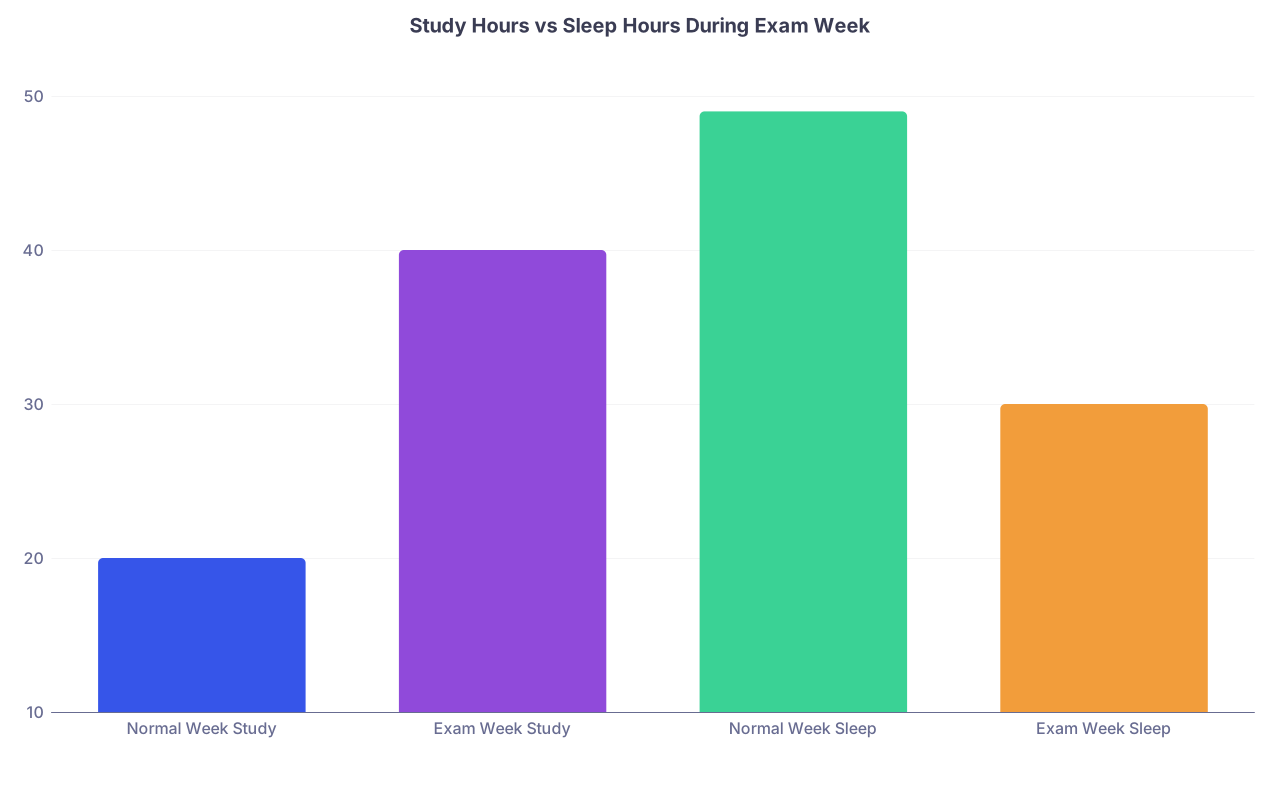
| Category | Value |
|---|---|
| Normal Week Study | 20 |
| Exam Week Study | 40 |
| Normal Week Sleep | 49 |
| Exam Week Sleep | 30 |
Common sleep-sabotaging exam-week habits:
- “Just one more block” at 1:30 a.m.
- Caffeine after 4–5 p.m. and then wondering why you are wired at midnight
- Studying in bed with your laptop glowing in your face
- Setting three alarms for 5:00 a.m. after going to bed at 2:00 a.m.
What actually goes wrong:
Cognitive performance tanks
You might feel “on,” but your exam performance is not. Sleep loss destroys:- Working memory (holding all the steps of that renal physiology pathway)
- Attention (reading the same question stem three times)
- Emotional regulation (small things feel catastrophic)
Anxiety amplifies
Sleep restriction and anxiety feed each other. Poor sleep increases amygdala reactivity and makes everything feel more threatening. That vague “I’m going to fail out” dread? Often sleep debt.Mood crashes after the exam
I have watched students walk out of an exam, finally stop, and then crash into a 3–5 day depressive funk. They think it is about the exam outcome. Often it is just accumulated sleep debt finally hitting.
What to do instead (that does not destroy your score):
- Set a non-negotiable “screens off” time, even in exam week (for most people, 11 p.m. latest is reasonable).
- If you are behind at 11 p.m., you do not need more time. You need triage. Pick the 1–2 highest-yield topics and stop.
- Swap “panic-review at midnight” for a 20–30 minute wind-down: shower, stretch, off-phone. Boring, but it works.
- Hold sleep duration as a hard boundary: 7 hours minimum. For most med students, 6 hours is not “fine,” it is chronic sabotage.
Do not worship grind culture. Nobody cares that you stayed up until 3 a.m. if you bomb pharmacology questions you actually knew.
2. Extreme Cramming and Content Hoarding
Exam week brings out the hoarder in people.
You open Boards & Beyond. Sketchy. Pathoma. Three Anki decks. Class lectures. Review notes from three friends. Now your brain has a dozen input sources and zero plan.
Typical pattern:
- “I’ll just go through everything quickly.”
- You race through content without encoding anything.
- Your brain is drowning in incomplete information and unresolved open loops.
- Anxiety spikes, confidence plummets, and you feel behind no matter how much you study.
This habit quietly crushes your mental health because it keeps you in a constant state of “not enough.” You never get the psychological win of “I covered what matters.”

Mistakes I see over and over:
- Switching resources mid-week because someone said, “That UWorld block had so much cardio, you should do Amboss cardio today.”
- Bouncing between three Anki decks and doing none of them well.
- Watching entire video series instead of practicing questions when you are 48 hours out.
- Re-reading lecture slides in full rather than focusing on your summarized notes or question performance.
This is not just inefficient. It is psychologically punishing. Your brain never gets closure.
Smarter, less-destructive behavior:
- Pick a maximum of 2 primary resources for the exam week (for example: Anki + UWorld; or lecture slides + your own notes).
- Convert late content to damage control: Use question banks to surface weak areas, then fill gaps selectively.
- Switch your metric from “how much content I touched” to “how many high-yield problems I solved and understood.”
Ask yourself: “If I knew I could only touch 3 things before this exam, what would they be?” Study like that. The clarity lowers anxiety fast.
3. Social Comparison and Toxic Group Chats
Exam week group chats are a mental health minefield.
You log in to check one clarification, and suddenly you are seeing:
“Just finished my third 40-question block today.”
“Guys, anyone else getting 80s on UWorld?”
“Here’s my 10-page rapid review I made at 2 a.m. if anyone wants it.”
You were barely holding it together, and now your brain is screaming, “You are behind. Everyone else knows more. You are the weak link.”
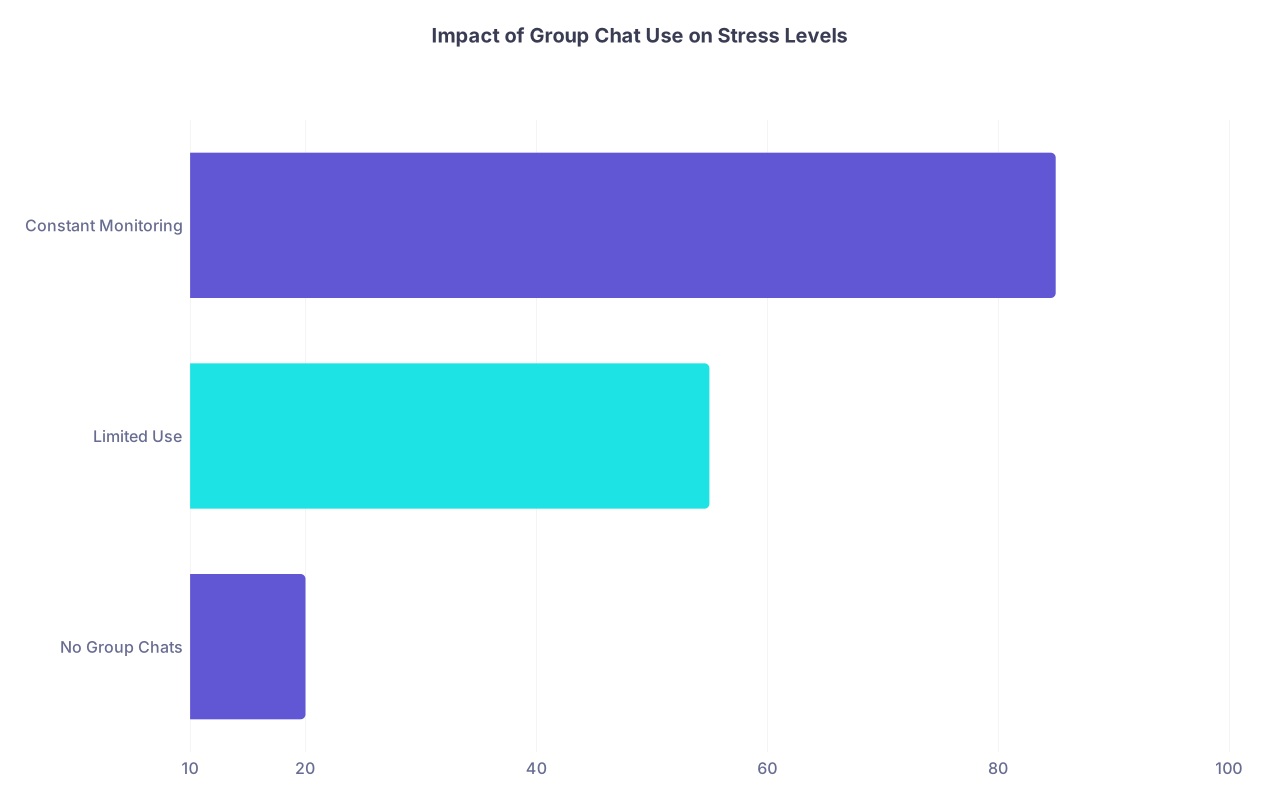
| Category | Value |
|---|---|
| No Group Chats | 20 |
| Limited Use | 55 |
| Constant Monitoring | 85 |
Common social-comparison habits that wreck you:
- Checking stats: asking people their UWorld percentages, NBME scores, Anki card counts.
- Lurking in chats without talking, letting your anxiety stew.
- Joining last-minute “review Zooms” where everyone tries to flex their obscure knowledge.
- Letting someone else’s pace dictate your panic, not your actual progress.
Here is the psychological problem: you are comparing your internal chaos to everyone else’s curated highlight reel. You see your uncertainty and their bravado and assume they are objectively ahead. Often they are just louder.
How to not let social contact fry your brain:
- Set hard boundaries with group chats. Mute them during study blocks. Check them once or twice a day max.
- Avoid asking or sharing raw numbers (percentages, hours, cards done). That rarely helps anyone and often just spikes anxiety.
- If you need accountability, use a one-on-one buddy who you trust to be honest, not performative.
- If a study group makes you walk away feeling worse about yourself after every session—leave. That is data, not weakness.
Protect your headspace like it is part of your study plan. Because it is.
4. Starving Your Body and Overdosing on Caffeine
Exam week nutrition in med school is usually some version of: coffee, energy drinks, takeout, and random bites of whatever is around.
People act like they are brains in jars. You are not. Your nervous system is not going to stabilize on iced coffee and leftover pizza at 1 a.m.
Usual exam-week mistakes:
- Strong coffee on an empty stomach → nausea, jittery panic, inability to sit still for questions
- “I do not have time to eat” → blood sugar peaks and crashes → irritability, brain fog
- Chugging an energy drink right before bed because “I just need to push through this block”
- Forgetting actual water exists and wondering why you have headaches all week
This does not just “make you feel a bit off.” It directly worsens anxiety and mood. Blood sugar swings mimic anxiety symptoms: racing heart, sweating, shakiness. So you interpret nutritional neglect as “I am freaking out about the exam,” when in fact you are also physiologically crashing.
Practical, not-perfect fixes:
- Anchor 2 real meals per day, even if they are simple: eggs + toast; rice + beans + frozen veggies; rotisserie chicken and salad. No gourmet cooking required.
- Front-load caffeine early. Last dose by about 3–4 p.m. You do not want 100–200 mg riding your nervous system at midnight.
- Pair coffee with actual food. A banana and peanut butter or toast with something on it is infinitely better than coffee alone.
- Keep water visible on your desk. This sounds stupidly simple, but people drink what they see.
You would never tell a patient to “just run on caffeine and hope for the best.” Do not do that to yourself.
5. Zero Movement: The “I Can’t Afford a Break” Lie
You sit. All day. You only move to hit the bathroom, refill coffee, or pace in place when a question block goes badly.
Then you wonder why your back hurts, your neck is tight, and your mood is flat.

Here is the mental health backfire: physical stillness plus cognitive overload is jet fuel for anxiety and low mood. Your body starts interpreting the situation as chronic threat with no discharge. So your baseline tension escalates all week.
People skip movement because they think: “I do not have 1–2 hours to work out.” That is not the bar.
What actually helps:
- 5–10 minute walks between long blocks, outside if possible. No phone, just move.
- Light stretching once or twice a day, especially hips, shoulders, neck. It decreases physical noise so your brain can focus.
- If you like more intense exercise and it genuinely energizes you (not exhausts you), 20–30 minutes is plenty during exam week.
Red flag: If you feel guilty for taking a 10-minute walk but not for losing 40 minutes to scrolling on your phone, your guilt is not about time. It is about anxiety. Call it what it is.
Movement is not “extra.” It is a reset button. You are not saving time by removing it; you are just eroding your mental stability.
6. Emotional Suppression and Isolation
Exam week often turns into emotional lockdown.
Your inner monologue: “I just need to get through this. I can’t think about how I feel right now.”
So you box up your emotions. You stop talking to friends. You slap on a functional face and grind.
Here is the problem. That strategy works for 24–48 hours. Maybe 72. Beyond that, suppression becomes pressure. The more you ignore how overwhelmed you are, the more it leaks out sideways: irritability, random crying, numbness, thoughts like “I do not even care anymore.”
I have watched very solid students hit exam week after a rough block (family illness, breakup, Step anxiety) and decide “I’ll handle it after the exam.” By the time “after” comes, they are not just stressed. They are depressed.
You do not need to process your entire life story during exam week. But you also cannot treat your emotions like spam mail to be ignored indefinitely.
Minimal, realistic emotional hygiene:
- Admit to yourself, in writing, how you actually feel. 5–10 minutes. Uncensored. “I’m terrified of failing this,” “I’m exhausted,” “I’m angry at how endless this feels.”
- Tell one person you trust: “This week is hitting me harder than usual.” That sentence alone reduces the isolation.
- If you are already in therapy, do not cancel your session “to study.” That is like skipping a med refill during a flare.
If you notice:
- Persistent hopelessness (“What is the point?”)
- Frequent thoughts that people would be better off without you
- Urges to self-harm or use substances to blank out
That is not “normal exam stress.” That is dangerous territory. You contact campus mental health, a physician, or an emergency service. Academic consequences are survivable. The alternative is not.
7. All-or-Nothing Thinking About Performance
“Oh my god, if I do badly on this exam, I’m screwed.”
“If I am not in the top quartile, I will never match.”
“If I miss questions I ‘should have known,’ I’m clearly not cut out for this.”
This absolutist thinking is incredibly common and incredibly corrosive.
You go into the exam not just trying to do well, but trying to avoid catastrophic identity collapse. Every missed practice question becomes evidence that you are defective. That is a brutal mental load to carry.

| Step | Description |
|---|---|
| Step 1 | All-or-nothing beliefs |
| Step 2 | Extreme pressure |
| Step 3 | Higher anxiety |
| Step 4 | Worse focus & performance |
| Step 5 | Perceived failure |
| Step 6 | Beliefs reinforced |
Why this wrecks your mental health:
- It ties your self-worth to one data point in a very long training process.
- It makes any setback feel existential instead of informational.
- It disables learning. You are too busy self-attacking to actually fix your weaknesses.
You do not have to become some ultra-balanced zen monk. You just need to stop lighting yourself on fire.
Better mental framing, concretely:
- Replace “I must crush this” with “I need to perform solidly enough, and every question is a chance to earn points, not prove my worth.”
- When you catch insane statements like “If I miss this, I’ll never be a good doctor,” literally say in your head: “No. That is catastrophizing.” Then restate something sane.
- After a bad block, do not jump to “I’m doomed.” Ask: “What pattern of mistakes shows up here? Do I rush? Misread? Lack content? That is fixable.”
Harsh truth: Surgical precision with your self-talk is as important as surgical precision with your answers. If you let your brain run wild, it will not magically choose a rational narrative.
Quick Comparison: Healthy vs Harmful Exam-Week Habits
| Domain | Common Harmful Habit | Healthier Alternative |
|---|---|---|
| Sleep | 4–5 hours, screens until 2 a.m. | 7 hours, hard cutoff time |
| Study Plan | 5+ resources, constant switching | 1–2 core resources, clear triage |
| Social | Constant group chats & comparisons | Limited use, 1–1 accountability |
| Nutrition | Coffee-only mornings, random snacks | Simple meals, early caffeine |
| Movement | Sitting 12+ hours straight | Short walks and stretches |
FAQ (Exactly 5 Questions)
1. Is it ever worth sacrificing sleep the night before an exam to keep studying?
Very rarely, and students overestimate how often that situation exists. If you genuinely have learned almost nothing and the exam is the next morning, a moderate extension (for example, midnight instead of 10 p.m.) might gain you points. But routinely cutting sleep from 7–8 hours to 4–5 hours sabotages cognitive performance far more than a bit of extra review helps. If you are repeatedly in a position where you feel forced to cram all night, the problem is in your planning, not the clock.
2. How much exercise is “enough” during exam week without hurting my study time?
You do not need full workouts if they stress your schedule. For mental health, 2–3 short bouts of movement per day (5–15 minutes each) are sufficient to reduce tension and improve focus. That can be brisk hallway walks, stairs in your building, or basic stretches. If you already have a workout habit and it energizes you, one 20–30 minute session most days is plenty. If a workout makes you so tired you lose a study block, you overshot.
3. What if my classmates really are studying more and scoring higher than me?
Then you adjust with strategy, not panic. Studying more hours is only useful if it is effective work, not anxiety-driven busywork. If others are outscoring you consistently, look at how they are studying: Are they doing more questions? Reviewing errors more deeply? Using fewer resources? Ask targeted questions. Then run small experiments in your own study plan. Feeling inferior is not a plan. Specific changes are.
4. How do I know if my exam stress has crossed into something more serious like anxiety or depression?
Red flags: persistent physical symptoms (racing heart, insomnia, GI trouble) even when you are not actively studying; daily feelings of hopelessness or worthlessness; loss of interest in things you used to enjoy; thoughts that life is not worth living or that others would be better off without you. If these are showing up for more than a week or two, or they are intense, you are beyond “normal exam stress.” That is the time for professional help, not more flashcards.
5. What one change gives the biggest mental health payoff during exam week?
For most students: guarding sleep like it is part of your exam. A realistic 7 hours of sleep, with a consistent cutoff time and minimal late caffeine, stabilizes mood, reduces anxiety, and improves focus more than almost any exotic productivity hack. If you already sleep decently, the next best change is simplifying your resources to 1–2 main tools. Mental health improves dramatically when your brain is not juggling five different systems and endless “I should also be doing…” noise.
Key Takeaways
First: Stop trading your mental health for a tiny, often imaginary bump in exam performance. The cost is higher than you think, and the benefit is smaller than you hope.
Second: The small, “boring” choices—sleep, simple food, one or two resources, short walks, reduced comparison—protect your mind far more than one more panicked question block at 1 a.m.
Protect your brain. It is the only tool you have that actually matters in this career.