<ai-image title="Medical student studying alone in library looking conflicted while phone buzzes with messages" location="headline" prompt="Professional DSLR photo of a medical student in scrubs sitting alone at a library table at night, textbooks and laptop open, looking torn between focusing on studying and a buzzing smartphone showing group chat notifications, dim warm lighting, subtle background of other students socializing" "/>
What if you finally say “no” so you can study… and that’s the moment your friends quietly decide you’re not worth inviting anymore?
Yeah. That fear.
The Quiet Panic Behind “I Really Need to Study”
This is the mental loop I see (and honestly, have lived):
You look at your exam calendar: cardio exam, OSCE, then pharm — all within 2 weeks. Your brain’s already frayed. Your friends drop a message in the group chat:
“Drinks tonight? We all need a break lol”
Your actual reaction?
Not joy. Not relief.
Because:
- If you go, you’ll feel guilty the entire time and spiral about how unprepared you are.
- If you don’t go, you’ll feel guilty that you’re “a bad friend” and everyone else is bonding without you.
And then the nasty thought: “If I keep saying no… they’re just going to stop asking, right?”
That’s the part that stings. Not missing one night. The fear that this is how friendships slowly die while you’re stuck in the library with UWorld and a cold coffee.
You’re not crazy for thinking this. Medical school is wired to make you feel like you’re constantly choosing between your future and your relationships.
But here’s the uncomfortable truth: if you never set boundaries around study time, you will pay for it — usually with burnout, resentment, or both.
The good news? You can protect your study time and not nuke your social life. But it’s not automatic. You have to be intentional.
Let’s dissect this like it’s a path question.
Are You Actually Losing Friends, Or Just Scaring Yourself?
First question I’d ask you if we were sitting in a coffee shop:
Do you have actual proof your friends will abandon you if you set boundaries, or just a loud, anxious brain screaming worst-case scenarios?
There are a few different patterns I see:

Healthier friends you’re scared to “test”
These are the ones who already say:
“I can’t tonight, got to finish my Anki.”
If you set a boundary, they’ll probably just say “Same, honestly.”Convenience friends
People who like you when you’re available and fun, but disappear when you’re stressed or busy. These don’t survive clerkships anyway. Or residency. Or life.Other anxious people-pleasers
They also don’t want to say no. So everyone’s silently overwhelmed and overcommitted and burnt out together.
Your brain probably groups them all into the same terrifying category: “If I say no, they’ll hate me.”
But notice something: you’re predicting a future where:
- No one understands studying is important in medical school (which is insane when you say it out loud), and
- Any boundary equals rejection
That’s not “reality.” That’s anxiety with a megaphone.
A quick gut-check: who are you actually scared of disappointing?
Imagine texting:
“Hey, I really need tonight for exam prep. Rain check?”
Picture 3 specific people and their reactions. Not an imaginary “everyone.” Actual people.
Usually one of these happens:
- “All good, we’ll catch you next time!”
- “Same, I need to study too lol”
- Silence — and your brain fills in, “They hate me,” when it might just be… they put their phone down.
You’re not wrong that some friendships will cool off when you say no more. That does happen. The real question is:
Is preserving every shaky social connection worth sacrificing your mental health and exam performance?
Because med school is unforgiving when you don’t protect time to actually learn.
What Happens If You Don’t Set Study Boundaries?
Let’s play out the scenario you’re already living or close to.
You keep saying yes:
- Yes to “quick” dinners that turn into 3 hours
- Yes to late-night calls when you’re exhausted
- Yes to being the “always available” friend
Short-term: less FOMO. Long-term: chaos.
Here’s what I’ve watched happen over and over:
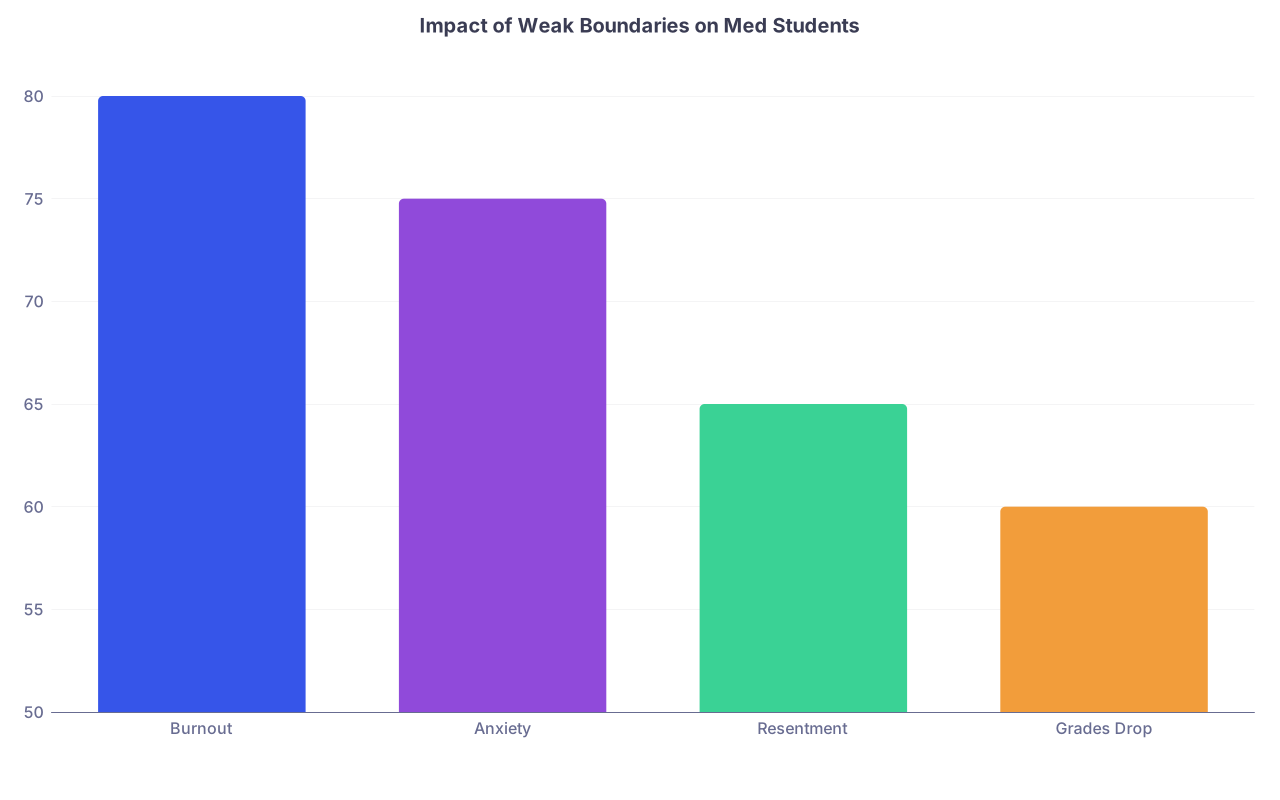
| Category | Value |
|---|---|
| Burnout | 80 |
| Anxiety | 75 |
| Resentment | 65 |
| Grades Drop | 60 |
Those numbers aren’t exact, obviously, but the pattern is real. When you don’t guard your time:
- Your sleep gets wrecked
- Your baseline anxiety explodes
- You start resenting the very people you’re afraid to disappoint
- Studying becomes this frantic, panicked thing squeezed into leftover scraps of time
Ironically, you become worse company. More distracted, more stressed, more irritable. You say yes, but you’re not really present.
And here’s the cruel twist: your friends might still drift anyway. Not because you studied too much, but because you were never emotionally fully there — mentally always half with your notes, half with them.
So no boundaries doesn’t actually save your friendships. It just guarantees you suffer more.
How to Say “No” Without Sounding Like You Don’t Care
You’re probably not afraid of blocking off time. You’re afraid of the conversation where you do it.
Let’s make that part stupidly simple.
1. Be specific, not vague and apologetic
Vague:
“Uh I don’t know, I’m kinda busy, maybe I’ll see how I feel?”
That invites pressure. People will push: “Just come for a bit” or “You’re always studying.”
Try this instead:
“I’m blocking off tonight for cardio and pharm. I really need this one. Can we plan something for after my exam on Friday?”
That says three things:
- You’re serious about studying
- It’s about this time block, not them
- You’re still invested in the friendship (you suggested another time)
2. Use a simple script and stop overexplaining
You don’t need to send a 3-paragraph essay defending your decision.
A simple formula:
- Acknowledge the invite
- State your boundary
- Offer an alternate
Like:
“Ahh that sounds fun. I’ve got a big exam coming up, so I’m keeping tonight for studying. What about grabbing coffee Saturday afternoon instead?”
That’s it. Stop there. Don’t add: “But if you’re mad I understand” or “I’m such a bad friend, sorry.” That just makes everyone uncomfortable and puts them in the role of comforting you.
3. Preempt it with “study truths”
Sometimes it helps to set expectations in advance, especially around exam blocks:
“Hey, next two weeks are rough for me with OSCE + finals, so I’ll probably be MIA and saying no more. Please don’t take it personally — I still want to see you all after the chaos.”
You’re basically telling them: if I disappear, it’s not rejection, it’s survival.
Building a Life Where Studying Isn’t the Villain
You’re not trying to become a lonely robot that only eats flashcards. You want both: decent grades and actual relationships that last.
So you need a system that doesn’t make every plan feel like a threat.

| Step | Description |
|---|---|
| Step 1 | Exams Coming Up |
| Step 2 | High study priority |
| Step 3 | Medium balance |
| Step 4 | Flexible time |
| Step 5 | Mostly say no, schedule small breaks |
| Step 6 | Selective yes, planned study blocks |
| Step 7 | More social time, lighter studying |
| Step 8 | How soon? |
1. Decide your “exam distance rules”
Rough idea you can tweak:
- Less than 7 days to exam → You say no to most social things, yes to tiny intentional breaks (walk, short coffee, quick dinner).
- 8–21 days → Balance. You protect certain evenings, leave one or two lighter nights open.
- More than 21 days → More flexible, you can afford some longer social stuff.
The point: you’re not making 100 tiny emotional decisions. You’re following a policy you created when you were clear-headed.
2. Have “low-friction” friend time
Not everything has to be a big group dinner that eats the entire night.
Examples:
- 20-minute walk with a friend between study blocks
- Eating lunch together after lecture instead of scrolling on your phone
- Doing silent study together, then chatting for 10–15 minutes after
You’d be surprised how stable a friendship can feel on small, consistent check-ins rather than rare, huge hangouts.
3. Be honest about the kind of friend you can be right now
This one hurts, but it’s real: during med school, you might not be the 24/7, always-down-for-anything friend. And that’s okay. You’re in a demanding phase.
Sometimes you literally have to tell people:
“I’m not ignoring you. Med school is just mentally loud right now. I still care — I’m just not super available this season.”
If someone can’t handle, “I care about you but I also need to study so I don’t melt down,” that’s not a stable friendship for where you’re headed.
What About Friends Outside Medicine?
These can be the hardest, because they often don’t get why you’re constantly drowning.
I’ve seen versions of this:
- “It can’t be that bad, just close the book for one night.”
- “You used to be fun before med school.”
- “Are you seriously studying again?”
That stuff cuts deep because it sounds like: “You changed, and I don’t like this new version.”
You have two options: explain or silently overextend yourself until you crack.
Try explaining first:
“I know it probably seems intense from the outside. Right now exams are coming pretty fast, and if I don’t respect my study time I fall apart. I still want you in my life, but I need you to know I’ll say no more often — it’s not about you.”
Then watch what happens.
Some will get it after seeing you’re serious. They might adjust: planning earlier, scheduling things with notice, being proud of you instead of offended.
Some won’t. They’ll keep testing the boundary or guilt-tripping you.
And then you have to decide: do I want to live in constant panic about disappointing this person every time I open my notes?
You’re allowed to outgrow friendships that make you feel like trash for trying to pass your exams.
How to Tell If You’re Being “Too Rigid”
Your anxiety might flip later and say: “Now I’m the bad friend who never shows up.”
Reality check questions:
- Do you ever make time to see people, even in small ways?
- Do you cancel last minute constantly, or do you set expectations early?
- Are you saying no from genuine need, or from avoidance and perfectionism?
If you’re declining everything for months while doom-studying 14 hours a day and still not retaining anything, that’s not boundaries. That’s fear running your life.
Healthy boundaries look more like:
| Pattern | Healthy Boundaries | Unhealthy Boundaries |
|---|---|---|
| Before exams | Clear protected blocks, some small breaks | Either constant socializing or 0 social contact |
| Friends' invites | Sometimes yes, sometimes no, with explanation | Always yes (resentful) or always no (isolated) |
| Guilt level | Occasional twinges but overall solid | Constant gnawing guilt no matter what you choose |
| Energy | Tired but functional | Exhausted, burned out, or emotionally numb |
If you’re still not sure, ask one trusted friend: “Have I been completely unavailable lately, or does this feel reasonable knowing my schedule?” Get actual feedback instead of letting anxiety script the whole story.
The Hard Part: Accepting That Some Friendships Will Shift
Here’s the part no one wants to say out loud:
Yes, some friendships will fade when you start respecting your limits.
Yes, some people liked you better when you were always available and didn’t say no.
That sucks. It does. You’re allowed to grieve that.
But also: friendships that require you to constantly abandon yourself to keep them alive are already broken. You’re just refusing to acknowledge it.
Medical school is a filter. Not just professionally. Socially.
Who survives this phase with you?
- People who can tolerate you being busy sometimes
- People who don’t take every “no” as a personal insult
- People who want you to take care of your mental health, not fry it to keep them comfortable
Those are the relationships that will actually still be around when you’re drowning in residency schedules and on-call shifts.
Quick Reality Reframe (Before Your Brain Spirals Again)
You’re not choosing between:
- “Being a good friend”
and - “Being a serious student”
You’re choosing between:
- Being a resentful, depleted friend who’s always panicked and behind
and - Being a more limited, but honest and present friend who’s trying to keep their own brain above water
If someone can’t handle the second version? They were never going to handle the real life that comes with this career.
You’re not selfish for needing boundaries. You’re just finally acting like your time and sanity matter.
FAQ (Exactly 5 Questions)
1. What if my friends stop inviting me because I say no too often?
Then two things are true:
- You probably said no a lot in a row (which might be necessary in exam blocks), and
- They may not know you want to keep being invited.
You can literally text: “I know I’ve been saying no a lot because of exams, but I still love being invited. Please don’t stop asking — I’ll say yes when I can.”
If they still completely cut you off after that? That’s not about one boundary. That’s about them.
2. How do I handle the guilt that hits after I say no?
Guilt isn’t always proof you did something wrong. In med school, it’s often just proof you’re used to overextending yourself. When the guilt kicks in, remind yourself: “I didn’t say no to my friends. I said yes to myself for one night so I don’t melt down.” Then prove to yourself it was worth it by actually using that time to study or rest, not doom-scroll.
3. Is it normal that I feel jealous when other med students seem to have a big social life and good grades?
Yes, and social media makes this worse. You’re seeing curated versions: the brunch pic, not the 8 hours they spent alone with question banks. Some people genuinely run on less social time. Some people are quietly falling apart behind the scenes. Comparing your inner chaos to someone else’s public highlight reel is a rigged game you’ll always lose.
4. What do I say to a friend who keeps guilt-tripping me about studying?
Be direct once. Something like: “When you say ‘you’re always studying’ in that tone, it makes me feel bad for trying to keep up with med school. I care about you, but I need you to respect that I can’t always hang out. Can we find a way to stay close without you making me feel guilty every time I say no?”
If they keep doing it after that? Believe them. That’s not respect. That’s control.
5. How do I know when I’m using “studying” as an excuse to isolate?
Red flags: you avoid even short hangouts after exams; you feel more lonely, not more stable, when you keep saying no; you’re “studying” but really just staring at your notes and spiraling. In that case, try committing to one small social thing a week (coffee, walk, 30-minute call). If your anxiety skyrockets at the thought of any connection, that’s less about boundaries and more about fear — and maybe a sign to talk to counseling or a therapist on campus.
Key points to walk away with:
- You won’t lose the right people by protecting your study time; you’ll just expose who was only there when it was convenient.
- Clear, simple boundaries plus small, consistent efforts to show you still care are usually enough to keep good friendships alive through med school chaos.
- You’re not “too much” for needing time to study; you’re just finally treating your own future like it matters.