
What if you finally tell your school you’re not okay… and it quietly ruins your career?
That’s the nightmare scenario, right? You’re barely holding it together, grades slipping, maybe panic attacks before exams, maybe thoughts you don’t even want to say out loud. And somewhere in the back of your head there’s this constant loop:
“If I tell them, will they put a note in my file?”
“Will I have to repeat the year?”
“Will I get labeled ‘unreliable’ or ‘unstable’?”
“Will this follow me into residency interviews?”
You’re not dramatic for thinking this. You’re not paranoid. Medical training is weirdly punitive sometimes, and a lot of schools do a terrible job communicating what actually happens when you say, “I’m struggling.”
So you end up trying to white-knuckle it alone.
Let’s talk about what really can happen. Worst case. Best case. And the messy middle that most people actually live in.
The Fears You’re Probably Too Embarrassed to Say Out Loud
You’re not just “tired” or “stressed.” You’re scared.
Scared that if you tell your school you’re depressed, they’ll assume you’re unsafe with patients.
Scared that if you admit you’re drowning in material, they’ll think you’re too dumb to be a doctor.
Scared that you’re the only one at your school who feels like they’re one bad exam away from total collapse.
You might be thinking things like:
- “If I go to counseling at school, will this be in my academic record?”
- “If I ask for accommodations, will attendings quietly blacklist me?”
- “If I need a leave of absence, am I basically done? Like, residency ruined?”
And the ugliest one:
“What if they decide I shouldn’t be a doctor at all?”
I’ve seen people delay getting help until they literally fail a course, have a meltdown on a rotation, or end up in the ER. Not because they didn’t know they needed help. Because they were terrified of the fallout.
Let me be blunt: the fallout of silence is usually worse than the fallout of speaking up.
Not always. But most of the time.
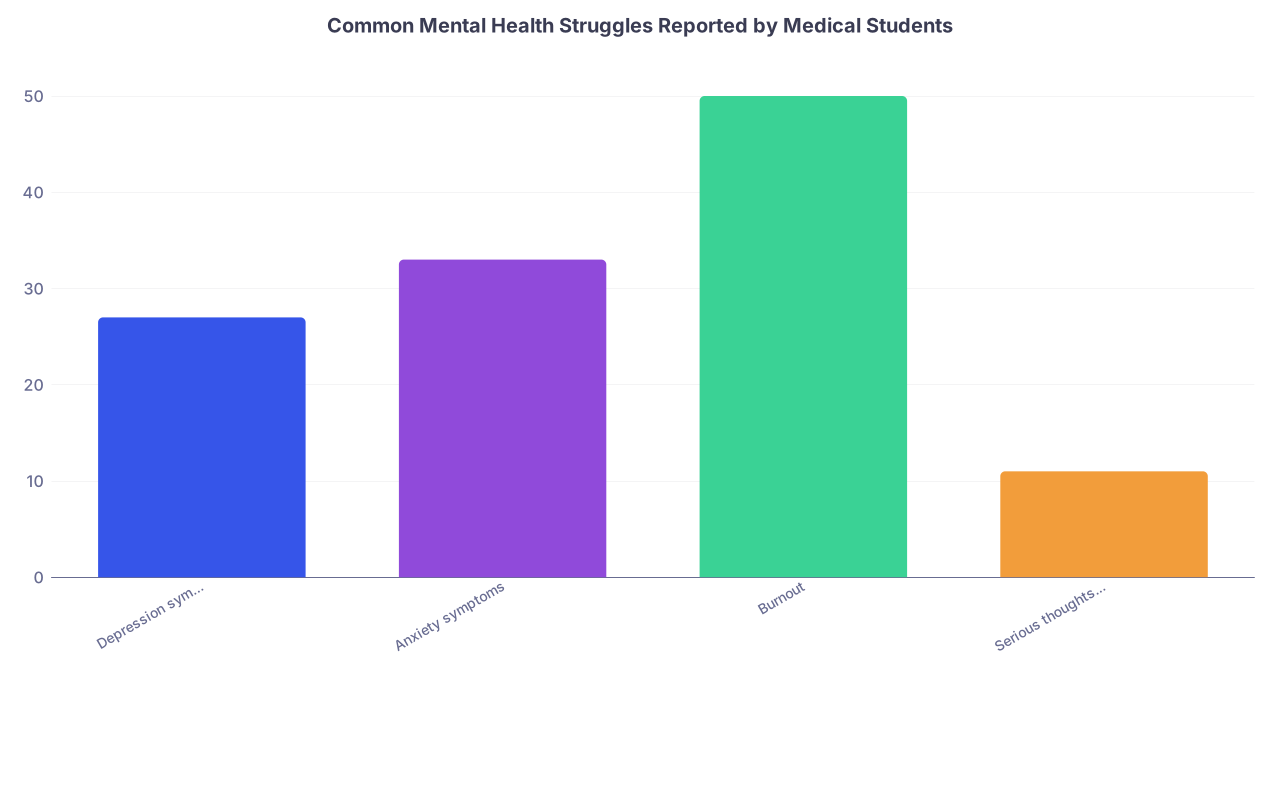
| Category | Value |
|---|---|
| Depression symptoms | 27 |
| Anxiety symptoms | 33 |
| Burnout | 50 |
| Serious thoughts of self-harm | 11 |
What Actually Happens If You Tell Someone Official You’re Struggling
There are a few different “levels” of telling your school. They’re not all the same, and they don’t all trigger a formal process.
Let’s break it down.
1. Using confidential counseling services
At many schools, student counseling/mental health services are confidential and separate from your academic record. That means:
- Your dean doesn’t get a note that says “depressed, anxious, maybe unstable.”
- Your clerkship directors don’t get an email.
- Your future residency programs don’t see a single word of it.
Is this true everywhere? No. Some schools are messier about boundaries than they should be. But most legit med schools know they’d be in deep trouble if counseling records casually leaked into academic files.
If you’re not sure, you can literally ask the clinic:
“Are my records ever shared with the dean or academic offices without my explicit consent, aside from immediate safety emergencies?”
If they can’t answer that clearly, that’s a red flag. But many times you’ll hear, “No, your academic side does not see this.”
Real talk: quietly seeing a therapist is usually the safest, lowest-risk step you can take. That doesn’t automatically trigger leaves, remediation, or committee reviews. It just means you’re not completely alone.

2. Telling a dean or academic advisor you’re struggling
This is where people panic. Because it feels like crossing a line from “private” to “on the radar.”
What could actually happen?
Possibilities include:
- They suggest counseling, tutoring, or accommodations.
- They document that you reached out (this can help you later when explaining grades/failures).
- They monitor your performance more closely.
- In more severe cases, they may recommend a reduced course load or leave of absence.
Worst-case in your head: “They kick me out.”
Real-world worst-case in most schools: “They strongly push you toward a leave or remediation.”
Do some schools handle this horribly? Yes. I’ve heard stories of dismissive comments like,
“Well, if you can’t handle this, maybe medicine isn’t for you.”
If you hear that? That’s about their lack of insight, not your worth.
But the other thing I’ve seen:
Someone fails a block, disappears, doesn’t tell anyone what’s going on, and by the time they finally speak to a dean, the pattern looks like “unprofessional, unreliable, non-communicative.”
Ironically, telling them earlier usually makes you look more professional, not less. It shows insight, responsibility, and willingness to address problems.
3. Requesting formal accommodations
This is when you go through disability services or a similar office for things like:
- Extended test time
- Separate testing room
- Reduced course load
- Flexibility with attendance for treatment
Words like “disability services” freak a lot of med students out. They picture residency PDs reading: “This person needed extra time, probably incompetent.”
Here’s the thing:
Residency programs do not see your detailed disability file. They don’t get your psych eval saying “ADHD” or “major depression.” They see your transcript, MSPE (dean’s letter), and letters of recommendation.
What can appear?
If your accommodations led to things like:
- Extended time in school (extra year, LOA)
- Unusual schedule or delayed graduation
Those may be visible in your timeline, sometimes briefly mentioned in your MSPE. But often it’s vague, like “student took a leave for personal/health reasons.” Not a list of diagnoses.
| Information Type | Usually Visible to Residency | Usually Not Visible |
|---|---|---|
| Counseling/therapy records | No | Yes |
| Specific mental health diagnoses | No | Yes |
| Leave of absence dates | Sometimes | |
| Reason for LOA (brief, nonspecific) | Sometimes | |
| Test accommodations details | No | Yes |
Could an LOA raise questions? Yes.
Is that automatically fatal? No. Plenty of residents matched after an LOA for mental health.
The part people underestimate:
Silent suffering that tanks your grades and professionalism flags you harder than a documented leave with a solid recovery story.
The Real Risks: What Could Actually Go Bad?
Let’s not sugarcoat it. There are risks.
Risk 1: Being “on the radar”
Once a dean knows you’re struggling, you might feel watched. Every borderline grade feels like “strike two.” There can be a sense you’ve lost the benefit of the doubt.
That’s uncomfortable. It can also be protective. If you do fail something, there’s context already on record and sometimes more willingness to advocate for you.
Risk 2: Pressure toward a leave of absence
Sometimes you’ll hear, “Given what you’ve described, we recommend a leave.”
This can feel like failure. Like you’ve been officially stamped “not strong enough.”
But here’s the brutal alternative I’ve watched play out:
Student keeps going, fails multiple blocks or a key clerkship, ends up forced to remediate or withdraw, except now they’re:
- More depressed
- More ashamed
- With an uglier academic record
A well-timed LOA with treatment and stabilization is usually less damaging than multiple failures spread across your transcript.
Risk 3: Awful comments and stigma
Yes, some faculty still say garbage like:
- “Back in my day, we just dealt with it.”
- “Maybe you’re not cut out for surgery if this is hard for you.”
- “You need to toughen up.”
You might run into a physician who thinks mental health struggles = weakness. It can sting like hell. It can make you want to crawl back into silence.
What matters more: the system’s official actions (LOA, remediation, dismissal) and how many people are quietly rooting for you in the background—often more than you realize.

| Step | Description |
|---|---|
| Step 1 | Tell no one |
| Step 2 | Grades / functioning worsen |
| Step 3 | Fail exams/rotations |
| Step 4 | Formal remediation / risk of dismissal |
| Step 5 | Tell counselor only |
| Step 6 | Confidential support |
| Step 7 | Improved coping / stable grades |
| Step 8 | Tell dean/advisor |
| Step 9 | Documented support plan |
| Step 10 | Accommodations / LOA / tutoring |
| Step 11 | Stabilize and continue training |
The Risks of Staying Silent (That No One Warns You About)
Everyone obsesses over “what if I tell?”
Almost no one talks about “what if I don’t?”
Here’s what I’ve watched happen.
The slow academic slide
You tell yourself, “I just need to push through this block.” Then the next. Then Step/Level. You’re not sleeping. You’re not retaining material. You’re studying, but nothing sticks.
You keep it secret, and then:
- You barely pass or outright fail an exam.
- You panic harder.
- You isolate even more because you’re ashamed.
Suddenly you’re on the radar anyway, but now it just looks like “poor performance,” not “student with an understandable, treatable problem who asked for help early.”
The professionalism landmines
When you’re mentally underwater, you’re more likely to:
- Be late.
- Miss emails.
- Snap at someone.
- Call out last minute.
- Forget key tasks on rotations.
Now instead of a contained mental health story, you have professionalism concerns. And those are what really haunt people into residency.
I’d rather have “took a leave for health reasons, returned strong” in my story than “pattern of unprofessionalism and unreliability.”
The “break” you don’t control
If you don’t voluntarily pause when you need to, sometimes your body or brain does it for you.
Panic attack during an OSCE.
Inability to complete an exam.
Full emotional breakdown in front of a preceptor.
Then your school has to intervene, often in a more dramatic, less controlled way than if you’d gone in earlier saying, “I’m struggling, and I want to address this before it gets worse.”
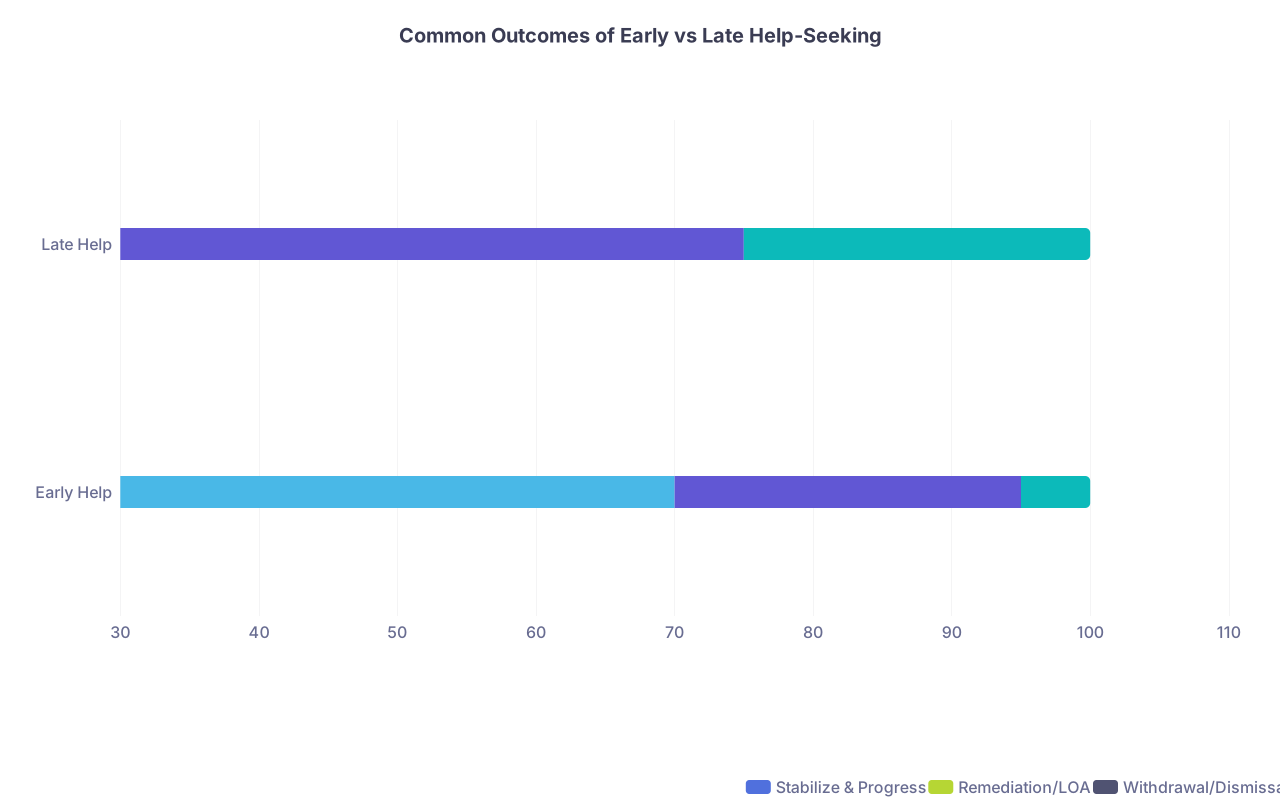
| Category | Stabilize & Progress | Remediation/LOA | Withdrawal/Dismissal |
|---|---|---|---|
| Early Help | 70 | 25 | 5 |
| Late Help | 30 | 45 | 25 |
How This Can Affect Residency (The Part You’re Really Terrified About)
Let’s be honest. Your brain is probably jumping straight to:
“If I say I’m struggling now, I’ll never match. I’ll be the cautionary tale.”
Here’s the reality.
Residency programs mainly see:
- Your transcript
- Your exam scores
- Your MSPE (dean’s letter)
- Letters of recommendation
- Any LOAs or extended training
They do not see:
- Your therapy notes
- Your counseling attendance
- Detailed psych diagnoses
- The fact that you cried in your dean’s office once
What actually hurts:
- Multiple unexplained failures
- Chronic professionalism issues
- Vague narrative of “concerns” across rotations
A single LOA with a coherent, honest-but-appropriate explanation like:
“During MS2 I took a brief leave for personal health reasons, got treatment, and returned. Since then I’ve passed all courses and rotations on time and have strong clinical evaluations.”
That is not the death sentence your anxious brain is making it out to be.
What PDs really want to know is:
“Is this person functioning now? Are they reliable on the wards? Would I feel safe having them care for patients at 2 a.m.?”
If your choice is:
- Keep quiet, spiral, accumulate red flags
vs. - Get help, maybe take a temporary step back, then come back more stable
The second is almost always the safer long-term career move.
How to Tell Them Without Completely Falling Apart
You don’t have to walk into a dean’s office and dump your entire life story. You can be honest and controlled.
A few ways to frame it that I’ve seen work:
“Over the last few months I’ve been dealing with worsening anxiety/depression that’s affecting my studying and performance. I’m getting help, but I’m worried I’m reaching a point where it might impact my exams/rotations if I don’t address it with the school.”
“My mental health has been deteriorating and I don’t want it to get to the point of failing or professionalism issues. I wanted to be proactive and ask what supports or options are available.”
You don’t need to list every intrusive thought, every family issue, every symptom. You just need to make it clear:
- This is real.
- It’s affecting your functioning.
- You’re willing to engage in help.
If you’re terrified of freezing or minimizing, write yourself a short script or bullet points. Yes, like you’re prepping for an OSCE. Except this time the standardized patient is your future sanity.

| Step | Description |
|---|---|
| Step 1 | Step 1: Quietly start therapy |
| Step 2 | Step 2: Clarify confidentiality rules |
| Step 3 | Step 3: Decide if dean/advisor should know |
| Step 4 | Step 4: Prepare 2-3 sentence summary |
| Step 5 | Step 5: Ask about options: support, accomms, LOA |
| Step 6 | Step 6: Get everything in writing if possible |
If You’re Reading This at 3 a.m. on the Edge
If you’re at the “I don’t know how much longer I can do this” stage, you’re not the only one. You’re just the only one inside your head.
Here’s the ugly, honest truth:
Yes, there are risks to telling your school you’re struggling. Some people get pushed into LOAs they didn’t want. Some get treated poorly by tone-deaf faculty. Some have to explain an extended timeline later.
But the risk of never saying anything?
That’s how people fail out.
That’s how people disappear from rotations.
That’s how people end up in crisis where decisions are no longer theirs to make.
You deserve better than “white-knuckle it until you break.”
If you do nothing else right now, at least start with the lowest-risk move: confidential counseling. Ask directly about their privacy rules. Then go from there.
You’re not weak for needing help in a system that regularly breaks people. You’re just human. In a profession that pretends it isn’t.
FAQ (Exactly 4 Questions)
1. Can my school actually kick me out just for having depression or anxiety?
Not legally for having a condition. They can act on performance and behavior—failed courses, professionalism violations, unsafe actions. If your depression leads to repeated failures and you never engage with offered help, yes, dismissal can happen. But disclosure alone—“I’m depressed and I’m getting treatment”—isn’t a standalone reason to throw you out. Schools that try to do that usually get smacked by legal/ADA issues.
2. Will a leave of absence for mental health destroy my chances at matching?
No, not by default. A mental health LOA may show up as a gap or brief blurb in your MSPE, but programs mostly care what happened after. If you returned, passed everything, and have solid clinical evals and letters, you’re still very much in the game. What wrecks chances more reliably is a messy transcript with multiple unexplained failures and professionalism concerns.
3. Should I avoid school counseling and only see an outside therapist so there’s no record?
Seeing an outside therapist can feel safer if you’re paranoid about internal records, and many students do it. But most school counseling centers keep separate, confidential charts that don’t go into your academic file. You can straight up ask: “Are my visits ever reported to the dean or academic affairs?” If the answer is no except for imminent safety issues, you’re not creating some secret academic black mark by showing up there.
4. If I ask for accommodations (like extra test time), will future programs know?
Generally, no. Your detailed accommodations and disability documentation stay with the disability/ADA office. Residency programs don’t get a report saying “Needed 1.5x time due to ADHD/anxiety.” They might see indirect effects like an extended graduation date, but not the specifics. If accommodations are the difference between functioning and falling apart, using them is usually far less risky than silently failing without support.
Key points:
- Telling your school you’re struggling can have consequences, but silence often has worse ones—especially for your grades and professionalism.
- Confidential counseling is usually the safest first step, and early, documented help-seeking often protects you more than it hurts you.
- A mental health story with recovery is almost always less damaging—to your life and your career—than a hidden struggle that explodes when you’re already in free fall.