
The biggest threat to med student mental health isn’t burnout. It’s fear of getting help because you think it’ll end up in your record and ruin your career.
Let’s say the quiet part out loud: you’re not just worried about feeling better. You’re worried about getting labeled. “That student.” The one with anxiety. Or depression. Or panic attacks during exams. You’re picturing some mysterious file with your name on it, admissions deans and future program directors scrolling through your therapy notes and judging every breakdown you’ve ever had.
You’re not crazy for thinking that. You’re just a med student who’s seen how the system treats “impaired” physicians, and your brain is connecting the dots.
Let’s walk through what’s real, what’s exaggerated, and where the actual risks are. No sugarcoating. But also no horror stories that aren’t actually possible.
What Actually Gets Shared (And What Doesn’t)
Here’s the blunt truth: your therapist’s clinical notes are not casually floating through your med school’s servers waiting for your dean, your exam proctor, or your future program director to browse.
Your default reality is this: therapy is protected by law. Not by “good intentions.” By actual legal teeth.
Most students are mixing up three totally different things in their head:
- Clinical mental health treatment (like regular therapy or psychiatry)
- School disability/academic accommodations
- Licensing / credentialing questions
They’re not the same “record.”
Let’s untangle them.
Therapy Records vs. School Records: Two Different Worlds
Think of it like this: you have two universes.
One universe is healthcare. The other is school administration.
Your therapist sits in the healthcare universe. Your dean’s office is in the school universe. Those universes don’t just merge because you had a bad week and cried in session.
Most campus counseling centers and outside therapists are covered by HIPAA or similar state privacy laws. That means:
- They cannot share your treatment information with your school without your written permission.
- They can’t email your dean “Hey, Alex is depressed and might fail Step” just because they’re worried.
- They can’t hand over your entire chart because someone “asked nicely.”
The “record” they keep is a clinical chart. Diagnosis codes, medications, very brief notes. It sits in their system, just like any other patient’s chart. It’s not an academic file.
Now, there are real exceptions. I’m not going to pretend those don’t exist.
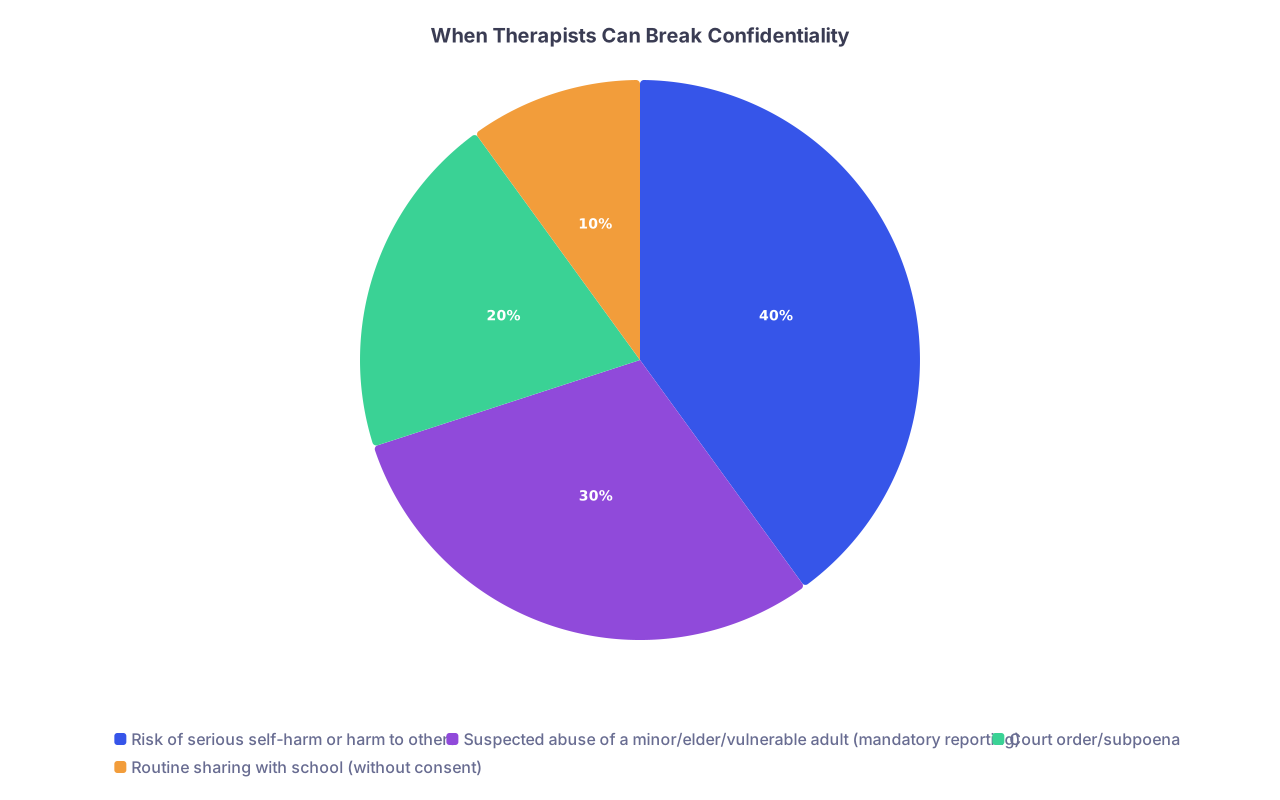
| Category | Value |
|---|---|
| Risk of serious self-harm or harm to others | 40 |
| Suspected abuse of a minor/elder/vulnerable adult (mandatory reporting) | 30 |
| Court order/subpoena | 20 |
| Routine sharing with school (without consent) | 10 |
The last category — “routine sharing with school without consent” — is basically zero in most situations. But your fear brain treats it like 90%.
The big triggers for breaking confidentiality aren’t “you’re anxious about exams.” They’re:
- Imminent risk of suicide or serious self-harm
- Threats of violence toward others
- Active child, elder, or vulnerable adult abuse
- Court-ordered records (rare for students unless you’re in a legal case)
That’s it. Your therapist isn’t a spy for your dean.
“But My School Counseling Center Said They’re Not Under HIPAA…”
Yep, this is where it gets murky and where your anxiety has a point.
Some university counseling centers are NOT under HIPAA. They’re under FERPA (the law that covers educational records). This freaks people out, and honestly, I get it.
Here’s the nuance you never get in those five-minute orientation blurbs:
- Many university counseling services keep counseling notes in a separate electronic system from your academic records.
- Under FERPA, schools can share certain information internally in some circumstances, but:
- Most counseling centers choose to treat therapy notes as confidential health records
- They usually still require your written consent to share anything beyond very minimal info
So yes, technically, the legal framework is different from a private practice therapist under HIPAA. But no, that doesn’t translate to “your dean gets a copy of your entire therapy record.”
If you’re using campus services and you’re paranoid (like most of us are), ask directly:
- “Are my counseling records part of my educational record?”
- “Who, if anyone, can access my notes?”
- “Do you ever share anything with the dean’s office, student affairs, or promotions committees without my written permission?”
Make them answer. You’re not being difficult. You’re being someone whose career literally depends on this.

What Goes in “The Record” When You Ask for Accommodations
Different universe now.
If you go to disability services (or student affairs) and say, “I need extended time” or “I need to take Step off-cycle” or “I need a leave,” that can create an official school record.
This is usually what you’re actually afraid of when you say “the record.”
Here’s how it usually plays out:
- You see a therapist/psychiatrist (campus or outside).
- You get a letter or form documenting a diagnosis and functional impairment.
- You take that letter to disability services / the dean’s office.
- They open a disability/academic file on you.
That file may include your:
- Diagnosis (e.g., major depressive disorder, ADHD, generalized anxiety)
- Summary of functional limitations
- Letters from providers
- Accommodation requests and decisions
That’s different from your therapy chart. That’s school-side documentation.
Now the question your brain is screaming: do residency programs, licensing boards, or future employers see that?
In the vast majority of cases: no.
Your school doesn’t send a dossier of your disabilities or therapy history with your MSPE (Dean’s Letter). They care about:
- Pass/fail/grades
- Professionalism issues
- Leaves of absence
- Exam performance
They don’t list “required 50% extended time on exams for anxiety” unless there’s some ultra-bizarre reason it became a professionalism or academic integrity thing. Which is rare.
Where it can show up is indirectly: a leave of absence, delayed graduation, or unusual Step timing. And even then, programs usually don’t get the underlying diagnosis unless you or your school decide to disclose it.
Is it totally risk-free? No. If you have a long leave, people will wonder why. But the idea that “going to therapy = permanent black mark in your academic record” is just false.
The Fear That Licensing Boards Will Dig Up Everything
This one is deep. Because you’ve probably seen or heard licensing questions like:
- “Have you ever been treated for a mental illness, including depression or anxiety?”
- “Have you ever had a condition that could impair your ability to practice medicine safely?”
Those questions used to be more invasive. Many states are slowly moving toward only asking about current impairment, not history of treatment.
But here’s the part nobody says out loud: avoiding therapy does not actually make you safer for licensing. It just makes you untreated.
Boards care about risk and impairment. If you’re severely depressed, suicidal, addicted, or nonfunctional, and everyone knows it, that’s more dangerous to your future license than the fact that you got help.
Also: licensing boards do not just randomly pull your therapy notes and read sessions like a novel. That’s not a thing.
If you end up in a physician health program or serious impairment investigation down the line, then yes, records can sometimes be requested or summarized. But:
- That’s usually after major red flags or actual incidents.
- That’s not triggered by “you went to therapy during MS2 and never told anyone.”

| Step | Description |
|---|---|
| Step 1 | You seek therapy |
| Step 2 | Therapy records stay with provider |
| Step 3 | Provide summary letter to school |
| Step 4 | School disability/academic file |
| Step 5 | No impact on licensing/residency files |
| Step 6 | Possible formal monitoring or review |
| Step 7 | Need accommodations? |
| Step 8 | Any major safety issues? |
Inside the Worst-Case Scenarios You’re Imagining
Let’s actually walk through the horror stories your brain is spinning at 2 a.m.
Fear #1: “If I tell a therapist I’m suicidal, they’ll immediately hospitalize me, notify my dean, and I’ll be kicked out.”
Reality:
- Saying “I’ve had suicidal thoughts” ≠ automatic hospitalization.
- Therapists hear that all the time, especially from med students.
- What triggers big action is imminent, specific risk: plan, intent, means, no ability to stay safe.
Are there therapists who overreact? Yes. Are there schools that are clumsy as hell with students in crisis? Also yes. But the default isn’t “you’re out.”
Are you at higher “visibility” risk if you’re actively unsafe? Yes. But then the question is ugly and simple: is it safer for your career to hide serious suicidality and maybe end up in an ER after an attempt? Or to get help early when there’s still room to work with accommodations and outpatient care?
I’ve seen more careers salvaged by early, honest intervention than destroyed by it.
Fear #2: “If I get on meds, it’ll follow me forever.”
Psych meds are not a permanent badge on your forehead.
Your psychiatrist documents your treatment in your medical chart. That’s it. Your school doesn’t get an automatic CC on your Zoloft prescription.
Could it come up later? Yes, if:
- You authorize release of records to support accommodations.
- You become involved in a fitness-for-duty or physician health investigation.
- You disclose it yourself on some form or to a dean.
But you being untreated and barely functioning is much more visible and dangerous to your record than a prescription buried in a private chart.

Fear #3: “If I ask for Step accommodations, programs will know I’m mentally weak.”
Programs do not get a printout that says: “Scored 240 with 50% extra time due to severe anxiety.”
NBME/USMLE does not flag your Step scores with “accommodated” vs “not accommodated” in the report seen by programs.
Where things can show up indirectly:
- Delayed Step timing (like taking Step 1 or 2 multiple months later than your class)
- LOA on transcript
- Gaps in training
Are there program directors who have biases about “mental health issues”? Yes. Some are absolutely behind the times and unfair.
But again, the trade-off is brutal: struggle untreated, possibly fail Step or rotations, rack up professionalism concerns, or barely pass everything and show up to residency wrecked. Or get help, stabilize, maybe adjust your timeline a bit, and show up actually able to function.
How to Protect Your Privacy and Your Sanity
You’re allowed to want both. You don’t have to choose between “reckless oversharing” and “white-knuckling everything alone.”
A few concrete moves that balance real-world risk with real-world help:
Decide: on-campus vs off-campus therapy.
If you’re extremely freaked about school entanglement, consider an off-campus therapist or psychiatrist who’s clearly under HIPAA and not university-employed. Use your insurance or sliding scale. Ask them directly about confidentiality.Ask privacy questions upfront.
In the first session, literally say: “I’m a med student and I’m very concerned about my career. Under what circumstances could anything we discuss be shared with my school or anyone else?”Separate treatment from accommodations where possible.
See your therapist for treatment. When/if you need accommodations, you can often ask them for a short functional letter instead of a full record dump. Something like: “This student has a diagnosed condition that significantly impacts focus under timed conditions. Extended time is appropriate.” No detailed session notes required.Be cautious but honest about risk.
If you’re actually unsafe, say so. Not “kind of stressed.” If you’re having suicidal thoughts, tell them exactly how bad, so they can calibrate interventions correctly — not underreact or overreact based on vague info.Document conversations.
If a school dean or disability office says, “This won’t go in your academic file,” or “Residency programs won’t see this,” write that down for yourself. Not as a legal weapon — as a sanity anchor. Your anxiety will rewrite history later.
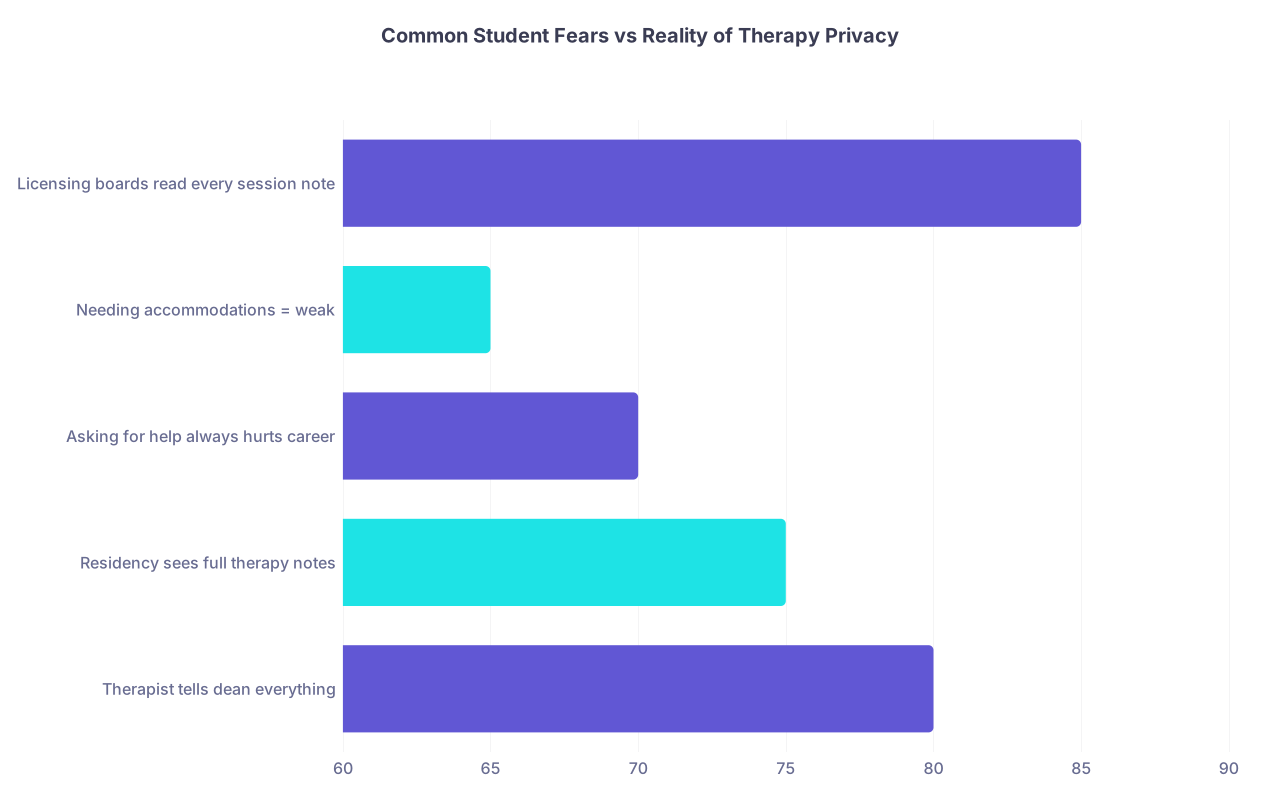
| Category | Value |
|---|---|
| Therapist tells dean everything | 80 |
| Residency sees full therapy notes | 75 |
| Asking for help always hurts career | 70 |
| Needing accommodations = weak | 65 |
| Licensing boards read every session note | 85 |
(Values roughly represent how intensely students fear these, not actual likelihood. The mismatch is the whole problem.)

The Most Dangerous Myth: “I’ll Get Help Later, When It’s Really Bad”
This is the lie most of us tell ourselves.
“I’ll just push through this block.”
“I’ll just get through Step.”
“I’ll start therapy once rotations are over.”
“I’ll deal with this during fourth year when it’s chill.”
Then it’s intern year. Then it’s “after boards.” Then it’s “once I’m an attending.”
Here’s the brutal professional reality: untreated mental health issues are way more likely to end up in your “record” via:
- Failed courses or exams
- Remediation
- Leaves of absence
- Professionalism reports (“unreliable,” “withdrawn,” “angry,” “poor team communication”)
- Major incidents (ER visits, DUIs, near-miss safety events)
Those things absolutely do show up. Much more than “student who quietly saw a therapist once a week and passed everything.”
So yeah, there is risk to seeking help. But there is massive, career-threatening risk to not seeking help too. You’re just more used to the second one because it feels like “doing nothing.”
FAQ: The Exact Panic Questions You’re Probably Thinking
1. Will my school automatically know I’m in therapy?
No. Not if you’re seeing an outside provider, and usually not even if you’re using campus counseling. There’s no automatic notification to the dean’s office saying, “Student X is in therapy.” Ask directly at your counseling center how they handle this, but automatic academic reporting is not standard.
2. Can residency programs see that I had accommodations or a disability file?
Programs don’t get a “disability report.” They see your transcript, MSPE, and some narrative comments. They may see leaves, failures, or odd timing. But “this student had anxiety accommodations” is not a standard line item they receive. The details of your diagnosis and your disability file stay with your school.
3. Are my therapy notes ever part of my “permanent record”?
Your therapy notes live in your therapist’s clinical record system, not your academic file. They’re part of your medical record, not some universal career dossier. They can be requested in specific legal or impairment situations, but they don’t just get attached to your medical school records or licensing file by default.
4. If I admit to suicidal thoughts in therapy, will I be forced out of school?
Having suicidal thoughts and talking about them honestly in therapy does not automatically mean hospitalization or dismissal. Therapists distinguish between passive thoughts (“I wish I didn’t exist”) and active, imminent intent. If you’re at real risk, there may be safety measures, but most schools try to support continuation or structured return, not instant expulsion.
5. Is it safer to never have a mental health diagnosis in my chart?
Short-term, it might feel emotionally safer. Long-term, it’s usually more dangerous for your actual career and your life. Untreated symptoms lead to visible problems: failed courses, professionalism flags, burnout, substance use, bad outcomes. A quiet “generalized anxiety disorder” or “MDD, in remission” in a private chart is far less threatening than a transcript or incident report full of red flags.
Here’s your next step: pick one concrete action you can take today that moves you 1% closer to real support. That might be emailing your student health center, looking up two off-campus therapists in your network, or writing down three privacy questions you’ll ask at your first appointment. Then actually do it. Tonight. Before your brain talks you out of it again.